
A sump pump that never shuts off is not normal outside of active flooding, and it is telling you something is failing right now. Treat continuous running as a fault: it usually means a stuck float, a bad check valve, a blocked discharge, or a pump that cannot keep up. Before anything else, check that the outlet has power and, if it is safe to do so, watch the float to see whether it is actually cycling.
TL;DR:
- Continuous sump pump operation during normal weather often indicates a failed check valve, a stuck float, or a clogged discharge pipe that prevents water from leaving.
- A sump pump should only run nonstop during extreme flooding; persistent continuous operation hours after rain stops suggests a mechanical fault requiring immediate attention.
- The most common causes of constant running are issues with the float switch, check valve, discharge line, or an overwhelmed pit, which can be diagnosed through simple homeowner tests like the pour test.
- Pump sizing and pit capacity are critical; an undersized pump or pit will cycle frequently under normal conditions, while a worn motor or impeller degrades performance over time.
- If troubleshooting does not resolve the issue or electrical hazards are present, calling a professional is necessary to prevent motor damage and ensure proper drainage.
Table of Contents
- Is constant running ever normal?
- The most common causes of a sump pump running constantly
- Step-by-step homeowner troubleshooting
- The pour test: proof your pump is or isn’t working
- Why constant running is a problem
- When to call a professional
- How Foundation RESQ inspects persistent sump pump problems
- What I’ve learned about sump pump troubleshooting
- How Foundation RESQ can help with sump pump and drainage issues
- Sources
- FAQ
Is constant running ever normal?
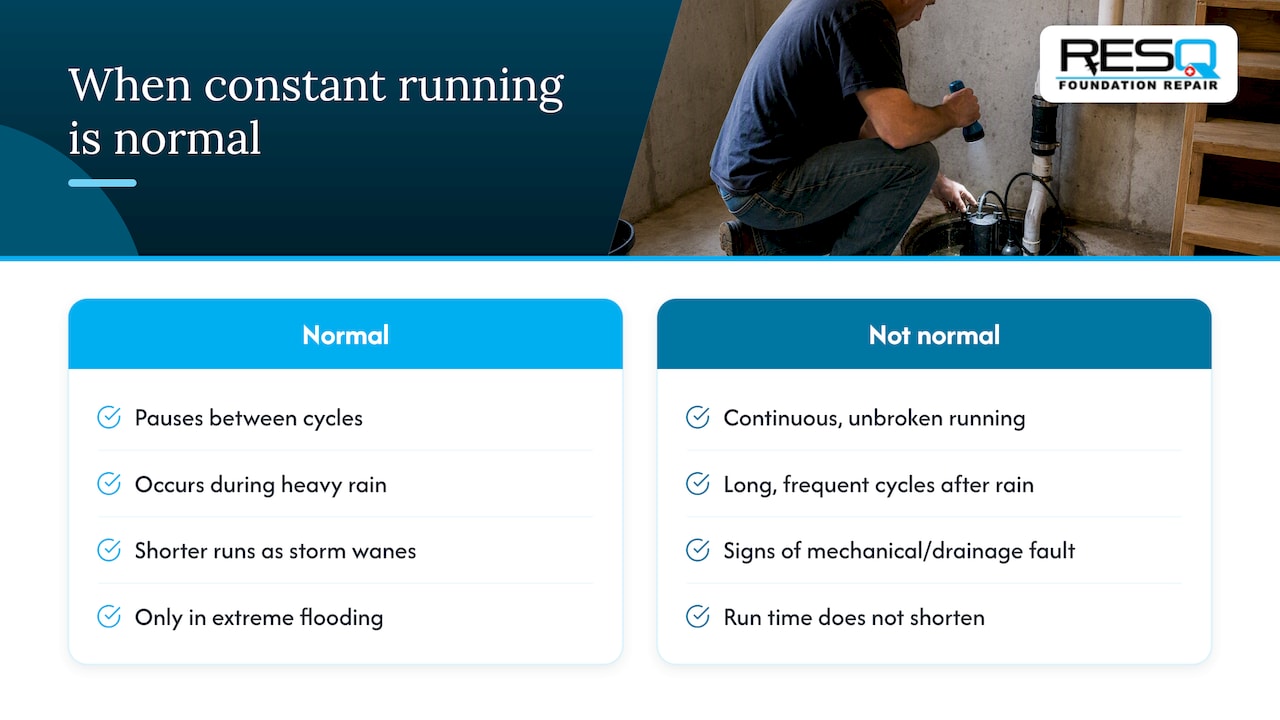
A healthy sump pump cycles: it turns on when water reaches a set level, empties the pit, and shuts off. During heavy rain, that cycle can repeat every few minutes, which feels constant but is not the same thing as never stopping. The pump should still pause between cycles, even briefly.
Continuous, unbroken running is expected only during extreme flooding or very high groundwater, when inflow genuinely outpaces the pump’s capacity. Outside of that, nonstop operation signals a mechanical or drainage problem rather than a weather event. A simple way to tell the difference: check whether the run time shortens as the storm passes. If cycles stay long and frequent hours after rain stops, or the motor never pauses at all, you are looking at a fault, not normal system behavior.
The most common causes of a sump pump running constantly
Most constant-run problems trace back to one of six issues, and some are easier to spot than others.
- Stuck or failed float switch: debris, a tangled cord, or a worn mechanism can trap the float in the “on” position, forcing the pump to run even when the pit is nearly dry.
- Failed or missing check valve: without a working check valve, water that already left the pit flows back down the discharge pipe, tricking the pump into cycling again and again.
- Clogged or frozen discharge pipe: a blocked or iced-over discharge line stops water from leaving the system, so the pump keeps working against pressure it cannot overcome.
- High groundwater or an overwhelmed pit: saturated soil after heavy rain can send water in faster than any residential pump can move it out.
- Undersized pump or pit: a pit that is too small or a pump rated below your drainage area’s needs will cycle almost continuously even under normal conditions.
- Worn motor or impeller: age and mineral buildup degrade a pump’s internal parts, reducing output and forcing the motor to run longer to move the same amount of water.
A missing check valve is a bigger factor than most homeowners realize. Extension guidance notes that a sump pump should have a check valve on the discharge specifically to stop water from flowing back into the pit, since backflow causes the frequent cycling or continuous running that wears pumps out early. If your pump was recently reinstalled or the discharge line was disturbed, that valve is one of the first things worth checking.
Pump sizing also matters more than most manuals admit. Sizing depends on drainage area, groundwater depth, and basement depth rather than a single correct horsepower, though a sump pump’s role in protecting a foundation depends on matching capacity to how much water actually reaches the pit.
Step-by-step homeowner troubleshooting
Work through these checks in order. Stop immediately if you see standing water near outlets, smell burning, or notice a tripped breaker that will not reset: that is an electrical hazard, not a DIY job.
- Cut power safely. Unplug the pump or switch off its breaker before touching anything inside the pit.
- Check the outlet and cord. Look for a tripped GFCI, a loose plug, or a frayed cord that could be cutting power intermittently.
- Test the float. Free it from any debris or tangled wiring, then manually lift and lower it to confirm the switch clicks on and off as expected.
- Inspect the discharge outlet. Go outside and check whether water is actually flowing out, and clear any visible blockage, debris, or ice at the pipe’s exit point.
- Check the check valve. Listen for water sliding back into the pit right after the pump shuts off. That sound usually means the valve is not sealing.
- Look at the pit and inflow. Check for debris, a dislodged drain tile inlet, or a pit diameter that seems too small for how fast water is entering.
Pro Tip: Write down what you observe at each step. A technician can often diagnose the cause faster from your notes than from a fresh inspection alone.
If the pump still will not settle into a normal on-off pattern after these checks, or if you have already reset a tripped breaker more than once, stop troubleshooting and call a professional. Repeated thermal trips and a motor that stays hot to the touch both point to internal damage that home checks cannot fix. For a fuller walkthrough of what to look for, see this guide to assessing sump pump performance.
The pour test: proof your pump is or isn’t working
The pour test is the single most useful diagnostic a homeowner can run, and it takes about five minutes.
- Pour roughly five gallons of water into the sump pit at a steady rate, similar to how water would naturally drain in.
- Watch the float rise, confirm the pump activates, and time how long it runs before shutting off.
- Pass: the pump starts once the float reaches its trigger point, empties the pit, and shuts off cleanly, with a clear pause before any next cycle.
- Fail: the pump never stops, restarts within seconds of shutting off, or fails to activate at all despite a rising water level.
This test matters because it produces evidence, not guesswork. FEMA recommends testing a sump pump annually by pouring water into the pit until the pump cycles at least twice, which confirms the float, switch, and motor are all working together correctly. Note your run time and the interval between cycles: those two numbers are exactly what a technician will ask for first.
Why constant running is a problem
A pump that never rests is a pump that is failing early. Repeated overheating trips the motor’s thermal protection over and over, and each trip shortens the motor’s working life even when it does not shut down completely. Continuous operation also means higher electricity use and constant wear on impellers and seals that were built for intermittent, not nonstop, duty.
The riskiest outcome is timing: a motor pushed to its limit is most likely to fail right before or during the next major storm, which is exactly when you need it most. Frequent short cycling carries its own warning: it often points to an undersized pit or a drainage problem rather than a pump defect.
When to call a professional
Call a professional immediately if you see electrical hazards near the pit, cannot restore normal cycling after working through the checks above, or the breaker keeps tripping. Visible motor damage, burning smells, or a pump that runs hot to the touch are also signs to stop DIY work and bring in a technician.
A typical service visit addresses the float switch, the check valve, the discharge line, or the pump itself, and may include correcting drainage around the pit if groundwater is the real driver. Bring your pour-test results, run times, and any photos of the pit or discharge line: that information lets a technician skip straight to the likely cause instead of starting from scratch.
How Foundation RESQ inspects persistent sump pump problems
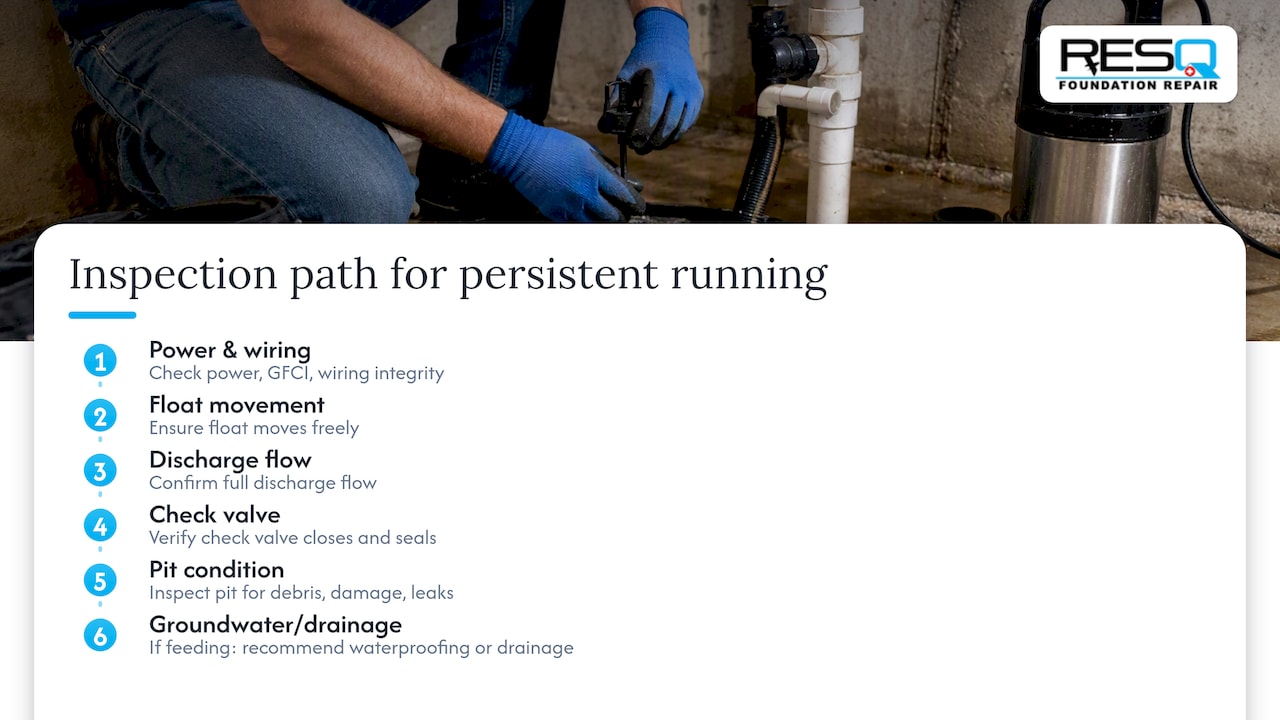
A thorough inspection checks power and wiring, float movement, discharge flow, check valve function, pit condition, and how groundwater or drainage around the foundation is feeding the pit. That last step matters because a pump can be working perfectly and still run constantly if the real problem is water reaching it faster than any pump should have to handle.
When the pit and discharge are sound, a targeted repair, like a new float switch or check valve, solves it. When groundwater or drainage is the driver, basement waterproofing or a drainage correction is the fix that actually holds, rather than a pump repair that gets undone by the next heavy rain.
What I’ve learned about sump pump troubleshooting
Most homeowners jump straight to replacement when a pump misbehaves, but a stuck float or a bad check valve costs far less to fix and solves the problem just as completely. Testing first saves money and tells you whether you are actually looking at a repair or a drainage issue that a new pump will not fix either.
That said, know your limits. Electrical faults, repeated thermal trips, or a flooded pit are reasons to stop and call someone, not reasons to keep experimenting. Protecting your basement long term means treating the pump as one part of a drainage system, not an isolated appliance.
— Kayle
How Foundation RESQ can help with sump pump and drainage issues
If your pump keeps running and the checks above have not solved it, a professional inspection settles the question fast. A free inspection may include a visual check of the pump, pit, and discharge line, a pour-test evaluation, and a repair estimate before any work begins.

Beyond sump pump repair, some companies also handle basement waterproofing and drainage correction when groundwater, not the pump itself, is the real cause of the problem. Visit our services page to request a free inspection and get a straight answer on what your system actually needs.
Sources
FAQ
How do you fix a sump pump that keeps running?
Start by cutting power, then check the float, discharge line, and check valve in that order, since those three cause most continuous-running problems. If the pump still will not cycle normally after clearing debris and confirming the float moves freely, the check valve or pump itself likely needs replacing.
How long can a sump pump run continuously before it burns out?
There is no fixed safe duration: repeated overheating and thermal trips reduce a motor’s life with each occurrence rather than at one specific point. If your pump has been running nonstop for more than a few minutes without pausing, treat it as a fault and work through the safety checks above.
Is it normal for a sump pump to run every 30 minutes?
It can be normal during heavy rain or high groundwater, as long as the pump fully shuts off between cycles. If frequent or long cycles continue long after rain has stopped, it usually points to a stuck float, a failing check valve, or a pit that is too small for your drainage area.
Why is my sump pump running every 20 seconds?
Rapid short cycling like this is a classic sign of a failed check valve, since water that already left the pipe is flowing back into the pit and tricking the float into restarting the pump. An undersized pit with too little clearance around the float can cause the same rapid-fire pattern.
When should I consider a battery backup for my sump pump?
A battery backup is worth considering if you experience power outages during storms, since a standard sump pump stops working the moment electricity does. Backup run-time depends heavily on battery size: NDSU testing found that the runtime of a backup battery depends on its amp-hour rating, with larger batteries capable of providing several hours of continuous pumping.