
Seawalls protect the land behind them. They also tend to destroy the beach in front of them. That trade-off is not a flaw in the design — it is the physics of how a fixed structure interacts with a dynamic shoreline, and every coastal property owner should understand it before signing a construction contract. USACE guidance confirms that seawalls can narrow or eliminate fronting beaches, while FEMA’s shoreline mitigation fact sheet warns that vertical walls often deflect wave energy in ways that increase erosional stress on the surrounding shore. The U.S. Army Corps of Engineers IWR adds that armoring creates a fixed point in a system that was never meant to stay still, which makes localized erosion more visible and can push sediment stress onto neighboring properties.
Before you plan any armoring, arrange a site assessment with a licensed coastal engineer. That single step separates owners who build a structure that performs for decades from those who spend the same money and watch their beach disappear within a few storm seasons.
The core trade-off at a glance:
- Seawalls protect upland property and structures from wave attack and flooding.
- They commonly cause passive loss of dry beach area directly in front of the wall.
- They can shift erosional pressure to adjacent, unarmored properties.
- They work best as part of an integrated coastal-management plan, not as a standalone fix.
- Toe protection, drainage design, and face geometry determine whether a seawall performs or fails early.
Key Takeaways
Seawalls protect upland property but consistently cause passive beach loss in front of the wall and can shift erosional stress to adjacent unarmored properties — making integrated planning, toe protection, and monitoring non-negotiable.
| Point | Details |
|---|---|
| Beach loss is predictable | Seawalls commonly narrow or eliminate the fronting beach through passive profile adjustment, documented by USGS. |
| Toe protection is the critical detail | Toe scour is the most frequent seawall failure mode; toe armor sized to site-specific wave conditions is required. |
| Permitting is complex | Federal permits (CWA §404, RHA §10) and state CZM permits are required; some states restrict new hard armoring entirely. |
| Alternatives exist for lower-energy sites | Living shorelines, beach nourishment, and hybrid approaches preserve beaches where wave energy allows. |
| Foundationresq covers the inland risk | Foundation inspections, crawl space waterproofing, and drainage evaluations address the structural impacts coastal erosion creates behind the shoreline. |
Table of Contents
- What are seawalls, and what types do you need to know about?
- How do seawalls affect erosion and the beach profile?
- What are the environmental and adjacent-beach consequences?
- What should you expect during design, construction, and maintenance?
- What do seawalls cost, and how long do they last?
- When do nature-based alternatives outperform a seawall?
- How do you decide whether a seawall is the right choice?
- What do U.S. agencies say about seawalls and erosion mitigation?
- The case for inspections before armoring decisions
- Coastal erosion is affecting more than your shoreline
- Sources
- FAQ
What are seawalls, and what types do you need to know about?
A seawall is a hard structure built at the land-water interface to absorb or deflect wave energy and prevent wave-driven flooding or erosion of the upland. The term is often used loosely, but coastal engineers draw meaningful distinctions between seawalls and closely related structures.
A bulkhead primarily retains soil rather than resisting wave attack — common in sheltered harbors and estuaries. A revetment is a sloping layer of armor stone or concrete units placed directly over the existing slope to protect it from wave scour. A detached breakwater sits offshore and reduces wave energy before it reaches the shore. Seawalls proper are typically vertical or near-vertical structures designed to take the full force of wave impact.
Common seawall types:
- Vertical gravity wall (concrete or masonry): Resists wave pressure through mass alone; highly reflective; prone to toe scour.
- Sloping/stepped concrete wall: Reduces wave reflection compared with a smooth vertical face; better energy dissipation; requires more material.
- Rubble-mound revetment: Armor stone or riprap placed on a filter layer over the slope; dissipates energy well; permeable; most forgiving of settlement.
- Tied-pile or anchored steel sheet pile: Steel sections driven into the substrate and tied back with anchors; common in estuarine and sheltered settings; vulnerable to corrosion.
- Timber bulkhead: Lower upfront cost; shorter service life; suited to low-energy, sheltered shorelines only.
Materials in brief:
- Concrete: Durable, 30–50-year design life with maintenance; high upfront cost; can crack under differential settlement.
- Armor stone/riprap: Flexible, self-adjusting; lower unit cost; requires periodic stone replacement after storms.
- Steel sheet pile: Strong in bending; corrodes in saltwater without cathodic protection; typical service life 25–40 years in marine environments.
- Timber: Lowest cost; susceptible to marine borers and rot; rarely appropriate for open-ocean exposure.
Pro Tip: Ask your engineer to sketch the wave behavior expected at each face geometry — a smooth vertical wall reflects nearly all incoming wave energy back seaward, which concentrates scour at the toe. A stepped or sloped face dissipates more energy and typically produces less toe scour for the same wave climate.
How do seawalls affect erosion and the beach profile?
A seawall does not stop erosion. It redirects it. Understanding where the energy goes is the most important thing a property owner can grasp before committing to armoring.
Active erosion vs. passive erosion
Active erosion is the direct removal of sediment by wave attack. A seawall stops this at the wall face — the upland behind it stays put. That is the protection you are paying for.
Passive erosion is subtler and often surprises owners. A natural beach profile adjusts constantly: sand moves offshore during storms and returns during calmer periods. When a seawall fixes the back of the beach in place, the profile can no longer migrate landward. As sea level rises or the shoreline naturally retreats, the dry beach in front of the wall narrows and eventually disappears — not because the wall is failing, but because it is doing exactly what it was designed to do. USGS research documents this passive loss of dry beach area as a consistent outcome of shoreline armoring, with the magnitude depending on local wave climate and sediment supply.
Wave reflection and toe scour
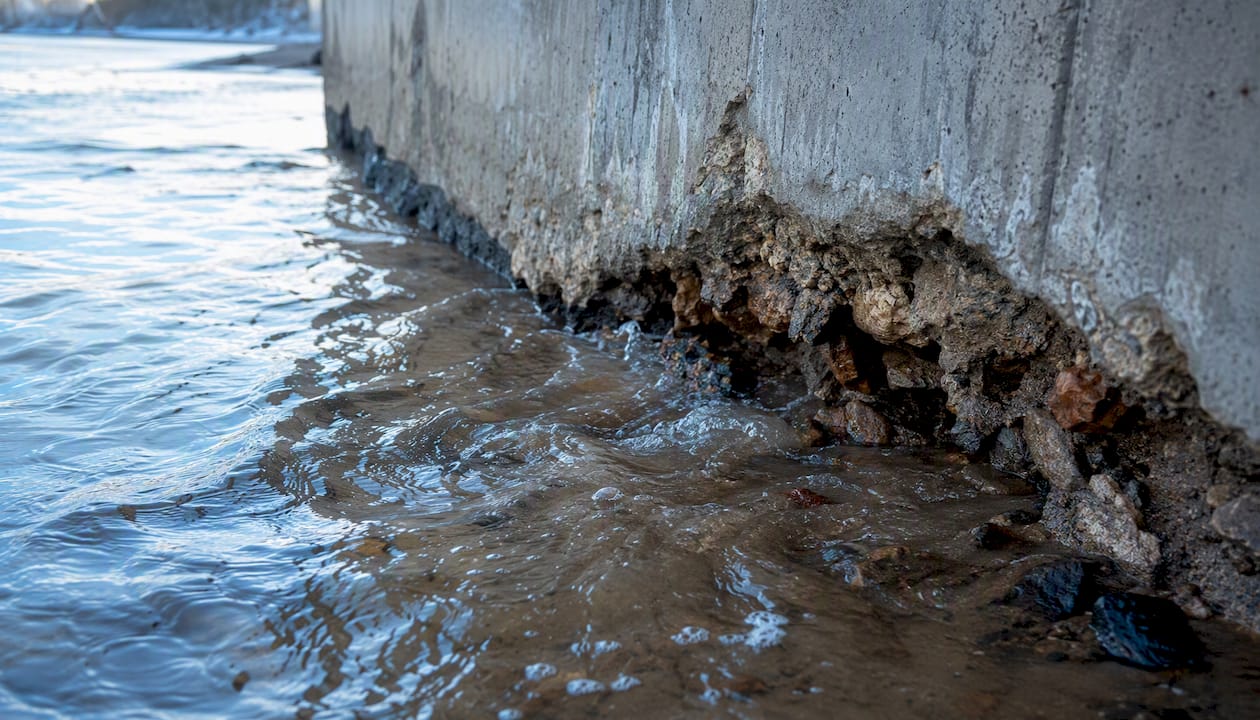
A smooth vertical seawall reflects incoming wave energy almost entirely back seaward. That reflected energy collides with incoming waves, creating a standing wave pattern directly in front of the wall. The turbulence concentrates at the base, scouring sediment from the toe. USACE Engineer Manual EM 1110-2-1614 identifies toe scour as the most frequent failure mode for seawalls and revetments, and NAVFAC design guidance recommends toe blankets, cutoff walls, or toe armor sized to the estimated scour depth from site-specific wave conditions.
Longshore transport and downdrift effects
Beaches are not static. Sand moves along the shore in a process called longshore transport, driven by waves arriving at an angle. A seawall interrupts that conveyor belt. Sand that would have traveled downdrift to replenish a neighbor’s beach no longer gets there. The result is accelerated erosion on the unarmored properties immediately downdrift of the wall.
Key erosion mechanisms owners should know:
- Wave reflection from vertical faces concentrates scour at the toe.
- Passive profile adjustment removes dry beach as the shoreline retreats.
- Longshore transport interruption starves downdrift beaches of sediment.
- Increased turbulence at the wall ends (flanking) can undercut the structure from the sides.
- Overtopping during storms can erode the backfill behind the wall if drainage is inadequate.
The Surfrider Foundation has documented these effects in case examples across U.S. coastlines, showing beach loss directly in front of armored sections and measurably higher erosion rates on adjacent unarmored properties.
What are the environmental and adjacent-beach consequences?
The impacts of a seawall extend well beyond the property line, and regulators increasingly weigh them in permitting decisions.
Documented impacts to expect:
- Beach narrowing and loss: The fronting beach shrinks as the profile adjusts; in high-energy settings, the dry beach can disappear entirely within years to decades.
- Dune and marsh habitat loss: Seawalls prevent the natural landward migration of dunes and coastal wetlands as sea level rises, effectively squeezing these habitats out of existence.
- Downdrift erosion: Adjacent unarmored properties receive less sediment and often experience accelerated erosion, sometimes triggering a chain of armoring requests from neighbors.
- Reduced public beach access: As the fronting beach narrows, recreational access shrinks — a significant issue in states where the public has legal rights to the wet sand.
- Visual and aesthetic impacts: Hard structures alter the character of the shoreline and can reduce property values for neighbors who lose their beach view or access.
When multiple properties along a stretch of shore armor simultaneously, the cumulative effect is far greater than any single wall would produce. The entire sediment budget for that reach is disrupted, and the remaining unarmored sections absorb disproportionate erosional stress.
Pro Tip: If your neighbor has already built a seawall, your property may already be experiencing downdrift erosion from it. Document your current shoreline position with dated photographs and a survey before you decide on your own response — that baseline will matter for permitting and for any future legal dispute about who caused what.
Understanding why retaining walls fail from a structural standpoint is also useful context, since many of the same failure modes (toe undermining, drainage failure, backfill loss) apply to coastal armoring structures.
What should you expect during design, construction, and maintenance?
Toe protection and drainage are the two design details that most often determine whether a seawall performs for its full design life or fails in the first major storm. Everything else matters, but those two come first.
Design features to require from your engineer
- Toe armor or toe wall: Sized to the estimated scour depth from site-specific wave analysis. This is non-negotiable on any open-coast exposure.
- Cutoff wall: A vertical barrier extending below the toe armor to prevent undermining from scour that exceeds the design depth.
- Drainage system: Weep holes, filter fabric, or a drainage layer behind the wall to relieve hydrostatic pressure from groundwater and storm runoff. A wall without drainage can fail from pressure alone.
- Tie-backs or anchors: Required for sheet-pile and gravity walls above a certain height; the design load must account for wave-induced lateral pressure.
- Stepped or sloped face: Reduces wave reflection and overtopping compared with a smooth vertical face; specify this where beach preservation matters.
- Adequate freeboard: The wall crest must be high enough to limit overtopping during design storm conditions, accounting for projected sea-level rise over the structure’s intended life.
Questions to ask your coastal engineer before construction
- What is the predicted long-term beach profile in front of this wall, and how does it change over 10, 25, and 50 years?
- What scour depth did you design the toe protection for, and what wave conditions drive that estimate?
- How will drainage be handled, and what happens if the filter fabric clogs?
- What is the design life, and what triggers replacement vs. repair?
- Have you checked for uplift and seepage under the base?
Maintenance schedule
Annual inspections and post-storm assessments are the minimum. After any named storm or significant wave event, walk the structure and look for:
- Toe scour or exposure of the toe armor base
- Seam separation, joint opening, or panel cracking in concrete walls
- Settlement or tilting of the wall face
- Loss of backfill material through weep holes or at wall ends
- Corrosion at tie-back anchor points (steel walls)
Typical repair actions include restoring toe armor, repointing joints, adding filter fabric where backfill is migrating, and replacing corroded hardware. Deferred maintenance on a seawall is expensive — a minor toe repair costs a fraction of what full reconstruction does after a failure.
Pro Tip: Keep a dated photo log of the wall face, toe, and fronting beach after every inspection. That record is your best evidence for insurance claims, permit renewals, and any neighbor dispute about erosion causation.
What do seawalls cost, and how long do they last?
Plan for the full lifecycle, not just the construction invoice. The upfront build cost is the largest single payment, but recurring maintenance and eventual replacement mean the true cost of a seawall is measured over decades.
The main drivers of construction cost are wave energy at the site, material choice, access (barge vs. land-based equipment), required toe protection depth, geotechnical work (borings, soil reports), and permitting complexity. Open-ocean sites with high wave energy cost significantly more than sheltered estuarine locations for equivalent linear footage.
Lifecycle cost categories to budget for:
- Initial construction: Materials, equipment, permitting fees, geotechnical investigation, and contractor markup.
- Annual inspection and minor maintenance: Cleaning, joint repointing, hardware checks, minor stone replacement.
- Post-storm repairs: Toe armor restoration, backfill replacement, panel repair — costs vary widely with storm intensity.
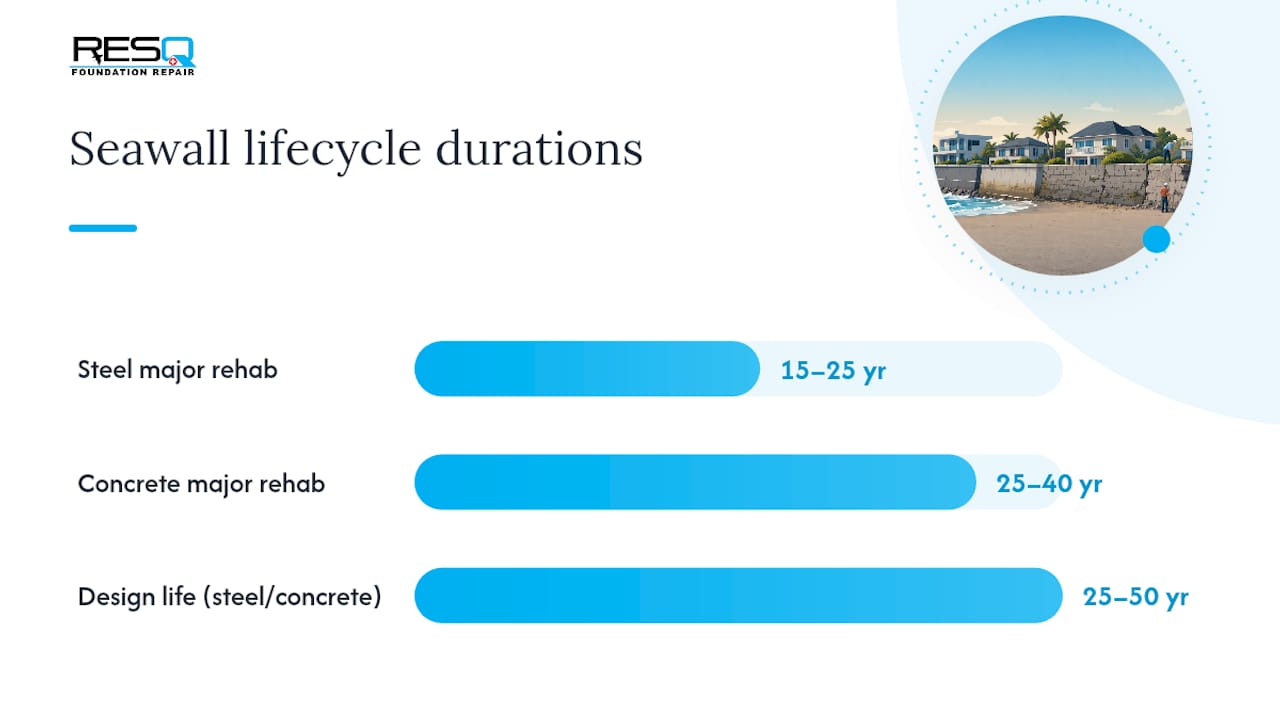
- Periodic major rehabilitation: Typically needed at 15–25 years for steel sheet pile (corrosion) and at 25–40 years for concrete (cracking, joint failure).
- Eventual replacement: Full reconstruction at end of design life; permitting costs at that point may be higher than today under future regulatory regimes.
Design life guidance from USACE and NAVFAC manuals typically ranges from 25 to 50 years for well-maintained concrete and steel structures, with shorter lives for timber in marine environments. Those figures assume the maintenance schedule is followed. Deferred maintenance, unexpected storm intensity, or sea-level rise beyond the design assumption can shorten that life materially.
Pro Tip: Budget for periodic beach nourishment or sand bypassing if your permit requires it or if your fronting beach is expected to narrow significantly. Include permit renewal fees in your 10-year financial plan — coastal permits do not last forever, and renewal conditions often become more stringent over time.
When do nature-based alternatives outperform a seawall?
Alternatives can preserve beaches and habitat in ways a seawall cannot, but they have real limits in high-energy settings. The right choice depends on wave exposure, sediment supply, the value of the upland asset, and how much beach you want to keep.
Living shorelines use oyster reefs, marsh plantings, submerged aquatic vegetation, and low-profile sills to attenuate wave energy while allowing sediment exchange. They work well on sheltered estuarine and low-energy shorelines. On open-coast, high-wave-energy sites, they are generally not sufficient to protect structures.
Beach nourishment places sand on an eroding beach to restore its profile and width. It preserves recreational access and habitat, but it requires a compatible sand source, periodic renourishment (typically every 3–10 years depending on the site), and ongoing funding. It does not protect against a single catastrophic storm the way a hard structure does.
Detached breakwaters are offshore structures that reduce wave energy reaching the shore. They can preserve a beach in their lee but create complex sediment patterns (tombolos, salient formation) and require careful design to avoid unintended downdrift effects.
Groins are shore-perpendicular structures that trap longshore sediment. They widen the beach on the updrift side but starve the downdrift side — a well-documented trade-off that makes them controversial and heavily regulated in many states.
Hybrid seawall plus nourishment is increasingly the approach recommended by coastal managers: a seawall protects the upland during extreme events while periodic nourishment maintains the fronting beach. This combination addresses both the land-protection need and the beach-loss consequence, though it carries the ongoing cost of nourishment cycles.
A successful U.S. example of the hybrid approach is the Miami Beach nourishment program, which has combined periodic beach fill with existing hard structures to maintain both recreational beach width and upland protection along a heavily developed shoreline.
| Option | Wave energy suitability | Beach preservation | Relative cost | Permitting complexity | Ecological impact |
|---|---|---|---|---|---|
| Vertical seawall | High | Poor (beach loss likely) | High upfront | High | High (habitat loss) |
| Rubble revetment | Moderate to high | Moderate | Moderate | Moderate | Moderate |
| Living shoreline | Low to moderate | Good | Low to moderate | Moderate | Low (habitat gain) |
| Beach nourishment | Low to high (with design) | Excellent | Moderate (recurring) | Moderate | Low |
| Detached breakwater | Moderate to high | Good in lee | High | High | Moderate |
| Hybrid (wall + nourishment) | High | Good | High (upfront + recurring) | High | Moderate |
Short guidance: favor nature-based solutions when the shoreline is sheltered, the upland asset is not immediately at risk, and beach preservation is a priority. Move toward hard armoring or hybrid approaches when infrastructure is directly threatened, wave energy is high, and the sediment budget cannot support nourishment alone.
How do you decide whether a seawall is the right choice?
The decision sequence matters as much as the decision itself: site assessment first, then permitting check, then design options, then neighbor coordination, then construction only if the alternatives are genuinely insufficient.
Decision checklist for coastal property owners
- Document your current shoreline position with a licensed survey and dated photographs before doing anything else.
- Assess site exposure: Is the shoreline open-ocean, estuarine, or sheltered? Wave energy determines which options are viable.
- Identify what you are protecting: A primary residence, a seawall protecting a road, or a vacant lot each carries a different risk calculus.
- Evaluate alternatives first: Has a coastal engineer assessed living shoreline, nourishment, or hybrid options for your site?
- Check the sediment budget: Is your site eroding because of a sediment deficit, or because of direct wave attack? The answer changes the remedy.
- Confirm permit feasibility: Contact your state coastal zone management office and the USACE district office before investing in design. Some states restrict or prohibit new hard armoring on certain shoreline types.
- Assess maintenance capacity: Can you fund annual inspections, post-storm repairs, and eventual replacement? A seawall you cannot maintain is a liability.
- Coordinate with neighbors: Downdrift neighbors will be affected. Early communication reduces disputes and may open the door to a shared, more cost-effective solution.
- Review your flood insurance: FEMA’s National Flood Insurance Program (NFIP) does not pay for seawall construction, but your structure’s presence affects flood zone mapping and future premiums.
- Get a second engineering opinion if the first proposal involves no toe protection or no drainage plan.
- Confirm the contractor’s permit history: Ask for copies of permits on comparable past projects.
- Build in a monitoring plan: Baseline beach profile surveys before construction and annual surveys after are the only way to know whether the structure is performing as designed.
Red flags that should stop a project
- No geotechnical investigation or site-specific wave analysis in the design package.
- A contractor who promises “no maintenance required.”
- No toe protection specified in the drawings.
- Contractor cannot provide permit history or references from comparable coastal projects.
- No drainage plan for the backfill zone.
- Design does not account for projected sea-level rise over the structure’s intended life.
Pro Tip: The MIT coastal engineering Q&A makes the point plainly: a seawall works best as part of a larger strategy. If the proposal in front of you treats the wall as a complete solution with no monitoring, no nourishment commitment, and no adaptive plan, that is a design gap, not a cost-saving feature.
What do U.S. agencies say about seawalls and erosion mitigation?
The consistent message from USACE, FEMA, NOAA, and USGS is that seawalls can protect property but should be deployed within an integrated plan that includes toe protection, drainage, monitoring, and a realistic accounting of beach impacts.
FEMA’s P-2181 shoreline fact sheet lists seawalls as a structural mitigation option while explicitly warning that vertical walls deflect wave energy and can make the shoreline more subject to erosion. FEMA recommends accounting for future sea-level rise, drainage, and maintenance in any armoring design. The USACE Coastal Engineering Manual describes seawalls as structures that protect upland assets but contribute to beach narrowing and local scour, with stepped-face designs and toe protection as the primary engineering responses. USGS analyses document passive beach loss as a consistent outcome of armoring, with site-specific variation driven by wave climate and sediment supply.
Permitting framework: what you need before you build
Federal permits are required for most coastal armoring in navigable waters:
- Clean Water Act Section 404 (U.S. Army Corps of Engineers): Required for structures placed in waters of the United States, including coastal wetlands.
- Rivers and Harbors Act Section 10 (USACE): Required for structures in navigable waters.
- State coastal zone management (CZM) permits: Every coastal state has its own program under the federal Coastal Zone Management Act. Requirements vary significantly — some states (California, North Carolina) restrict or prohibit new hard armoring on certain shoreline types; others (Florida, Texas) have their own permitting tracks.
- Local setback and zoning rules: Many coastal counties impose additional setback requirements from the mean high-water line.
Mitigation measures that improve permitability and performance
- Toe armor sized to site-specific scour estimates (USACE EM 1110-2-1614 and NAVFAC MIL-HDBK 1025-4 both specify this).
- Sand bypassing or nourishment commitments written into the permit conditions to offset downdrift sediment loss.
- Baseline and periodic beach profile surveys to document performance and detect early failure.
- Stepped or sloped face geometry to reduce wave reflection and toe scour.
- Drainage layer and weep holes to prevent hydrostatic pressure buildup behind the wall.
Structures that include these measures are more likely to receive permits, perform longer, and avoid the enforcement actions that follow unpermitted or under-designed armoring. The IWR armoring commentary reinforces that mitigation does not eliminate the trade-off between land protection and beach loss — it manages it.
The case for inspections before armoring decisions
The most common mistake coastal property owners make is treating a seawall as the first option rather than the last. A site assessment by a licensed coastal engineer costs a fraction of construction and frequently reveals that a less invasive solution — nourishment, a low-profile sill, or improved drainage — addresses the actual erosion driver without sacrificing the beach.
Seawalls are genuinely the right answer in some situations: high wave energy, infrastructure directly at risk, no viable nourishment source, and a property owner who has budgeted for the full lifecycle. But that description fits fewer sites than the number of seawall proposals written each year. The engineering literature is consistent on this point, and so is the agency guidance.
There is also a dimension that rarely appears in contractor proposals: what happens to your foundation and drainage when the coastal environment around your property changes. Altered groundwater levels, changed runoff patterns, and increased soil saturation from coastal processes can affect the structural integrity of buildings well back from the shoreline. That is where a foundation and drainage inspection becomes relevant alongside the coastal engineering assessment.
Coastal erosion is affecting more than your shoreline
Coastal erosion does not stop at the water’s edge. When wave action, altered drainage, or rising groundwater reaches the soil beneath your home, the structural consequences can show up far from the shoreline — in settling foundations, bowing walls, and moisture intrusion in crawl spaces and basements.

Foundationresq provides foundation inspections, crawl space waterproofing, drainage evaluations, and basement waterproofing services for residential and commercial properties across North Florida, South Georgia, and Alabama. These services address the inland structural and moisture risks that coastal erosion and altered drainage patterns create — risks that a seawall contractor is not equipped to assess. Foundationresq is not a coastal engineering firm, and the company will refer you to a licensed coastal engineer for shoreline armoring decisions. What Foundationresq does is protect the structure behind the shoreline: the foundation, the crawl space, the drainage system. If you are concerned about what coastal changes are doing to your home’s structural integrity, schedule a free inspection or call for a consultation today.
Sources
The following U.S. agency and research resources were referenced in this article and are worth reading directly for technical depth and current regulatory guidance:
- FEMA P-2181 fact sheet 5.4 — Shorelines
- USACE / Coastal Engineering Manual (overview page)
- U.S. Army Corps of Engineers — IWR (armoring structures commentary)
- USGS technical report — Chapter on shoreline response to armoring
- Surfrider Foundation — ‘Seawalls Are Stealing Our Sandy Beaches’
Note: State and local permitting requirements vary significantly. Contact your state’s coastal zone management office and the relevant USACE district office for jurisdiction-specific rules before beginning any design work.
FAQ
How do seawalls prevent erosion?
Seawalls absorb or deflect wave energy at the land-water interface, stopping wave-driven removal of soil and sediment from the upland behind the wall. They do not prevent passive beach loss in front of the wall or downdrift erosion on adjacent properties.
What are the three main types of seawalls?
The three most common types are vertical gravity walls (concrete or masonry), sloping or stepped concrete walls, and rubble-mound revetments. Each handles wave energy differently, with rubble-mound designs generally producing less toe scour than smooth vertical faces.
How long do seawalls typically last?
Timber structures in marine environments generally last for a shorter duration. Deferred maintenance, unexpected storm intensity, or sea-level rise beyond the design assumption can shorten any structure’s life.
How do you stop seawall erosion at the toe?
Toe scour is controlled through toe armor (riprap or concrete units sized to estimated scour depth), cutoff walls that extend below the scour zone, and filter fabric to prevent fine sediment from migrating out from under the structure. USACE EM 1110-2-1614 provides the design methodology.
Does building a seawall hurt my neighbor’s beach?
It can. Seawalls interrupt longshore sediment transport, which reduces the sand supply to downdrift properties. The Surfrider Foundation has documented measurably higher erosion rates on unarmored properties adjacent to armored sections, and the USACE IWR notes that armoring can increase erosional stress on neighboring beaches.