
Mold on wood is usually a cosmetic problem, not a structural one. But it’s a warning light: mold only colonizes at 80% to 95% ambient relative humidity, and that same moisture is exactly what decay fungi need to start breaking down structural wood fibers.
- Dry materials within 24 to 48 hours of a leak or flood and you generally sidestep both problems.
- Wipe-clean mold on solid framing with no soft spots is a scrub-and-monitor job.
- Soft, spongy wood, growth inside wall cavities, or contamination over 10 square feet means it’s time to call a professional.
Key Takeaways
Mold signals moisture, but decay fungi are what actually reduce wood’s load-bearing strength, and a 10% weight loss from decay can mean a 40% drop in bending strength.
| Point | Details |
|---|---|
| Mold is a symptom | It signals humidity between 80% and 95% RH, not immediate structural failure on its own. |
| Decay needs moisture past FSP | Wood moisture content above roughly 26% MC is when decay fungi typically take hold. |
| The 24 to 48 hour window matters | Drying wet materials within that window generally prevents the shift from mold to decay. |
| Small weight loss, big strength loss | A 10% weight loss from decay can mean a 40% drop in bending strength. |
| Fix the source, not just the symptom | Scrubbing mold without stopping the moisture source invites the problem right back. |
Table of Contents
- Why Mold Affects Wood Structural Integrity Less Than Rot Does
- The Moisture Thresholds That Separate Mold From Decay
- How Decay Actually Reduces Wood’s Strength
- Where to Look and How to Check for Damage
- What to Do in the First 48 Hours After a Water Event
- Fixing the Moisture Source for Good
- When Does Mold Damage Require a Professional?
- Sources
- FAQ
Why Mold Affects Wood Structural Integrity Less Than Rot Does
Here’s the distinction that trips up most homeowners: mold and decay are not the same organism, and they don’t do the same damage.
Mold and sapstain fungi feed on surface sugars and starches sitting on the wood’s surface. They discolor it, they smell bad, and they can affect indoor air quality, but they mostly leave the wood’s structural chemistry alone. FPL research confirms stain and mold fungi mainly affect appearance and shock resistance rather than load-bearing capacity.
Decay fungi are a different animal entirely. Brown rot, white rot, and soft rot organisms don’t just sit on the surface. They send enzymes into the wood to break down hemicellulose, cellulose, and lignin, the three polymers that give wood its strength. That’s structural damage, and it only gets worse over time.
A few terms worth knowing:
- MC (moisture content): the percentage of water in wood relative to its dry weight.
- FSP (fiber saturation point): the moisture level, around 26% MC, where wood cell walls become saturated and decay risk climbs sharply.
- Sapwood vs. heartwood: sapwood, the outer, younger wood, is generally more susceptible to fungal attack than denser heartwood.
Surface mold doesn’t just look bad. It increases wood’s absorbency and porosity, which can make previously resistant wood more vulnerable to decay fungi the next time moisture shows up.
Species matters too. Denser hardwoods resist fungal attack longer than softwoods, and modern engineered lumber with more sapwood content and paper facings can be more vulnerable than old-growth framing.
The Moisture Thresholds That Separate Mold From Decay
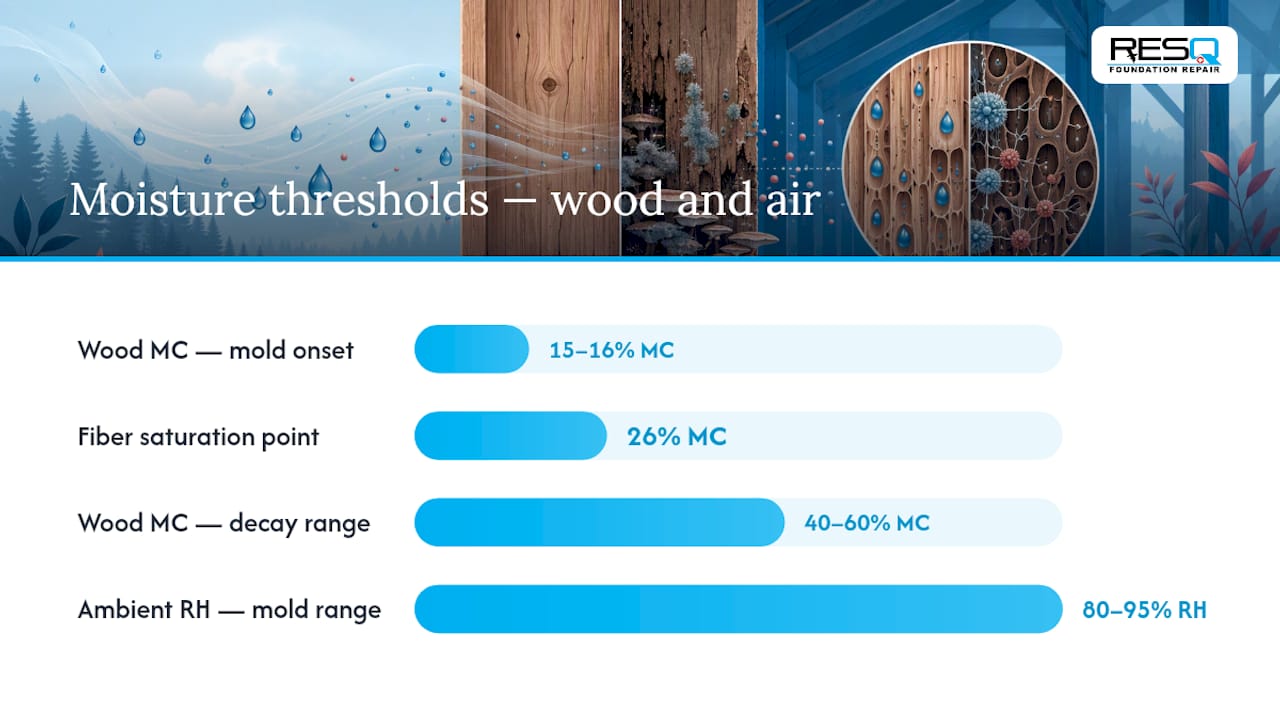
Numbers make this easier to act on. Mold colonizes wood surfaces when ambient relative humidity sits between roughly 80% and 95%. Most households run drier than that, so sustained readings in that range usually mean a leak, poor ventilation, or a crawl space problem, not normal indoor air.
Wood itself has its own thresholds. Mold activity typically starts around 15% to 16% moisture content. Decay is a different story: it generally requires wood to cross the fiber saturation point, around 26% MC, and many decay fungi grow most aggressively once wood hits 40% to 60% MC.
The clock matters as much as the number. Drying wood within 24 to 48 hours of getting wet typically prevents the jump from mold-friendly conditions to decay-friendly ones. This partner guide on property dry-out after water damage walks through the practical side of hitting that window.
| Condition | Reading | Recommended Action |
|---|---|---|
| Ambient RH | 80% to 95% | Ventilate, dehumidify, inspect for leaks |
| Wood MC | ~15% to 16% | Monitor, dry surfaces, watch for mold |
| Wood MC | Above 26% (FSP) | High decay risk, probe for softness, consider a pro inspection |
Short-term wetting mostly invites mold and sapstain fast. Repeated or prolonged wetting is what lets decay fungi actually settle in and persist even between drying episodes.
How Decay Actually Reduces Wood’s Strength
Decay doesn’t weaken wood evenly. Toughness and impact resistance go first, often before you’d notice anything visually wrong. Bending strength (MOR) and stiffness (MOE) follow. Compressive strength, the property that keeps a post or joist from crushing under load, tends to hold up longest, which is part of why decayed wood can look and feel mostly fine right up until it doesn’t.
The math here should get your attention. Lab testing found that a 10% weight loss from fungal decay can correspond to roughly a 40% drop in bending strength, with even steeper losses in energy-absorption properties, according to FPL research on decayed wood.
That nonlinear relationship is why visible decay should never be treated casually:
- A small amount of visible rot often means a disproportionately larger loss in strength underneath.
- Wood can look structurally sound while already carrying significant hidden weakness.
- Probing and measurement, not just a glance, are what tell you whether a member is still load-bearing.
Once decay reaches this stage, you’re not managing cosmetics anymore. You’re managing structural risk.
Where to Look and How to Check for Damage
Mold and early decay hide in predictable places: crawl spaces, basements, around roof and attic penetrations, behind trim, near window frames, and under sinks and plumbing fixtures. Any spot with poor airflow and a moisture source is a candidate.
A basic inspection checklist covers most of what you can safely assess yourself:
- Visible discoloration, staining, or fuzzy growth on wood surfaces.
- A persistent musty odor, even without visible growth.
- Wood that feels soft, spongy, or gives when pressed.
- Cracking in a cube-like pattern, a classic sign of advanced brown rot.
- Ambient humidity readings taken with a hygrometer, checked against the 80% to 95% mold range.
Safety comes first here. Wear gloves and an N95 mask at minimum, ventilate the area before you start poking around, and avoid disturbing visibly moldy materials more than necessary, since disturbance can release spores into the air.
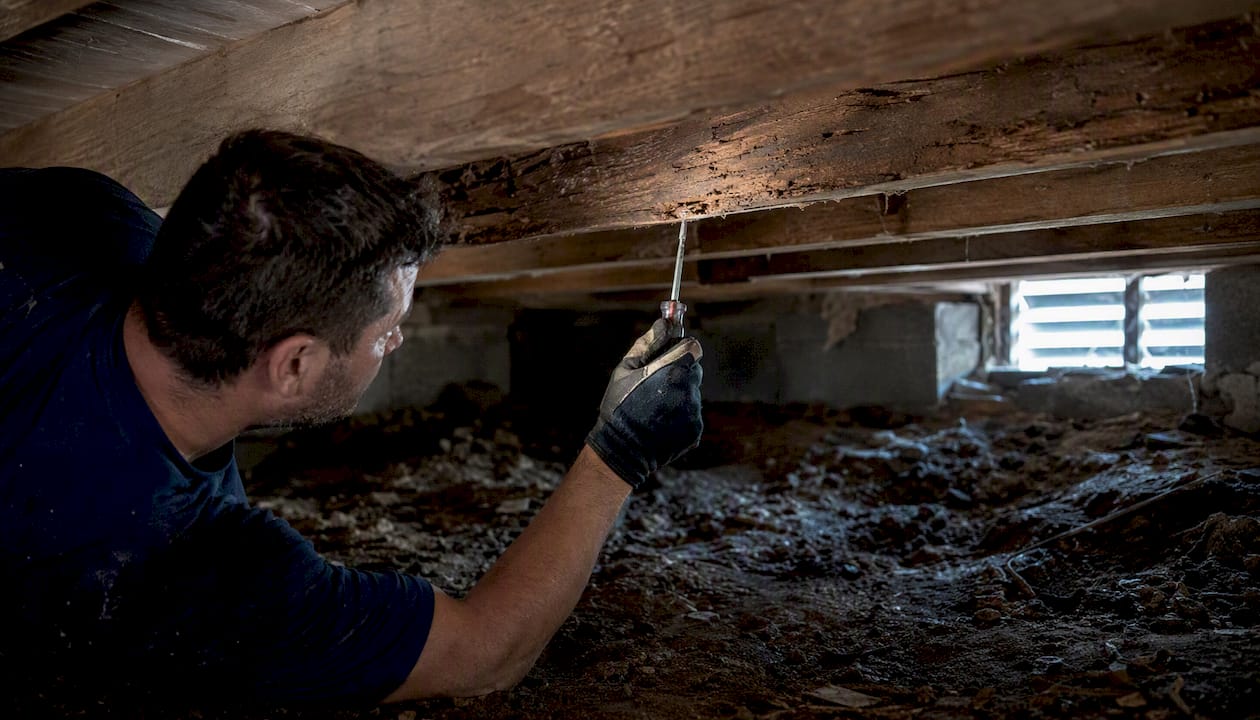
Pro Tip: Press a screwdriver tip into suspect wood at a low angle. If it sinks in easily or the wood crumbles, you’re likely dealing with decay, not just surface mold, and a wipe test alone won’t tell you that. A cheap pin-type moisture meter is worth owning if you deal with crawl spaces or basements regularly.
If you suspect hidden crawl space moisture, this guide on signs of water damage in crawl spaces covers locations easy to miss during a quick walkthrough.
What to Do in the First 48 Hours After a Water Event
Speed determines whether you’re dealing with a cleaning job or a repair job. Here’s the order that matters:
- Stop the water source before doing anything else, whether that’s a burst pipe, a roof leak, or a failed sump pump.
- Remove standing water with a wet vac or pump, then get fans and dehumidifiers running immediately.
- Increase airflow by opening interior doors and, if weather allows, windows, to speed evaporation.
- Remove saturated porous materials, like soaked carpet padding or drywall, that can’t dry fast enough on their own.
- Isolate the affected area from HVAC circulation to avoid spreading spores through the ductwork.
Wear gloves and a mask throughout, and never touch electrical outlets or panels in standing water. If the affected area is under 10 square feet, involves no structural framing, and no one in the household has respiratory sensitivities, DIY drying and cleanup is usually reasonable. Beyond that threshold, or if framing members are involved, bring in a professional. Foundationresq’s guide on why mold grows after water intrusion breaks down this window in more detail.
Fixing the Moisture Source for Good
Cleaning mold without fixing the moisture source is a temporary patch, not a solution. Homeowners often spend money scrubbing visible mold while the leak, poor drainage, or ventilation gap that caused it keeps feeding the problem, since mold is a symptom, not the root cause.
Prioritize fixes in this order:
- Stop active leaks and fix drainage around the foundation, gutters, and grading first. Water intrusion is the root cause in most cases.
- Control indoor humidity with dehumidification, especially in crawl spaces and basements where airflow is naturally poor.
- Improve ventilation in attics and crawl spaces to keep ambient RH out of the 80% to 95% mold range discussed earlier.
- Protect vulnerable wood with treated lumber or preservatives in areas prone to repeated moisture exposure.
Material choices matter long term, too. Reducing sapwood exposure in framing and avoiding paper-faced engineered wood products in damp areas both cut colonization risk. Construction sequencing plays a role as well: keeping wood dry before it’s enclosed is far easier than trying to dry it out after the walls go up.
For crawl spaces and basements specifically, encapsulation and dedicated dehumidification address the humidity problem at its source rather than treating symptoms repeatedly. Pairing that with routine maintenance, cleaning gutters, checking grading slopes away from the foundation, and inspecting HVAC drip pans, catches small problems before they become expensive ones. Building-science research also points to modern construction practices, tighter assemblies with less natural drying capacity, as a factor in why mold problems have increased in newer homes.
When Does Mold Damage Require a Professional?
Some signs mean it’s time to stop DIY-ing and get an inspection:
- Framing that feels soft, spongy, or crumbles under a screwdriver probe.
- Mold coverage exceeding roughly 10 square feet.
- Growth you suspect is hidden inside wall cavities, subfloors, or HVAC systems.
- Anyone in the household with asthma, allergies, or other respiratory sensitivities.
A professional inspection typically involves:
- Moisture mapping across affected areas using meters and thermal imaging.
- Containment and remediation protocols to prevent spore spread during cleanup.
- Structural evaluation of framing members, including probing and, where needed, lab-verified moisture content readings.
- Sistering or full replacement of compromised joists, sills, or studs.
- Waterproofing or encapsulation work to stop the moisture source long term.
When you’re vetting a contractor, ask about their testing methods, whether they document moisture readings over time, what repair options they’re recommending versus which they’re required to recommend, and their project timeline. Ask for before-and-after photos and references from similar jobs. Foundationresq’s mold remediation services outline what a proper containment and repair process looks like from start to finish.
A Homeowner’s Note on Acting Early
The homeowners who come out ahead financially are the ones who act in the first 48 hours, not the ones who wait to see if the smell goes away. Fast drying and a targeted fix cost a fraction of what sistering a rotted joist or rebuilding a crawl space support does later. If you’re unsure whether what you’re looking at is surface mold or something structural, a professional moisture reading settles it faster than any amount of guessing.
Sources
The claims in this guide draw on institutional and technical sources worth bookmarking if you want deeper detail:
- Mold Remediation in Schools and Commercial Buildings: Chapter 4 — EPA
- Biodeterioration of Wood — FPL GTR282, Chapter 14
- Mold on Wood: What Homeowners Need to Know — InspectandTest
These sources go deeper into standards-based remediation than any single blog post can cover.
FAQ
Does mold itself weaken wood structurally?
No. Mold mostly affects appearance and shock resistance; decay fungi are what break down the cellulose and lignin responsible for wood’s strength.
What moisture content triggers wood decay?
Decay generally begins once wood moisture content passes the fiber saturation point, around 26% MC, and accelerates between 40% and 60% MC.
How fast do I need to dry wet wood to prevent mold?
Within 24 to 48 hours of a water event, according to EPA guidance, to avoid the conditions that let mold and later decay fungi take hold.
How much strength can decayed wood actually lose?
Lab tests found a 10% weight loss from decay can correspond to roughly a 40% drop in bending strength, with even larger losses in impact resistance.
When should I call a professional instead of cleaning mold myself?
Call a professional if mold covers more than about 10 square feet, if wood feels soft or crumbles when probed, or if growth is hidden inside walls or HVAC systems.
Recommended
- White Mold on Wood in Crawl Space: Identification, Risks, and Solutions for 2026
- Is Mold in Your Crawl Space Dangerous? Health and Structural Risks Explained – Tallahassee Foundation Repair | Foundation ResQ
- Wood Rot in Crawl Space: Identification, Repair, and Prevention Guide – Tallahassee Foundation Repair | Foundation ResQ
- The Ultimate Guide to Wood Rot Repair Products and Techniques – Tallahassee Foundation Repair | Foundation ResQ