
Most uneven sinking in garage floors traces back to three things: poorly compacted fill dirt settling under its own weight, water quietly washing soil out from beneath the slab, or clay soil expanding and shrinking with the seasons. If you’re seeing a gap that’s growing, diagonal cracks reaching into the house, or a garage door that suddenly won’t seal right, that’s your cue to stop watching and start measuring.
A few quick checks and, when the signs point to something structural, a professional inspection will tell you whether this is a slab-only problem or something tied to your home’s footings.
- Growing gap at the wall or driveway lip
- Diagonal cracks extending into living space
- Sticking doors or windows near the garage
Key Takeaways
Uneven garage floor sinking happens when soil compaction failure, water erosion, or clay shrink-swell removes support from beneath the slab, and early diagnosis keeps repair options like polyjacking on the table.
| Point | Details |
|---|---|
| Three root causes | Poor compaction, water erosion under the apron joint, and clay shrink-swell drive most slab sinking. |
| Measure seasonally | Track the threshold gap in wet and dry seasons to catch active soil movement early. |
| Know the red flags | A growing gap, a driveway lip over 3/8 to 1/2 inch, or diagonal cracks in the house warrant a professional inspection. |
| Match the repair to the cause | Polyjacking suits single voids; piers are needed when house footings are involved. |
| Fix drainage first | Correcting grading and downspouts prevents the same void from reappearing after repair. |
Table of Contents
- Why Garage Floors Sink Unevenly: The Signs to Watch For
- Common Causes of Garage Floor Sinking
- Diagnosing the Problem: DIY Checks and When to Call a Pro
- Repair Options for an Uneven Garage Floor
- Preventing Future Settlement Around Your Garage
- How Foundation RESQ Approaches an Uneven Garage Floor
- What the Research Actually Tells Homeowners
- Sources
- FAQ
Why Garage Floors Sink Unevenly: The Signs to Watch For
A slab settling from soil loss looks different from ordinary concrete shrinkage cracking, and the distinction matters because one is cosmetic and the other isn’t.
- Gaps and lips. Look where the garage slab meets the house foundation or the driveway apron. A gap that keeps widening, or a lip where the driveway now sits noticeably higher or lower than the garage floor, points to the slab moving independently.
- Crack patterns. Cracks that start at a slab edge and grow, or diagonal cracks running through drywall in an adjacent room, are more concerning than fine hairline shrinkage cracks scattered across the middle of the slab.
- Doors and shelving. A garage door that no longer seals evenly, shelving units that lean, or a car that seems to roll toward one corner all suggest the floor beneath them has tilted.
- Pooling water. Low spots that collect standing water after rain are a sign the slab has dipped in that section.
Pro Tip: Measure the gap at your garage door threshold during a dry spell and again after a heavy rain or a stretch of drought. Seasonal shifts in the gap size reveal whether soil volume is actively changing underneath, which tells you whether this is a one-time settling event or an ongoing process.
Common Causes of Garage Floor Sinking
Every sinking garage floor comes down to the same basic mechanism: the soil under the slab has compressed, eroded away, or shifted volume, leaving a void the concrete eventually settles into. What creates that void, though, changes depending on how the slab was built and what’s happening in the soil around it.
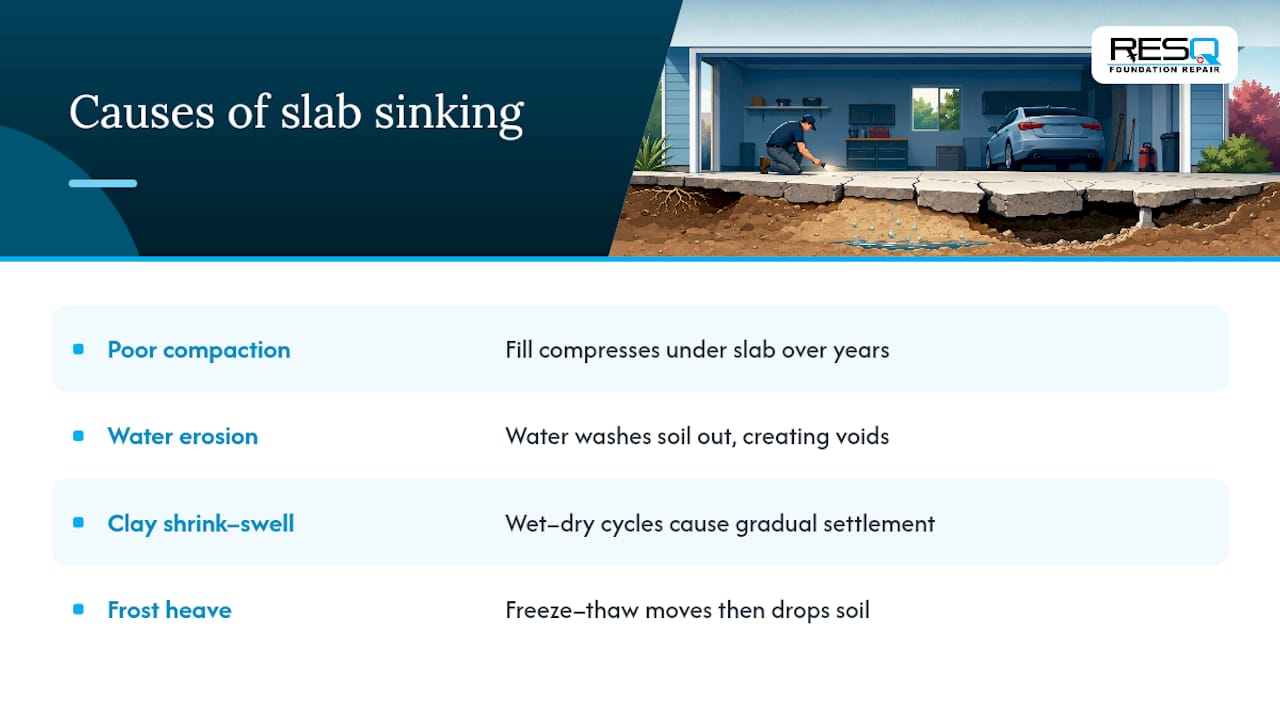
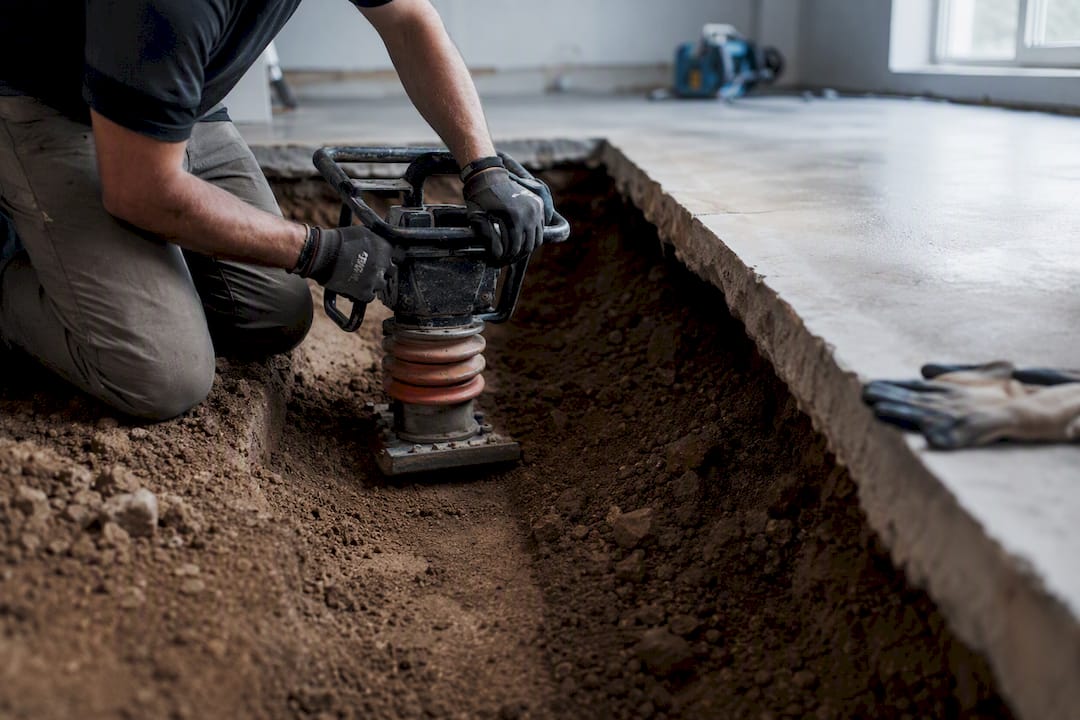
Poor compaction during construction is one of the most frequent culprits. When fill dirt goes in too thick per lift, or gets rushed without proper compaction equipment, it looks solid on day one but keeps compressing for years afterward under the slab’s own weight and the load of parked vehicles.
Water-driven erosion does the same damage a different way. Water finds a path through the apron joint, through hairline cracks, or off a downspout aimed at the foundation, and it carries fine soil particles out from under the slab as it drains. Over months or years, that slow washout creates a void the concrete has nothing left to rest on. This is one of the most common patterns contractors see, and it’s also one of the most preventable, because poor grading and clogged downspouts are directly responsible for a large share of subgrade erosion cases.
Clay soil shrink-swell works on a seasonal clock. Clay expands when it’s wet and contracts when it dries out, and each cycle doesn’t fully reverse the last one. That ratchet effect produces net settlement over several seasons even without any single dramatic event.
Frost heave adds another layer in colder climates, where freeze-thaw cycles push and drop soil beneath the slab in ways that mimic the same shrink-swell pattern.
In practice, these causes rarely act alone. A slab with mediocre compaction and a leaky downspout nearby will sink faster than either problem would on its own, and the dominant cause often depends on your regional soil type and drainage setup as much as the original construction quality.
Diagnosing the Problem: DIY Checks and When to Call a Pro
Start with what you can measure yourself before assuming the worst.
- Measure the gap at the garage door threshold with a tape measure and note the date.
- Set a 4-foot level or a marble on the slab to check for slope; a marble that rolls consistently toward one spot confirms a low point.
- Tap the slab with a hammer or mallet in a grid pattern and listen for hollow-sounding areas, which suggest a void underneath.
- Photograph any pooling within an hour of a rainstorm, and repeat that photo in a different season.
Certain findings mean it’s time to bring in a professional rather than keep monitoring:
- A gap that’s grown measurably over a few months, not just seasonally shifted
- A lip greater than 3/8 to 1/2 inch where the driveway meets the garage
- Diagonal cracks reaching into the house’s living space
- Doors or windows near the garage that suddenly bind
A professional foundation inspection typically includes elevation mapping across the slab, a review of drainage and grading around the garage, and sounding tests to locate voids before recommending a repair path. Catching a single-void problem early keeps your repair options open. Foundations that progress to multiple voids or slab fragmentation cost more to fix and limit you to more invasive repairs.
Repair Options for an Uneven Garage Floor
The right fix depends on what’s actually happening under the slab, not just how bad it looks on the surface.
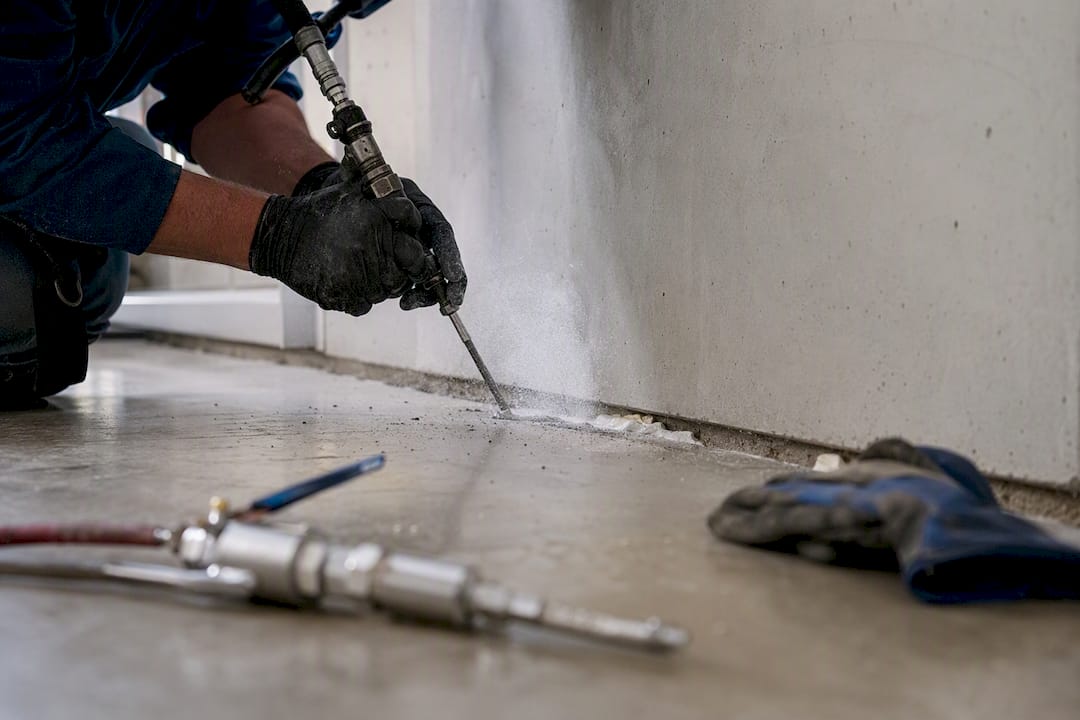
Polyurethane foam injection, often called polyjacking, works by drilling small holes into the slab and injecting expanding foam that fills the void and lifts the concrete back into position. It cures within about 15 minutes, weighs a fraction of what traditional grout does, and seals the void against future water infiltration rather than just filling it. It’s commonly the first recommendation for single-void settlement, where the slab itself is intact and the soil loss is localized.
Mudjacking, or slurry grouting, uses a cement-based mix pumped under the slab instead of foam. It’s a longer-standing method and still shows up on older jobs, but the mix is heavier, takes longer to cure, and can add its own load to soil that’s already struggling to support the slab.
Underpinning with helical or push piers comes into play only when the settlement isn’t confined to the garage slab. If the slab is structurally tied to the house’s footings and diagonal cracks or door binding suggest the house itself is moving, piers driven to load-bearing soil or bedrock are what actually stops the movement. This is a different scope of work than lifting a slab.
Slab replacement becomes necessary when the concrete has fractured into pieces moving independently of each other, or when contamination or extensive cracking makes injection impractical.
Pro Tip: Fix the water source before or alongside any structural repair. Lifting a slab back into place without correcting the grading or downspout that caused the erosion just sets up the same void to reappear within a few seasons.
Preventing Future Settlement Around Your Garage
A repaired slab stays level only if the water that caused the original problem gets redirected somewhere else.
- Check that the ground slopes away from the garage slab at a consistent grade, not flat or sloping toward it
- Extend downspouts at least several feet away from the foundation and clean gutters twice a year
- Seal the apron joint where the driveway meets the garage floor to keep surface water from tracking underneath
- Use sandbagging or temporary channeling to divert water away from a known problem spot while you schedule a permanent fix
- Ask about compaction testing on new construction, or bring in a geotechnical assessment if the same section of slab keeps failing after repair
If drainage around your property is part of the problem, a dedicated drainage solution that regrades and redirects runoff can prevent the erosion cycle from starting again.
How Foundation RESQ Approaches an Uneven Garage Floor
Foundation RESQ’s inspection process starts with the same basics any homeowner can check: a visual walk of the slab, sounding tests to map hollow areas, and elevation readings to quantify how far out of level the floor really is. From there, the team reviews grading and drainage around the garage, since fixing the lift without addressing the water source rarely holds.
Foundation RESQ offers polyfoam lifting for single-void settlement, along with concrete leveling, basement waterproofing, and underpinning for cases where slab movement is tied to the house’s footings. Financing options are available for homeowners who need repairs scheduled sooner rather than later.
A sinking garage slab rarely fixes itself, and the earlier a void gets diagnosed, the more repair options stay on the table.
Before booking an inspection, gather a few photos of the affected area, your threshold gap measurement, and a rough timeline of when you first noticed the change. Homeowners can also review past concrete lifting projects and check contractor credentials through resources like the Better Business Bureau before committing to any repair.
What the Research Actually Tells Homeowners
Most advice on this topic jumps straight to repair methods and skips the diagnostic step that actually determines which repair is right. That’s backwards. The single most useful thing a homeowner can do is figure out whether the garage slab is moving independently or whether it’s tied to the house footings, because that distinction decides whether you need a foam injection job that takes an afternoon or a pier system that takes days and costs considerably more.
The conventional wisdom of “get it inspected” isn’t wrong, but it undersells how much a homeowner can learn before that inspection ever happens. A tape measure, a marble, and two photos taken a season apart will tell you more about whether your slab problem is progressing than any amount of guessing. Prioritize the water source over the cosmetic crack. Erosion from a misdirected downspout is slower to notice and far easier to fix than most people assume, and ignoring it is how a small void becomes a slab replacement job.
Sources
FAQ
How do you fix an uneven garage floor?
The fix depends on the cause: polyurethane foam injection lifts and seals single voids, while piers or underpinning are needed if the slab’s movement is tied to the house’s footings.
Does homeowners insurance cover a sinking garage floor?
Standard homeowners insurance typically excludes gradual settling and earth movement, since these are considered maintenance issues rather than sudden covered losses; check your specific policy language for exclusions.
How do I fix the gap at the bottom of my garage door?
A growing gap at the door threshold usually means the slab has settled; sealing the apron joint stops further water intrusion, but the gap itself typically requires lifting the slab back into position.
How can I tell if my garage floor is sinking versus just cracking?
Sinking shows up as a widening gap at the slab edge, a lip at the driveway, or pooling water in one spot, while ordinary shrinkage cracking stays hairline and doesn’t shift the slab’s elevation.