
Yes, trees can damage a foundation, but only when specific conditions line up: shrinkable clay soil, a thirsty species, a shallow foundation, and a trunk too close to the house. NHBC Chapter 4.2 guidance and forensic engineering research on tree-related movement both point to the same variables, and once you know them, you can check your own yard in twenty minutes.
Start here, before you call anyone:
- Identify the tree species and estimate its mature height.
- Measure the distance from the trunk to your foundation wall.
- Walk the exterior and note any cracks, sticking doors, or sloped flooring.
- Photograph everything and write down the date. You’ll need this timeline later.
- If cracks are widening by the week or a door has suddenly jammed, get an inspection. Foundationresq offers a free assessment for homeowners in North Florida, South Georgia, and Alabama who want a professional read before deciding anything.
Key Takeaways
Tree-related foundation damage results from a specific combination of clay soil, high-water-demand species, close proximity, and shallow foundation depth, not from trees alone.
| Point | Details |
|---|---|
| Soil type drives risk | Clay soils shrink and swell with moisture changes; sandy soils rarely cause tree-related movement. |
| Distance should track height | Use mature tree height as your guide, spacing large trees 15 to 20 feet or more from walls. |
| Watch for active signs | Widening cracks, sticking doors, and sloped floors mean it’s time for a professional look. |
| Removal isn’t automatic relief | Cutting a mature tree on clay soil can trigger rehydration heave lasting months to years. |
| Get combined expertise | Pairing an arborist with a geotechnical engineer avoids misdiagnosis and wrong repairs. |
| Foundationresq offers free inspections | Documented findings can be shared with outside specialists and support underpinning or waterproofing decisions. |
Table of Contents
- How Tree Proximity Affects Foundation Stability Through Soil Moisture
- What Determines Whether a Nearby Tree Is a Real Risk?
- What Signs Point to Tree-Related Foundation Damage?
- When Should You Call an Arborist or Structural Engineer?
- What Are the Best Ways to Fix or Prevent the Damage?
- Can Removing a Tree Make Foundation Problems Worse?
- How Far Should You Plant Trees From Your Foundation?
- How Foundationresq Approaches Tree-Related Foundation Problems
- What Homeowners Get Wrong About Trees and Foundations
- Get a Free Foundation Inspection Before Deciding on the Tree
- Sources
- FAQ
How Tree Proximity Affects Foundation Stability Through Soil Moisture
Trees pull enormous volumes of water out of the ground through their roots and release it through their leaves, a process called transpiration. In clay soils, that moisture loss causes the clay to shrink, and shrinking soil under one part of a foundation while the rest stays wet creates uneven settlement. That’s the mechanism behind most tree-related subsidence, and it’s why NHBC’s guidance treats clay content as the deciding factor in how close a tree can safely stand.
The moisture story runs in cycles:
- A mature tree desiccates the clay beneath and around it during dry seasons.
- The soil rebounds and softens when rain returns, but not evenly, since roots keep drawing from some pockets more than others.
- Repeated cycles progressively weaken the soil’s ability to support a stable foundation.
Roots also cause direct physical problems that have nothing to do with moisture. They grow under slabs, wedge into drain joints, and lift flatwork simply by getting thicker over the years. A cracked drain line leaking near a foundation footing can make a moisture problem worse than the tree itself, which is one reason forensic engineering reviews insist on checking drainage before blaming the nearest oak.
What Determines Whether a Nearby Tree Is a Real Risk?
Four variables decide the outcome, and soil type carries the most weight. Research on soil classification and root-related foundation risk identifies shrinkable clay as the dominant factor, since sandy or gravelly soils rarely move enough from tree activity to matter. If your yard has heavy, sticky soil that cracks in dry weather and turns to paste in wet weather, you’re likely dealing with clay.
Run through this checklist:
- Soil type: clay is highest risk; sand and well-drained loam are lower risk.
- Species water demand: oaks, willows, and poplars pull far more water than dogwoods or magnolias.
- Mature size: a tree’s root spread tends to track its crown width, so a species that will eventually tower over your roofline will eventually reach your foundation too.
- Distance versus height: NHBC’s D/H guidance ties safe planting distance to a fraction of the tree’s mature height, with higher water-demand species requiring more distance.
- Foundation type: shallow slab-on-grade construction and older homes with shallow footings move more easily than modern deep or piled foundations.
What Signs Point to Tree-Related Foundation Damage?
Certain patterns show up again and again in root-related cases. Stair-step cracking in brick or block, and diagonal cracks running from window and door corners, usually mean the foundation beneath that section has shifted unevenly.
Watch for these:
- Doors or windows that suddenly stick or won’t latch properly.
- Floors that visibly slope or feel uneven when you walk them.
- New gaps between baseboards and the floor, or around exterior door frames.
- Lifted or cracked sidewalks and driveways near the tree.
- Drains that clog repeatedly in the same spot, which often means roots have entered the line.
Not every sign demands an emergency call. A single hairline crack that hasn’t changed in a year is worth photographing and monitoring. A crack that widens visibly month to month, or a door that jammed overnight, is not.
Pro Tip: Tape a strip of clear packing tape across a crack and date it. If the tape splits within a few weeks, the crack is active and you need an inspection now, not later.
When Should You Call an Arborist or Structural Engineer?
Before contacting anyone, gather what you already have: species identification, the trunk-to-foundation measurement, dated photos, and notes on when symptoms first appeared. That timeline saves professionals hours of guesswork.
- An arborist maps root spread, assesses the species’ water demand, and can recommend pruning or removal strategies that won’t shock the soil.
- A geotechnical engineer classifies the soil, sometimes running suction or filter-paper tests, and may recommend a Level C investigation that includes soil borings and moisture profiling.
- A foundation contractor gets involved once movement is confirmed and structural repair is on the table, not before.
Monitoring alone is reasonable when cracks are stable and small. Once you see active widening, sticking doors, or sloped floors, combined arborist and geotechnical assessment becomes the safer path, since treating the tree or the foundation in isolation often misses the real cause.
What Are the Best Ways to Fix or Prevent the Damage?
Mitigation works best in stages, starting with the least invasive option. Crown reduction lowers a tree’s water demand without killing it, and correcting drainage around the foundation reduces the moisture swings that drive shrink-swell cycles in the first place.
Root-control measures come next; for practical guidance on root-control measures and tree maintenance, consult our tree root management guide.
- Physical root barriers installed vertically between the tree and the foundation can redirect growth downward instead of laterally.
- Monitored root pruning, done under arborist supervision, removes problem roots without destabilizing the tree.
Barriers only work when installed correctly. A poorly placed root barrier can actually trap roots at a shallow depth and push them to spread faster under the slab, which is worse than doing nothing.
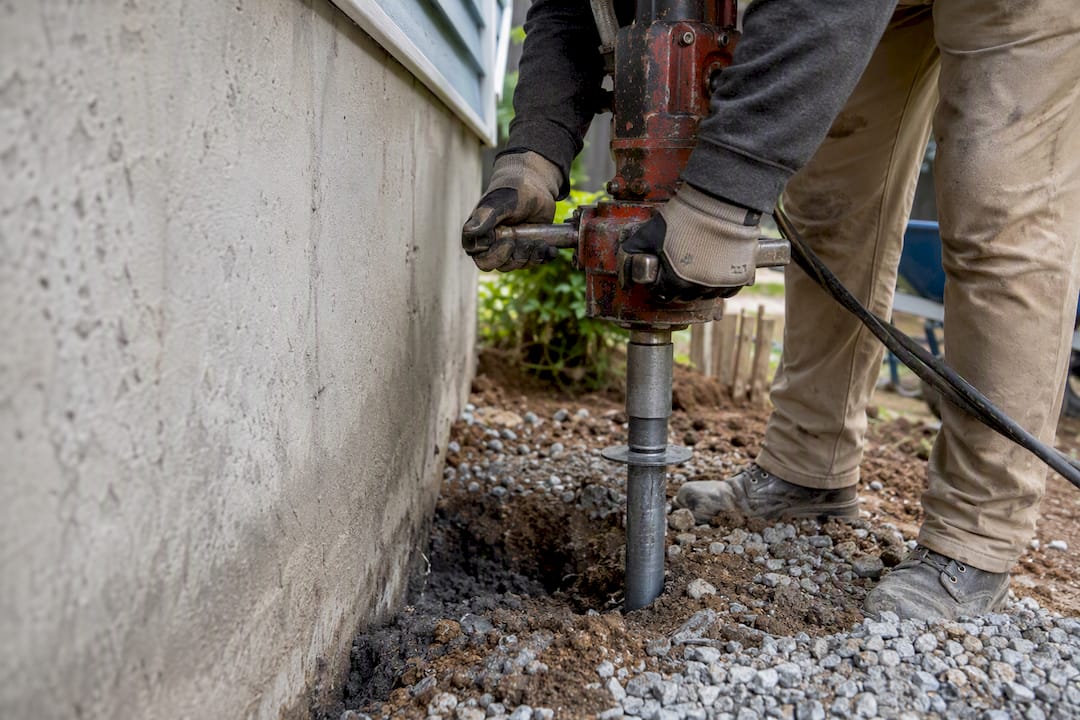
When movement has already occurred, vegetation fixes aren’t enough. Underpinning, helical piers, or slab stabilization restore support directly, and these repairs are typically engineered to account for the tree that’s still there, or the one that’s coming out. Foundation settlement repair methods vary in cost and timeline depending on how many piers a foundation needs and how deep they have to go.
Pro Tip: Never schedule tree removal and foundation repair as separate, unrelated projects. Coordinate the timing with your contractor so the repair design accounts for how the soil will behave after the tree is gone.
Can Removing a Tree Make Foundation Problems Worse?
Removal isn’t an automatic fix on clay soils, and it can sometimes make things worse before they get better. Once a mature tree has desiccated clay for years or decades, cutting it down lets moisture creep back into that dried zone through old root channels, and the soil can swell unevenly as it rehydrates. That process can take months to years depending on rainfall and how deep the root channels run, according to forensic case documentation on rehydration and heave.
- Rehydration heave sometimes causes more visible damage than the original shrinkage.
- Removal without an engineering plan can prolong movement instead of stopping it.
- Staged removal, combined with before-and-after monitoring using level gauges or survey benchmarks, gives engineers real data to design around instead of guessing.
How Far Should You Plant Trees From Your Foundation?
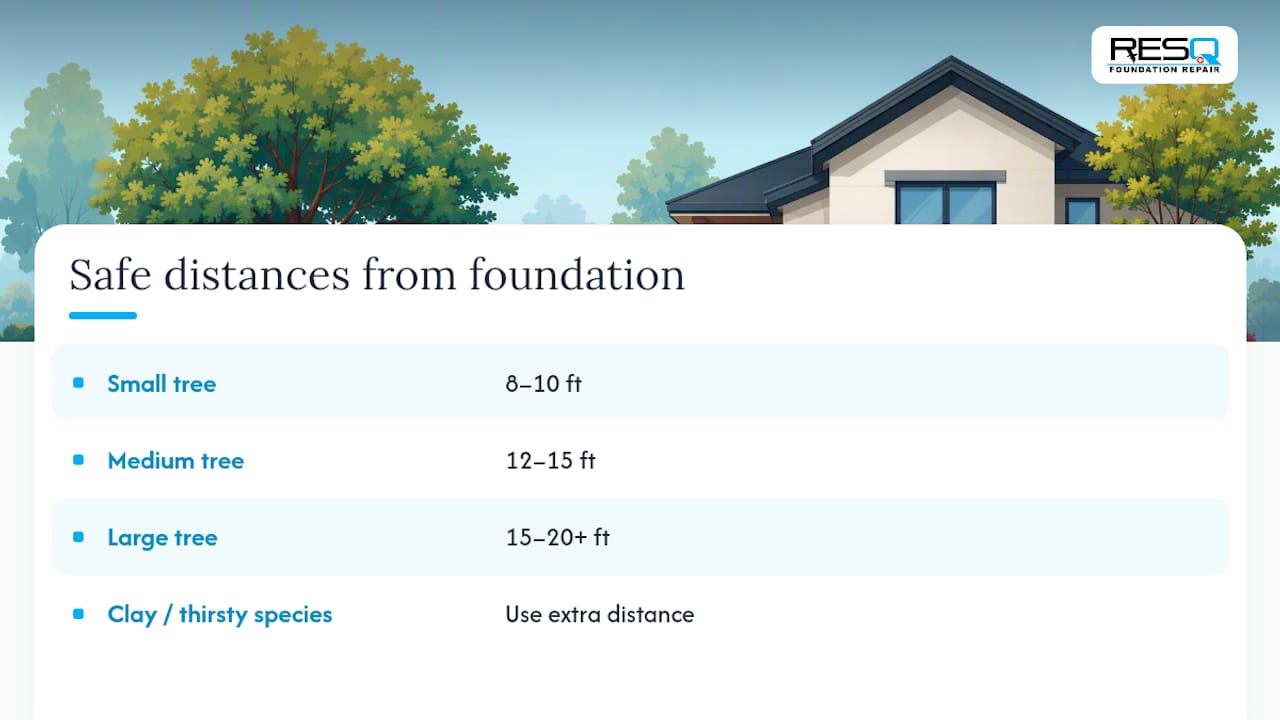
Planting distance should scale with how tall the tree will eventually get, not how big it looks in the nursery pot. General landscape guidance recommends planting small trees 8 to 10 feet from a wall, medium trees 12 to 15 feet, and large trees 15 to 20 feet or more, with wider spacing for thirsty species on clay soils.
- Follow the mature-height rule as a baseline, then adjust upward for oaks, willows, or other high-demand species.
- Keep new plantings well clear of sewer and drainage lines, since roots seek out the moisture and nutrients inside cracked joints.
- On clay soils, favor lower-water-demand species and avoid planting directly against foundation walls or driveways.
- Arbor Day Foundation guidance notes that most tree roots stay within the top 24 inches of soil but spread well beyond the canopy, which is why lateral distance matters more than most homeowners assume.
How Foundationresq Approaches Tree-Related Foundation Problems
A Foundationresq inspection for a suspected tree-related issue documents crack patterns, floor levels, and moisture conditions in enough detail to hand off to an arborist or geotechnical engineer if one is needed. That documentation matters because misdiagnosing a tree problem as a plumbing problem, or vice versa, leads to repairs that don’t hold.
- Services relevant to tree-driven issues include foundation inspection, underpinning, crawl space moisture control, and basement waterproofing.
- Homeowners typically get a written summary of findings, not just a verbal opinion, which makes coordination with outside specialists straightforward.
- Foundationresq recommends monitoring when movement is minor and stable, and recommends structural repair once measurable settlement or active cracking is confirmed.
What Homeowners Get Wrong About Trees and Foundations
Most homeowners assume the biggest tree is the biggest threat. It usually isn’t. A massive live oak on sandy soil thirty feet from the house is often less dangerous than a mid-sized willow fifteen feet from a slab on heavy clay. Soil type does more work in this equation than tree size, and that’s the piece the conventional advice skips.
The second mistake is treating removal as the default fix. Cutting down a tree feels decisive, but on clay soils it can trigger a rehydration cycle that causes new cracking a year or two later, sometimes worse than what prompted the removal in the first place. Academic reassessment of tree-foundation interactions has flagged this for decades, yet it rarely makes it into homeowner-facing advice, which tends to frame trees as either safe or dangerous with no middle ground.
What actually works is sequencing: soil testing before decisions, arborist and engineer input together rather than separately, and staged action instead of a single dramatic move. If your yard has clay soil and a thirsty species close to the house, the priority isn’t panic. It’s getting the measurements and the soil classification first, because that’s the information every good decision after this depends on.
Get a Free Foundation Inspection Before Deciding on the Tree
If cracks, sticking doors, or sloped floors have you wondering whether a nearby tree is the culprit, Foundationresq gives North Florida, South Georgia, and Alabama homeowners a direct way to find out, with a free inspection instead of a guessing game.

An inspection documents what’s actually happening to your foundation, not just what a general contractor assumes from a quick look. If the findings point to soil conditions that need a geotechnical read, or root activity that needs an arborist’s opinion, Foundationresq will say so rather than pushing a repair that won’t solve the real problem. When movement has already occurred, the full range of services covers underpinning, crawl space moisture control, and drainage correction, and financing options are available for homeowners who want repairs done without draining savings. Call Foundationresq or use the contact page to schedule your free inspection and get a clear answer instead of a guess.
Sources
- Foundation Performance: Tree effects on foundations — movement types and diagnostic guidance
- Trees and foundations — a reassessment (1993)
FAQ
How close is too close for a tree to be to a house?
It depends on species and soil, but as a rule of thumb, a mature tree’s root spread often exceeds its canopy width, so distances under half the tree’s mature height on clay soil raise real risk.
What is the mature-height rule for planting trees near foundations?
The rule scales safe distance to a fraction of a tree’s expected mature height, with NHBC guidance providing specific ratios for different species and soil conditions.
Do trees actually mess up house foundations?
Yes, but only under specific conditions: shrinkable clay soil, a high-water-demand species, and a foundation close enough and shallow enough to be affected by soil moisture changes.
How far should trees be from the foundation?
General guidance suggests 8 to 10 feet for small trees, 12 to 15 feet for medium trees, and 15 to 20 feet or more for large trees, with extra distance on clay soils or for thirsty species.
Should I remove a tree that’s close to my foundation?
Not automatically. On clay soils, removal can cause rehydration and heave that sometimes causes more damage than leaving the tree, so get a combined arborist and engineering assessment first.