
If your foundation is cracking, sagging, or your yard has a strange dip in it, the odds favor settlement, not a sinkhole. Settlement moves slowly and shows up as gradual cracks and sticking doors. A true sinkhole tends to announce itself with sudden collapse or a fast-growing circular hole. If the ground is actively dropping right now, get everyone out and call emergency services. If it isn’t, take photos, measure what you see, and book a professional inspection this week.
TL;DR:
- Most foundation cracks are caused by settlement, which develops slowly and is generally manageable without extensive or costly repairs.
- Active sinkholes typically cause sudden ground collapse or circular depressions and require immediate evacuation and professional investigation.
- Confirming a void underground involves specialized geophysical surveys, soil borings, and ongoing monitoring, not DIY methods.
- Insurance coverage often excludes normal settlement but may cover sinkhole damage if documented by an engineer’s report and proper testing.
- Regular inspections, proper drainage management, and early professional assessments help prevent or address foundation issues before they worsen.
Table of Contents
- Sinkhole vs Settlement: A Quick Comparison
- How to Tell the Difference Between Sinkhole and Settlement Damage
- What a Professional Investigation Actually Involves
- Who Pays: Insurance and Cost Realities
- What to Do in the Next 72 Hours
- Does This Affect Resale Value?
- Where Sinkholes and Settlement Are Most Common
- Preventing Both Problems Before They Start
- A Contractor’s-Eye View: What Repair Actually Looks Like
- Sources
- FAQ
Sinkhole vs Settlement: A Quick Comparison
Settlement is the far more common culprit behind cracked foundations, sagging floors, and uneven walkways. It’s caused by soil compressing or shifting unevenly under a structure’s weight, and it almost always develops over months or years. A sinkhole, by contrast, is a void that opens up underground when soluble rock like limestone dissolves or erodes, and the ground above eventually loses support. Some sinkholes form gradually too, but the ones that make headlines happen fast.
Here’s the quick rundown homeowners actually need:
- Speed: Settlement creeps; classic collapse sinkholes drop suddenly, sometimes overnight.
- Shape: Settlement cracks follow stress lines across a foundation; sinkhole damage often centers on a roughly circular depression.
- Cause: Settlement usually traces back to soil compaction, expansive clay, or drainage problems; sinkholes trace back to underground rock dissolving or a buried void collapsing.
- Urgency: Settlement generally allows time to schedule an inspection; active sinkhole collapse is an immediate safety issue.
- Who confirms it: Neither type should be self-diagnosed with total confidence. A geotechnical engineer or structural engineer makes the actual call.
Most homeowners who panic about a “sinkhole” are dealing with ordinary foundation settlement, which is a very different repair conversation.
How to Tell the Difference Between Sinkhole and Settlement Damage
The signs live in two places: inside the house and outside on the property. Reading them correctly saves you from either overreacting or waiting too long.
Interior clues that point to settlement:
- Stair-step cracks running diagonally through brick or block, especially near corners.
- Horizontal cracks in a foundation wall, which usually signal more serious pressure than vertical ones.
- Doors and windows that stick or won’t latch the way they used to.
- Gaps opening up between crown molding and the ceiling, or baseboards pulling away from the floor.
According to This Old House, gradual settling is common and often manageable, but horizontal cracks, sticking doors, and cracks that keep widening are the signs worth an inspection.
Exterior clues that raise sinkhole concern:
- A roughly circular depression in the yard, especially one that wasn’t there last season.
- Water pooling in one spot after rain, in a pattern that looks like a bowl rather than a puddle.
- Trees, fence posts, or utility poles leaning without an obvious storm event to explain it.
- Cracked or broken underground utility lines with no digging or construction nearby.
Track any crack with a soft pencil mark and the date, then measure width with a simple ruler or a $10 crack gauge every couple of weeks. A crack that holds steady at an eighth of an inch for six months behaves very differently than one that doubles in a month.
Pro Tip: Photograph cracks and depressions right after a heavy rain. Water is often the trigger that reveals how active the movement really is, and before/after rain photos give an engineer a much clearer read than a single dry-day snapshot.
What a Professional Investigation Actually Involves
Homeowners can spot warning signs, but confirming a void underground is not a DIY job. Concrete Fix Tampa puts it plainly: there’s no reliable way to test for a deep sinkhole yourself. That confirmation takes equipment and training.
A typical investigation includes:
- Ground-penetrating radar (GPR) or other geophysical surveys, which image what’s below the surface without digging. This is noninvasive imaging that can reveal voids, though it has limits. Certain void shapes don’t show up clearly, which is why engineers pair GPR readings with physical confirmation.
- Soil borings, where a drill pulls core samples at specific depths and locations. Engineers pick boring spots and spacing based on what the geophysical scan flagged as suspicious.
- Monitoring wells and crack gauges, installed when movement is ongoing rather than a one-time event, tracking whether things are getting worse week to week.
- Lab analysis of soil samples to identify expansive clay content, compaction levels, or moisture saturation.
The final report ties all of it together. It states what’s actually happening underground, whether it’s a void, compacted fill, or soil shrink-swell, and that diagnosis is what determines the repair plan and, often, whether an insurance claim has a leg to stand on.
Who Pays: Insurance and Cost Realities
Here’s where a lot of homeowners get an unpleasant surprise. Most standard homeowners insurance policies treat normal settlement as ordinary wear and tear, which usually isn’t covered. Sinkhole coverage is a different story, but it varies significantly by state and by policy, so check your declarations page and call your carrier early rather than assuming either way.
What insurers almost always want before they’ll classify damage as sinkhole related:
- A structural or geotechnical engineer’s report documenting the cause.
- Photos and a written timeline of when signs first appeared.
- Any prior inspection reports if you’ve had the property looked at before.
- Proof the damage matches a sinkhole pattern rather than routine settling.
Repair costs swing widely because the price depends on the depth and extent of the void, how hard it is to access the affected area, the local geology, and which repair method the engineer specifies. A shallow soil compaction fix and a large-scale grouting job under a slab are not remotely the same invoice, which is exactly why a diagnostic report matters before anyone signs a repair contract.
Practical steps: notify your insurer as soon as you notice active movement, preserve every crack and depression exactly as you found it, and get an independent engineer’s opinion if the insurer’s assessment doesn’t match what you’re seeing.
What to Do in the Next 72 Hours
- If the ground is actively collapsing, evacuate immediately. Rope off the area, keep kids and pets away, and shut off gas or water lines if they’ve been damaged.
- Document everything. Timestamped photos, crack measurements, and notes on when signs appeared, especially right after rain, give an engineer a real record to work from.
- Call a structural or geotechnical engineer first, not a general contractor. The initial visit typically includes a visual assessment and a recommendation on whether GPR or borings are needed next.
- Avoid DIY fixes on large depressions. Filling a hole with dirt or gravel yourself can mask a growing void and complicate both diagnosis and any future insurance claim.
Delaying any of this rarely helps. Active movement tends to accelerate rather than plateau, and an early inspection protects both safety and your ability to file a clean insurance claim.
Does This Affect Resale Value?
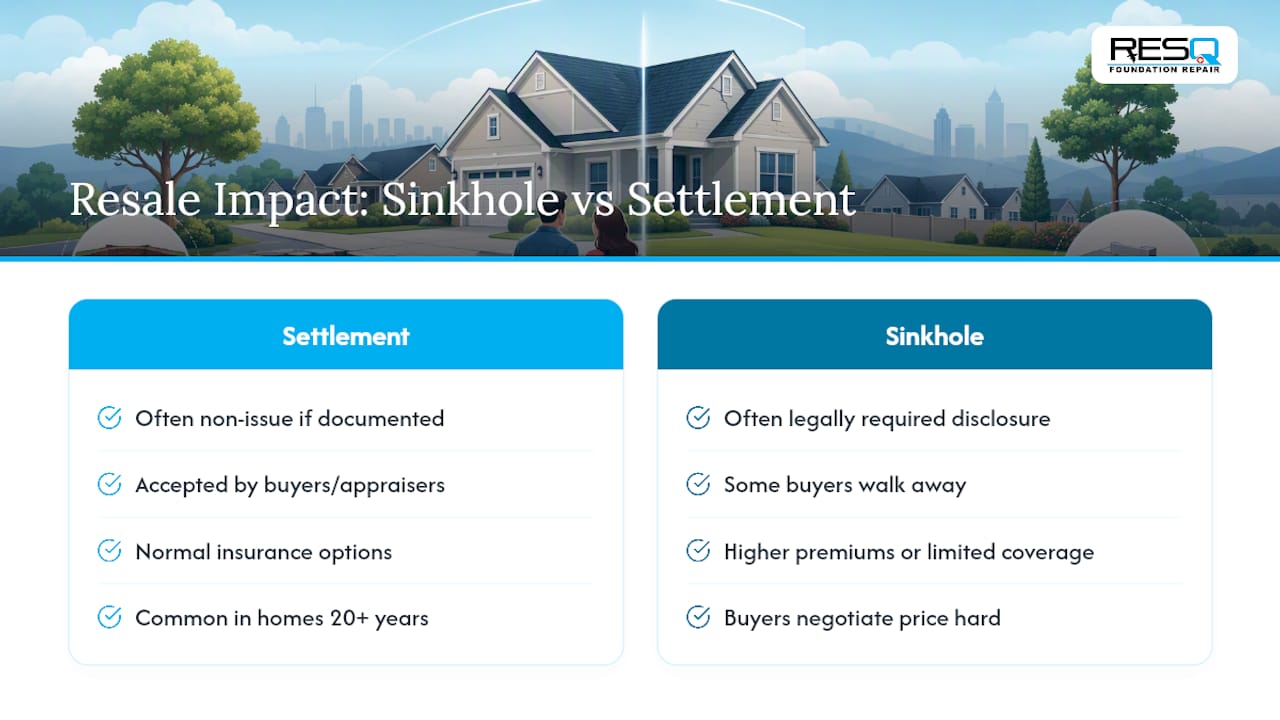
Yes, and the two issues age very differently on a title report. Settlement that’s been properly diagnosed and repaired, with documentation to prove it, is often a non-issue for buyers and appraisers. Lenders and inspectors see stabilized settlement all the time, particularly on homes over 20 years old.
A confirmed sinkhole history is a heavier disclosure. Many states require sellers to disclose past sinkhole activity or claims, and some buyers walk away regardless of how well the repair was done. Others simply negotiate hard on price. Insurance also gets trickier: a property with a sinkhole claim history can face higher premiums or more limited coverage options going forward, which shows up in a buyer’s math even if the physical repair was solid.
The single biggest factor in either scenario is paperwork. A documented engineer’s report, a permitted repair, and a warranty on the work turn a scary word on a disclosure form into a manageable line item. Undocumented repairs, or damage that was patched cosmetically without addressing the underlying cause, are what actually tank resale value and scare off buyers during inspection.
Where Sinkholes and Settlement Are Most Common
Geography matters more than most homeowners realize. Sinkholes cluster in karst terrain, regions where limestone, dolomite, or gypsum sits close to the surface and slowly dissolves as groundwater moves through it. Florida, along with parts of Texas, Alabama, Missouri, Pennsylvania, and Tennessee, sits on some of the most sinkhole-prone geology in the country. A pilot mapping study in North Central Florida found that many reported subsidence events cluster in areas the mapping had already flagged as high-favorability zones, which is a strong argument for checking regional geology before you assume every crack is routine.
Settlement, on the other hand, shows up almost everywhere, but certain conditions make it worse. Expansive clay soils that swell when wet and shrink when dry are common across much of the Southeast and Texas. Poorly compacted fill dirt under new construction is a nationwide issue, not a regional one. And any property with poor site drainage, whether that’s clogged gutters, a yard that slopes toward the foundation, or a high water table, is more prone to both settlement and, in karst areas, sinkhole triggers. Groundwater fluctuation is one of the common triggers cited by the Florida Geological Survey for sinkhole activity, and it plays the same troublemaking role in ordinary settlement.
Preventing Both Problems Before They Start
You can’t control the limestone under your neighborhood, but you can control a lot of what triggers movement above it. Water is the common thread behind both settlement and sinkhole activity, so managing it is the highest-leverage move available to any homeowner.
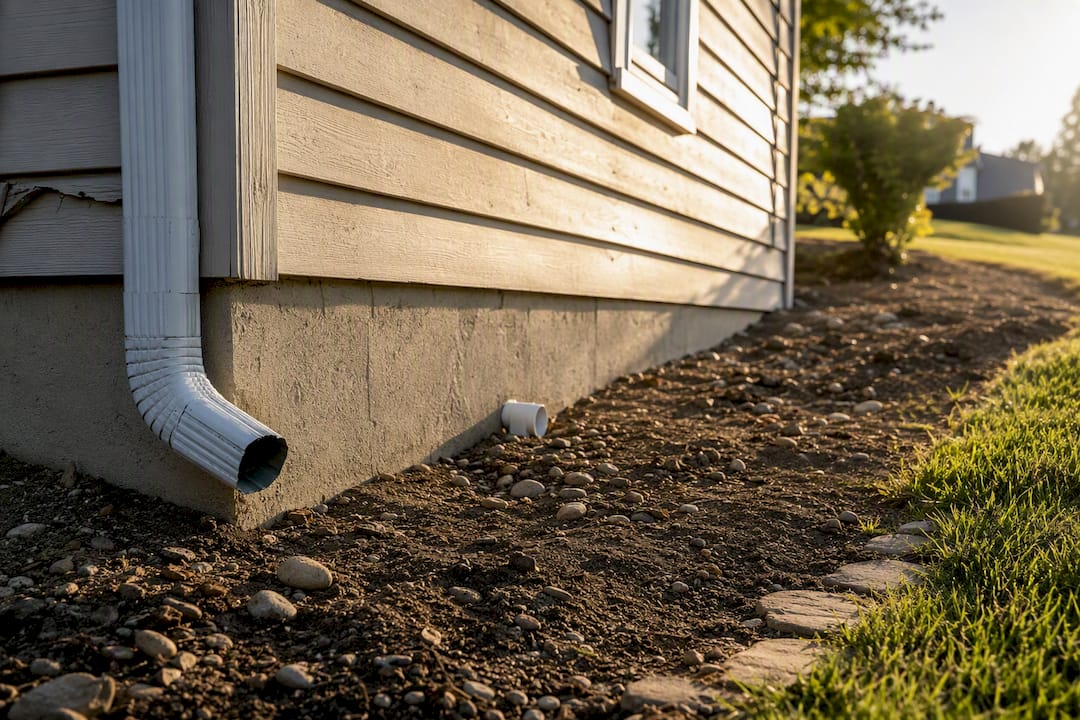
Start with drainage. Gutters that dump water right next to the foundation, grading that slopes toward the house instead of away from it, and a sump pump that hasn’t been checked in years are all quiet contributors to soil movement. Fixing these is inexpensive compared to structural repair, and it addresses one of the most consistent triggers behind both problems.
For builders and buyers evaluating new construction, proper soil compaction before a slab is poured matters enormously. Skipping or rushing this step is one of the most common reasons a newer home settles faster than an older one built on properly prepared ground.
For existing homes, routine inspection catches small problems while they’re still small. Walking your foundation every few months, checking crawl spaces for moisture, and watching how doors and windows behave after seasonal humidity shifts gives you an early warning system that costs nothing but attention. If you’re in karst-prone territory, factor that geology into how seriously you take an unexplained depression in the yard. It’s worth reviewing early foundation warning signs so you know what “normal” looks like on your specific property before something abnormal shows up.
A Contractor’s-Eye View: What Repair Actually Looks Like
Once an engineer identifies the cause, the fix depends entirely on what’s underground. Common approaches include soil stabilization, compaction grouting to fill voids, polyurethane foam injection for concrete leveling, helical or push piers for underpinning, and drainage correction to stop the problem from recurring. Crawl space remediation often enters the picture too, since moisture there frequently compounds settlement issues.
Foundation RESQ recommends an engineer-first approach on anything beyond routine settling, because a repair plan built without a real diagnosis is a guess dressed up as a fix. Our team coordinates directly with geotechnical findings so the repair method matches the actual cause, not just the visible symptom.
A professional quote should break down the diagnosis, the specific repair method, and the timeline, with financing options available for larger jobs. If you’re seeing warning signs and want a straight answer on which one you’re dealing with, schedule an inspection and get it confirmed instead of guessed at.
Sources
- USGS — What is a sinkhole?
- Transportation research: Common misconceptions about foundation movement
- This Old House — Foundation settling vs. foundation problems (2024)
- Florida Geological Survey — sinkhole information leaflet
FAQ
Is sinkhole insurance coverage worth it?
It depends heavily on your state and your property’s geology. If you live in karst-prone terrain, the added coverage can be worth the premium, but standard policies rarely cover normal settlement either way, so check your declarations page and ask your carrier directly.
What are the three types of sinkholes?
The main types are cover-collapse (sudden, little warning), cover-subsidence (slow, gradual sinking), and solution sinkholes (formed as bedrock dissolves at the surface over time), according to the Florida Geological Survey.
Who pays for sinkhole damage versus settlement damage?
Sinkhole claims typically go through homeowners insurance when the policy includes that coverage and an engineer’s report confirms the cause; normal settlement is usually treated as wear and tear and falls to the homeowner to repair.
How do you tell if a property has a sinkhole?
Look for a circular depression, sudden pooling in one spot, and leaning trees or fence posts, then confirm it with a professional geophysical survey and soil borings, since visual signs alone can’t reliably prove a void exists.
The gap between what people fear and what’s actually happening under their feet is almost always bigger than the crack in the wall suggests. Most calls that start with “I think I have a sinkhole” end with a much more boring diagnosis: soil compaction, a clogged gutter, or clay that swelled after a wet summer. That’s not a dismissal, it’s good news, because settlement is fixable in ways that don’t involve filling a hole with grout and hoping.
Where I’d push back on conventional advice is the instinct to wait and see. Homeowners treat “watch and wait” as the safe, cheap option, but the research on foundation movement consistently shows the opposite: documenting changes and getting an engineer out early protects both your safety and your insurance claim, while delay tends to let active movement get worse, not better. The crack you’re measuring with a pencil mark today is either going to stay put or it’s going to tell you something. Either way, you want that data before you talk to an adjuster, not after.
The other thing worth saying plainly: a contractor who skips the engineer’s report and jumps straight to a repair quote is guessing. The diagnosis is the expensive part to get wrong and the cheap part to get right.
— Kayle