
Sometimes a sticking door is a sign of foundation movement, but most of the time it’s humidity or worn hardware. The fastest way to tell the difference: check whether one door sticks seasonally or several doors stick year round, especially on one side of the house. If it’s the latter, run the checklist below before you touch a plane or a hinge, and if the pattern points to structural movement, schedule a professional inspection rather than repeating the same fix every spring.
TL;DR:
- Foundation settlement often causes corner-specific door binding, which results in uneven gaps or racked frames that do not respond to simple adjustments.
- Seasonal humidity swelling generally affects one side or edge of a door evenly, unlike foundation movement, which causes directional shifts and localized binding.
- Proper diagnosis involves measuring gaps, checking frame squareness, photographing changes over time, and assessing if multiple doors or signs like cracks accompany the issue.
- Temporary fixes such as hinge tightening or sanding may work for humidity-related swelling but do not resolve persistent foundation movement.
- A professional foundation inspection includes detailed measurements, elevation surveys, photo documentation, and tailored repair plans, which are essential for long-term stability.
Table of Contents
- Quick Diagnosis Checklist for a Door Sticking Foundation Problem
- Why Foundation Movement Makes Doors Stick, and How It Differs From Swelling
- Step-by-Step Tests to Document a Sticking Door
- Short-Term Fixes That Restore Door Function Now
- Permanent Foundation Repairs That Stop the Racking
- What a Professional Foundation Inspection Actually Includes
- A Measure-First Approach to Sticking Doors
- How a specialized foundation repair company handles inspection, repair, and financing
- Sources
- FAQ
Quick Diagnosis Checklist for a Door Sticking Foundation Problem
Before assuming the worst, or ignoring the door for another season, run through a few fast checks.
- Timing: does it stick only in humid months, or all year? A cheap hygrometer helps confirm whether swelling lines up with moisture spikes.
- Scope: one door, or several? Doors clustered on one side of the house point toward foundation movement indicators rather than a single warped slab.
- Gap shape: is the gap even all around, or wedge-shaped, wider at the top than the bottom (or vice versa)? A small, even gap around the door is normal; an uneven or tapered gap is a sign of trouble.
- Latch scrape: does the latch scrape a specific spot on the strike plate? That mark is a rough gauge of how far the frame has shifted.
- Floor slope: set a marble on the floor near the doorway. If it rolls consistently toward one wall, note the direction.
Pro Tip: Photograph each door with a date stamp and a tape measure in frame. A contractor can spot a trend in thirty seconds from six months of dated photos, but they can’t reconstruct history from memory.
Why Foundation Movement Makes Doors Stick, and How It Differs From Swelling
A door frame built as a rectangle can become distorted if the foundation settles unevenly, skewing the shape and causing binding. The door itself hasn’t changed size; the frame around it has skewed, so the door now binds against one corner instead of sitting square in the opening.
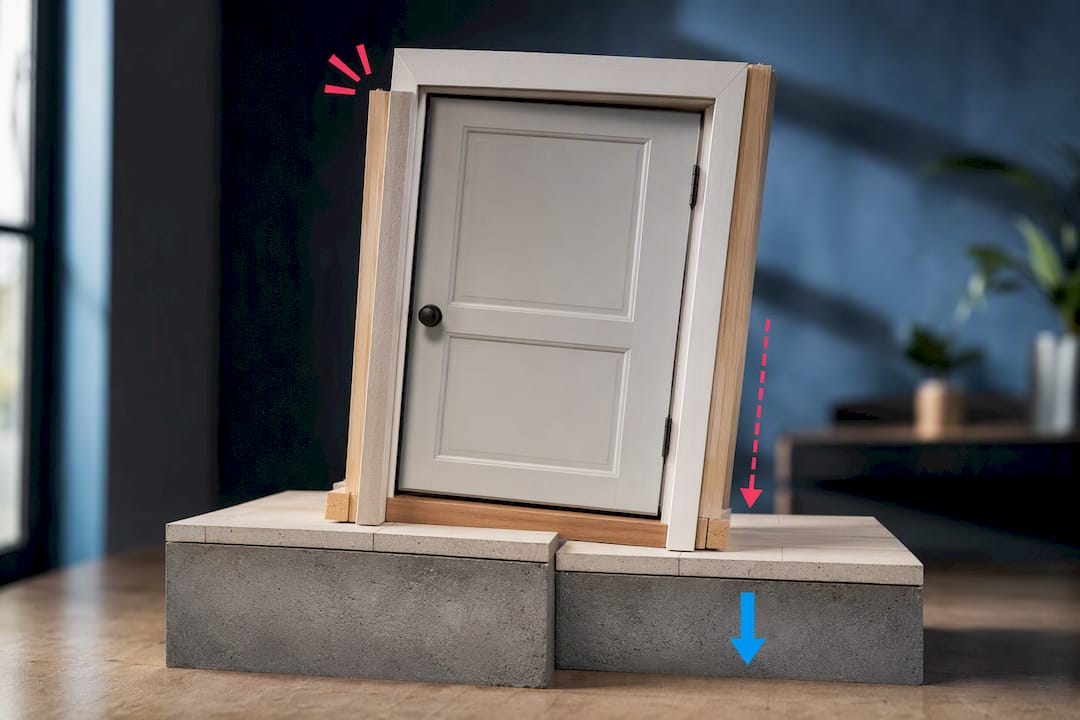
That’s the key mechanical difference from humidity swelling. Moisture makes wood expand more or less evenly along the edge that absorbs it, so the door drags evenly across the bottom or one long side. Foundation movement produces directional, corner-specific binding, and a racked frame from foundation or floor tilt usually shows the tightest point at a single top or bottom corner.
Settlement itself is usually driven by soil behavior underneath the footing:
- Expansive clay soil that swells when wet and shrinks when dry, pulling footings up and down with the seasons
- Drought conditions that dry out and shrink support soil, leaving footings under-supported
- Poor grading or gutter drainage that channels water against the foundation on one side
Companion signs worth checking alongside the door itself: diagonal cracks at frame corners, floors that visibly slope, and gaps opening up along baseboards or window trim.
Step-by-Step Tests to Document a Sticking Door
Run these in order and write down what you find. Evidence beats guessing, and it saves money if you eventually call a contractor.
- Photograph and date every affected door. Note the weather and approximate humidity that day.
- Measure the gap around the frame at four points: top, bottom, and both sides. A small and uniform gap is typical; a gap noticeably wider at one end than the other may indicate frame distortion rather than swelling.
- Check plumb with a level held against the vertical frame member. Then measure both diagonals of the door opening corner to corner with a tape measure. Equal diagonals mean the frame is still square; a difference of more than a small fraction of an inch suggests it has racked.
- Run the marble floor test in the same room and log which direction it rolls.
- Read the latch scrape on the strike plate to estimate roughly how far the frame has shifted.
- Repeat monthly for a season. If the gap or the latch mark keeps changing rather than staying stable, movement is likely progressive.
Contractors rely on far more precise versions of these same ideas. A proper elevation survey maps the exact high and low points across the floor, giving numbers instead of guesses about how much a wall has dropped. If your homemade measurements show change over two or three months, that’s the point to request one.
Short-Term Fixes That Restore Door Function Now
Several small adjustments fix a sticking door without touching the foundation, and they’re worth trying first if your checklist points toward hardware or humidity rather than structural movement.
- Tighten loose hinge screws, or replace them with longer screws that bite into the framing stud.
- Add a thin cardboard shim behind a hinge leaf to nudge the door’s position within the frame.
- Move the strike plate slightly if the latch is scraping rather than seating cleanly.
- Lubricate hinges with a light oil or graphite if the sticking is really just friction, not misalignment.
- Plane or sand a swollen edge, but only a small amount at a time, and only after ruling out settlement.
Pro Tip: Never plane a door twice for the same spot in the same year. If it swells back or binds again within months, that’s not a humidity problem repeating, it’s a foundation problem you planed around instead of solved.
These fixes work well for genuine seasonal swelling or loose hardware. If the underlying cause is settlement, the frame keeps racking and the same corner binds again, sometimes within a single season, because the wood you removed didn’t change what’s happening under the slab.
Permanent Foundation Repairs That Stop the Racking
When testing points to structural movement, temporary fixes become a cycle instead of a solution. A few established methods address the settlement itself:
- Push piers or helical piers get driven or screwed down to stable soil or bedrock beneath a settling footing, then used to lift and stabilize that section of foundation. Push piers work well where there’s enough structure weight to drive them; helical piers suit lighter loads or areas with less overhead weight to anchor against.
- Polyurethane injection or slab lifting targets localized settlement in a concrete slab, filling voids underneath and raising the slab back toward level without full excavation.
- Crawl space support, such as sister beams or adjustable jack posts, reinforces sagging floor framing from below, often paired with drainage corrections so the soil that caused the problem in the first place doesn’t repeat it.
- Grading and drainage fixes, extending downspouts and correcting slope away from the foundation, reduce the moisture swings in clay soil that drive seasonal settlement.
Stabilizing the underlying settlement usually stops further racking, and many doors and windows loosen up on their own once the structure holds still. That said, a frame that has racked significantly may need actual carpentry afterward, resquaring the jamb or patching trim, since lifting the structure doesn’t automatically un-warp wood that’s already distorted. Readers dealing with wall bowing alongside sticking doors should treat that as a related structural signal worth mentioning to whoever inspects the foundation.
What a Professional Foundation Inspection Actually Includes
A real inspection goes well beyond a walkthrough and a guess. Expect a technician to take detailed measurements at multiple points around the structure, run an elevation survey to map exactly where the foundation sits low, photograph visible damage indoors and out, and hand you a written report tying those findings to specific repair recommendations.
That documentation matters because it separates symptom fixes from root-cause stabilization. Anyone can plane a door; a report that shows the floor drops three-quarters of an inch across one corner tells you why the door keeps sticking and what fixing it actually requires.
- Measurements and elevation mapping of the affected area
- Photo documentation tied to specific rooms and dates
- A written report with recommended repair methods
- A discussion of timeline and, where financing is a factor, payment options for the work
| What you bring | What it speeds up |
|---|---|
| Dated photos of gaps and cracks | Faster confirmation of pattern and timeline |
| Marble test and latch scrape notes | Rough estimate of movement direction before the survey |
| List of which doors and rooms are affected | Faster targeting of which footings to check first |
Homeowners who show up with a season of notes and photos give the inspector a head start, and that head start often shortens the gap between the first visit and a firm repair plan.
A Measure-First Approach to Sticking Doors
Measure before you fix. A planed door that binds again in four months wastes money and time that a level, a tape measure, and a few dated photos would have saved. Call a professional once you see multiple doors sticking, a diagonal crack widening, or the problem getting worse season over season. Treat your first inspection report as a baseline, not a verdict; measuring again in a year tells you whether the ground under your house is still moving.
— Kayle
How a specialized foundation repair company handles inspection, repair, and financing
A specialized foundation repair company offers a direct route to an answer when your own checklist points toward settlement rather than swelling. Instead of guessing your way through another planing job, professional technicians measure the actual movement, map it with an elevation survey, and provide a written plan rather than a hunch.

A Foundation RESQ inspection covers the same ground your homemade checklist started: gap measurements, floor elevation, photo documentation, and a report that names the likely cause. From there, the services page breaks down which repair method, piers, slab leveling, or crawl space support, fits your specific settlement pattern, and the financing guide lays out payment options so a bigger repair doesn’t have to happen all at once. If your doors need resquaring or trim work once the structure is stable, that carpentry follow-up gets coordinated as part of the same project rather than left for you to chase down separately. Schedule an inspection and get the elevation numbers behind your door problem instead of another season of wondering.
Sources
FAQ
Do Sticking Doors Always Mean Foundation Problems?
No. Most sticking doors are caused by seasonal humidity swelling or loose hardware, and only the doors that stick year round, worsen progressively, or cluster on one side of the house typically point to foundation movement.
How Do I Fix a Door That Sticks at the Bottom?
Check the gap first; if it’s uniform and worse in humid months, light sanding or planing the bottom edge usually solves it, but if the gap is wedge-shaped, hold off on planing and check for foundation movement instead.
Why Would a Door Suddenly Start Sticking?
A sudden change often follows a wet or dry spell that shifted humidity or soil moisture fast, but a sudden stick paired with a new crack near the frame corner deserves a closer look rather than an assumption.
What’s the Best Way to Fix a Sticking Door for Good?
Tighten hinges, adjust the strike plate, or plane the edge for hardware and humidity causes; for door sticking foundation issues driven by settlement, the fix that actually holds is stabilizing the foundation itself, whether that means piers, slab leveling, or crawl space support, since carpentry alone just gets undone by the next round of movement.