
Tearing out a sunken pool deck is rarely the right solution for an uneven backyard. When property owners evaluate concrete lifting around pool Tallahassee options, they are usually trying to resolve sudden trip hazards before someone gets hurt or before shifting slabs damage buried plumbing lines. You already know the stress of watching guests navigate an uneven pool perimeter, especially with the lingering fear that broken coping stones or costly, messy demolition are just around the corner.
The good news is that you don’t have to rip up your concrete to reclaim a level, secure swimming area. This guide reveals how modern polyurethane concrete lifting eliminates hazardous trip ledges, safeguards delicate underground pipes, and restores safety around Tallahassee pools without invasive excavation. Below, we examine why Leon County soils trigger slab settlement and how high-density polymer injection stabilizes your deck against Florida’s heaviest downpours.
Key Takeaways
- Loose perimeter backfill and heavy Leon County rainfall create sub-slab voids that cause pool slabs to settle unevenly.
- Modern concrete lifting around pool Tallahassee backyards using lightweight PolyRenewal eliminates trip hazards without overloading fragile subsoils.
- Precision lifting protocols protect buried PVC plumbing, coping stones, and pool liners from differential shear stress.
- High-density polymer injection cures within 15 minutes through penny-sized access holes, returning your pool deck to service immediately.
- Long-term slab stabilization in North Florida requires closed-cell, water-resistant foam engineered to withstand saturated ground conditions.
Why Concrete Pool Decks Sink Around Tallahassee Pools
Swimming pool decks don’t sink by accident. They settle because the earth supporting them experiences structural movement that standard building practices cannot fully prevent. When homeowners explore options for concrete lifting around pool Tallahassee backyards, the root cause is almost always a collision between pool construction realities and North Florida’s unique soil hydrology. Understanding the mechanics behind slabjacking and concrete leveling methods begins with examining how the sub-slab base loses its load-bearing capacity.
The Pool Excavation and Backfill Reality
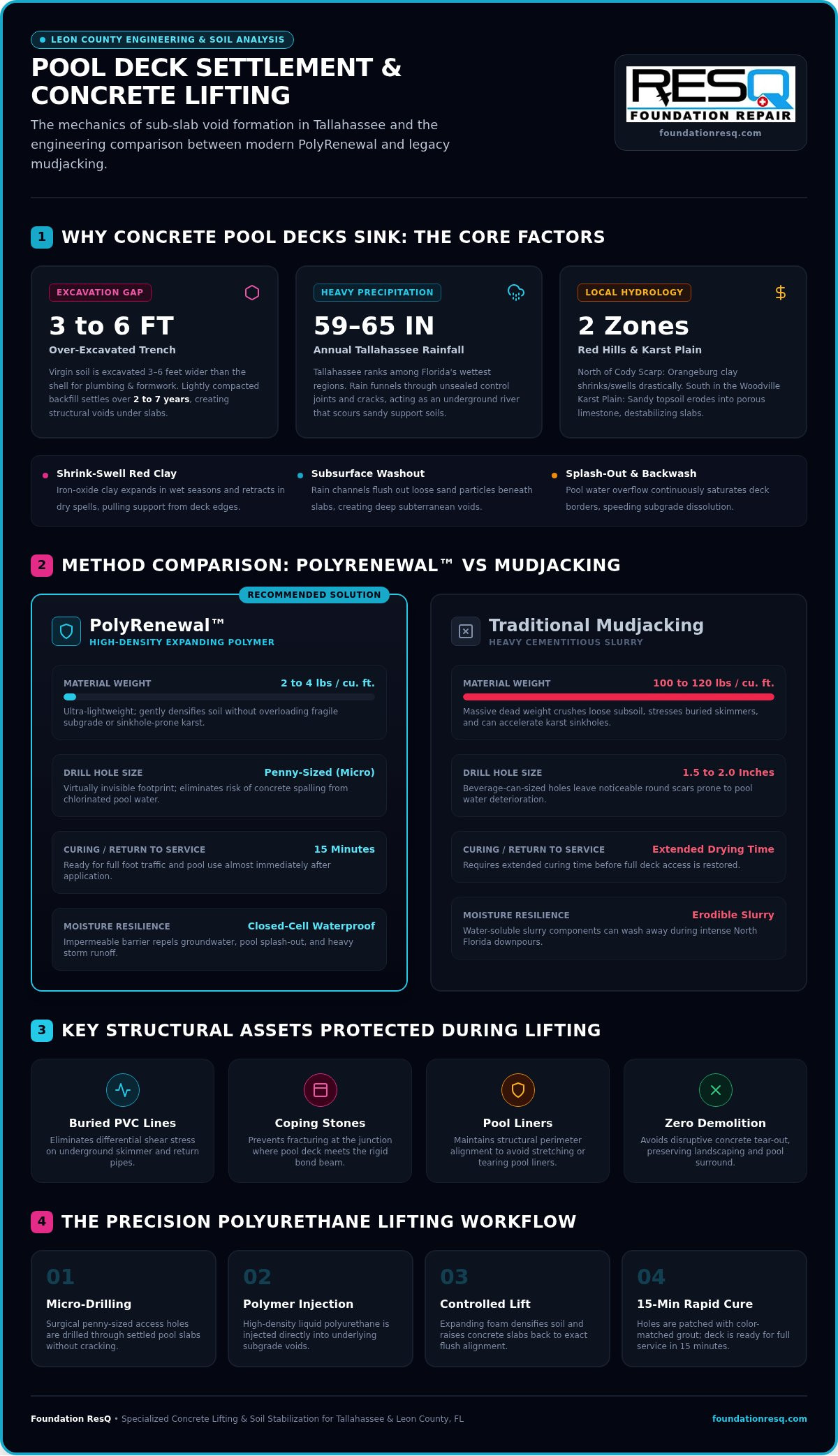
Installing an inground pool requires contractors to over-excavate virgin ground, digging a pit roughly three to six feet wider than the pool shell itself. This perimeter trench provides work space for structural forms, skimmers, and buried PVC plumbing. Once the pool shell cures, crews backfill the perimeter with excavated dirt.
Because heavy, vibrating compaction equipment can easily crush subterranean pool plumbing or fracture concrete pool walls, crews must pack this backfill lightly. This soil never matches the density of the surrounding, undisturbed earth. Over the next two to seven years, gravity and foot traffic consolidate these loose soil pockets. As the backfill settles, it pulls away from the pool’s rigid bond beam, leaving hidden voids directly beneath the perimeter slabs. Without solid support, the heavy concrete breaks along joint lines and drops.
Tallahassee Soil and Climate Factors
Leon County’s intense weather patterns accelerate this settlement. Tallahassee averages 59 to 65 inches of rainfall per year, ranking it among the wettest regions in Florida. When summer downpours strike, unsealed expansion joints and cracked control seams become funnels that direct water beneath the deck.
- Shrink-swell red clay: North of the Cody Scarp, the Red Hills region features Orangeburg fine sandy loam rich in iron-oxide clay. This clay swells drastically during heavy storms and shrinks during dry weeks, pulling supporting subgrade away from concrete edges.
- Subsurface washout: Water rushing beneath unsealed slabs acts like an underground river, flushing out loose sandy particles and scouring subterranean drainage channels.
- Splash-out and backwash runoff: Routine pool splash-out, coping overflow, and filter discharge continuously saturate the deck perimeter, dissolving weak subgrades and speeding up void expansion.
South toward the Woodville Karst Plain, thin sandy topsoils wash downward into porous limestone terrain just as readily. In both geological zones, this continuous void development eventually demands professional concrete lifting around pool Tallahassee homes to stabilize the subgrade before pipes shear or coping cracks.
Comparing Pool Deck Leveling Methods: PolyRenewal vs Mudjacking
Restoring a settled pool surround requires selecting an engineering method that addresses the underlying soil deficit without creating new structural hazards. For homeowners weighing concrete lifting around pool Tallahassee properties, the choice typically comes down to traditional cementitious mudjacking or modern polyurethane injection like PolyRenewal. Understanding how these materials behave over loose pool backfill is vital for preventing repeat settlement.
Weight, Structural Load, and Soil Capacity
Traditional mudjacking pumps a heavy mixture of water, soil, and cement beneath the deck. This wet slurry weighs between 100 and 120 pounds per cubic foot. When applied over backfilled trenches, that massive dead weight often crushes the fragile subgrade below and places dangerous downward force on buried skimmer lines. In areas near the Cody Scarp and Wakulla where limestone cavities exist, as detailed in the USGS guide on karst terrain and sinkholes, adding thousands of pounds of heavy grout can accelerate underground raveling.
PolyRenewal offers a stark contrast. The expanding structural foam weighs only 2 to 4 pounds per cubic foot. As it injects, it seeks out micro-voids, gently expanding to densify loose soil particles rather than overloading them. This closed-cell polymer forms an impermeable barrier beneath the slab that actively repels groundwater and pool splash-out.
Drill Hole Size and Aesthetic Impact
The physical footprint of the repair method plays a major role in preserving your deck’s appearance. Mudjacking relies on large injection nozzles that require drilling 1.5 to 2-inch holes, roughly the diameter of a beverage can, directly through your concrete. These large patches are difficult to disguise and frequently spall when exposed to chlorinated pool water.
PolyRenewal relies on surgical precision. Technicians drill penny-sized ports measuring just 5/8 of an inch. After injection, these small ports are filled with aggregate-matched sealant that blends seamlessly into textured cool decks, stamped patterns, or brushed surfaces, leaving almost no visible trace of the repair.
Cure Time and Pool Area Downtime
Mudjacking introduces substantial water beneath the slab, requiring 24 to 72 hours of curing before the surface can support normal weight. If an afternoon thunderstorm sweeps across Leon County during this window, the uncured slurry can easily wash away into your yard or pool.
Polyurethane structural foam cures through an exothermic chemical reaction rather than moisture evaporation. It reaches 90 percent of its compressive strength and supports full foot traffic in roughly 15 minutes. Families can step right back onto the concrete and enjoy their pool immediately after technicians finish the job. If you want a dependable, lasting solution that protects your plumbing, turn to Foundation ResQ for PolyRenewal concrete lifting designed specifically for local soil conditions.
The Step-by-Step Polyurethane Pool Deck Lifting Process
Remediating settled pool slabs demands an exact, methodical sequence. Because concrete slabs sit adjacent to rigid pool coping and fragile PVC lines, the repair requires high precision rather than brute force. Groundworks engineering standards guide modern concrete lifting around pool Tallahassee homes, turning a complex structural challenge into a tidy, non-invasive remediation. In fact, Bob Vila’s concrete leveling and mudjacking cost breakdown underscores how precision polymer injection preserves existing concrete far more reliably than legacy mudjacking slurries.
Inspection, Void Mapping, and Site Setup
Work begins with an exhaustive site evaluation. Technicians use precision optical laser levels to map elevation discrepancies across every pool deck slab. Before setting equipment, the crew maps the path of buried skimmer connections, water returns, and pool light conduit lines to avoid hidden utilities. Protective containment screens shield the pool water from concrete dust, keeping filtration equipment clean while technicians prepare the work zone.
Precision Injection and Slab Leveling
Technicians strategically drill penny-sized, 5/8-inch injection ports in an engineered grid across sunken slabs. Specialized mechanical equipment then injects two liquid components beneath the deck. As they mix, a rapid chemical reaction turns the liquid into high-density expanding foam.
- Subgrade consolidation: The expanding foam tracks along loose soil fissures, permeating uncompacted backfill and firming up weak ground.
- Controlled lift: Once underlying voids fill, the expanding foam creates gentle upward pressure. Technicians monitor laser receivers to lift slabs millimeter by millimeter until they sit flush with pool coping.
- Plumbing isolation: Because the material expands uniformly, it avoids concentrated point loads that could stress buried pool piping.
Sealing Joints Against Future Moisture Washout
Once leveling finishes, technicians extract the injection ports and patch each 5/8-inch hole with a UV-resistant, color-matched compound blended to the pool deck’s original texture. To ensure long-term stability against Tallahassee downpours, crews scrape away degraded wood or foam joint filler and install commercial elastomeric silicone along all perimeter expansion gaps. This dynamic water barrier stops pool splash-out and storm runoff from infiltrating the subgrade. Homeowners seeking full property protection beyond the pool can review concrete leveling in Tallahassee to address settling driveways, patios, and walkways with the same proven system.
Protecting Pool Coping, Plumbing, and Liners During Lifting
Lifting a dropped pool deck requires far more finesse than raising an isolated driveway slab. Concrete slabs surrounding swimming pools intersect with expensive plumbing systems, perimeter coping stones, and delicate pool shells. Executing concrete lifting around pool Tallahassee backyards demands specialized protocols that prevent collateral damage while realigning the walking surface. Uncontrolled movement risks snapping buried lines or dislodging decorative stone; precision geotechnical methods protect these vulnerable assets from start to finish.
Safeguarding Underground Plumbing and Skimmers
Differential settlement places intense downward shear stress on rigid PVC pipe fittings. As a deck drops, it pulls directly against skimmer assemblies and water return conduits, frequently cracking intake throats beneath the slab. Polyurethane lifting mitigates this hazard through controlled volumetric expansion rather than abrupt hydraulic pressure.
Before injection begins, technicians inspect clearance around skimmer boxes to ensure the concrete can move freely. The polymer injects as a low-viscosity liquid, flowing naturally around plumbing sleeves and electrical runs before gently expanding. This process cushions subterranean lines instead of pinching or crushing them against compacted subgrade.
Preventing Stress on Pool Coping and Tile Bands
The expansion joint between the pool coping and deck slab serves as a vital structural buffer. If dirt, debris, or old mastic binds the fallen slab tightly against coping pavers, raising the concrete can transfer lateral pressure directly into the pool’s bond beam. That unintended friction fractures expensive bullnose coping and pops waterline tiles off gunite walls.
- Joint scoring: Technicians clear out hardened debris or saw-cut frozen expansion joints before pumping begins, ensuring the deck lifts independently from the coping.
- Laser verification: Continuous elevation tracking monitors joint movement in millimeter increments to avoid uneven vertical thrust against the pool wall.
- Zero edge impact: By releasing the perimeter bond, the deck slides vertically upward without binding against fragile coping stones.
Vinyl Liner and Fiberglass Shell Considerations
Different pool structures require specialized physical precautions during alignment. On vinyl liner pools, sinking concrete tugs violently on perimeter liner receiver tracks, risking torn vinyl or dislodged bead locking. Fiberglass shells feature protruding structural top flanges that cannot tolerate uneven lateral pressure during remediation.
Precision polymer leveling gently relieves tension on liner extrusions and fiberglass lips, bringing concrete back to grade without transferring kinetic energy into the pool vessel itself. If you notice signs of widespread ground movement threatening your property, explore our approach to foundation repair Tallahassee solutions to secure your home from the ground up. To protect your pool structure and eliminate hazardous deck offsets, schedule an expert pool deck evaluation with Foundation ResQ today.
Choosing the Right Tallahassee Pool Deck Repair Contractor
Selecting a contractor for concrete lifting around pool Tallahassee homes requires vetting that goes far beyond checking general remodeling reviews. Because pool deck slabs interface directly with subterranean return lines, filtration plumbing, and structural shell edges, standard flatwork contractors lack the specialized geotechnical training needed for this delicate environment. Homeowners must verify that their chosen specialist understands local soil mechanics and uses materials engineered specifically for saturated soils.
Key Questions to Ask Concrete Contractors
Before allowing any drilling near your pool, ask prospective service providers detailed questions about their equipment, materials, and track record. Reliable contractors will answer directly and provide clear documentation.
- Plumbing precautions: What specific protocols do you use to map and protect skimmer throats and buried return lines prior to lifting?
- Material properties: Is your polymer closed-cell and hydrophobic, ensuring it won’t absorb groundwater or degrade under standing pool water?
- Local experience: Can you show recent examples of pool deck leveling completed within Leon County clay and sandy loam environments?
Warranty Coverage and Long-Term Value
A contractor’s warranty reveals their confidence in their sub-slab stabilization methods. Inquire whether their written guarantee covers future re-settlement and structural foam integrity. DIY injection kits and surface-applied self-leveling overlays regularly fail around swimming pools because they treat the cosmetic symptom rather than filling underlying voids. Working with Foundation ResQ provides peace of mind through proven Groundworks engineering standards, ensuring high-density PolyRenewal injections create permanent subgrade support that repels moisture.
Schedule Your Pool Deck Assessment
A professional on-site evaluation removes the guesswork from pool deck restoration. During an assessment, a specialist measures slab elevations with precision optical instruments, inspects control joints, and maps subterranean voids without tearing up your backyard. The non-invasive PolyRenewal process requires zero heavy excavation machinery, leaving your turf intact and allowing your family to return to the pool fifteen minutes after injection. Take the first step toward restoring a safe, level pool deck today: Book your free pool deck inspection with Foundation ResQ.
Reclaim a Safe, Stable Pool Deck for Your Tallahassee Home
Sunken concrete around your swimming pool doesn’t have to mean messy demolition or enduring dangerous trip hazards all season. Addressing sub-slab void formation early preserves buried plumbing runs, protects delicate coping pavers, and keeps guests safe. When you invest in modern concrete lifting around pool Tallahassee backyards, you get a clean, permanent remedy that stabilizes weak soil without placing heavy stress on fragile utility trenches.
Backed by rigorous Groundworks engineering standards, our locally experienced structural specialists know how to protect Leon County properties from seasonal washout. The entire PolyRenewal process relies on penny-sized injection ports that cure in just 15 minutes, meaning zero landscape disruption and immediate pool access. Take proactive control of your outdoor living space and restore your pool deck safety with Foundation ResQ today.
Frequently Asked Questions
How long does concrete lifting around a pool take to complete?
Most residential pool deck leveling projects take between two and four hours to complete. Technicians arrive, set up containment to protect pool water, drill penny-sized injection ports, and lift the slabs using optical laser guidance. Because there is no demolition or waiting on concrete delivery trucks, your backyard stays fully functional, and our crew typically wraps up the entire injection and joint caulking process in a single morning.
Can polyurethane foam lifting damage my buried pool plumbing lines?
High-density polyurethane foam does not damage underground plumbing when installed by experienced geotechnical technicians. The liquid polymer begins at low viscosity, flowing freely around buried PVC pipes and skimmer throats before expanding. Rather than creating concentrated pressure spikes or adding crushing dead weight like traditional mudjacking slurries, the expanding foam gently encases utility lines and cushions them against future ground settlement.
Will expanding foam wash away in heavy Tallahassee rainfall?
PolyRenewal uses closed-cell, hydrophobic structural foam that won’t wash away, dissolve, or break down during severe storms. When performing concrete lifting around pool Tallahassee properties, technicians rely on this water-resistant formula because it actively displaces groundwater during injection. Even with Leon County’s heavy annual rainfall, the cured polymer maintains its structural integrity and forms an impermeable underground barrier that stops future subsurface soil erosion.
Is concrete lifting around a pool cheaper than replacing the slab?
Polyurethane concrete lifting typically costs significantly less than total slab demolition and replacement, often saving homeowners between 50 and 75 percent. Repouring requires jackhammering old concrete, hauling away debris across your lawn, and risking collateral damage to perimeter coping and tile. Polymer injection preserves your existing concrete slabs, saves substantial peripheral restoration expenses, and eliminates expensive landscape repair bills entirely.
How soon can we swim after our pool deck is leveled?
You and your family can safely swim and walk across the deck roughly 15 minutes after the injection process finishes. PolyRenewal cures through a swift chemical reaction rather than moisture evaporation, reaching full load-bearing strength almost immediately. Technicians thoroughly clean the work area and vacuum any residual drilling dust before departing, leaving your pool area clean, safe, and ready for use that very afternoon.
Will lifting the concrete fix standing water puddles on my pool deck?
Yes, precision leveling directly eliminates low spots where splash-out and rainwater collect. Sinking slabs tilt backward toward pool edges or create depressions that trap water, creating slip hazards and staining concrete coatings. By using laser levels to adjust the elevation millimeter by millimeter, technicians restore the intentional pitch of the concrete, ensuring water drains naturally away from the coping and into appropriate yard runoff zones.
What happens if the soil settles again after polyurethane leveling?
While polyurethane expands to densify loose subgrade soils and prevent future void formation, choosing a certified contractor ensures lasting peace of mind. For concrete lifting around pool Tallahassee homes, Foundation ResQ backs its installations with robust structural warranties supported by Groundworks engineering standards. If secondary shifting occurs in adjacent uncompacted backfill, our team evaluates the subgrade and injects supplemental polymer to maintain a flush, stable grade.