
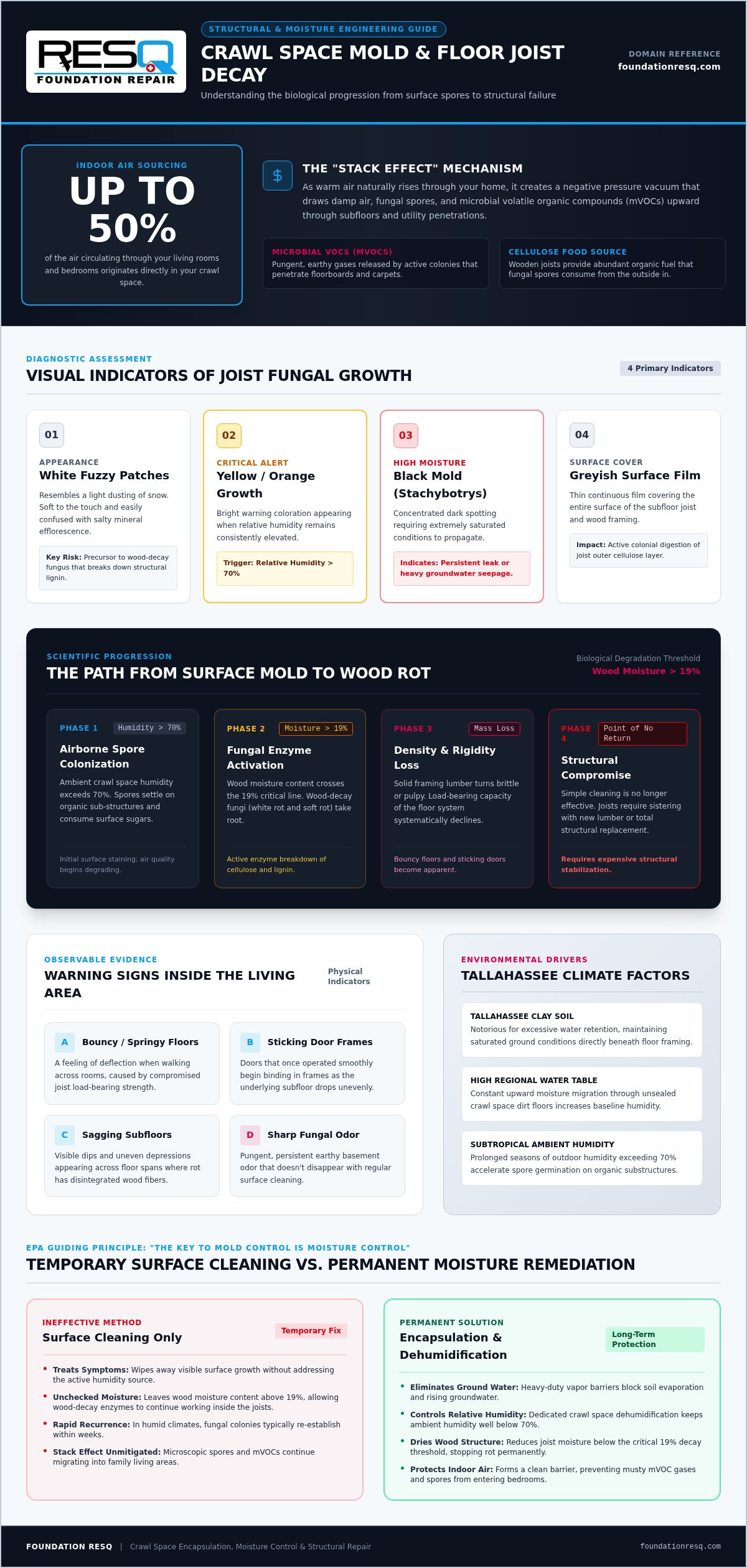
Did you know that up to 50% of the air circulating through your living rooms and bedrooms originates in your crawl space? When you discover mold growth on floor joists in crawl space areas, it’s more than just a hidden nuisance. It’s a direct threat to your family’s respiratory health and the physical integrity of your home. We understand the deep concern that comes with spotting dark spots or fuzzy growth on your support beams. You likely worry about your floors losing their stability or your children’s allergies flaring up, and the conflicting advice about cleaning versus encapsulation only adds to the stress.
You deserve a home that feels solid and safe. This guide will help you understand exactly why mold thrives in our humid Tallahassee climate, the specific structural risks involved, and how to permanently protect your property. We’ll examine the root causes of moisture, the dangers of wood rot, and the professional remedies that ensure better indoor air quality. By addressing the source of the problem rather than just the symptoms, you can achieve a stable, rot-free floor system that lasts for decades.
Key Takeaways
- Identify visual indicators of fungal growth like white fuzzy patches or dark spotting on your home’s wooden support structures.
- Understand how untreated mold transitions into wood rot, physically weakening the density and stability of your floor joists.
- Learn why Tallahassee’s unique humidity levels and high water table contribute to mold growth on floor joists in crawl space environments.
- Discover the difference between temporary surface cleaning and permanent remedies like professional crawl space encapsulation and dehumidification.
- Gain insights into how controlling crawl space moisture creates a protective barrier that improves indoor air quality for your entire family.
Identifying Mold Growth on Floor Joists
Mold isn’t just a stain on your wood; it’s a living fungal colony that thrives on the organic sub-structures of your home. In the dark, damp environment under your house, mold growth on floor joists in crawl space areas occurs because these beams are rich in cellulose. This organic material provides a constant food source for spores that have drifted in from the outside. When moisture levels remain high, these spores settle on the wood and begin to digest it from the outside in.
You can usually spot an infestation by looking for specific visual markers. It might appear as white, “fuzzy” patches that look like a light dusting of snow, or as concentrated black spotting. In some cases, a thin, greyish film covers the entire surface of the joist. Because of the “Stack Effect,” these colonies don’t stay isolated. As warm air rises through your home, it creates a vacuum that pulls air, and the microscopic spores within it, up through floorboards and utility penetrations. This means the health of your crawl space directly dictates the air quality in your bedrooms.
Common Types of Crawl Space Mold
Identifying the specific type of growth helps determine the severity of the moisture problem. White mold is frequently encountered in North Florida; it’s often confused with efflorescence, which is a salty mineral deposit. However, white mold is soft and fuzzy to the touch and has a clear affinity for damp wood. This process often paves the way for a more destructive Wood-decay fungus, which actively breaks down the lignin and cellulose that give your floors their strength.
- Black Mold (Stachybotrys): This variety requires extremely high moisture levels and often indicates a persistent leak or significant groundwater seepage.
- Yellow or Orange Growth: These bright colors serve as an early warning sign. They typically appear when relative humidity stays consistently above 70%, alerting you to a problem before structural damage begins.
The Musty Odor Warning Sign
If you notice a persistent “basement smell” in your Tallahassee home, it’s rarely just a sign of an old house. That distinct, earthy scent is caused by microbial volatile organic compounds (mVOCs) released by an active colony. These gases are small enough to bypass floorboards and carpets, filling your living space with a stale odor that doesn’t go away with cleaning. Identifying the difference between a harmless “old house smell” and active fungal growth is vital for protecting your home’s structural health. A true fungal odor is sharp and pungent, indicating that mold growth on floor joists in crawl space supports is currently expanding.
The Structural Impact: From Mold to Wood Rot
Many homeowners view mold as a purely cosmetic issue or a simple air quality concern. However, persistent mold growth on floor joists in crawl space areas is often the first stage of a serious structural decline. While surface mold consumes the sugars on the wood’s exterior, it creates a damp micro-environment that invites wood-decaying fungi to take root. These organisms are far more destructive than common mold, as they actively dismantle the internal skeleton of your home. As the U.S. Environmental Protection Agency points out, the key to mold control is moisture control, because without a water source, these fungi cannot survive.
Ignoring this growth leads to a loss of wood density that manifests in visible household problems. You might notice your floors feel bouncy or “springy” when you walk across the room. Doors that once swung freely may begin sticking in their frames, and you might see sagging sections in your subfloor. These aren’t just signs of an aging house; they’re indicators that your floor system’s load-bearing capacity is failing. Addressing the issue early prevents the need for expensive structural stabilization or total floor replacement later.
How Fungi Consume Wood Fibers
The biological process of decay is methodical. Fungi like “white rot” and “soft rot” produce enzymes that break down lignin and cellulose, the two primary components that give wood its strength and rigidity. When wood moisture content rises above 19%, it triggers this biological decay process, turning solid lumber into a brittle or pulpy material. Once the wood reaches a point of significant mass loss, it hits the point of no return. At this stage, simple cleaning is no longer an option, and the joist requires sistering with new lumber or complete replacement to ensure the home remains safe.
The Connection to Foundation Health
The moisture that fuels mold doesn’t just stay on the wood. It also affects the ground beneath your home. In our region, Tallahassee clay soil is notorious for retaining water, which can lead to soil saturation and shifting. When moisture levels are high enough to rot your joists, they’re often high enough to soften the soil supporting your footings. This creates a dual threat where both the wooden structure and the ground beneath it are compromised. If you’ve noticed cracks in your drywall alongside musty odors, you may need to consult a guide on Professional Foundation Repair in Tallahassee to address the root cause.
Protecting your home requires a remedy-based approach that looks at the whole ecosystem. If you suspect your support beams are softening, a professional assessment from Foundation ResQ can help you determine the best path toward permanent stabilization.
Why Mold Is Growing in Your Tallahassee Crawl Space
Understanding why mold growth on floor joists in crawl space areas is so prevalent in North Florida requires looking at our specific climate. In Tallahassee, relative humidity frequently exceeds 70%, which is the critical threshold where fungal spores begin to colonize organic materials. While some industry professionals in drier states might blame construction-era moisture, our local challenge is a constant battle against ambient humidity and groundwater seepage. The dense tree canopy and heavy summer rainfall in our region keep the soil around foundations perpetually damp.
Ground moisture is often compounded by slow plumbing leaks that go unnoticed in the dark, cramped environment. Because these spaces are rarely inspected, a small pinhole leak or a sweating pipe can saturate wooden beams for months. When moisture levels stay high, federal resources like FEMA provide guidance on Dealing with mold and mildew, emphasizing that porous materials like wood require immediate moisture control to prevent deep-seated structural rot. Without a dedicated drainage system or sump pump, standing water from Tallahassee’s frequent storms becomes a permanent reservoir for fungal growth.
The Myth of the Vented Crawl Space
For decades, building codes required vents to “air out” the area beneath a home. We now know this practice is counterproductive in the humid Southeast. When warm, moisture-laden Tallahassee air enters through a vent, it hits the cooler floor joists above. This temperature difference causes the air to reach its dew point, resulting in liquid condensation dripping directly onto the wood. This physical process effectively turns your crawl space into a greenhouse. Localized weather patterns make traditional venting obsolete, as they actually increase the moisture load rather than reducing it.
Inadequate Vapor Barriers
Many older homes in Leon County rely on a thin, 6-mil plastic sheet loosely spread across the dirt. This “builders grade” barrier is easily torn during utility repairs and offers little protection against rising soil gases. Over time, these thin sheets degrade, allowing moisture from the high water table to evaporate directly into the floor system. A professional-grade solution involves more than just a plastic sheet; it requires a remedy-based approach that creates a permanent, airtight seal. Without a robust barrier, mold growth on floor joists in crawl space environments is almost a statistical certainty in our region, as the earth constantly releases moisture into the structure above.
How to Stop Crawl Space Mold Permanently
Stopping mold growth on floor joists in crawl space environments requires more than a surface-level cleaning. Many homeowners turn to online forums that suggest spraying bleach or vinegar, but these methods often backfire. Bleach is primarily water-based; while it might change the color of the mold on the surface, the water penetrates the porous wood and actually feeds the fungal roots deeper inside. A professional remedy-based approach focuses on killing the colony at its source and then physically isolating the structure from the elements. This creates a permanent protective barrier that keeps your support beams dry and stable regardless of the weather outside.
The 4 Steps to a Dry Crawl Space
Our methodical process ensures that your home remains protected against the high water table and humidity of Leon County. We don’t just treat the symptoms; we re-engineer the environment to make fungal growth impossible.
- Step 1: Professional mold removal. We use industrial-grade antimicrobial agents that penetrate deep into the wood fibers to neutralize the colony without adding harmful moisture.
- Step 2: Vapor barrier installation. We install a heavy-duty, puncture-resistant liner that covers the floor and foundation walls, sealing out soil gases and moisture.
- Step 3: Water management. For homes prone to seepage, we integrate sump pump systems to direct groundwater away from the foundation footings.
- Step 4: Air conditioning. A specialized crawl space dehumidifier is non-negotiable in Florida to maintain relative humidity below 55% year-round.
Why Encapsulation is Worth the Investment
Choosing a permanent solution over a temporary fix offers significant long-term benefits. By sealing the crawl space, you reduce the HVAC load on the rooms above, leading to measurable energy savings. You also improve the indoor air quality for your family by preventing allergens and spores from entering the living space. A certified dry crawl space significantly protects the resale value of your Tallahassee property. Modern buyers and home inspectors look for these upgrades as proof of structural health and professional maintenance. If you are ready to secure your home’s future, schedule a professional crawl space evaluation with our team today.
Expert Mold Remediation and Prevention in Tallahassee
Addressing a damp subfloor requires deep knowledge of regional environmental factors. General contractors often overlook how the local water table interacts with residential structures, but our team approaches every home with localized expertise. When dealing with mold growth on floor joists in crawl space areas, we look beyond the visible fungus to analyze the surrounding soil, drainage patterns, and foundation stability. This comprehensive viewpoint ensures that the remedies we install act as a definitive final line of defense for your property.
When wood fibers have been softened by prolonged moisture exposure, simply killing the mold is insufficient. We combine our remediation protocols with structural stabilization techniques to reinforce sagging or compromised beams. This dual approach restores the structural integrity of your floor system while ensuring that the fungal colony cannot return. By pairing environmental control with physical reinforcement, we provide a complete resolution that keeps your home safe and level.
The Foundation ResQ Solution
Our company designs customized remediation and prevention plans that balance environmental control with structural integrity. We install high-performance crawl space dehumidifiers specifically engineered to handle the heavy moisture loads common to North Florida. These systems work in tandem with our heavy-duty liners to maintain a stable, unvented ecosystem beneath your living spaces. To learn more about our comprehensive engineering standards, view our detailed guide on structural integrity and moisture management.
- Customized Drainage: We integrate sump pumps and French drains to manage groundwater before it reaches your wooden framing.
- Climate-Specific Equipment: Our dehumidifiers are selected for their durability and efficiency in high-heat environments.
- Long-Term Warranties: We stand behind our stabilization and encapsulation work with robust warranties that offer true peace of mind.
Next Steps for Tallahassee Homeowners
If you have noticed soft spots in your flooring, a sudden increase in family allergy symptoms, or a sharp musty odor, you should not delay an inspection. These red flags indicate that moisture is actively weakening your home’s support system. During a professional crawl space evaluation, an expert will measure wood moisture content, map out water intrusion points, and provide a clear path toward permanent protection. Don’t leave your property’s safety to chance; Schedule your free crawl space inspection with Foundation ResQ today.
Securing Your Home’s Foundation for the Future
Addressing mold growth on floor joists in crawl space areas is a vital step in maintaining both the structural integrity and the indoor air quality of your property. As we have examined, temporary surface cleaning fails because it ignores the underlying moisture that drives wood rot. True protection requires a remedy-based approach that seals out Florida’s intense humidity and manages groundwater before it reaches your structural lumber. By transitioning from a traditional vented system to a modern encapsulated space, you create a permanent barrier against environmental decay.
As Tallahassee’s local crawl space experts and a proud member of the Groundworks network, Foundation ResQ provides comprehensive mold and moisture solutions tailored to our region’s unique climate challenges. We engineer systems that stabilize your floors, eliminate musty odors, and protect your family’s health for decades to come. You can take the first step toward a dry, stable home by scheduling a professional evaluation of your subfloor ecosystem today. Protect your home with a free crawl space inspection from Foundation ResQ and gain lasting peace of mind.
Frequently Asked Questions
Is mold on floor joists common in Tallahassee homes?
Mold growth on floor joists in crawl space areas is extremely common in Tallahassee due to the city’s high relative humidity and dense tree canopy. Our local climate keeps crawl spaces damp year-round, especially in older homes with traditional vents. The combination of heavy summer rainfall and Tallahassee clay soil creates a persistent moisture reservoir. Many homeowners discover fungal growth during routine plumbing repairs or home inspections.
Can I just spray bleach on the mold to kill it?
You should avoid using bleach on wooden floor joists. While bleach can kill surface mold on non-porous materials like tile, it doesn’t penetrate the fibers of organic wood. The chlorine stays on the surface, while the water in the bleach solution soaks into the joist, potentially feeding the fungal roots deeper inside. Professional mold remediation uses specialized antimicrobial agents designed to neutralize the colony without introducing harmful moisture.
How much does it cost to remove mold from a crawl space?
The cost of remediation varies significantly based on the square footage of your home and the severity of the infestation. Factors such as the accessibility of the space, the extent of the growth, and whether structural repairs are needed all influence the final investment. Because every crawl space in Leon County has a unique moisture profile, we recommend a professional inspection to receive an accurate assessment tailored to your property.
Will mold on my joists make my family sick?
Mold spores in your crawl space can impact your family’s health through a process called the stack effect. Air from beneath your home naturally rises into your living rooms and bedrooms, carrying microscopic spores and microbial volatile organic compounds with it. This exposure often triggers allergic reactions, sneezing, or respiratory irritation in sensitive individuals. Maintaining a dry, mold-free environment is a critical step in ensuring long-term indoor air quality.
How do I know if the mold has turned into wood rot?
You can distinguish between mold and wood rot by checking the density of the support beams. Mold is typically a surface-level growth that looks fuzzy or spotted, but wood rot actively breaks down the lignin and cellulose within the timber. If you can easily press a screwdriver into the wood or if the joists appear crumbly and brittle, the fungal growth has transitioned into structural decay. This stage requires immediate stabilization.
Does crawl space encapsulation really prevent mold forever?
Crawl space encapsulation is a highly effective long-term solution when paired with a dedicated dehumidifier. By sealing out external humidity and soil gases, you remove the moisture that mold needs to survive. While the barrier itself is permanent, the system requires occasional maintenance of the dehumidifier and sump pump to ensure the environment remains conditioned. This remedy-based approach provides the most reliable protection against mold growth on floor joists in crawl space environments.
Can I still use my crawl space for storage after encapsulation?
An encapsulated crawl space is much better suited for storage than a traditional vented one. Because the area is sealed with a heavy-duty vapor barrier and the air is conditioned, it becomes a clean, dry environment similar to a finished basement. This prevents your stored items from developing musty odors or moisture damage. You should simply ensure that stored items don’t puncture the liner or block the airflow to your dehumidifier or drainage components.
What is the difference between white mold and efflorescence on walls?
White mold and efflorescence look similar but have different origins. Efflorescence is a salty mineral deposit that forms on brick or concrete walls when water evaporates, leaving behind a white, crystalline powder. It’s not alive and doesn’t grow on wood. White mold is a living fungus that thrives on organic materials like floor joists. If the white substance looks fuzzy or grows on wooden beams, it’s likely mold rather than a mineral deposit.