
More ventilation isn’t always the answer to a damp crawl space. In humid weather, outside air can add moisture rather than dry the area. Learning how to keep humidity out of crawl space starts with identifying where the moisture comes from. It may rise from the ground, enter with outdoor air, collect through condensation, or get in because of drainage problems or water intrusion.
If you’re concerned about mold, wood damage, or musty odors, it’s reasonable to want a dependable fix. The right approach depends on the source. A dehumidifier, improved drainage, ventilation changes, and encapsulation each address different conditions. Treating symptoms without addressing the cause can leave humidity problems unresolved.
This guide explains how to spot common moisture clues and compare practical control methods, including what each can and can’t do. You’ll also learn what to monitor after making changes and when persistent dampness, visible water, or signs of damage may warrant an expert assessment. Once you understand the likely source, you can choose steps for your crawl space without relying on a one-size-fits-all solution.
Key Takeaways
- Look for condensation, musty odors, damp surfaces, and standing water. Consider humidity readings alongside what you observe.
- Trace moisture to its likely source before choosing a solution. Drying the space alone won’t resolve active water intrusion or drainage problems.
- Learn how to keep humidity out of crawl space by matching controls to the cause, from managing ground vapor to considering a dehumidifier or encapsulation.
- Follow a practical sequence: inspect conditions, measure humidity, address water entry, and reassess the results.
- Full encapsulation isn’t necessary for every humid crawl space. Use assessment findings to decide whether monitoring, targeted measures, or professional help makes sense.
How to Tell Whether Crawl Space Humidity Is a Problem
Crawl space humidity is the amount of moisture in the air beneath a home. A hygrometer reading can help you identify a pattern, but one measurement isn’t a diagnosis. Weather, ventilation, and wet materials all affect what the number means. A crawl space is the low area between the ground and the first floor, and its conditions can reflect moisture from inside and outside the home.
In Tallahassee, humid outdoor air may contribute to damp conditions, especially when it enters a cooler crawl space. Ground moisture and poor drainage can also be factors. Look at the space as a whole rather than assuming that one humidity reading points to one cause.
What signs suggest humidity is lingering below the house?
Notice whether dampness keeps returning or appears alongside other clues. Condensation on pipes or other surfaces, persistently damp soil or materials, and a musty odor can all justify further investigation. Visible growth is another reason to take a closer look, but odor or appearance alone can’t identify the moisture source or confirm what a substance is.
A brief change after a shift in weather may not mean the space has a lasting moisture problem. Persistent condensation or surfaces that remain damp deserve more attention, particularly if you also see standing water. Don’t disturb suspected mold, and don’t enter a space that’s unsafe, contaminated, or restricted. If water is present or conditions make inspection risky, seek qualified help.
How can you measure crawl space humidity?
Relative humidity is the amount of water vapor in the air compared with the maximum that air can hold at the same temperature. A hygrometer measures relative humidity. Place the device where it can provide a representative reading, follow its instructions, and record readings over time instead of relying on a single snapshot.
Compare the readings with what you can safely observe. Is there condensation, a damp surface, or standing water? Note whether conditions change with outdoor weather or across seasons. A number without that context can’t tell you whether humid air, ground moisture, or water entry is driving the problem.
There isn’t a single reading in this guide that can determine whether your crawl space needs a particular repair. To understand how to keep humidity out of crawl space, first look for recurring signs and record conditions over time. That evidence can help guide the next step: checking likely moisture sources before choosing a control method.
What Causes Crawl Space Humidity, and Why Source Control Comes First
High humidity can have more than one source, and the right response depends on what’s adding moisture. Water vapor can rise from exposed soil. A plumbing leak can wet a limited area, while rainwater may enter through openings or collect in low spots. Humid outdoor air can also contribute when it reaches cooler surfaces beneath the house.
Effective crawl space humidity control begins by identifying and managing moisture sources, not just drying the air. A dehumidifier may reduce airborne moisture, but it won’t repair a leak or stop rainwater from entering. If the source remains, moisture can return and the equipment may have to work against an ongoing problem.
How do ground moisture and rainwater enter a crawl space?
Exposed soil releases moisture into the air, while rainwater can seep through openings or collect in lower areas. Outside, roof runoff that lands near the foundation, ground that slopes toward the home, or poor drainage can contribute to wet conditions below the floor.
Look for patterns after rainfall and note where water or dampness appears, but don’t enter an unsafe or restricted area. If you can safely see signs of a plumbing leak, avoid disturbing the area and arrange for a qualified professional to investigate and repair it. Drying nearby surfaces without fixing the leak won’t address its cause.
Can humid outdoor air make the crawl space wetter?
Yes, under the right conditions. Warm, moisture-laden air can cool when it enters a crawl space. As it cools, moisture may collect on cooler surfaces such as pipes or other materials. That means open vents don’t automatically dry the space. Ventilation may help in some conditions, but its effect depends on the outdoor air and the conditions inside the crawl space.
This matters for Tallahassee homeowners, where humid outdoor air may be part of the moisture picture. It shouldn’t be treated as the only possible cause. Check for ground vapor, plumbing leaks, and rainwater entry as well. A surface that feels damp after a humid day could have a different source than standing water after a storm, and each calls for a different response.
If you’re deciding how to keep humidity out of crawl space, trace the moisture before choosing a fix. Record where and when dampness appears, and whether it follows rain or changes in outdoor conditions. That history can help narrow the next step. Once the likely source is clearer, a proportionate plan may include targeted moisture controls. Crawl space encapsulation and dehumidifier options are among the services Foundation ResQ offers in Tallahassee.
Crawl Space Humidity Solutions Compared: Ventilation, Dehumidifiers, and Encapsulation
No single method addresses every moisture source. A dehumidifier manages moisture in the air, while a ground vapor barrier limits moisture rising from exposed soil. Drainage work addresses water around or entering the crawl space. Choosing how to keep humidity out of crawl space starts with matching the control to the cause, then considering how different methods may work together.
| Method | What it addresses | Limitations and maintenance |
|---|---|---|
| Ventilation adjustments | Air exchange, when outdoor and crawl space conditions make it useful. | Humid outdoor air may add moisture instead of removing it. Don’t open or seal vents as a stand-alone fix. Check applicable building requirements before changing ventilation or enclosure details. |
| Ground vapor barrier | Moisture vapor rising from exposed soil. | It won’t repair plumbing leaks or stop exterior water entry. Check for damage or gaps that may reduce its effectiveness. |
| Dehumidifier | Moisture in crawl space air. | It can’t fix leaks or correct drainage problems. Suitable sizing, a way to manage collected water, and routine upkeep matter. |
| Drainage improvements | Rainwater that collects near the home or enters low areas. | They don’t directly control ground vapor or humidity in the air. Recheck conditions after rainfall to see whether water still gathers or enters. |
| Encapsulation | A coordinated approach that can combine a ground vapor barrier, sealed vents and air leaks, insulation, and a dehumidifier. | It involves more than laying plastic over soil. The right components and ongoing checks depend on the crawl space and its moisture sources. |
When can ventilation help, and when can it add moisture?
Ventilation outcomes depend on outdoor humidity, temperature, and the crawl space setup. Air exchange may help under some conditions, but warm, humid air entering a cooler space can leave moisture on surfaces. Neither opening nor sealing vents is a universal fix. Before changing the enclosure or ventilation, verify the building requirements that apply to your home.
What do a vapor barrier, dehumidifier, and encapsulation each do?
A barrier over exposed soil targets ground vapor. A dehumidifier removes moisture from the air, but only addresses that part of the problem. Encapsulation brings several controls together, which can be useful when moisture has multiple pathways. Results depend on the home’s conditions and the quality of the installation, so no system should be treated as a guaranteed match for every crawl space.
For more detail on the coordinated approach, look for a crawl space encapsulation guide covering how barriers, sealing, and humidity management work together. Start by identifying the source, then compare options and their upkeep needs. If conditions call for an assessment, Foundation ResQ serves Tallahassee homeowners with crawl space encapsulation and crawl space dehumidifier installations.
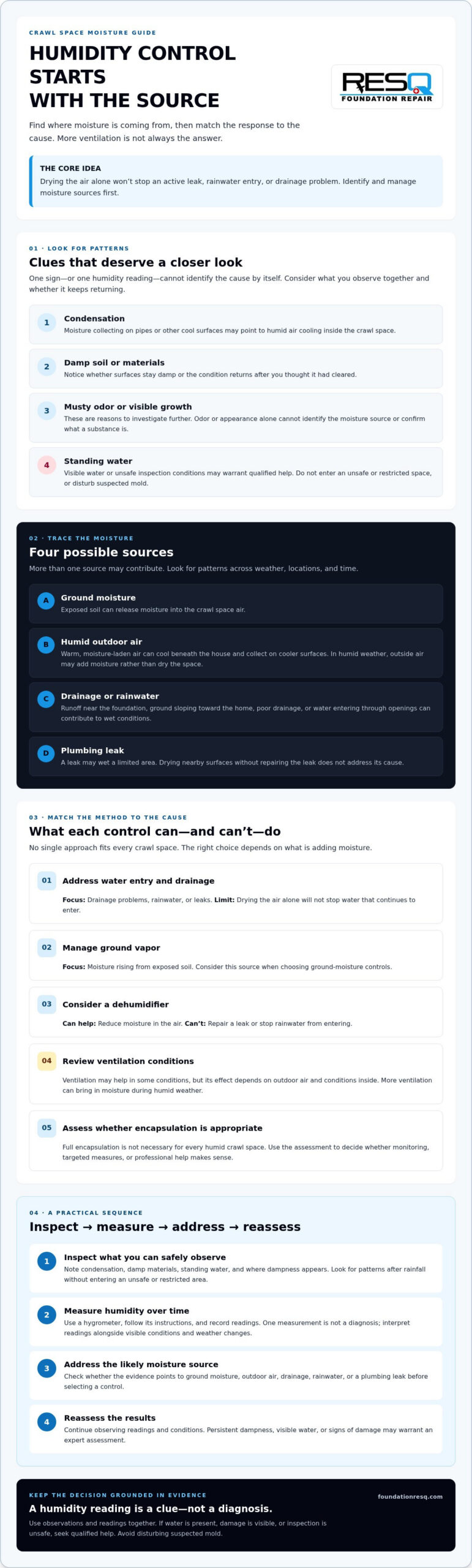
How to Keep Humidity Out of Crawl Space: A Practical Step-by-Step Plan
A methodical check can help you distinguish a humidity pattern from an active water problem. The goal is to document what’s happening, address the likely source, and then see whether conditions improve.
- Observe what you can safely access. Look for damp surfaces, standing water, damaged or displaced vapor barriers, and unusual odors. Don’t enter an unsafe or restricted area, approach exposed wiring, touch contaminated water, or disturb suspected mold.
- Measure and keep a log. Use a hygrometer according to its instructions. Record readings with the date, recent weather, and any visible changes. A series of observations is more useful than one measurement.
- Look for patterns that point to a source. Note whether moisture appears after rain, near plumbing, or across exposed soil. Keep observations factual. A log can help a qualified professional understand when and where conditions change.
- Address water entry before relying on drying alone. If you suspect a plumbing leak, recurring rainwater intrusion, or drainage issue, arrange for qualified evaluation and repair. A dehumidifier may manage air moisture, but it won’t resolve an active leak or water entry.
- Reassess and maintain. Compare new readings and observations with your baseline. Check conditions after heavy rain, and periodically inspect installed moisture-control equipment according to its instructions. If dampness returns, revisit the suspected source rather than assuming the first measure solved it.
Observe, measure, trace the source, address water entry, then reassess and monitor. This sequence keeps the focus on the cause while helping you judge whether the chosen control is working.
When should you call a crawl space professional?
Seek an assessment if water keeps returning, dampness persists, you see suspected mold, or wood appears deteriorated for no clear reason. A professional can evaluate how drainage, ground vapor control, and dehumidification may interact, then recommend an approach based on the conditions rather than assuming one fix fits every space. For more rain-focused guidance, see how to keep a crawl space dry during Florida rains.
If you’re in Tallahassee and need help evaluating moisture-control options, contact Foundation ResQ about crawl space moisture control. An assessment can help clarify whether the space calls for targeted humidity management, encapsulation, or further attention to water entry.
When Professional Crawl Space Moisture Control Is the Lasting Next Step
A humid crawl space doesn’t automatically need full encapsulation. If the cause is a specific water-entry issue, addressing that source may be the priority. If moisture is coming from several pathways, a combination of controls may make more sense. Match the work to the conditions instead of choosing the most extensive system by default.
For Tallahassee homeowners, professional input can help clarify whether the concern is ground moisture, rainwater, damp air, or a combination. Foundation ResQ provides crawl space encapsulation, sump pump systems, and crawl space dehumidifier installations. Which option may fit depends on what’s found in the space.
How can an assessment match the solution to the moisture source?
An assessment can consider signs of water entry, exposed ground and existing barriers, drainage conditions, and air moisture. Those findings help determine whether the priority is controlling water, limiting ground vapor, managing humidity with a dehumidifier, or combining measures. No particular system should be treated as necessary without evaluating the property and its specific conditions.
This distinction matters because a dehumidifier manages moisture in the air, while a sump pump system addresses water collection, and encapsulation provides a coordinated approach to crawl space moisture control. The right plan should explain how each recommended measure relates to an identified condition.
What should you ask before choosing a moisture-control plan?
Ask the evaluator to explain the findings clearly. A practical discussion should cover the source of moisture, what the proposed work is intended to address, and what it won’t resolve. Also ask what maintenance the equipment or system may need, how you can monitor conditions afterward, and what signs would indicate that moisture is returning.
These questions help you compare recommendations and understand the reasoning behind them. If you’re weighing how to keep humidity out of crawl space, look for a plan that connects each step to a specific source rather than relying on one product to solve every moisture issue.
Tallahassee homeowners who want to discuss their crawl space moisture concerns can request a crawl space moisture assessment from Foundation ResQ. A measured conversation about the conditions can help you consider suitable options, from dehumidification to encapsulation, without assuming every home needs the same solution.
Build a More Reliable Plan for Your Crawl Space
Lasting humidity control starts with finding the source. Ground moisture, water entry, and humid outdoor air can call for different responses, so a single reading or one-size-fits-all fix may miss the cause. Track conditions over time, address water entry, and reassess before deciding what else the space needs.
That’s the practical approach to how to keep humidity out of crawl space: match moisture controls to the conditions, then monitor the results. Not every damp crawl space requires full encapsulation, but recurring water, persistent dampness, or visible damage may call for an expert assessment.
Foundation ResQ serves homeowners in Tallahassee with crawl space encapsulation, sump pump systems, and crawl space dehumidifier installations. If you’d like help considering which options may suit your crawl space, talk with Foundation ResQ about crawl space moisture control. A clear assessment can help you decide on a next step for your home.
Frequently Asked Questions
Can opening crawl space vents increase humidity?
Yes. Opening crawl space vents can increase humidity when warm, humid outdoor air enters and cools against surfaces inside. Ventilation’s effect depends on outdoor conditions, temperature differences, and how the home’s crawl space is configured, so vents shouldn’t automatically be opened or closed. Check local building requirements before changing vents or enclosure details. If humidity persists, have a qualified professional assess the space and likely moisture sources before making changes.
What is the best way to lower humidity in a crawl space?
There isn’t one best method for every home. A reliable plan for how to keep humidity out of crawl space starts by identifying and addressing water entry, drainage problems, or moisture rising from exposed soil. Depending on conditions, a ground vapor barrier, a properly selected dehumidifier, or a broader encapsulation plan may help. The right combination depends on what you observe. If dampness keeps returning, a professional assessment can guide the next step.
Does a crawl space dehumidifier remove the source of moisture?
No. A crawl space dehumidifier reduces moisture in the air, but it doesn’t repair a plumbing leak, redirect rainwater, or stop ground vapor by itself. It may be one part of a broader moisture-control plan after sources are addressed. The unit needs suitable sizing, a reliable way to drain collected condensate, and routine maintenance. If water keeps returning, investigate and address its source rather than relying on equipment alone.
Should I put a vapor barrier over the dirt in my crawl space?
A ground vapor barrier can help limit moisture rising from exposed soil, but it won’t necessarily resolve plumbing leaks, poor exterior drainage, or every source of damp air. Its material, coverage, and installation details should fit the space and existing conditions. Before selecting a barrier or deciding how it should be installed, assess where moisture is coming from and check applicable local requirements. A barrier is one control, not a universal fix.
How can I tell whether crawl space humidity is causing mold?
Musty odors, visible growth, and damp materials can signal a moisture problem, but they don’t prove that humidity caused mold or identify the source. Treat these signs as a reason to investigate. Don’t disturb suspected growth or enter an unsafe, contaminated, or restricted crawl space. Addressing moisture sources is important, and a qualified professional can evaluate growth that’s extensive, recurring, or difficult to reach and advise on appropriate next steps.
When should I call a professional about crawl space humidity?
Call a professional if water repeatedly enters, dampness persists despite basic checks, or you notice visible mold, wood deterioration, or drainage concerns. An assessment can help distinguish moisture sources and match controls to the conditions, without assuming every home needs encapsulation. Foundation ResQ serves Tallahassee homeowners with crawl space encapsulation, sump pump systems, and crawl space dehumidifier installations. Discussing the findings can help you understand which options may be appropriate for your space.