
Most foundation corner pops are cosmetic, wedge-shaped spalls rather than signs of structural failure, but they still deserve a quick look. Measure the crack, snap dated photos, and watch it for a few weeks. If it widens, keeps reopening, or shows up alongside doors that stick or floors that slope, call a licensed professional. If repair is needed, your options run from a small surface patch to a full structural fix.
TL;DR:
- Measure the widest point, photograph it with a ruler, and mark its tip; recheck every four to six weeks and after major storms.
- Cracks up to roughly 1/8 inch are often cosmetic; widening, repeated reopening, sticking doors, sloped floors, or horizontal and step cracks warrant professional evaluation.
- DIY patching suits shallow spalls up to about 5 by 5 inches and 1 inch deep, but exposed rebar needs rust treatment first.
- Most homeowners policies exclude gradual settling, and the national average foundation repair cost is about $5,175, though actual costs depend on repair type.
Table of Contents
- What a corner pop looks like and where it shows up
- Common causes and contributing factors
- How to tell cosmetic damage from structural distress
- DIY and temporary repairs: safe actions and common pitfalls
- How contractors diagnose and repair corner pops
- Inspection checklist, timeline, and what repairs typically cost
- What years of foundation inspections have taught me
- Get a free inspection from a local foundation repair company
- FAQ
- Sources
What a corner pop looks like and where it shows up
A corner pop is a small, wedge-shaped section of concrete that breaks away from a corner or edge, usually leaving a rough, triangular void with the point aimed inward. They form at stress points where concrete is thinnest and least supported, which is why they cluster in predictable spots.
- Exterior slab edges, especially where a driveway or patio meets a foundation wall
- Garage corners, where vehicle traffic and temperature swings add stress
- The junction where a foundation wall meets a slab or stem wall
Corner pops are easy to mistake for something worse, so it helps to know what they are not. A horizontal crack running along a basement wall suggests lateral soil pressure, not a surface spall. A step crack, which zigzags along mortar joints in a block or brick wall, points to differential settlement somewhere in the footing. Shear failures, where concrete displaces out of plane, signal active structural movement. A corner pop, by contrast, is typically shallow, localized, and limited to the outer inch or two of concrete, which is one reason structural engineers and inspection guides treat it as a lower-priority finding compared to cracks that run through a wall’s full thickness.
Common causes and contributing factors
Corner pops rarely trace back to one single problem. They tend to result from a mix of soil behavior, material stress, and how the concrete was placed originally.
Expansive clay soils swell when wet and shrink when dry, and that repeated cycle pushes and pulls at foundation edges over years. In regions with freeze and thaw cycles, water that seeps into tiny surface cracks expands as it freezes, prying concrete apart from the inside. Brick veneer resting against a foundation corner can also concentrate load in one spot, especially if the veneer was installed without enough of a gap for thermal movement.
- Expansive clay soil that swells and contracts with seasonal moisture changes
- Brick veneer or masonry pressing against a corner with no expansion joint
- Freeze and thaw cycles that force water into hairline surface cracks
- Construction defects such as poor concrete consolidation, weak corner forming, or insufficient cover over rebar
- Localized impacts (a dropped tool, a bumped vehicle) or corrosion of embedded steel that expands and cracks the surrounding concrete
Corrosion deserves a closer look because it is progressive. Once rebar near a corner starts rusting, the rust occupies more volume than the original steel, and that expansion cracks and eventually pops the concrete covering it. That is a different repair job than a simple weather-driven spall, since the steel itself needs treatment before any patch goes on.
How to tell cosmetic damage from structural distress
Crack width is a reasonable starting point but not the whole story. Hairline cracks and anything up to roughly 1/8 inch are commonly treated as cosmetic, while cracks approaching or exceeding 1/4 inch warrant closer attention, according to foundation damage assessment guidance. What matters more than a single measurement is whether the crack is active: a hairline crack that keeps widening is more concerning than a 1/4 inch crack that has stayed the same size for a decade. You can read more detail on this distinction in our guide to telling if a foundation crack is structural.
Watch for these signals alongside the crack itself:
- Doors or windows that newly stick, bind, or no longer latch properly
- Step cracks forming in brick or block mortar joints near the same corner
- Horizontal cracks anywhere on a foundation wall
- Floors that feel sloped or show a visible dip when you set a level on them
- A crack that reopens every season, particularly after heavy rain or a dry spell
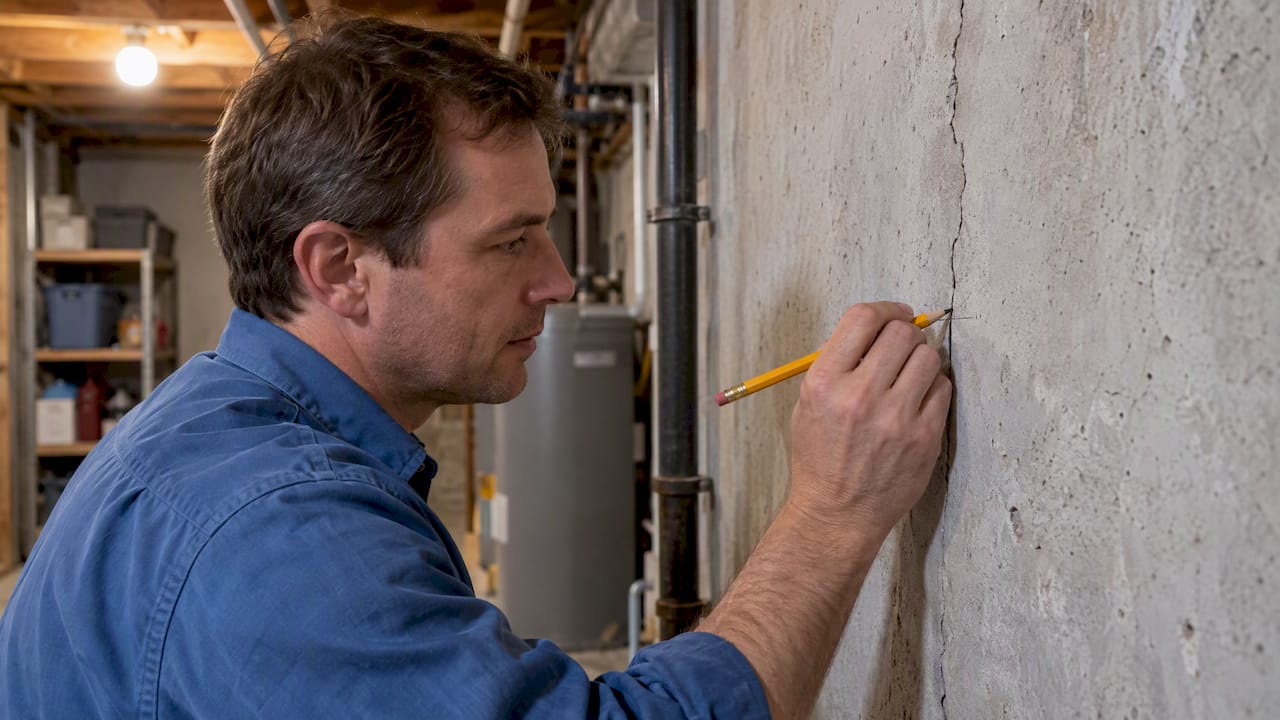
A simple monitoring routine catches changes early. Take a dated photo with a ruler or coin for scale, measure the width at its widest point, and mark the crack’s tip with a pencil line so you can see if it extends. Check again every four to six weeks, or sooner after a major storm.
Pro Tip: Write the measurement date directly on the wall near the crack in pencil. It is a low-tech way to see progression at a glance without digging through old photos.
A foundation contractor can usually evaluate a corner pop and recommend a patch. A licensed structural engineer becomes the better call when you see step cracks, horizontal cracks, or any sign of movement beyond the corner itself, since an engineer can assess load paths and footing condition that a repair crew is not equipped to certify. For smaller, very early cracks under 1/16 inch, our hairline crack checklist walks through what to track before anyone needs to be called at all.
DIY and temporary repairs: safe actions and common pitfalls
Before touching a corner pop, address anything feeding moisture into it. Clear gutters and downspouts so water is not pooling at the foundation edge, since poor drainage is one of the most common hidden contributors to repeat spalling. Sagging or clogged gutters often push water directly down a foundation wall, and Five Star Aluminum’s guide to failing gutters covers the signs that yours need attention. Clear away loose, crumbling concrete by hand so you can see the full extent of the damage, then document it with photos before any patch work begins.
Small, shallow spalls are reasonable DIY territory. Manufacturer guidance for polymer-modified structural repair products describes chipping away unsound concrete, coating any exposed rebar with a rust inhibitor, and filling the cavity with a high-strength hydraulic cement or polymer-modified patch. Surface patches around 5 inches by 5 inches and up to an inch deep are commonly handled this way, with some rapid-set products ready for light use in under an hour.
- Clear debris and expose sound concrete before applying any patch material
- Treat exposed rebar with a rust-inhibiting coating before patching over it
- Use a product rated for the patch size and depth, not a general-purpose filler
- Avoid feather-edging high-strength patch material into a thin, fragile tip
Most homeowners insurance policies exclude gradual foundation settling, expansion, and shrinkage from coverage, according to Progressive’s guidance on foundation repair coverage. That makes documentation your best protection: dated photos and measurements can matter later if a claim or dispute ever comes up, even though they rarely guarantee approval on their own.
The main pitfall with DIY patches is treating the symptom instead of the cause. A patch over a corrosion-driven pop will fail again once the rust resumes expanding underneath it, and a patch applied while water is still draining into the crack rarely holds through a full season.
How contractors diagnose and repair corner pops
Professional repair starts with the same surface prep a careful homeowner would do: removing unsound concrete back to a solid edge, treating exposed rebar, and selecting a patch material suited to the depth and exposure. For small spalls, that often means a high-strength hydraulic cement or a two-part product such as ARDEX ARDIFIX. It is a rigid polyurethane and epoxy compound specified for filling pop-outs and recessed repairs with a fast return to service.
When a crack is active or wider than a hairline, patching alone will not hold. Epoxy injection, done to ASTM C881 bonding standards, can restore structural bond in a crack that is not actively moving, while grout injection or underpinning comes into play when the underlying footing itself needs support. Epoxy products are explicitly limited to surface patches of a certain size and are not intended for cracks that are still moving, per Quikrete’s epoxy concrete repair data sheet, which is why diagnosing movement correctly matters more than picking the right tube of filler.
- Surface prep: remove unsound concrete, square the edges, treat exposed steel
- Small spalls: hydraulic cement or polymer-modified patch, often same-day
- Active or wide cracks: epoxy or polyurethane injection following ASTM-grade materials
- Settlement-related slabs: polyurethane foam lifting or traditional mudjacking
| Repair type | Typical material | Best suited for |
|---|---|---|
| Surface patch | Hydraulic cement, polymer-modified concrete | Small, shallow corner pops under 1 inch deep |
| Crack injection | Epoxy or polyurethane resin | Hairline to moderate cracks that are not actively moving |
| Slab lifting | Polyurethane foam or mudjacking | Settled slabs, uneven garage floors, sunken walkways |
| Structural stabilization | Underpinning, piers | Footing movement or ongoing settlement |
Polyurethane foam leveling has become a common choice over traditional mudjacking because it is lighter and cures fast, though both aim to restore a slab to grade rather than fix what is happening underground. A pro worth hiring will often recommend fixing drainage or soil conditions alongside any patch, since a repair that ignores standing water or persistent moisture tends to need redoing. We offer inspections and financing options to help make the evaluation step easy to schedule.
Inspection checklist, timeline, and what repairs typically cost
A thorough inspection looks well beyond the crack itself. Expect a contractor or engineer to check crack width and geometry, look for any displacement across the crack, test whether doors and windows operate normally, check floor elevations with a level or laser, and trace nearby moisture sources like downspouts, grading, or plumbing leaks.
- Crack width, direction, and whether it is consistent or tapering
- Vertical or horizontal displacement across the crack face
- Door and window operation throughout the affected area
- Floor elevation readings across multiple rooms
- Moisture sources: gutters, grading, plumbing, and crawl space humidity
Beyond a visual walkthrough, diagnostics can include a floor elevation survey, a soil probe to check compaction and moisture near the footing, moisture mapping with a meter, and in more serious cases a written engineer’s report. Most inspections can happen within a few days of a call, with a written estimate following shortly after; actual repair scheduling depends on the scope of work and material lead times.
Costs vary widely by repair type. National cost data shows the average foundation repair lands around $5,175, with a wide range depending on the type of work involved, according to aggregate foundation repair cost research. A cosmetic corner patch sits at the low end of that range, slab lifting falls in the middle, and structural stabilization or underpinning accounts for the higher end. Our breakdown of foundation crack repair costs covers these ranges by repair type in more detail. As noted earlier, insurance typically will not cover gradual settlement, so understanding these ranges upfront helps you plan rather than assume a claim will cover the work.
What years of foundation inspections have taught me
Most of the corner pops I have looked at over the years turn out to be exactly what they look like: a cosmetic spall from freeze and thaw, veneer pressure, or a dropped tool, not a sign the house is failing. The ones that worry me are never about width alone. They are the ones that keep changing, or that show up next to a sticking door or a crack running somewhere it has no business being.
A proper inspection should never feel like a sales pitch. If a contractor is pushing a full underpinning job before measuring anything or asking about your drainage, that is a signal to get a second opinion. My advice stays the same in nearly every case: document what you see, get water moving away from the foundation, and bring in a professional evaluation the moment anything about the crack changes.
— Kayle
Get a free inspection from a local foundation repair company
If you have found a corner pop and want a straight answer instead of a guess, inspections across the service area are available. A team evaluates the crack, checks for red flags, and lays out what, if anything, needs repair, whether that is a small patch, a crack injection, or a slab leveling job.

We handle the full range of related issues in one visit when needed: foundation repair, crawl space remediation, concrete lifting and leveling, and basement waterproofing.
- A technician measures the crack, checks for displacement, and reviews drainage around the affected corner
- You get a written assessment and, if repair is needed, options at different price points
- Financing is available for larger jobs, with details in our financing guide
Our case studies page shows how past jobs were diagnosed and resolved, useful context if you want to see what a repair actually looks like before scheduling your own inspection.
FAQ
Is foundation corner pop normal?
Corner pops are a common form of surface spalling and are usually cosmetic, caused by freeze-thaw cycles, veneer pressure, or minor construction defects rather than structural failure. They become a concern only when the crack is actively widening or appears alongside other warning signs like sticking doors or sloped floors.
How do you fix a foundation corner pop?
Small, shallow corner pops are typically repaired by removing loose concrete, treating any exposed rebar with a rust inhibitor, and filling the area with a hydraulic cement or polymer-modified patch. Wider or actively moving cracks usually need epoxy or polyurethane injection instead of a simple surface patch.
What is the best crack filler for a basement floor?
For hairline to moderate basement floor cracks, two-part epoxy or polyurethane products formulated for concrete repair, such as those meeting ASTM C881 standards, are commonly used because they bond well and cure quickly. Active or widening cracks should be evaluated before filling, since a filler alone will not stop ongoing movement.
Can you live in a house with a cracked foundation?
Many homes with minor, stable foundation cracks remain safe to live in, since the vast majority of foundation cracks are cosmetic rather than an immediate safety issue. A crack that is widening, paired with doors that stick or floors that slope, should be evaluated by a professional before you assume it is safe to ignore.
How much does foundation crack repair typically cost?
Costs vary by repair type, with the national average foundation repair landing around $5,175, according to foundation repair cost research. A small cosmetic patch costs far less than slab lifting or structural underpinning, and most homeowners insurance will not cover gradual settlement-related damage.
Sources
- QUIKRETE product guidance / polymer-modified structural repair
- InspectApedia — Foundation damage assessment
- RapidEye — Foundation repair cost and damage statistics (2026)
- ARDEX ARDIFIX specification