
Crawl space encapsulation is defined as the process of sealing a crawl space with a continuous vapor barrier, insulation, and active moisture control to protect your home’s structure and air quality. What does crawl space encapsulation cost? The national average sits around $5,500, with prices ranging from $1,500 for basic vapor barrier installs up to $15,000 or more for full systems that include drainage, dehumidification, and vent sealing. Labor drives the majority of that cost. Labor accounts for 50–70% of total project expenses because crawl space work is physically demanding and time-consuming. Understanding what you are paying for is the first step toward making a sound investment in your home.
What factors influence crawl space encapsulation prices?
Crawl space size is the single biggest driver of encapsulation cost. A 500-square-foot crawl space costs far less to seal than a 2,000-square-foot one, simply because more material and more labor hours are required. Most contractors price projects by the square foot, so getting an accurate measurement before requesting bids saves time and prevents surprises.
The scope of work matters just as much as size. A basic liner installation involves laying a plastic sheet on the ground with minimal sealing. A full encapsulation system adds wall coverage, rim-joist insulation, sealed vents, a drainage system, and a commercial-grade dehumidifier. Each layer of protection adds cost, but also adds long-term value.
Access difficulty is a factor most homeowners overlook. Crawl spaces under 30 inches of clearance increase labor costs by 40–60% because workers must drag materials through tight spaces and spend more time on every task. Difficult soil conditions and long carry distances from the access point to the work area also push prices up.
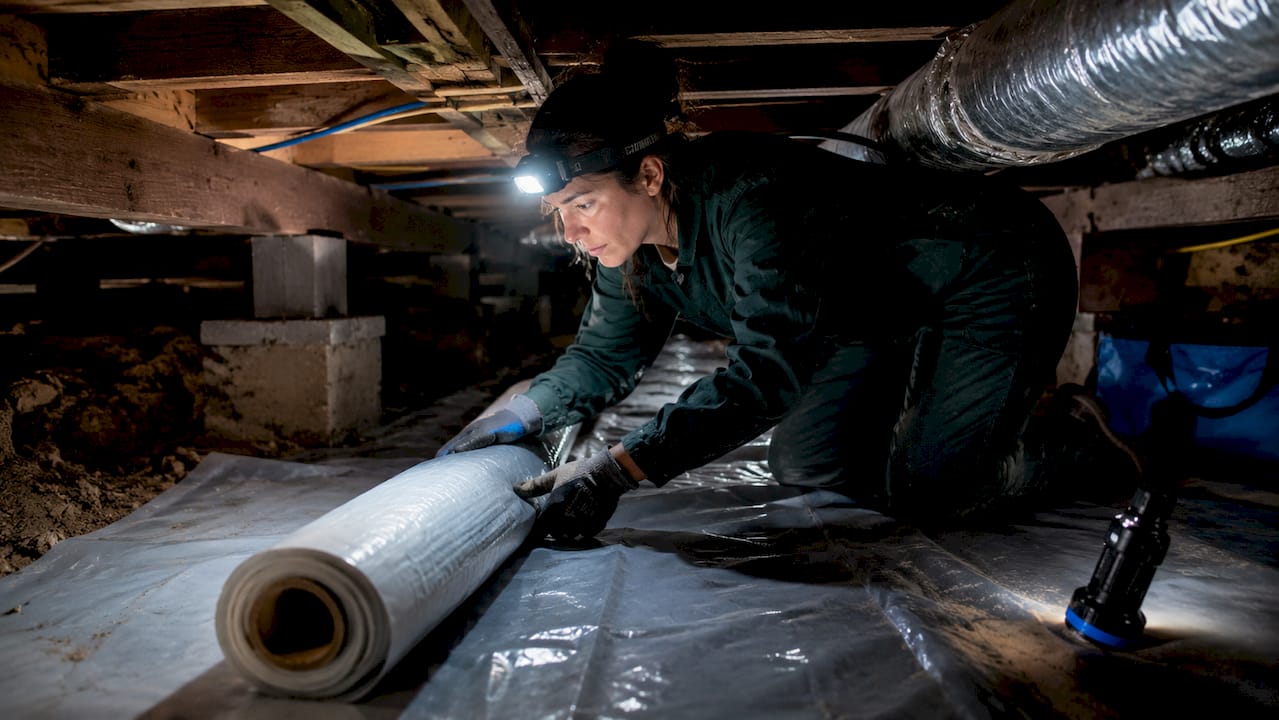
Pre-existing conditions add to the bill before encapsulation even begins. Mold, standing water, damaged insulation, or rotted wood must all be addressed first. Standing water and active leaks must be fully remediated before encapsulation, or moisture problems will worsen under the sealed barrier. Skipping this step is one of the most expensive mistakes homeowners make.
Here is a summary of the main cost factors:
- Crawl space square footage: Larger spaces require more material and labor hours.
- Project scope: Basic liner vs. full system with drainage and dehumidification.
- Access difficulty: Low clearance or complex entry adds 40–60% to labor costs.
- Material quality: Vapor barrier thickness ranges from 6-mil to 20-mil, affecting both durability and price.
- Pre-existing damage: Mold remediation, water intrusion repairs, and sump pump installation all add to the total.
- Regional labor rates and permits: Costs vary by location, and permit fees can apply depending on your jurisdiction.
Pro Tip: Get at least three itemized bids before committing. Ask each contractor to specify the vapor barrier thickness, whether vents will be sealed, and whether a dehumidifier is included. Bids that look similar on price can differ dramatically in scope.
How much do the individual cost components add up?
Labor is the largest line item in any encapsulation project. Labor represents 50–70% of total costs because installers work in confined, physically demanding conditions. Material costs, by contrast, typically represent only 10–20% of the budget.
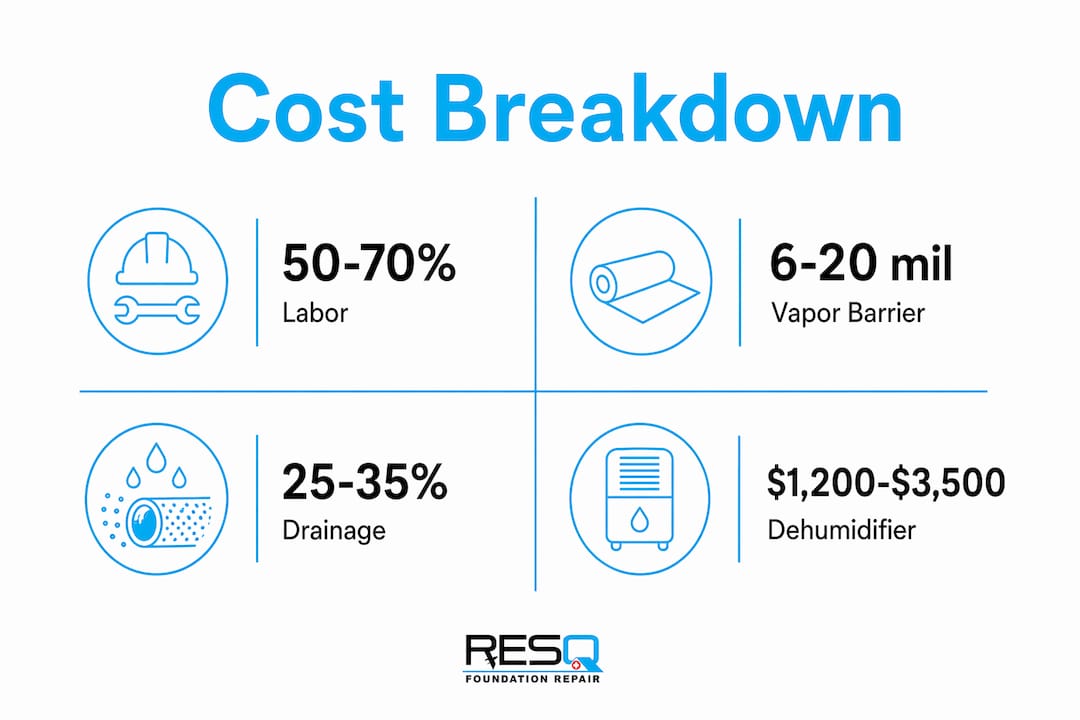
Vapor barrier materials are priced by thickness and quality. Barrier thickness ranges from 6-mil to 20-mil, with raw material costs running roughly $0.15 to $0.80 per square foot. A professionally installed liner with labor included costs approximately $0.50 to $1.25 per square foot. Thicker barriers resist punctures better and last longer, making them worth the premium for most homeowners.
Drainage systems and sump pumps are a significant add-on. Drainage and sump pump installation adds 25–35% to the overall project budget when water intrusion is present. This is not optional if your crawl space has a history of water pooling. Skipping drainage and sealing over a wet space creates a trapped moisture problem that accelerates wood rot and mold growth.
Dehumidifiers are another major cost component in full encapsulation systems. Commercial-grade units cost $1,200 to $3,500 installed, depending on the unit’s capacity and the complexity of installation. A residential dehumidifier is not an adequate substitute. Undersized equipment is one of the most common reasons DIY encapsulation fails.
| Project type | Approximate cost range | What is typically included |
|---|---|---|
| Basic vapor barrier only | $1,500–$4,000 | Ground liner, minimal sealing |
| Mid-level encapsulation | $4,000–$8,000 | Wall coverage, vent sealing, basic dehumidifier |
| Full encapsulation system | $8,000–$15,000+ | Drainage, sump pump, commercial dehumidifier, rim-joist insulation |
Permit and inspection fees apply in many jurisdictions. Permits typically cost between $0 and $300 depending on your local authority. Factor this into your budget from the start, since some contractors do not include permit fees in their initial quotes.
Pro Tip: Ask your contractor whether the dehumidifier included in their quote is a commercial-grade unit rated for crawl spaces or a standard residential model. The difference in performance and longevity is significant.
Basic vapor barrier vs. full crawl space encapsulation: what is the difference?
A basic vapor barrier installation is not the same as full encapsulation. Many homeowners confuse the two, and that confusion leads to underspending on a problem that does not go away. A basic liner covers only the ground, leaving walls, vents, and rim joists exposed to outside air and moisture.
Full encapsulation seals all crawl space vents and penetrations, unlike a basic vapor barrier. A complete system includes a heavy-duty ground liner, wall coverage, sealed foundation vents, rim-joist insulation, and active dehumidification. This full system significantly reduces mold risk and HVAC strain, which translates to lower energy bills and better indoor air quality throughout the home.
The cost difference reflects the scope difference. Basic vapor barrier jobs run $1,500–$4,000. Full encapsulation systems with dehumidifiers and drainage regularly exceed $15,000 for larger or more complex spaces. The gap is wide, but so is the gap in long-term performance.
DIY encapsulation is a common source of expensive mistakes. DIY encapsulation frequently fails because homeowners underestimate dehumidifier requirements and leave gaps in the sealing. A partially sealed crawl space can trap moisture against wood framing, accelerating the exact damage you were trying to prevent. Professional installation is strongly recommended for any project beyond a simple ground liner in a dry, accessible space.
Key differences between the two approaches:
- Ground coverage only vs. full envelope: Basic liners cover the floor. Full encapsulation covers walls, vents, and rim joists.
- Passive vs. active moisture control: A liner slows vapor migration. A dehumidifier actively removes moisture from the air.
- Temporary vs. permanent protection: Liners degrade and shift. A sealed, conditioned crawl space creates a permanent moisture barrier as part of the building envelope.
- Cost vs. value: Spending $2,000 on a liner that fails in five years costs more over time than a $7,000 system that lasts decades.
How to budget and plan for crawl space encapsulation costs
Start with a thorough inspection before you request any bids. A professional assessment identifies pre-existing moisture damage, mold, or structural issues that must be resolved before encapsulation. Skipping this step means your bids will not reflect the true scope of work, and you will face unexpected costs mid-project.
Request multiple itemized bids with clear scope definitions. A bid that lists only a total price tells you nothing about what you are getting. Ask each contractor to specify the vapor barrier thickness, whether wall coverage is included, what dehumidifier model they plan to install, and whether drainage is part of the scope. This makes bids comparable and reveals quality differences that a single number hides.
Budget for hidden costs from the start. Mold remediation, crawl space repair costs, and water intrusion fixes are common additions that are not always visible during an initial walkthrough. Setting aside 15–20% of your estimated project cost as a contingency is a practical approach.
Think about the long-term return. Professional encapsulation can save $3,000–$8,000 in future mold remediation and structural repair costs. Typical projects pay back over 6–10 years through energy savings and avoided repairs. For homeowners planning to sell, a properly encapsulated crawl space is a documented improvement that supports home value.
Steps to plan your encapsulation budget:
- Schedule a professional inspection to identify pre-existing moisture, mold, or structural damage.
- Collect three or more itemized bids that specify materials, scope, and equipment.
- Add a contingency buffer of 15–20% for hidden conditions discovered during installation.
- Evaluate financing options if the full system cost exceeds your immediate budget.
- Confirm permit requirements with your local building department before work begins.
Pro Tip: If you are planning other home improvements like HVAC replacement or insulation upgrades, timing encapsulation alongside those projects can reduce overall costs. Contractors already on-site for related work sometimes offer better pricing for combined scopes.
Key Takeaways
Full crawl space encapsulation costs more than a basic vapor barrier but delivers lasting moisture control, energy savings, and structural protection that a ground liner alone cannot provide.
| Point | Details |
|---|---|
| National average cost | The average encapsulation project costs around $5,500, with a range of $1,500–$15,000+ depending on scope. |
| Labor is the biggest expense | Labor accounts for 50–70% of total cost due to the physical difficulty of crawl space work. |
| Scope determines value | Full encapsulation with dehumidification and drainage outperforms basic vapor barriers for long-term protection. |
| Pre-existing damage adds cost | Mold, standing water, and structural issues must be fixed before encapsulation or problems will worsen. |
| ROI is real | Professional encapsulation can prevent $3,000–$8,000 in future repairs and pays back over 6–10 years. |
What I have learned about crawl space encapsulation costs after years in the field
The number that surprises homeowners most is not the total price. It is how much of that price is labor. When you get a quote for $7,000 and the materials only cost $1,200, it feels wrong. But crawl spaces are brutal to work in. Low clearance, wet soil, and tight access points turn a straightforward installation into a full-day physical ordeal. That labor cost is earned.
The second thing I have seen trip up homeowners is the assumption that a vapor barrier is encapsulation. It is not. A liner on the ground slows moisture migration from the soil. A sealed, conditioned crawl space stops moisture from entering through walls, vents, and rim joists. Those are fundamentally different outcomes. I have inspected homes where a ground liner was installed five years earlier and the floor joists above it were still rotting because the walls and vents were never addressed.
My honest advice is to address any water intrusion before you spend a dollar on encapsulation. A sealed crawl space with an active leak is a petri dish. Fix the source, then seal the space. Foundationresq always starts with a full moisture assessment for exactly this reason. Encapsulation is not a fix for a drainage problem. It is the final layer of protection after drainage is solved.
Timing matters too. If you are already planning HVAC work or insulation upgrades, encapsulation done at the same time reduces mobilization costs and avoids redundant work. The homeowners who get the best value are the ones who treat encapsulation as part of a broader moisture management plan, not a standalone fix.
— Kayle
Foundationresq crawl space encapsulation services for Tallahassee homeowners
Crawl space encapsulation is a significant investment, and the quality of the system you install determines how long it protects your home. Foundationresq specializes in complete encapsulation systems that include vapor barriers, vent sealing, rim-joist insulation, and commercial-grade dehumidification, all installed by experienced crews who work in crawl spaces every day.
Foundationresq also handles crawl space waterproofing and drainage solutions before encapsulation begins, so moisture problems are resolved at the source rather than sealed in. For homeowners concerned about upfront costs, financing options are available to spread the investment over time. Contact Foundationresq for a free inspection and a detailed, itemized estimate for your home.
FAQ
What is the average cost of crawl space encapsulation?
The national average cost for crawl space encapsulation is approximately $5,500, with projects ranging from $1,500 for basic vapor barrier installs to $15,000 or more for full systems with drainage and dehumidification.
Why does crawl space encapsulation cost so much?
Labor accounts for 50–70% of total encapsulation costs because working in a confined crawl space is physically demanding and time-consuming. Access difficulty, pre-existing damage, and the scope of materials all add to the final price.
Is crawl space encapsulation worth the cost?
Professional encapsulation can prevent $3,000–$8,000 in future mold and structural repair costs and typically pays back over 6–10 years through energy savings and avoided damage. For most homeowners, it is a sound long-term investment.
What is the difference between a vapor barrier and full encapsulation?
A vapor barrier is a ground liner that slows moisture from the soil. Full encapsulation seals all vents, walls, and penetrations and includes active dehumidification, providing permanent moisture control rather than a partial fix.
Do I need a permit for crawl space encapsulation?
Permit requirements vary by jurisdiction. Permit fees typically range from $0 to $300, and homeowners should confirm local requirements with their building department before work begins.
Recommended
- Beginner’s Guide to Crawl Space Encapsulation – Tallahassee Foundation Repair | Foundation ResQ
- Is Crawl Space Encapsulation Worth It? A Tallahassee Homeowner’s Guide for 2026 – Tallahassee Foundation Repair | Foundation ResQ
- Crawl Space Encapsulation Tallahassee: The Complete Homeowner’s Buying Guide for 2026 – Tallahassee Foundation Repair | Foundation ResQ