
A ground liner can cover exposed soil without addressing every source of crawl space moisture. For homeowners considering crawl space vapor barrier installation Tallahassee, the key question is whether moisture is rising from the ground, entering as liquid water, or building up in the air. A vapor barrier can help limit moisture vapor from soil, but its role depends on the conditions beneath the home and how the wider crawl space is managed.
It’s reasonable to wonder whether a liner alone will be enough, especially if you’ve noticed dampness, musty odors, or changes to wood framing or insulation. The answer depends on what’s happening in the crawl space. An inspection can help identify the moisture pattern and whether ground coverage should be part of a broader plan that includes encapsulation, drainage, or dehumidification.
This article explains what a vapor barrier does, which installation details matter, and where its limits are. You’ll also learn how ground coverage fits into crawl space moisture control, so you can assess your Tallahassee home’s needs and choose a practical next step.
Key Takeaways
- A ground liner limits moisture vapor rising from soil, but it won’t resolve every water or humidity problem beneath a home.
- For crawl space vapor barrier installation Tallahassee homeowners should consider the moisture source, site preparation, coverage, and whether other moisture-control measures are needed.
- Standing water, recurring seepage, persistent humidity, or suspected mold call for a closer look at moisture sources, not just a ground-covering layer.
- Depending on the conditions, a broader plan may include crawl space encapsulation, drainage, or dehumidification alongside ground coverage.
Why crawl space vapor barrier installation matters in Tallahassee
Damp soil, a musty odor, or moisture on surfaces beneath the home can prompt a practical question: would covering the ground help? Tallahassee’s humid weather and rain make it sensible to pay attention to crawl space moisture, but what you notice is a clue, not a diagnosis. Crawl space vapor barrier installation Tallahassee homeowners consider should begin with identifying where moisture is coming from and what the barrier is intended to address.
What a crawl space vapor barrier is designed to do
A vapor barrier is a layer placed over exposed soil to limit water vapor moving from the ground into the crawl space. Covering bare earth can reduce one pathway for moisture, but a liner isn’t designed to stop active water entering the space, correct drainage problems, or control humid air by itself.
A vapor barrier covers soil to limit ground moisture vapor; crawl space encapsulation is a broader system designed to manage moisture across the crawl space. The distinction matters: a sheet over the ground may help with one source, but it isn’t the same as addressing other moisture pathways. Foundation ResQ provides crawl space encapsulation and moisture-control services in Tallahassee. For a general overview of crawl spaces and their role in a home, see this guide to crawl space encapsulation.
Why Tallahassee homes need a moisture-aware assessment
Rain and humid conditions can affect a crawl space in different ways. Water may collect or enter because of drainage issues, while humid air can contribute to damp surfaces or condensation. A musty odor can have more than one possible cause, so it shouldn’t be treated as proof that soil vapor is the only issue.
A useful assessment looks beyond the symptom. Damp soil is a reason to check ground coverage; visible water calls for attention to how it is entering or moving beneath the home. The Tallahassee crawl space encapsulation guide explains how a broader system may address conditions a ground liner alone cannot.
Why coverage and condition matter
A liner can only cover the soil it reaches. Gaps around obstacles, uncovered sections, or damage can leave areas of earth exposed, so installation quality affects how consistently the barrier performs its intended role. The condition of the crawl space before work begins matters too. Existing moisture or debris should be considered during preparation rather than simply covered over.
Read signs as clues, not conclusions
Musty smells, damp ground, and condensation are useful observations to share during an inspection, but none identifies the moisture source on its own. Note whether you see wet soil, water on the ground, or moisture on surfaces, and where it appears. That information can help determine whether ground coverage fits the conditions or whether drainage, encapsulation, or dehumidification should also be considered.
What a Tallahassee crawl space vapor barrier can, and cannot, solve
A ground liner addresses one moisture pathway: water vapor rising from exposed soil. It doesn’t stop rainwater or groundwater from entering the crawl space, correct drainage problems, or remove excess moisture from the air. Understanding that distinction helps homeowners avoid treating every damp crawl space as though it has the same cause. Crawl space vapor barrier installation Tallahassee homeowners consider should match the conditions found beneath the home.
When a ground barrier may be only one part of the answer
Consider the type and location of moisture. Damp soil without visible water may make ground vapor one concern to assess. Puddles, recurring seepage, or water marks suggest liquid water movement that a liner alone won’t address. If the crawl space remains humid after the ground is covered, additional humidity control may be needed. These clues can guide an assessment, but they don’t diagnose a home on their own.
Moisture vapor is water moving from soil into the air as a gas; visible intrusion is liquid water entering or collecting in the crawl space, often requiring drainage attention. Foundation ResQ provides crawl space drainage and dehumidification, which can complement encapsulation when those measures fit the conditions. Drainage addresses water movement; a dehumidifier manages moisture in the air. Each serves a different purpose.
How moisture control relates to mold and structural concerns
Persistent dampness can create conditions that support mold growth and may contribute to wood deterioration over time. A musty smell or damp surface doesn’t prove damage has occurred, but recurring moisture deserves attention.
Mold remediation involves removal and moisture mitigation. Removing affected material without addressing the moisture source leaves the underlying conditions unresolved, so removal alone isn’t a complete approach. Mold can return if moisture problems remain. The Tallahassee mold remediation guide explains more about the process.
Match the response to the moisture pattern
Before treating a barrier as the entire solution, note what you observe and where: damp soil, standing water, recurring seepage, condensation, or persistent musty odors. Share those details during an inspection so the conditions can be assessed together. Ground coverage may suit one part of the problem, while drainage, encapsulation, or dehumidification may be appropriate for others.
If you’re unsure which pattern applies beneath your home, you can request a crawl space inspection to evaluate the moisture conditions and discuss possible next steps.
How professional crawl space vapor barrier installation works
Professional installation involves more than laying material over exposed soil. The work should account for access, existing moisture, and areas where the liner could be interrupted or damaged. For homeowners considering crawl space vapor barrier installation Tallahassee, these checkpoints help explain what the work involves and how ground coverage fits into a broader moisture-control plan.
- Inspect the crawl space. Start by assessing access, exposed soil, visible moisture, and the general condition of the area. Standing water, damp surfaces, or signs of recurring seepage can affect the plan. An inspection helps determine whether ground coverage fits on its own or whether other moisture concerns need attention too.
- Prepare the installation area. Debris, obstructions, and existing moisture affect how the ground is prepared. The area may need to be cleared so the liner can cover the soil without being laid across loose objects. If active water concerns are present, they should be considered before the ground is covered. Preparation depends on the crawl space’s condition and layout.
- Place the barrier across the ground. The liner is positioned to cover exposed soil and reduce the path for moisture vapor moving upward. Supports, corners, and obstacles can make continuous coverage more challenging, so placement needs to account for the shape of the space. The barrier’s intended role depends on how well it covers the ground, not merely on whether a sheet is present.
- Review coverage and transitions. Seams, overlaps, edges, supports, and penetrations are important checkpoints. Gaps between sections or uncovered soil can interrupt coverage; openings around pipes or other features also need careful handling. The appropriate overlap, attachment, and sealing details depend on the project. Review the finished coverage for gaps and areas that may have been missed.
- Coordinate related moisture-control work. The overall plan should reflect the conditions identified during inspection. If water movement is a concern, drainage may be relevant; if humidity remains elevated, dehumidification may also be considered. Encapsulation can bring multiple moisture-control components into a coordinated system. These measures are not automatic add-ons: their fit depends on the crawl space.
A useful review asks whether the ground is covered continuously, whether seams and edges have been considered, and whether the work addresses the moisture source identified during inspection. A vapor barrier can help limit ground moisture vapor, but coverage alone doesn’t establish that standing water or humid air has been managed. Understanding these checkpoints helps homeowners assess the installation and see where additional moisture control may be appropriate.
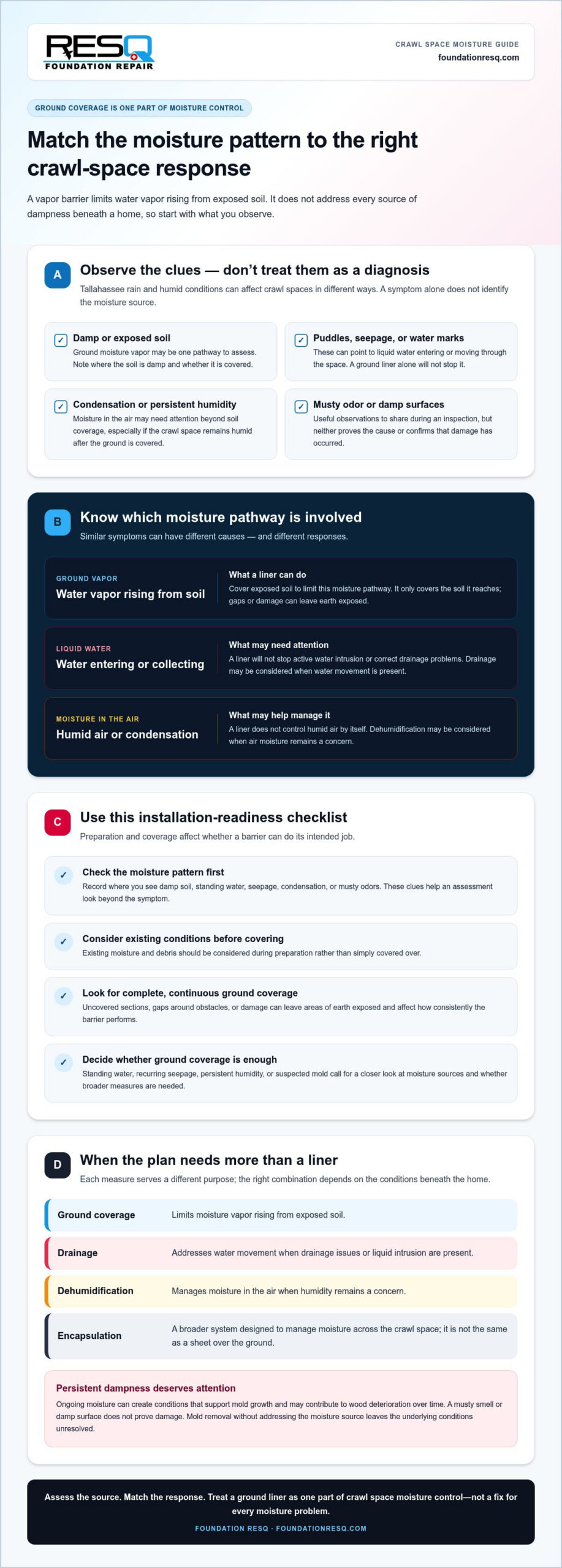
How to decide whether your crawl space needs a barrier or broader moisture control
Start with what you can observe, then use those clues to guide an assessment rather than choosing a fix by appearance alone. Damp soil, standing water, persistent humidity, and suspected mold point to different questions. They don’t identify the cause on their own, but they can help clarify whether ground coverage may fit or whether the crawl space needs a broader moisture-control plan.
Observations to share during a crawl space inspection
Note where moisture appears and whether you see it after rainfall, throughout the year, or only in particular areas. Describe musty odors and visible changes, but don’t disturb material you suspect may be mold. These observations give an inspector useful context, though the moisture source can’t be established without assessing the crawl space itself.
- Damp soil, without visible water: Ask whether limiting moisture vapor from the ground is appropriate and whether the exposed soil can be covered continuously.
- Standing water or recurring seepage: Share where water collects and when you notice it. The assessment may need to consider water entry and drainage, not just ground coverage.
- Persistent humid or clammy conditions: Describe whether the air or surfaces seem damp even when the ground appears covered. This can help determine whether dehumidification should be considered.
- Visible suspected mold or moisture-related changes: Point out the location without touching or removing material. A professional assessment can help determine the appropriate response.
Keeping a simple record can help. Note the location, timing, and whether the condition changes after rain or remains consistent. A recurring pattern is useful context, but it isn’t a diagnosis. For crawl space vapor barrier installation Tallahassee homeowners should have the observed conditions assessed before deciding that a liner alone will address them.
When a more complete moisture-control plan may be appropriate
Repeated water, ongoing humidity, or signs of moisture-related concerns may warrant evaluating more than a ground barrier. Foundation ResQ provides crawl space encapsulation, drainage, and dehumidification in Tallahassee. An inspection can help assess which measures fit the conditions beneath your home, rather than treating every symptom the same way.
Foundation ResQ includes a free inspection or estimate with each service request. Financing is available for major repairs. The goal is to connect the observed moisture pattern with practical next steps, whether that means ground coverage or a more coordinated plan.
If dampness keeps returning or you’re unsure what you’re seeing, request a free crawl space inspection to evaluate the space and discuss suitable moisture-control options.
Arrange crawl space vapor barrier installation in Tallahassee with Foundation ResQ
A vapor barrier can be a useful part of moisture control, but the first decision is whether ground moisture is the main concern or whether water entry, drainage, or humidity also needs attention. For crawl space vapor barrier installation Tallahassee homeowners can start with an assessment that connects visible conditions with an appropriate next step, rather than assuming a ground liner will solve every moisture issue.
Foundation ResQ provides crawl space encapsulation, drainage, dehumidification, and related repair services in Tallahassee. The right combination depends on the crawl space. Ground coverage can address moisture rising from exposed soil, while other conditions may call for a broader plan.
What to expect from a Foundation ResQ inspection
An inspection provides an opportunity to assess visible crawl space conditions and discuss the moisture concerns you’ve noticed. Share whether dampness appears in one area, whether water has been present, or whether musty odors or other changes persist. These details help inform the evaluation, while the conditions beneath the home guide the recommendations.
Depending on the findings, recommendations may address encapsulation, drainage, or dehumidification. A free inspection or estimate is included with each service request. The process is straightforward: understand the conditions, discuss suitable options, and decide how you want to proceed.
Take the next step toward a drier crawl space
Before choosing a ground liner as the complete fix, find out what the moisture pattern suggests. An assessment can clarify whether soil coverage is appropriate by itself or whether the crawl space may benefit from additional moisture-control work. That gives you a clearer basis for deciding and helps avoid treating a visible symptom while overlooking another source.
For Tallahassee homeowners, submitting a contact form or using the website’s service-booking option is a simple way to request an inspection or estimate. Financing is available for major repairs. If you’re ready to discuss the conditions beneath your home, book your free crawl space inspection.
Take a clear next step for your crawl space
A more confident decision starts with a clear picture of what’s happening beneath your home. Before arranging crawl space vapor barrier installation Tallahassee homeowners can jot down where they’ve noticed dampness, odors, or changes and when they occur. These observations can help make an assessment more focused without requiring you to determine the cause yourself.
The goal isn’t to choose the biggest solution or settle for the quickest fix. It’s to understand the moisture conditions and identify work that fits the home. Foundation ResQ provides crawl space services tailored to those needs. You can review the findings and consider your options at your own pace.
Start with an assessment and a practical conversation about the space. Request your free crawl space inspection and take an informed step toward protecting your home.
Frequently Asked Questions
Is a crawl space vapor barrier enough to stop moisture?
No. A ground liner can reduce moisture vapor from soil, but it won’t stop liquid water entering the crawl space or manage humid air on its own. For crawl space vapor barrier installation Tallahassee homeowners should consider the pattern: is soil damp, water pooling, or condensation appearing on surfaces? Those observations help guide an assessment, but the liner may be only one part of the solution.
Can I install a crawl space vapor barrier myself?
Possibly, if the crawl space is accessible and conditions are straightforward, but achieving continuous coverage around supports, pipes, and corners can be challenging. Before starting, consider whether there’s standing water, suspected mold, restricted access, or damage that needs attention. Covering a concern without understanding it can make the real issue harder to assess. If you’re unsure about conditions or coverage, a professional inspection can help clarify the work involved.
How long does crawl space vapor barrier installation take?
There isn’t one reliable timeframe for every home. The time depends on factors such as crawl space access, layout, preparation needs, and whether the work includes moisture-control measures beyond the liner. A clear, open area may involve a different scope from a space with obstructions or water concerns. An inspection can help establish what the project involves rather than relying on a generic time estimate.
What happens if a crawl space vapor barrier is damaged?
A tear or separated seam can leave soil exposed, so the affected area should be examined rather than ignored. Note where the damage is, whether the liner has shifted, and whether moisture or debris is visible nearby. The right repair depends on the liner’s condition and the extent of the damage. Avoid applying an arbitrary patch that may not suit the material or resolve the underlying cause.
Does a crawl space vapor barrier prevent mold from returning?
No. A barrier may reduce moisture coming from soil, but mold can recur if other moisture sources remain. A covered ground surface won’t address ongoing water intrusion or persistent humidity. Mold remediation involves removal and moisture mitigation, not removal alone. If you notice suspected mold, avoid disturbing it and have the conditions assessed so the moisture source can be considered along with the affected area.
Should standing water be covered with a vapor barrier?
No. A vapor barrier is meant to cover soil, not serve as a remedy for pooled water. Covering standing water doesn’t identify or correct why it’s there, and it can make the condition less visible. Note where water collects and whether it appears after rain or persists, then have the crawl space assessed. Water management should be considered before deciding whether ground coverage is appropriate.