
Why Crawl Space Wood Rot Is a Hidden Threat to Your Home
Crawl space wood rot is a fungal decay that attacks the wooden structural components beneath your home when exposed to persistent moisture. It weakens floor joists, support beams, and subflooring, compromising your home’s structural integrity and creating potential health hazards through poor air quality.
Quick Facts About Crawl Space Wood Rot:
- Primary Cause: Excessive moisture from humidity, leaks, poor drainage, or condensation
- Common Signs: Sagging floors, musty odors, visible fungal growth, darkened wood
- Types: Dry rot, wet rot, and soft rot—each with different characteristics
- Consequences: Structural damage, pest infestations, health issues, increased energy costs
- Solution: Address moisture sources through encapsulation, dehumidification, and repair damaged wood
Your crawl space might seem like an out-of-sight, out-of-mind area of your home. But what’s happening down there directly affects everything above it. Currently, 10 percent of wood production is needed each year to repair damage caused by rotting wood—a staggering statistic that highlights how common and costly this problem truly is.
Wood rot doesn’t just weaken the wooden supports holding up your floors. It creates a cascade of problems: sagging and bouncy floors, musty smells seeping into your living spaces, poor indoor air quality affecting your family’s health, and even pest infestations as termites and carpenter ants are drawn to damp, decaying wood.
The good news? Wood rot is both preventable and repairable when you understand what causes it and how to address it properly.
As Kayle Vernon, I’ve spent over a decade helping homeowners understand and solve complex property issues through strategic, data-driven approaches. While crawl space wood rot affects thousands of homes across Florida, Alabama, and Georgia, many homeowners don’t realize the extent of the damage until it becomes a serious structural problem.
This guide will walk you through everything you need to know about identifying, repairing, and preventing wood rot in your crawl space—so you can protect your home’s foundation, your family’s health, and your property’s value.
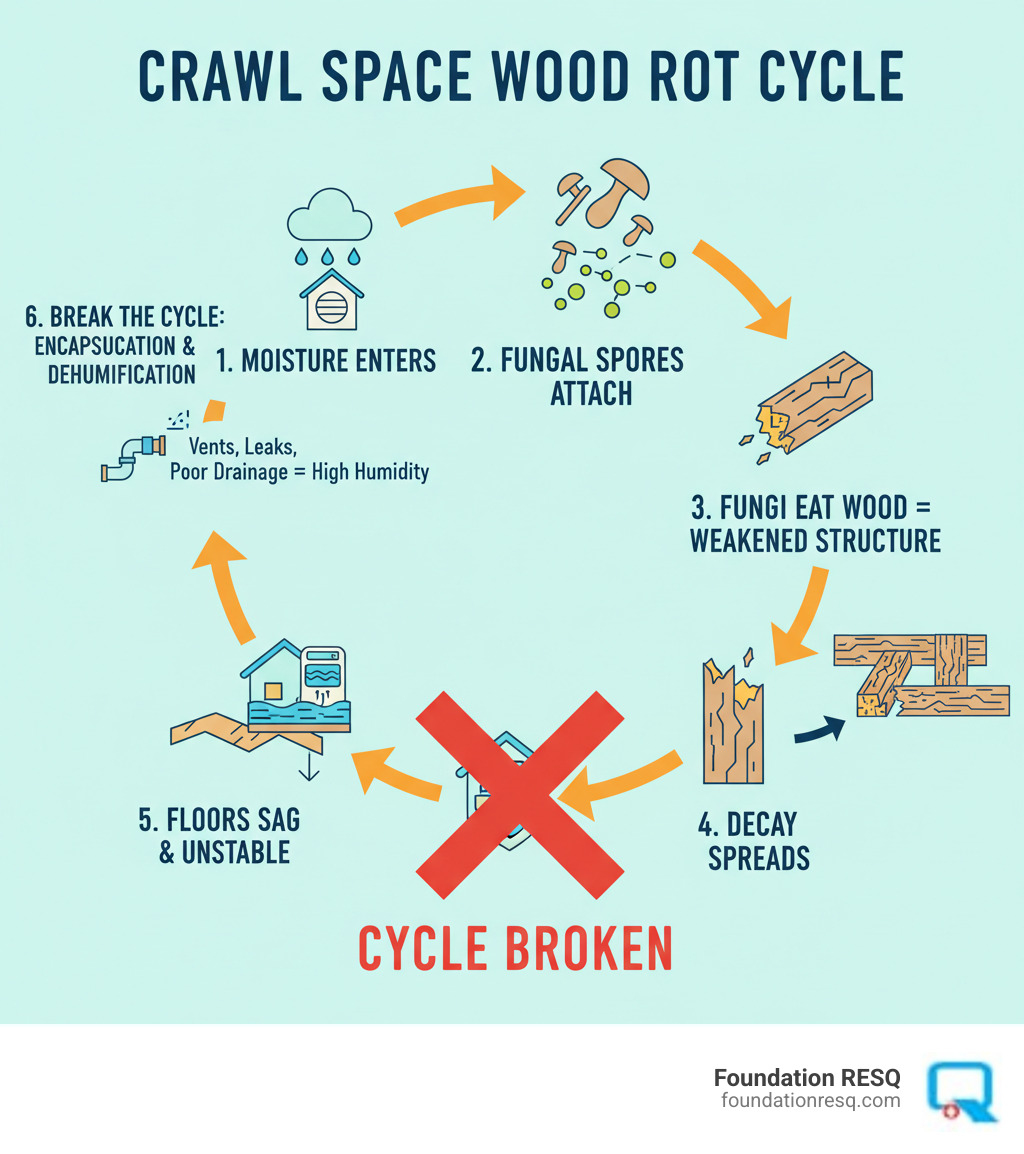
Understanding Wood Rot: The Silent Destroyer
Picture this: beneath your feet, hidden in the shadows of your crawl space, tiny fungal spores are quietly feasting on the wooden beams that hold up your entire home. It’s happening right now in thousands of crawl spaces across Florida, Alabama, and Georgia—and you might not even know it.
Crawl space wood rot is essentially a fungal decay process, but calling it just “decay” doesn’t capture how insidious it really is. These wood-destroying fungi are living organisms with a specific appetite: they consume the cellulose and lignin that give wood its strength and structure. Think of cellulose as the wood’s muscle and lignin as its bones—when fungi start breaking these down, your home’s structural support literally begins to crumble.
What makes this so dangerous is the environment. Crawl spaces in our region tend to be dark, damp, and poorly ventilated—which happens to be the perfect breeding ground for these destructive fungi. Once they take hold, they spread silently through floor joists, support beams, and subflooring, weakening everything they touch. By the time most homeowners notice sagging floors or catch that telltale musty smell, the damage has often spread far beyond what’s visible.
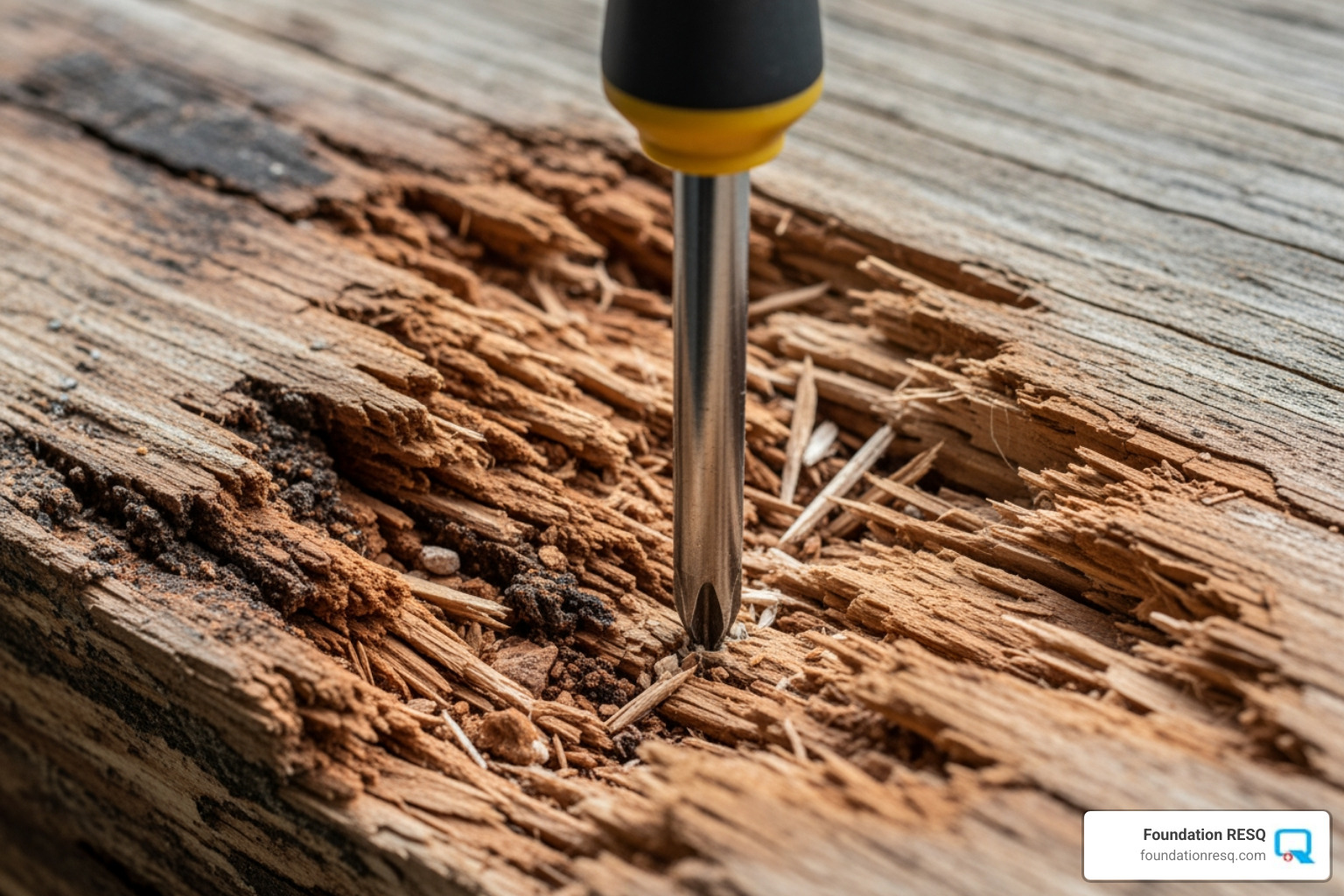
The image above shows just how devastating wood rot can be. That screwdriver is penetrating what should be solid, load-bearing wood as easily as pushing into soft butter. This is what happens when fungi consume the structural integrity of your home’s foundation—and it’s exactly the kind of damage that can compromise your family’s safety.
The Different Types of Wood Rot
Not all crawl space wood rot looks or behaves the same way. Understanding the different types helps us identify what we’re dealing with and how aggressively we need to address it.
Dry rot might be the most misunderstood type because its name is completely misleading. Caused by a particularly aggressive fungus called Serpula lacrymans, often referred to as the ‘building cancer’ for its destructive capabilities, dry rot actually needs moisture to get started. But here’s what makes it so dangerous: once it establishes itself, it can create its own moisture through the wood digestion process. This allows it to spread rapidly through timbers and even across non-wood surfaces like masonry to reach fresh wood. The affected wood becomes brittle and crumbly, often with a cube-like cracking pattern. If you have dry rot, you’re dealing with one of the most destructive forms of fungal decay.
Wet rot is far more common in our humid Southern climate. Unlike its dry cousin, wet rot stays put in areas where there’s consistent dampness—it needs that continuous moisture source to survive. The wood takes on a darker, saturated appearance and feels soft and spongy to the touch. While wet rot doesn’t spread as aggressively as dry rot, it can still cause serious structural damage if the moisture problem isn’t addressed. The good news is that once you eliminate the moisture source, wet rot stops spreading.
Within the wet rot category, we see two distinct subtypes based on what they eat. Brown rot breaks down the cellulose in wood while leaving the lignin behind. This causes the wood to shrink, crack in distinctive cube-like patterns (sometimes called “alligatoring”), and turn dark brown. Because it targets the wood’s primary structural component, the wood becomes dry and crumbly, losing its strength with alarming speed. Brown rot fungi thrive in temperatures between 65-90°F—which unfortunately describes most of our crawl spaces for much of the year.
White rot takes the opposite approach, primarily consuming the lignin while leaving most of the cellulose intact. This gives affected wood a bleached or whitish appearance with a soft, spongy, or sometimes stringy, fibrous texture. Like brown rot, white rot fungi prefer temperatures between 65-90°F, making Southern crawl spaces ideal targets.
There’s also soft rot, though it’s less common in structural timbers. Soft rot occurs in wood that stays consistently very wet—like wood in direct contact with soil or standing water. The fungi create a honeycomb-like pattern of microscopic cavities in the wood as they break down cell-wall carbohydrates. What makes soft rot unique is its ability to survive in extreme temperatures, from freezing to 110°F.
Each type represents a serious threat to your home’s stability. The specific type sometimes influences our repair approach, but the most important thing is addressing the underlying moisture problem that allowed any of them to take hold in the first place.
Wood Rot vs. Mold: How to Tell the Difference
Here’s a question we hear constantly: “Is that mold or wood rot in my crawl space?” It’s an understandable confusion since both are fungi that love damp, dark places. But while they’re related, their impact on your home is worlds apart.
Mold grows on the surface of materials and primarily affects air quality and health. It’s definitely a problem—one we take seriously with our Mold Remediation Services. But crawl space wood rot actually invades and destroys the wood itself, compromising your home’s structural integrity. That’s a much more serious issue.
| Feature | Wood Rot | Mold |
|---|---|---|
| Growth Pattern | Penetrates deep into wood structure, destroying it from within | Grows on the surface of materials without penetrating |
| Texture | Makes wood soft, spongy, crumbly, or stringy | Appears fuzzy, powdery, or slimy on surfaces |
| Color | Darkens wood to brown/black, or bleaches it white; creates cracking patterns | Shows as black, green, white, orange, or purple patches |
| Impact on Wood | Destroys structural strength; wood becomes weak and unstable | No structural damage; mainly cosmetic and health concerns |
| Smell | Produces a musty, earthy, damp smell | Creates a musty or mildew-like odor |
Here’s a simple test: if you can wipe it off with a cloth, it’s probably mold. If the wood itself feels soft when you press a screwdriver or fingernail into it, you’re dealing with wood rot. Mold sits on top; rot lives inside.
Both problems signal that you have a moisture issue in your crawl space. But wood rot means that moisture has been present long enough—and at high enough levels—to allow fungi to actually digest your home’s support structure. That’s why addressing wood rot requires not just removing the damaged wood, but solving the moisture problem that created the perfect environment for decay in the first place.
If you find mold in your crawl space, don’t panic—but don’t ignore it either. Our Mold Remediation Services can help you address the problem before it affects your family’s health. And if you find wood rot, you’ll want to act even faster to prevent further structural damage.