
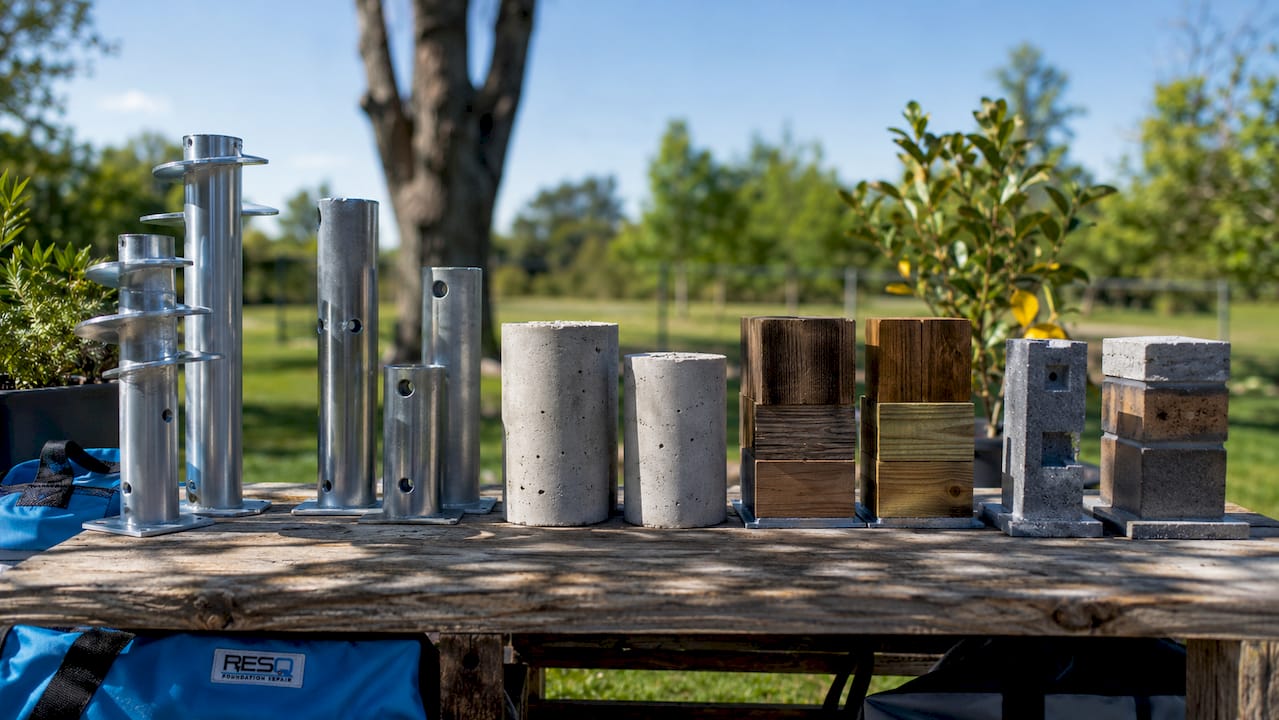
Foundation piers are structural supports driven deep into the ground to stabilize or lift a settling foundation by bypassing weak soil and transferring the load to stable strata below. The main pier types for foundation repair are helical piers, push piers, concrete piers, timber piers, and masonry piers. Each one works differently and suits different conditions. Helical piers and push piers are the current industry standards for residential repair, and pier selection is a site-specific engineering decision based on soil composition, structure weight, and site access. Knowing the difference before you call a contractor puts you in a much stronger position.
1. What are the pier types for foundation repair?
The five main categories of foundation repair piers are helical piers, push piers, concrete piers, timber piers, and masonry piers. Steel piers, meaning helical and push types, dominate modern residential repair because they reach stable soil reliably and carry measurable loads. Concrete piers remain useful in specific soil conditions. Timber and masonry piers appear mostly in older homes or limited repair scopes. Understanding each type helps you ask the right questions when getting a professional evaluation.
2. How helical piers work and when to use them
Helical piers are steel shafts with one or more helical plates welded along the shaft, similar in concept to a large screw. Installation equipment rotates the pier into the ground using torque rather than impact force. That rotation drives the helical plates through the soil until the pier reaches a stable bearing layer, typically between 15 and 40 feet deep.
One major advantage is that helical piers bear load immediately upon installation, with no curing or waiting period. That makes them the go-to choice for emergency stabilization when a foundation needs support right away. Engineers verify capacity in real time because torque monitoring during installation confirms each pier meets the required load rating. That quality check does not exist with poured concrete methods.
Helical piers also work well in conditions that challenge other pier types:
- High groundwater or saturated soils where driving is difficult
- Lighter wood-frame structures that cannot generate enough weight to drive push piers
- Tight access areas where small installation equipment causes minimal site disruption
- New construction additions or porches with limited dead load
- Sites where landscaping or hardscape must be preserved
Pro Tip: Ask your contractor for the torque log from helical pier installation. That document proves each pier reached its rated capacity and gives you a record for future buyers or insurance purposes.
For a deeper look at installation scenarios, Foundationresq covers helical pier installation in detail, including when this method fits Florida soil conditions best.
3. How push piers stabilize foundations and what makes them different
Push piers work on a completely different principle. A hydraulic ram drives steel tubes into the ground using the weight of the structure itself as the driving force. The tubes advance section by section until they reach bedrock or a dense load-bearing stratum. A steel bracket then connects the pier to the foundation footing, and the load transfers from the failing soil to the pier.
Because push piers rely on the structure’s weight to drive them down, they work best on heavy concrete or masonry foundations. A light wood-frame home simply does not provide enough dead load to push the pier to the required depth. That is the single most important distinction between push piers and helical piers.
Key characteristics of push pier systems:
- Installation method: Hydraulic rams drive steel tubes to bedrock or dense bearing strata
- Best structure type: Heavy concrete slab, block, or masonry foundations
- Typical depth: 15–40 feet, depending on local geology
- Load capacity: High, suited for significant structural loads
- Timeline: Most residential projects complete within 1–5 days
Push piers do not require large excavation. Crews dig small pits at each pier location, drive the pier, attach the bracket, and backfill. The process is relatively fast and causes limited disruption to the interior of the home. For a side-by-side breakdown of both steel pier systems, Foundationresq’s guide on helical vs. push piers covers the selection criteria in detail.
4. What are concrete piers and when might they be preferred?
Concrete piers come in two forms: poured-in-place and pre-cast. Poured-in-place piers involve drilling a hole to the required depth, placing a steel reinforcement cage, and filling the hole with concrete. Pre-cast piers are manufactured off-site and driven or pressed into position.
The main advantage of concrete piers is corrosion resistance. In highly acidic soils or coastal environments where steel corrodes faster, concrete offers a longer service life without the need for protective coatings. Concrete also performs well in expansive clay soils common across the South, where the pier’s mass resists lateral movement.
The trade-off is time. Concrete piers require curing before they can carry load, which delays the repair timeline by days or weeks. Steel reinforcement is standard practice to prevent cracking under lateral soil pressure.
Pro Tip: If your soil report shows high sulfate or chloride content, ask your contractor specifically about concrete pier options. Sulfate-rich soils accelerate steel corrosion and can shorten the service life of uncoated steel piers significantly.
Situations where concrete piers outperform steel alternatives include:
- Highly corrosive or acidic soil conditions
- Coastal properties with salt-laden groundwater
- Sites where long-term maintenance access is limited
- Repairs where budget constraints favor locally sourced materials
5. What other pier types exist and when are they applicable?
Timber, masonry, and block piers represent older or more traditional approaches to foundation support. You will encounter them most often in historic homes, crawl space repairs, or regions where these materials were the local standard decades ago.
Timber piers are wood posts, typically pressure-treated, set on concrete footings to support floor beams in crawl spaces. They are inexpensive and easy to replace but degrade over time from moisture, insects, and rot. Masonry piers, built from brick, stone, or concrete block, appear under older homes and can carry significant loads when properly constructed. Their weakness is uneven load distribution and susceptibility to moisture-driven deterioration.
Key limitations of traditional pier types:
- Timber piers require periodic inspection and replacement, especially in humid climates
- Masonry block piers can shift or crack under differential settlement
- Neither type reaches deep stable strata the way steel piers do
- Load capacity is harder to verify without engineering testing
- Modern building codes in most jurisdictions now require engineered pier systems for structural repairs
For homeowners dealing with sagging floors linked to deteriorating crawl space piers, replacing timber or masonry supports with engineered steel piers is the most reliable long-term fix. Traditional piers are a maintenance item. Engineered steel piers are a permanent repair.
6. How to choose the right pier type for your foundation repair needs
The right pier type depends on four factors: soil composition, structure weight, site access, and budget. No single pier type wins in every situation. A geotechnical report or professional site evaluation is the only way to know which system fits your specific conditions.
| Feature | Helical piers | Push piers | Concrete piers |
|---|---|---|---|
| Best structure type | Light to medium | Heavy masonry/concrete | Any, corrosive soils |
| Installation time | 1–3 days | 1–5 days | 3–7 days (curing) |
| Load-ready | Immediately | Immediately | After curing |
| Soil requirement | Variable, high water table OK | Needs structure weight | Stable bearing layer |
| Corrosion resistance | Coated steel | Coated steel | High (inherent) |
Helical and push piers typically cost $1,000–$3,000 per unit, with total projects often exceeding $20,000 depending on depth and the number of piers required. That is a significant investment, and the cost of getting the wrong pier type can mean redoing the work.
Exterior pier installations often carry hidden costs from removing and restoring landscaping, irrigation systems, decking, or patios. Always ask for a separate line item for site restoration in any contractor quote. Foundationresq’s foundation repair cost estimator breaks down what homeowners in the Tallahassee area should expect to budget.
Pro Tip: Get at least two quotes that specify pier type, depth, number of piers, and restoration costs as separate line items. A low total price that bundles everything together almost always means something is being left out.
Piers bypass weak soil rather than fixing it. That means addressing drainage and soil moisture after installation is not optional. A pier system installed without correcting the water source that caused the settlement will eventually face new problems in adjacent areas of the foundation.
For Florida-specific guidance, Foundationresq’s resource on pier selection for Florida soil addresses the sandy, high-water-table conditions that make helical piers the dominant choice in this region.
Key takeaways
Helical and push piers are the most reliable pier types for foundation repair, with the right choice determined by soil conditions, structure weight, and site access rather than cost alone.
| Point | Details |
|---|---|
| Helical piers suit lighter structures | They use torque for installation and bear load immediately, ideal for high-water-table soils. |
| Push piers need structural weight | Heavy masonry or concrete foundations provide the force needed to drive push piers to bedrock. |
| Concrete piers resist corrosion | Use them in acidic or coastal soils where uncoated steel degrades faster. |
| Hidden costs add up fast | Budget separately for landscaping and hardscape restoration after exterior pier work. |
| Piers bypass soil, not fix it | Moisture and drainage control after installation prevents future settlement in adjacent areas. |
What I’ve learned after seeing hundreds of pier jobs go right and wrong
The most common mistake homeowners make is choosing a pier type based on price per unit rather than suitability. A push pier installed under a light wood-frame home will not reach adequate depth because the structure cannot generate enough driving force. The pier stops short, the repair fails, and the homeowner pays twice.
The second mistake is treating pier installation as the complete solution. Piers stabilize what is already there. They do not fix the soil, redirect water, or stop the moisture cycle that caused the settlement in the first place. Every pier job I have seen succeed long-term was paired with drainage corrections, crawl space moisture control, or grading improvements. The ones that failed within a few years skipped that step entirely.
Soil reports matter more than most homeowners realize. The geology under your home determines everything: which pier type works, how deep the piers must go, and how many you need. A contractor who quotes a job without referencing soil data is guessing. That guess costs you money.
My honest recommendation is to treat the pier selection conversation as an engineering discussion, not a sales conversation. Ask your contractor why they are recommending a specific pier type for your soil and structure. If they cannot answer that question clearly, find someone who can. Foundationresq’s foundation settlement repair page is a good starting point for understanding what a thorough evaluation should include.
— Kayle
Foundationresq’s pier installation services for Tallahassee homeowners
Foundation issues in North Florida move fast, especially in the sandy, moisture-variable soils around Tallahassee. Foundationresq specializes in helical and push pier installation for residential foundations, with every project starting from a free on-site inspection and a clear, itemized quote.
The team at Foundationresq evaluates soil conditions, structure type, and site access before recommending any pier system. Homeowners can review foundation repair services and real project outcomes on the case studies page. Financing options are available for qualified homeowners through Foundationresq’s repair financing guide. Schedule your free inspection and get a repair plan built around your specific foundation, not a one-size-fits-all approach.
FAQ
What is the most common pier type for residential foundation repair?
Helical and push piers are the most widely used pier types for residential foundation repair. Helical piers dominate in lighter structures and high-water-table soils, while push piers suit heavy masonry or concrete foundations.
How long does foundation pier installation take?
Most residential pier installations complete within 1–5 days, depending on the number of piers and site conditions. Concrete piers require additional time for curing before load transfer.
Do foundation piers permanently fix a settling foundation?
Piers permanently stabilize the repaired section, but they do not fix the underlying soil or moisture conditions. Addressing drainage and soil moisture after installation is necessary to prevent future settlement in adjacent areas.
How much do foundation piers cost per unit?
Helical and push piers typically cost $1,000–$3,000 per unit. Total project costs often exceed $20,000 when depth, number of piers, and site restoration are factored in.
Can helical piers be used in wet or sandy soils?
Yes. Helical piers are specifically well-suited to high-water-table and variable soil conditions because they are mechanically screwed in rather than driven by structural weight. That makes them the preferred choice for many Florida properties.
Recommended
- Helical Piers vs. Push Piers: Choosing the Right Foundation Solution in 2026 – Tallahassee Foundation Repair | Foundation ResQ
- Get Your Foundation Right: Installing Helical Piers Like a Pro – Tallahassee Foundation Repair | Foundation ResQ
- Foundation Repair Cost Estimator: A 2026 Homeowner’s Guide – Tallahassee Foundation Repair | Foundation ResQ