What if the first step for an uneven loading dock isn’t choosing a repair method, but understanding what’s happening beneath the slab? A settled transition can disrupt forklifts, pallet jacks, and deliveries, while the cause and extent of movement may not be obvious from the surface. PolyRenewal for commercial loading docks uses expanding foam injected beneath concrete to help fill voids and lift a sinking slab toward its intended level.
It’s reasonable to look for a repair that addresses the concrete without creating unnecessary disruption to facility operations. The right plan depends on the slab’s condition, its connection to adjacent surfaces, and how crews, equipment, and deliveries use the dock. A site assessment helps establish the repair objective before work is planned.
This article explains how foam-injection lifting works, what site conditions matter, and how to prepare for an assessment. Foundation ResQ provides commercial concrete lifting in Tallahassee. A free inspection and estimate can help your team evaluate the slab and identify a practical next step.
Key Takeaways
- Watch for uneven transitions, slab separation, cracking, and pooling as signs that dock concrete may have settled.
- PolyRenewal for commercial loading docks uses expanding foam injected beneath a sinking slab to help lift it toward the intended level.
- Concrete lifting addresses slab elevation. It doesn’t replace work needed to address waterproofing or other dock-assembly concerns.
- Document level changes, visible cracks, pooling, and affected access points to make a commercial dock assessment more useful.
- Match the remedy to the slab’s condition and the facility’s access needs before planning repair work.
Why Settled Commercial Loading Dock Concrete Disrupts Daily Operations
For a facility manager, loading access needs to stay stable and predictable. A height change where the dock meets a ramp or warehouse floor can make routine movement less smooth, even when the affected area looks minor. Forklifts and pallet jacks may cross the transition repeatedly, while dock plates and delivery routes rely on a usable connection between surfaces. The Loading Dock Overview explains how a dock connects a building with vehicles and material movement, which helps put the importance of these transitions in context.
Settled dock concrete is a slab that has moved downward or out of alignment, creating uneven access that can complicate equipment movement and deliveries. This describes a visible condition and its operational effect, not a confirmed cause or diagnosis. PolyRenewal for commercial loading docks may be an option when an assessment finds that lifting fits the slab’s condition.
What signs suggest a loading dock slab has settled?
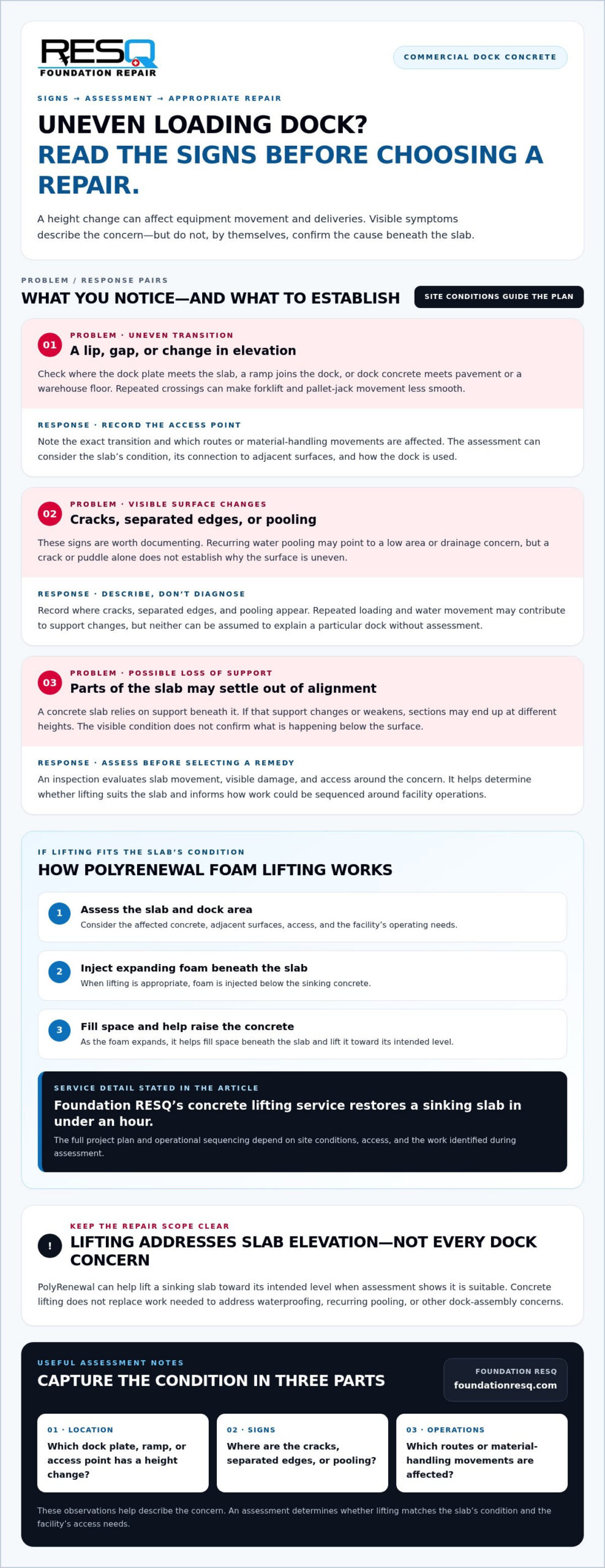
Look for changes in elevation where a dock plate meets the slab, where a ramp joins the dock, or where dock concrete meets adjacent pavement or a warehouse floor. A gap or lip at a slab edge, cracks, or visible separation between concrete sections are also worth noting. Recurring water pooling may point to a low area or drainage concern, but it doesn’t establish why the surface is uneven.
Record where each sign appears and whether it affects a particular access point. These details help describe the concern, but visible symptoms alone don’t confirm that settlement is the cause.
Why does loading dock concrete lose support?
A concrete slab relies on support beneath it. If that support changes or weakens, parts of the slab may settle, leaving sections at different heights. Repeated loading and water movement are possible contributing factors, but neither can be assumed to explain a particular dock’s condition without an assessment. A crack or puddle by itself doesn’t prove what is happening below the surface.
The operational effect often shows up at the transition. A sudden lip can make equipment travel less smoothly, while a gap or uneven surface may affect how staff move goods between the building and a vehicle. These conditions can make a route harder to use consistently, but they don’t automatically mean the entire dock needs replacement. The extent of movement and the condition of the affected slab matter.
For a useful first record, note:
- Which dock plate, ramp, or access point has a height change.
- Where cracks, separated edges, or pooling appear.
- Which routes or material-handling movements are affected.
These observations separate visible symptoms from the repair question. In Tallahassee, a professional assessment can examine the slab and its support before a remedy is selected. That keeps the decision grounded in the actual site rather than assumptions about local soil or operating conditions.
How PolyRenewal Foam Injection Lifts and Levels Commercial Slabs
PolyRenewal is concrete lifting that uses expanding foam injected beneath a sinking slab. The foam expands below the concrete, helping fill space and raise the slab toward its intended level. At a loading dock, the goal is to correct the slab’s elevation when an assessment shows lifting is an appropriate response, not to assume every crack, gap, or water issue has the same cause.
What happens during expanding-foam concrete lifting?
The work begins with an assessment of the slab and the area around it. If lifting suits the condition, expanding foam is injected beneath the concrete. As it expands, it fills space below the slab and helps lift it toward the planned level. The method is straightforward, but the work plan depends on the specific slab and dock layout.
At a commercial facility, the target level matters because the slab connects with adjacent concrete, dock plates, ramps, and access routes. The Loading Dock Design Guidelines provide context on how dock function and vehicle access shape design needs. A lifting plan should account for the transition being addressed, rather than treating the concrete as an isolated surface.
What can an inspection establish about a dock slab?
A free inspection helps evaluate slab movement, visible damage, and access around the area of concern. It can help determine whether lifting is suitable and inform how the work could be sequenced around the facility. This step matters because a visible height difference alone doesn’t establish what is happening beneath the slab or confirm that lifting is the right remedy.
Foundation RESQ’s concrete lifting service restores a sinking slab in under an hour. This describes the slab-restoration service. The full project plan and operational sequencing depend on site conditions, access, and the work identified during assessment. Facility managers can share delivery patterns and affected routes during the inspection so planning reflects how the dock is used.
PolyRenewal for commercial loading docks is a method to assess against the slab’s condition and the facility’s needs. It addresses concrete elevation, but it doesn’t by itself establish that related concerns, such as recurring pooling or damage beyond the slab, are resolved. A clear assessment separates the lifting objective from other repair needs and defines a practical scope before work is planned.
For Tallahassee facilities, a free inspection and estimate from Foundation ResQ’s commercial concrete lifting service can help turn visible symptoms into an informed next step. The aim is a site-specific decision: understand the slab, identify the intended level, and plan with dock access in view.
PolyRenewal or Slab Replacement: Match the Repair to the Dock
A low slab doesn’t automatically mean the whole loading dock needs to be removed, and lifting isn’t the answer to every concrete problem. The decision depends on the slab’s movement, overall condition, and the repair objective. A height difference may be a reason to assess concrete lifting, while widespread deterioration or damage may call for a different scope.
Concrete lifting addresses slab elevation, replacement rebuilds concrete, and waterproofing addresses water entry. These are distinct scopes, not interchangeable fixes. Cracks and settlement are important clues, but neither one alone confirms which repair is appropriate. An assessment helps clarify whether the main concern is a sunken slab, damaged concrete, water intrusion, or a combination that needs more than one remedy.
When should a facility consider concrete lifting?
Lifting may be worth assessing when a slab has settled and the concrete remains a candidate for elevation correction. The review should consider the extent of movement, visible damage, adjoining surfaces, and access to the affected dock area. These details help define the lifting objective and support a site-specific decision, without assuming a particular load capacity or forklift outcome.
When might replacement or waterproofing be a different scope?
Replacement is a separate approach when the slab’s condition calls for rebuilding rather than raising existing concrete. Waterproofing serves another purpose: managing water entry through or around the dock assembly. It doesn’t correct slab elevation on its own. If a low slab and water concerns are both present, each issue should be identified so the repair plan addresses the right problem.
A practical comparison starts with the repair objective:
- Consider lifting for assessment when the main concern is a settled slab and the goal is to correct its elevation.
- Consider replacement as a distinct scope when the concrete condition indicates rebuilding may be needed.
- Consider waterproofing separately when the concern is water entering the dock assembly, rather than the slab’s level.
These are decision points, not a diagnosis. For example, a crack near a lowered edge may accompany settlement, but the crack alone can’t establish the slab’s condition below the surface or determine whether lifting is suitable. The same applies to recurring water: pooling is a reason to investigate, but raising concrete by itself doesn’t establish that water entry has been addressed.
For Tallahassee facilities weighing a concrete-lifting option, the Tallahassee PolyRenewal concrete leveling guide offers related information about the method. A commercial dock assessment can focus on the specific slab, access requirements, and repair objective. Separating elevation correction from rebuilding and water management gives facility teams a clearer basis for planning than choosing a remedy based only on the most visible symptom.
Plan a Commercial Loading Dock Assessment in Tallahassee
A focused assessment starts with a clear record of what staff see and where dock operations are affected. You don’t need to diagnose the cause. Gather observations that show the location, pattern, and practical impact of the concrete concern. For PolyRenewal for commercial loading docks, this information can help shape a site-specific discussion about the slab and access needs.
What should facility managers document before an inspection?
Walk the affected area and note where transitions feel uneven, slab edges appear separated, or cracks are visible. Record recurring water pooling and any changes staff have noticed over time. Identify the dock approaches, plates, ramps, and routes involved so the assessment can focus on the concrete and access points that matter to daily work.
- Mark the locations of height changes, separation, and visible cracking.
- Note where water collects and whether pooling recurs.
- Describe which dock approaches, access points, or equipment routes are affected.
- Record when staff first noticed the condition and any changes since then.
Photos can preserve a visual record, especially if the concern is easier to see from a particular angle or after rain. Keep notes descriptive: identify the transition between a ramp and dock slab, for example, rather than guessing what caused the change. This gives the inspection useful context without treating observations as a confirmed diagnosis.
How can the assessment fit around dock operations?
Access and operating schedules help inform project planning. Before the inspection, note the facility’s busier receiving periods, typical operating windows, and the routes forklifts or pallet jacks use near the area. Identify any approach staff rely on to keep deliveries moving. This context helps the assessment account for how the dock functions while the concrete concern is reviewed.
Share access restrictions and explain which routes are most important to keep available. The inspection can evaluate the slab and help inform an appropriate work plan, including operational sequencing. The specific schedule depends on the site and the work identified during the assessment.
With observations and operating context in hand, facility managers can have a more productive conversation about the condition, access, and next steps. Foundation ResQ offers free inspections and estimates for concrete services, giving Tallahassee facilities a straightforward way to assess a commercial dock concern.
Schedule a free concrete inspection to discuss the loading dock slab and the details you’ve gathered.
Get a Foundation ResQ Assessment for Commercial Dock Concrete
A useful repair decision follows a clear sequence: identify the visible symptoms, assess the slab and surrounding conditions, then match the remedy to the problem. This helps prevent a low transition from being treated as proof that the entire dock needs rebuilding, while also avoiding the assumption that lifting will address every concern. For Tallahassee facility managers, the goal is to understand the concrete and choose a next step that reflects how the dock is used.
What Foundation ResQ’s concrete lifting service addresses
Foundation ResQ provides commercial concrete lifting using expanding foam injected beneath sinking concrete slabs. The foam helps lift a slab toward its intended level when the site assessment indicates lifting is appropriate. The service restores a sinking slab in under an hour. The time claim refers to restoring the slab, while the full project plan depends on the site and the work identified.
PolyRenewal for commercial loading docks can be considered when the central issue is settled concrete. The inspection helps evaluate the slab’s movement and visible condition, along with access around the affected area. A site-specific review matters because the same surface symptom can call for a different scope depending on the concrete and the concern being addressed.
How to take the next step
Before the inspection, gather notes on the locations of level changes, cracks, separation, and recurring pooling. Identify which approaches or routes are affected and share relevant operating windows with the assessment team. This context helps clarify the concern and inform project planning.
During a free inspection, commercial property managers can discuss the observed symptoms, the slab’s condition, and the intended repair objective. The assessment helps determine an appropriate project scope and whether concrete lifting matches the site. If signs extend beyond the dock slab and suggest broader structural concerns, the foundation repair guide for Tallahassee provides related information about foundation issues.
For a settled loading dock slab in Tallahassee, request a free concrete inspection and estimate from Foundation ResQ. It’s a straightforward way to review the condition, understand the next step, and plan around the needs of your commercial property.
Make a Clear Plan for Your Dock
A loading dock assessment can turn an operational concern into a practical decision. Keep your observations and access priorities together, then use them to discuss the slab’s condition and how a repair plan can account for facility operations. PolyRenewal for commercial loading docks may be part of that discussion when the assessment finds lifting suitable.
Foundation RESQ serves commercial properties in Alabama, Florida, and Georgia, including Tallahassee. Its concrete lifting uses expanding foam injected beneath sinking slabs, and free inspections and estimates are available for concrete services.
To discuss your dock and identify a sensible path forward, schedule a free commercial concrete inspection.
Frequently Asked Questions
Can PolyRenewal lift a commercial loading dock slab?
Yes. PolyRenewal may lift a commercial dock slab when an assessment finds the concrete suitable for lifting. PolyRenewal for commercial loading docks uses expanding foam beneath sinking concrete to help raise it toward the intended level. A lowered slab transition may be a candidate for assessment, while extensive deterioration could call for a different repair scope. The slab’s condition and site access guide the decision.
How does expanding-foam concrete lifting work?
Expanding-foam lifting involves injecting foam beneath a sunken concrete slab. The foam expands and helps raise the concrete toward its intended level in relation to nearby surfaces, such as a dock approach or adjoining floor. The method doesn’t automatically address every crack or water concern. A site review helps clarify whether the main issue is slab elevation or whether other conditions need attention too.
How long does concrete lifting take for a loading dock?
Foundation RESQ’s concrete lifting service restores a sinking slab in under an hour. This time claim refers to restoring the slab. The facility’s access, the concrete’s condition, and the work plan inform operational sequencing. Discussing dock use during the inspection helps with planning for the specific site.
Can a loading dock stay open during concrete lifting?
Whether a dock can remain open during lifting depends on the work area, access, and facility operations. For example, identify whether the affected slab is on a route used for active deliveries or whether another approach is available. Share operating windows and equipment routes during the assessment so sequencing can be considered. A site-specific plan is needed to determine how the work relates to dock access.
How do I know whether a loading dock needs lifting or replacement?
The slab’s overall condition and the repair objective help distinguish lifting from replacement. Lifting may suit a slab that has settled and remains appropriate to raise. Replacement is a separate scope when the concrete needs rebuilding. A crack, gap, or height change alone can’t establish which remedy is right. An assessment can examine the affected area and help clarify whether the concern is elevation, deterioration, or more than one issue.
Does concrete lifting fix water pooling at a loading dock?
Not necessarily. Lifting may change the level of a sunken slab, but pooling can have causes beyond slab settlement. Raising concrete doesn’t by itself establish that water entry or drainage concerns are resolved. Note where water collects and whether the pattern returns after rain. That information helps distinguish a low area from a separate water-management concern and supports an appropriate assessment of the dock.
Does Foundation RESQ offer free commercial concrete inspections in Tallahassee?
Yes. Foundation RESQ offers free inspections and estimates for concrete services, including commercial concrete concerns in Tallahassee. An inspection gives facility managers an opportunity to discuss the affected slab, access needs, and visible conditions with the assessment team. Bring notes about the routes or dock areas involved so the discussion can focus on the property’s specific concern and help establish a practical next step.