That heavy slurry used in traditional mudjacking might feel like a solid solution, but it often becomes the very weight that causes your concrete to sink a second time. If you’ve noticed pooling water near your foundation or a growing trip hazard on your sidewalk, you’re likely feeling the effects of Tallahassee’s unique karst topography. When weighing PolyRenewal vs mudjacking Tallahassee residents must consider how North Florida’s clay and erosion-prone soil react to different materials. You need a repair that stabilizes your home’s exterior without the mess or the risk of future settlement.
We understand that you want a safe, level surface that won’t require another fix next year. This article explores why lightweight polyurethane foam, weighing only 2 to 6 pounds per cubic foot, provides a more permanent result than mudjacking slurry that can weigh up to 140 pounds. We’ll break down the technical differences in soil compression and cure times so you can protect your home’s structural health with confidence. By the end of this guide, you’ll see why a modern, non-invasive approach is the best defense for your property’s stability.
Key Takeaways
- Understand the fundamental differences between traditional mudjacking and modern PolyRenewal technology for restoring sinking concrete.
- Discover why heavy cement slurry can trigger secondary settlement in North Florida’s unique karst topography and limestone voids.
- Evaluate PolyRenewal vs mudjacking Tallahassee outcomes based on durability, cure times, and the size of the injection holes required.
- Learn how the 2026 Florida Building Code’s focus on structural integrity makes polyurethane foam a superior long-term investment.
- Identify why a non-invasive, waterproof solution is essential for creating a safe, level surface that won’t wash out during heavy Florida rains.
Understanding Concrete Leveling in Tallahassee: PolyRenewal vs. Mudjacking
Concrete leveling is the process of filling empty voids beneath a sunken slab to restore it to its original height and stability. For many years, this was achieved through a method known as mudjacking or slab jacking. However, as we learn more about the specific geological challenges of North Florida, the conversation around PolyRenewal vs mudjacking Tallahassee has shifted. Homeowners are increasingly moving away from traditional methods because the heavy materials used in the past often fail to address the underlying cause of the settlement, leading to a cycle of repeated repairs.
Choosing the right method is about more than just a temporary fix. It’s about protecting your home’s long-term structural health and curb appeal. In Tallahassee, where the ground is often unpredictable, the weight of the repair material is just as important as the lift it provides. You need a solution that stabilizes the foundation without adding unnecessary stress to the soil below.
What is Mudjacking? The Traditional Slurry Method
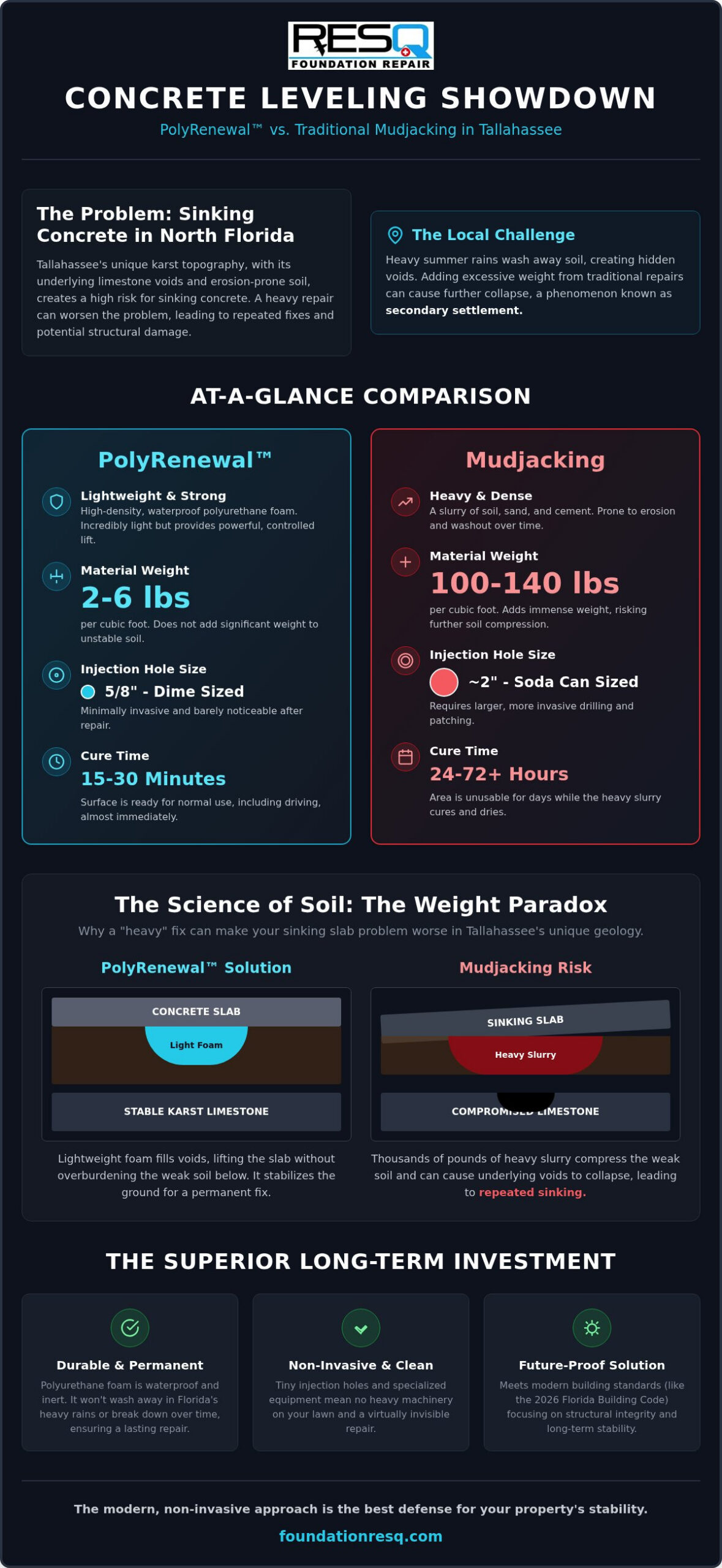
Mudjacking relies on a thick, heavy mixture of soil, sand, and cement. This slurry is pumped through large holes, often two inches in diameter, under high pressure to fill the space beneath the concrete. While it was once the industry standard, it creates significant issues in our local environment. The slurry is incredibly dense, often weighing between 100 and 140 pounds per cubic foot. This added weight puts immense pressure on the already weak karst soil beneath your driveway or patio. Instead of stabilizing the area, the heavy mud can actually compress the soil further, causing the slab to sink again shortly after the repair is finished.
What is PolyRenewal? The Modern Polyurethane Solution
PolyRenewal represents the modern evolution of structural repair. Instead of heavy mud, this method uses high-density polyurethane foam. When the two-part liquid is injected through tiny, 5/8-inch holes, a chemical reaction occurs that causes the foam to expand and harden. This expansion provides incredible lifting force with high precision, allowing technicians to level the slab within a fraction of an inch.
This high-precision polyurethane technology is also utilized by specialists like Airlift Concrete Experts to provide durable concrete leveling and raising services for residential and commercial properties in regions like Arkansas.
While various concrete leveling methods are available, polyurethane stands out because it’s a closed-cell, waterproof material. It won’t wash away during a heavy Tallahassee rainstorm, and it’s remarkably lightweight. At only 2 to 6 pounds per cubic foot, it provides the necessary support without overloading the subsoil. Additionally, it cures in minutes rather than days. You can usually drive on a PolyRenewal-treated surface within 15 to 30 minutes, making it a far more convenient and durable solution for the modern homeowner.
The Science of Soil: Why Weight is the Enemy of Tallahassee Foundations
Tallahassee’s rolling hills hide a complex geological secret that directly impacts your home’s stability. While you might see a solid concrete driveway on the surface, the ground beneath it is often riddled with voids and soft spots. When homeowners evaluate PolyRenewal vs mudjacking Tallahassee, they often overlook the “weight paradox.” This happens when a repair intended to fix a sinking slab actually accelerates the problem by adding massive amounts of weight to unstable ground. If the soil couldn’t support the original concrete, it certainly won’t support the concrete plus thousands of pounds of heavy cement slurry.
Tallahassee’s Karst Topography and “Sinkhole Alley”
Our local landscape is defined by karst topography, a geological feature where the limestone bedrock is slowly dissolved by acidic rainwater. This process creates a network of underground cavities, making our region part of Florida’s notorious “Sinkhole Alley.” During our intense summer downpours, water moves through these channels, washing away soil and leaving behind empty pockets. Because of Florida’s problem soils, adding a heavy, traditional repair material like mudjacking slurry is a gamble. The sheer mass can cause the ceiling of an underground void to collapse, leading to sudden shifts and secondary settlement that a lighter material would have avoided.
The Compaction Factor: Slurry vs. Lightweight Foam
The primary difference between these methods lies in their density. Mudjacking slurry is a mixture of soil, sand, and cement that weighs between 100 and 140 pounds per cubic foot. Pumping this material under your foundation is like trying to brace a weak shelf with a stack of lead bricks; it eventually crushes the subsoil, leading to more sinking. PolyRenewal, however, is a high-density foam that weighs only 4 to 5 pounds per cubic foot. It expands as a liquid to fill even the smallest microscopic gaps before hardening into a rigid, structural support. This lightweight footprint provides the necessary lift without taxing the fragile earth below. If you’re concerned about how your property is handling recent rainfall, a professional foundation inspection can help identify these hidden voids before they become major hazards. When choosing between PolyRenewal vs mudjacking Tallahassee residents should prioritize materials that work with the soil, not against it.
Performance Comparison: Durability, Weather, and Aesthetics
When choosing between PolyRenewal vs mudjacking Tallahassee homeowners usually prioritize how long the repair will actually last. Performance isn’t just about the initial lift; it’s about how the material stands up to the elements and how it looks on your property. Traditional mudjacking often leaves behind a “bouncy” feel because the heavy slurry doesn’t always fill every microscopic void or bond perfectly with the underside of the slab. In contrast, PolyRenewal expands as a liquid to create a solid, rigid structure that eliminates that hollow sound and prevents future shifting.
Resistance to Florida’s Heavy Rains and High Water Table
Tallahassee experiences intense humidity and frequent tropical storms that saturate the ground. This high water table is a major enemy of mudjacking. Because the slurry is a mixture of soil, sand, and cement, it remains water-soluble to an extent. Over a few hurricane seasons, moving groundwater can erode the material, leading to a “washout” effect that leaves your concrete unsupported once again. PolyRenewal is a closed-cell, waterproof material. It acts as a permanent moisture barrier that won’t degrade, even when submerged. It stops the cycle of recurring sinking by providing a foundation that water simply cannot touch or wash away.
Installation Footprint: Protecting Your Property’s Curb Appeal
The aesthetic difference between these two methods is striking. Mudjacking requires drilling holes that are between 1 and 2 inches in diameter, which is roughly the width of a soda can. These large circles are difficult to patch invisibly and often remain as permanent scars on your driveway. PolyRenewal uses tiny injection ports only 5/8 of an inch wide, which is smaller than a penny. Once the job is finished, these holes are filled with color-matched grout that blends into your existing concrete, preserving your home’s curb appeal.
Beyond the visual impact, the physical mess on your lawn varies significantly. Mudjacking involves heavy machinery and hoses filled with wet, muddy cement that can spill and stain your landscaping. Our PolyRenewal equipment is contained within a single truck, and the process is remarkably clean. Perhaps the biggest performance win is the speed. While mudjacking requires you to keep off the surface for 24 to 48 hours to allow for curing, PolyRenewal is ready for traffic in just 15 to 30 minutes. You can get back to your normal schedule almost immediately, knowing your concrete is stabilized for the long term.
Cost vs. Value: Evaluating Your Investment for 2026 and Beyond
When you’re comparing the bottom line for PolyRenewal vs mudjacking Tallahassee contractors will likely provide two very different numbers. Mudjacking often appears more attractive on paper because the initial materials are cheaper. However, a low initial quote can be deceptive if the repair fails within two years. In our local real estate market, a permanent fix is a genuine investment, while a temporary patch is often just a delayed expense. You’ve got to look past the first check you write to see the total lifecycle cost of the project.
Initial Quotes vs. Long-Term Reality
The true cost of a concrete repair includes its longevity. If you choose mudjacking and the heavy slurry causes the slab to sink again, you’ll end up paying for the same job twice. It’s a common cycle in North Florida. PolyRenewal systems are designed for permanence, often backed by warranties that traditional slurry methods simply can’t match. By choosing a material that won’t wash out or compress the soil, you’re protecting your wallet from future remediation. For a more detailed breakdown of what to expect, you can consult our PolyRenewal Concrete Leveling Cost: 2026 Guide for Tallahassee Homeowners to see how this investment fits your property’s needs.
Future regulations also play a role in your decision. The 9th Edition of the Florida Building Code is scheduled to take effect on December 31, 2026. This upcoming update continues the state’s trend toward prioritizing structural longevity and safety. Choosing a high-density polyurethane solution aligns with these evolving standards by ensuring that your home’s walkways and driveways aren’t just level today, but stable for the long haul. It’s also significantly more affordable than a full concrete replacement, which involves the high costs of demolition, disposal, and pouring new slabs.
The Cost of Inaction: Liability and Real Estate Inspections
Ignoring a sinking slab carries its own hidden financial risks. In Tallahassee real estate transactions, trip hazards are immediate red flags for home inspectors and mortgage lenders. A sidewalk with a vertical offset of just a fraction of an inch can become a major legal liability if a guest or neighbor is injured on your property. Addressing these issues proactively with PolyRenewal provides a clean, professional finish that reassures potential buyers of the home’s health. If you’re ready to secure your property’s value and safety, you can schedule a professional evaluation to get a clear picture of your stabilization options.
Why Foundation ResQ is Tallahassee’s Specialist for PolyRenewal
Choosing between PolyRenewal vs mudjacking Tallahassee homeowners need a team that understands why our soil acts the way it does. At Foundation ResQ, we don’t just patch concrete; we stabilize it using advanced technology backed by the national Groundworks network. Our local crews receive specialized training to handle the complexities of North Florida’s karst terrain. This ensures that every injection is precise and every slab is supported for the long term. We believe in providing a permanent remedy that protects your home’s structural health and your family’s safety.
The Foundation ResQ Installation Process
Our approach is designed to be as non-invasive as possible, respecting your property and your schedule. The process follows a methodical four-step framework. First, we inspect the area. Our technicians conduct a thorough evaluation to locate underground voids and determine the extent of the settlement. Second, we drill. We drill small, 5/8-inch holes in the affected slabs. These are significantly smaller than the holes required for mudjacking, which preserves the integrity of your concrete.
The third step is the injection. We pump the high-density PolyRenewal foam beneath the concrete. As it expands, it fills even the smallest voids and provides the necessary lifting force to level the slab. Finally, we seal the site. Once the slab is level, we remove the injection ports and seal the holes with a durable, color-matched grout. We take pride in maintaining a clean job site. Because our equipment is contained in specialized trucks, there’s no heavy machinery tearing up your lawn or messy slurry spills to clean up afterward.
Restoring Stability and Peace of Mind
As your steadfast local expert, Foundation ResQ is committed to more than just a quick fix. We understand that a sinking driveway or a cracked patio is a source of stress for any homeowner. By choosing a modern polyurethane solution, you’re opting for a waterproof, lightweight, and durable barrier against the elements. It’s a choice that respects the delicate nature of Tallahassee’s limestone foundation while providing a stable surface for your family to enjoy.
If you’re dealing with more than just uneven concrete, you can find additional insights in our guide on Professional Foundation Repair in Tallahassee: A Guide for 2026. We’re here to help you navigate these structural challenges with clear, dependable guidance. Don’t let a small trip hazard turn into a major liability or a costly replacement. Contact Foundation ResQ today for a free concrete leveling inspection and take the first step toward a safer, more stable home.
Protect Your Property’s Value and Safety
Selecting the right stabilization method is the final line of defense for your home’s exterior health. When considering PolyRenewal vs mudjacking Tallahassee homeowners must account for the unique pressure North Florida’s karst soil places on traditional repairs. While heavy slurry often leads to secondary sinking, our high-density foam provides a permanent, waterproof solution that won’t tax the ground beneath your feet. It’s a proactive way to eliminate trip hazards and restore your home’s curb appeal without the mess of outdated methods.
Foundation ResQ provides specialized North Florida soil expertise and a non-invasive installation process that uses tiny, penny-sized injection holes. Backed by the Groundworks network, our PolyRenewal technology features a 15-minute cure time, allowing you to use your concrete almost immediately after we finish. We’re dedicated to delivering a remedy that focuses on long-term outcomes rather than quick fixes. You can trust our team to protect the structural integrity of your property with professional precision and care.
Our local specialists are ready to help you find the best path forward for your home. Schedule Your Free Concrete Leveling Inspection with Foundation ResQ and secure a level, safe surface for years to come.
Frequently Asked Questions
Is PolyRenewal better than mudjacking for Florida homes?
PolyRenewal is generally superior for Florida properties because it specifically addresses the state’s unique geological challenges. Unlike mudjacking, which adds thousands of pounds of heavy slurry to unstable ground, polyurethane foam is remarkably lightweight. This prevents the weight paradox where the repair material itself causes further sinking. It provides a more permanent remedy for homeowners dealing with Tallahassee’s erosion-prone limestone and karst topography.
How long does PolyRenewal last compared to mudjacking?
PolyRenewal is designed as a permanent solution that typically lasts as long as the concrete slab itself. Mudjacking often requires re-application within a few years because the organic materials in the slurry can decompose or settle. When evaluating PolyRenewal vs mudjacking Tallahassee residents should consider the long-term value. Polyurethane remains stable and rigid over decades, whereas traditional mudjacking is often a temporary patch that fails as the soil shifts.
Will mudjacking wash away in heavy rain?
Yes, mudjacking material is susceptible to washout during North Florida’s intense tropical storms and hurricane seasons. The mixture of soil, sand, and cement is not waterproof and can erode when exposed to a high water table or heavy groundwater flow. PolyRenewal is a closed-cell, waterproof polymer that doesn’t degrade or wash away. It creates a protective moisture barrier that stabilizes the subsoil and prevents future erosion beneath the slab.
Does PolyRenewal work on pool decks and driveways?
PolyRenewal is highly effective for both pool decks and driveways, as well as sidewalks, patios, and interior slabs. Its precise injection process allows technicians to level delicate pool coping without damaging underlying plumbing or filtration systems. Because the material is waterproof and resistant to chlorine or salt, it’s an ideal choice for wet environments. It restores the safety and aesthetics of your outdoor living spaces with minimal disruption.
How much weight can polyurethane concrete lifting support?
High-density polyurethane foam can support substantial loads, including heavy SUVs, delivery trucks, and even structural foundations. Despite its lightweight nature, once the foam cures, it possesses a high compressive strength that often exceeds the load-bearing capacity of the soil it replaces. It’s strong enough for commercial applications and residential driveways alike. This ensures that your concrete remains level even under the daily stress of parked vehicles.
What is the difference in hole size between PolyRenewal and mudjacking?
The physical footprint of the repair varies significantly between the two methods. Mudjacking requires large holes, usually about 2 inches in diameter, which are difficult to patch seamlessly and often leave visible scars. PolyRenewal uses tiny injection ports that are only 5/8 of an inch wide. These smaller holes are roughly the size of a penny and are much easier to conceal with color-matched grout, preserving your property’s curb appeal.
Can I drive on my driveway immediately after PolyRenewal?
You can typically drive on your driveway within 15 to 30 minutes of the application. The chemical reaction that hardens the foam happens almost instantly, allowing it to reach full structural integrity much faster than cement-based materials. Mudjacking requires 24 to 72 hours of cure time before it can support the weight of a vehicle. When comparing PolyRenewal vs mudjacking Tallahassee families find the quick turnaround of polyurethane much more convenient for their daily schedules.