
Concrete leveling is defined as the process of lifting and stabilizing sunken or uneven concrete slabs back to their original grade using injected materials beneath the surface. The role of concrete leveling in parking areas goes well beyond cosmetics. Uneven slabs create trip hazards, violate ADA accessibility standards, and accelerate water damage to the subgrade. Concrete leveling costs 50%–75% less than full slab replacement, and most projects finish in a single day. For property owners and managers, that combination of speed, savings, and safety makes leveling the first repair method worth evaluating before any parking lot project begins.
How does concrete leveling improve parking area safety and compliance?
Uneven concrete is a direct liability. The ADA defines any vertical offset over 1/4 inch on an accessible route as a trip hazard. That threshold is tighter than most property owners expect, and parking lots are full of joints and slab edges that can shift past it quickly.
The financial stakes are real. The Department of Justice imposes civil penalties up to $15,000 for first-time ADA violations in commercial parking areas. A single slip-and-fall lawsuit can cost far more. Concrete leveling eliminates the height differentials that trigger both outcomes.
Beyond pedestrian safety, uneven slabs affect vehicle traffic. A raised slab edge can damage low-clearance vehicles, create drainage channels that ice over in winter, and funnel water toward building entrances. Leveling corrects all three problems at once by restoring the slab to its designed grade.
Key safety and compliance benefits of concrete leveling include:
- Trip hazard elimination: Lifts slab edges back below the 1/4-inch ADA threshold
- ADA route restoration: Reopens accessible parking spaces and pathways that were technically non-compliant
- Liability reduction: Removes the physical condition that supports negligence claims
- Vehicle protection: Eliminates raised edges that damage tires and undercarriages
- Ice and pooling prevention: Corrected grades stop water from collecting at slab joints
Pro Tip: Document the slab heights before and after leveling with a digital level. That record protects you if a compliance question arises later.
What technical methods are used to level parking lot concrete?
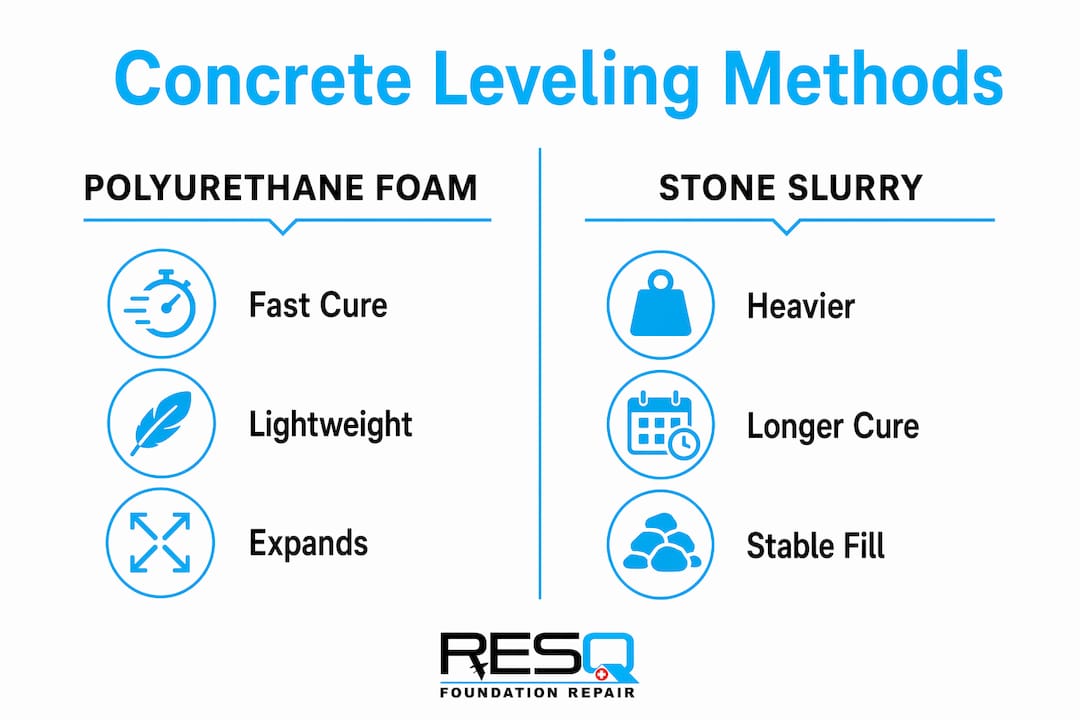
The two primary methods for parking lot concrete leveling are polyurethane foam injection and stone slurry grout injection. Both work by drilling small ports through the slab, injecting material beneath it, and allowing that material to fill voids and lift the concrete back to grade.
Polyurethane foam injection
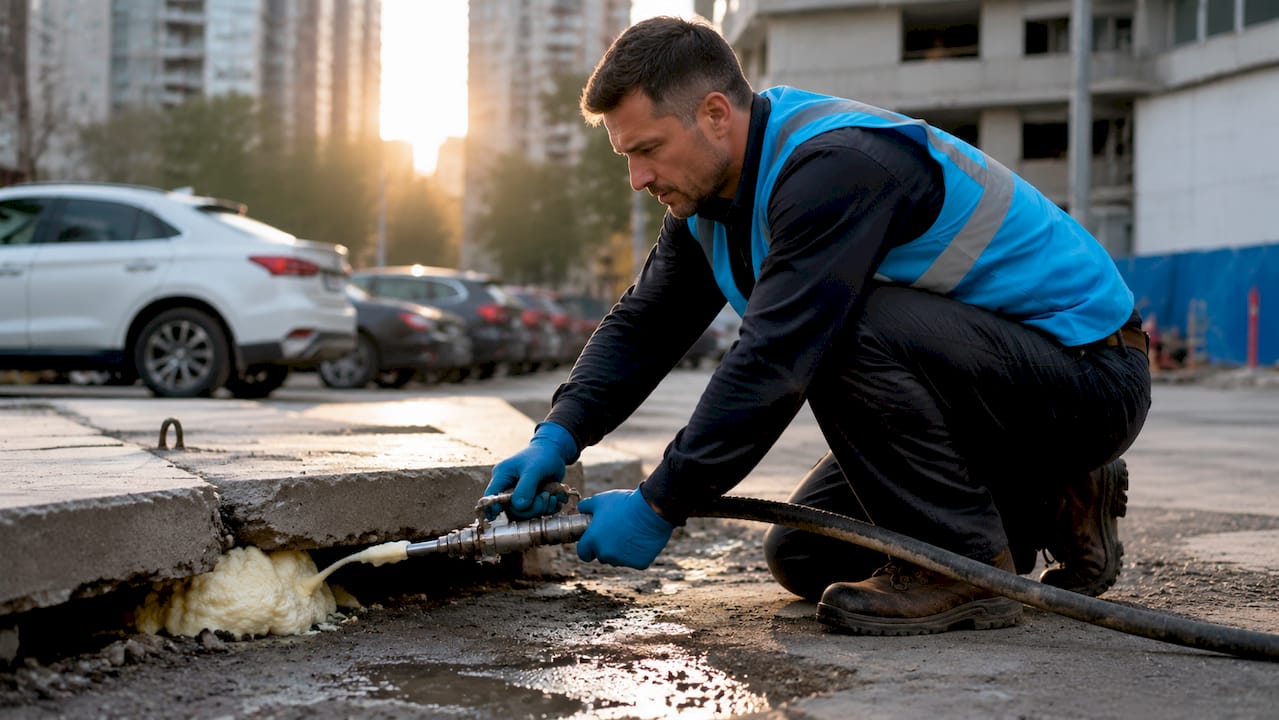
Polyurethane foam expands after injection, filling voids and exerting upward pressure on the slab. It cures fast, bonds to the subgrade, and does not wash out over time. Traffic can resume within 15–25 minutes after injection. That rapid return to service is the single biggest operational advantage for busy commercial parking areas.
Stone slurry grout injection
Stone slurry grout uses a mixture of water, stone dust, and cement. It is heavier than foam and better suited for large voids under thick slabs. Cure time is longer than foam, but the material is highly stable and resists lateral movement under heavy vehicle loads.
The standard process for either method follows these steps:
- Site assessment: A technician maps the sunken areas and identifies void locations using probing or ground-penetrating radar.
- Port drilling: Small holes (typically 5/8 inch in diameter) are drilled through the slab at calculated injection points.
- Material injection: Foam or slurry is pumped beneath the slab until it reaches the target grade.
- Grade verification: The technician checks slab height with a level after each injection sequence.
- Port patching: Injection holes are filled and finished to match the surrounding surface.
- Joint and crack sealing: All joints and cracks are sealed with commercial-grade polyurethane or silicone to block future water infiltration.
Pro Tip: Ask your contractor to seal every joint and crack after lifting, not just the ones that look damaged. Water finds the smallest opening, and unsealed joints are the most common reason a leveled slab settles again within two years.
How does concrete leveling support drainage and extend parking area lifespan?
Proper drainage is the foundation of any long-lived parking surface. When slabs settle unevenly, water pools in low spots instead of flowing toward drains or collection points. Standing water accelerates freeze-thaw damage in cold climates and softens the subgrade in warm ones.
Water infiltration through unsealed cracks causes approximately 90% of subgrade settling. That statistic reframes the entire repair conversation. Leveling without sealing is only half a fix. The water that caused the original settlement will return through the same cracks and restart the cycle.
Concrete leveling restores the original slope of the slab, directing runoff toward drains and away from building foundations. It also fills the voids beneath the slab that water was using as a pathway. Both actions reduce the rate of subgrade erosion and extend the useful life of the pavement.
Leveling sunken slabs addresses two problems at once: it removes the standing water that damages the surface and eliminates the voids beneath the slab that allow soil to wash away. Fixing only the visible surface without correcting the drainage grade leaves the root cause intact.
The connection between drainage and pavement life is direct. A slab that drains correctly experiences less thermal stress, less subgrade movement, and less joint deterioration. Property owners who level and seal their parking areas on a proactive schedule consistently get more years out of their concrete than those who wait for visible failure.
When is concrete leveling the right choice versus full replacement?
Concrete leveling works best when slabs are structurally intact and have settled less than 4 inches. Beyond that threshold, or when the slab itself is shattered, crumbling, or missing large sections, replacement is the correct call. A professional inspection is the only reliable way to confirm which category your parking area falls into.
The table below outlines the key decision criteria:
| Condition | Leveling | Replacement |
|---|---|---|
| Settlement depth | Less than 4 inches | More than 4 inches |
| Slab structural integrity | Intact, no major cracking | Shattered, crumbling, or spalled |
| Void size beneath slab | Moderate, fillable | Severe base failure |
| Surface damage | Minor cracking, joint gaps | Large missing sections |
| Timeline needed | Same day, no permit required | Multi-day, permits often required |
| Cost relative to replacement | 50%–75% less | Full cost baseline |
Concrete leveling rarely requires permits, which gives property managers the flexibility to schedule repairs during off-peak hours or overnight. Full replacement involves demolition, disposal, forming, pouring, and a curing period that keeps the area closed for days. That downtime has a real cost for any commercial property with active parking demand.
The most common mistake property owners make is waiting too long. A slab that qualifies for leveling today can deteriorate to the point of requiring replacement within one or two seasons if water continues to erode the subgrade. Early intervention is always cheaper. For a detailed breakdown of how to evaluate your specific situation, Foundationresq’s leveling vs. replacement guide walks through the decision criteria with real examples.
Key Takeaways
Concrete leveling is the most cost-effective, fastest, and least disruptive method for restoring safe, ADA-compliant, and properly draining parking areas when slabs are structurally intact.
| Point | Details |
|---|---|
| Cost savings are substantial | Leveling costs 50%–75% less than full replacement and typically finishes in one day. |
| ADA compliance is non-negotiable | Any vertical offset over 1/4 inch on an accessible route is a violation with fines up to $15,000. |
| Sealing joints is mandatory | Water infiltration causes 90% of subgrade settling; unsealed joints restart the damage cycle. |
| Drainage restoration extends pavement life | Correcting slab grade directs runoff away from foundations and reduces freeze-thaw stress. |
| Professional inspection determines eligibility | Leveling suits intact slabs with less than 4 inches of settlement; damaged slabs require replacement. |
Why I always recommend addressing the root cause before lifting
Property managers often call about a sunken slab and want it lifted as fast as possible. I understand the urgency. But the single biggest mistake I see in commercial parking repairs is lifting a slab without first fixing whatever caused it to sink.
If a drainage pipe is leaking beneath the slab, or if the lot grades toward the building instead of away from it, the foam or grout you inject will simply wash out over the next two seasons. You will be back to the same problem, having spent money twice. Addressing drainage and site grading before leveling is what separates a permanent repair from a temporary fix.
My other strong opinion: seal every joint after lifting, not just the cracks you can see. Polyurethane and silicone joint sealants are inexpensive relative to the cost of re-leveling. Skipping that step to save a few hundred dollars is a false economy that almost always costs more later.
Proactive leveling, done correctly with root cause resolution and proper sealing, is one of the best risk management investments a property owner can make. It keeps your lot compliant, your visitors safe, and your repair budget predictable.
— Kayle
Foundationresq’s concrete leveling services for parking areas
Foundationresq specializes in concrete leveling services for property owners and managers across the Tallahassee area. The team uses polyurethane foam injection to lift sunken slabs, fill voids, and restore proper drainage grades with minimal disruption to your operations.
Most parking area leveling projects are completed in a single visit, with traffic returning to the repaired surface within 30 minutes. Foundationresq handles the full process from site diagnostics to joint sealing, so you get a repair that lasts. Explore the full range of concrete repair and foundation services or request a free inspection to find out whether your parking area qualifies for leveling.
FAQ
What is the role of concrete leveling in parking areas?
Concrete leveling restores sunken or uneven slabs to their original grade, eliminating trip hazards, restoring ADA compliance, and correcting drainage patterns. It is the primary method for repairing settled parking lot concrete without full replacement.
How long does it take for traffic to return after leveling?
Traffic can resume within 15–25 minutes after polyurethane foam injection. Stone slurry grout requires a longer cure time, but most parking areas reopen the same day.
How do I know if my parking lot needs leveling or replacement?
Leveling is appropriate when slabs are structurally intact and have settled less than 4 inches. Shattered slabs, large missing sections, or severe base failure require full replacement. A professional inspection confirms which repair is correct.
Does concrete leveling require a permit?
Concrete leveling rarely requires local permits, which allows property managers to schedule repairs during off-hours and complete the work faster than a full replacement project.
Why does leveled concrete sometimes settle again?
Re-settling usually happens when the root cause was not fixed before lifting. Water infiltration through unsealed cracks causes approximately 90% of subgrade settling, so sealing all joints after leveling is critical to long-term success.
Recommended
- The Best Way to Level a Concrete Patio: 2026 Homeowner’s Guide
- Concrete Leveling in Tallahassee: The Homeowner’s 2026 Guide to PolyRenewal® – Tallahassee Foundation Repair | Foundation ResQ
- Polyurethane Concrete Lifting: Pros, Cons, and How It Works – Tallahassee Foundation Repair | Foundation ResQ
- Fixing Uneven Concrete Driveways in Tallahassee: A Complete Repair Guide – Tallahassee Foundation Repair | Foundation ResQ