
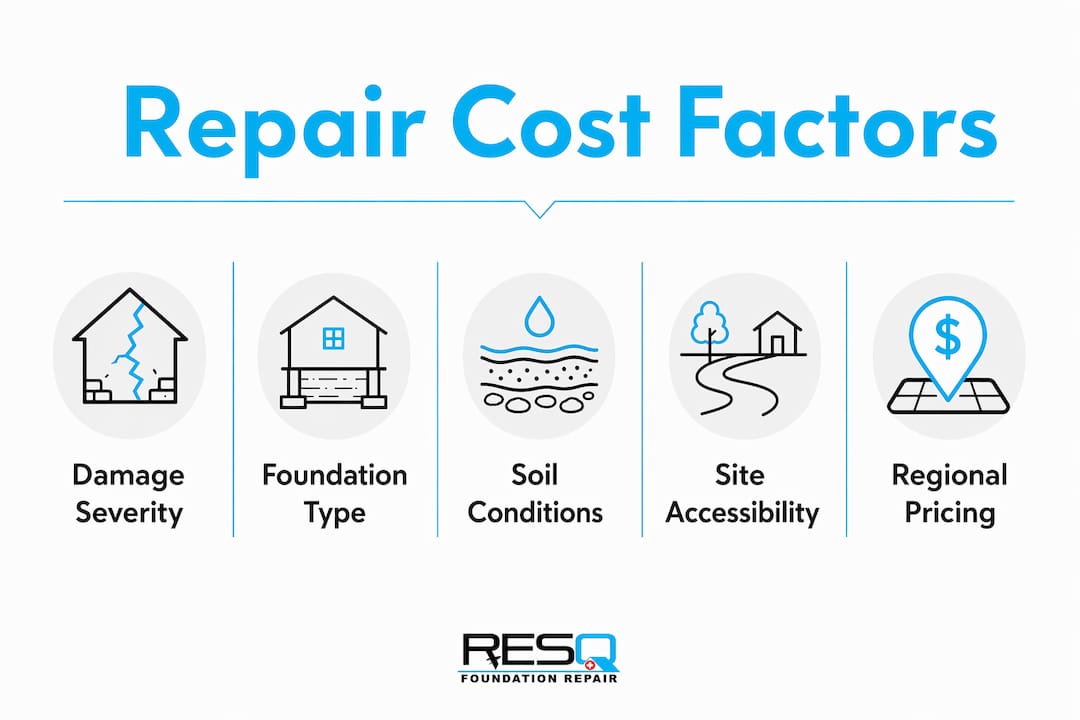
Foundation repair cost is determined by five core factors: damage severity, foundation type, soil conditions, site accessibility, and regional labor pricing. The national average for residential foundation repair runs $5,000–$12,000, while major underpinning projects reach $15,000–$30,000 or more. Knowing what affects foundation repair cost before you call a contractor puts you in control of the conversation, the scope, and the budget. This guide breaks down each pricing factor with real numbers so you can plan accurately and compare estimates without getting burned.
How damage severity and foundation type affect repair pricing
Damage severity is the single biggest driver of foundation repair pricing. Minor crack sealing costs a few hundred dollars, while full structural underpinning can exceed $50,000. The gap exists because more severe damage requires more piers, deeper excavation, and longer labor hours.
Foundation type shapes which repair methods are even available, and that directly affects price. The three most common residential foundation types each carry different cost profiles:
- Concrete slab foundations are the most common in the South and Gulf Coast. Slab repairs typically involve mudjacking, polyurethane foam injection, or pier installation beneath the slab. Costs range from $1,500 for minor leveling to $15,000+ for full pier systems.
- Pier-and-beam foundations are common in older homes and areas with expansive soils. Access to the crawl space makes some repairs easier, but replacing deteriorated beams or adding new piers still runs $4,000–$12,000.
- Basement foundations are more common in the Northeast and Midwest. Wall bowing, cracking, and water intrusion require carbon fiber straps, wall anchors, or full excavation. Costs for basement wall repair range from $3,000 to $30,000 depending on extent.
Pro Tip: Request a written description of the repair method alongside any quote. Two bids at the same price may use completely different methods with very different long-term outcomes.
The table below gives a practical cost reference by foundation type and damage level.
| Foundation type | Minor damage | Moderate damage | Severe damage |
|---|---|---|---|
| Concrete slab | $500–$2,500 | $3,000–$8,000 | $10,000–$25,000+ |
| Pier-and-beam | $1,000–$4,000 | $4,000–$10,000 | $12,000–$30,000+ |
| Basement | $1,500–$5,000 | $5,000–$15,000 | $15,000–$50,000+ |
Per-square-foot pricing for foundation repair runs $1.50–$12 nationally. That wide range reflects the difference between a simple crack fill and a full pier-and-beam replacement.
How do soil conditions and site accessibility raise costs?
Soil type is a cost multiplier that most homeowners never see coming. Expansive clay soils require deeper piers, often reaching 15–30 feet to hit stable ground. More depth means more material, more labor, and a higher final bill compared to sandy or loam soils where piers may only need to go 8–12 feet.
Soil reports cost $500–$1,500 and are worth every dollar before a major repair. A soil report tells the engineer exactly how deep piers need to go and how many are required. Without one, contractors make assumptions, and those assumptions often lead to under-designed repairs that fail within a few years.
Site accessibility is the second hidden cost driver. Interior pier installation through finished flooring adds significant labor and restoration costs that many initial quotes exclude. Cutting through tile, hardwood, or concrete, then restoring those surfaces after the repair, can add $500–$2,000 to the project total.
Common accessibility issues that raise costs include:
- Mature landscaping or tree roots near the foundation perimeter
- Fences, decks, or outbuildings blocking equipment access
- Finished basement or crawl space interiors requiring protection during work
- Narrow side yards that prevent machinery from reaching the repair zone
Protecting finished surfaces during repair is part of the accessibility cost, not just physical site preparation. A contractor who quotes without walking the full perimeter is almost certainly leaving line items out.
Pro Tip: Ask every contractor to walk the full property before quoting. A site-specific evaluation catches access issues early and prevents surprise charges mid-project.
Does your location change what you pay for foundation repair?
Geographic location affects foundation repair cost by 20–40% depending on the region. That swing reflects differences in labor rates, material costs, permit fees, and the climate-driven repair methods each region demands.
Gulf Coast states like Florida, Texas, and Louisiana tend to have lower labor costs and high contractor competition, which keeps prices closer to the national average. The Northeast and Pacific Northwest run higher due to union labor rates, stricter permitting, and more complex soil conditions from freeze-thaw cycles.
| Region | Relative cost level | Primary cost driver |
|---|---|---|
| Gulf Coast (FL, TX, LA) | Below average | High contractor competition |
| Southeast (GA, SC, NC) | Near average | Clay soil, moderate labor rates |
| Midwest (IL, OH, MI) | Near to above average | Freeze-thaw cycles, basement repairs |
| Northeast (NY, MA, CT) | Above average | Union labor, strict permitting |
| Pacific Northwest (WA, OR) | Above average | Wet soil conditions, higher wages |
Local climate also dictates which repair methods contractors use most. In Tallahassee and the broader Gulf Coast, foundation repair contractors deal primarily with clay soil expansion and contraction driven by seasonal moisture swings. That pattern demands more piers at greater depths than the same square footage of home would require in a drier climate.
Getting a local estimate from a contractor who works specifically in your market gives you a more accurate baseline than any national average. National figures are useful for context, but your actual cost depends on your zip code.
What additional costs do homeowners miss when budgeting?
Structural repairs are only part of the total bill. Several additional cost categories catch homeowners off guard when the final invoice arrives.
Engineering and permitting fees are the most commonly overlooked line items. Structural engineering design plans cost $300–$800, and permits run $100–$500 depending on the municipality. Independent inspections can reach $1,200 but give you an unbiased assessment of the repair scope before you commit to a contractor.
Drainage and waterproofing are frequently required alongside structural repairs. Drainage and waterproofing systems cost $800–$15,000 depending on severity. A complete interior drainage system runs roughly $2,800–$6,500. Skipping drainage when it is part of the root cause means the foundation problem returns, and you pay twice.
Moisture control should be budgeted as part of root-cause repairs to prevent recurring damage. This is not an optional upgrade. It is a structural necessity in moisture-prone regions like North Florida.
Cosmetic restoration is the final budget gap. Drywall and tile repair after structural work adds $2,000–$10,000 to the total. Most contractor quotes cover structural work only. Finish restoration is a separate line item that homeowners often discover only after signing the contract.
A realistic total project budget should include:
- Structural repair (piers, wall anchors, crack injection)
- Soil report and engineering fees
- Permits and inspections
- Drainage and waterproofing if moisture is a contributing factor
- Interior and exterior finish restoration
Costs escalate significantly when drainage and structural stabilization overlap. Plan for both from the start rather than adding drainage as a reactive afterthought.
How do you get accurate foundation repair estimates?
Accurate estimates start with a clear, documented scope. Define the scope with photos and measurements before any contractor visits. Walk the property yourself, photograph every crack, note where floors slope, and measure any visible gaps around doors or windows. This documentation prevents contractors from quoting different problems and makes bids directly comparable.
Request a good-better-best pricing structure from each contractor. This approach shows you the minimum viable repair, the recommended repair, and the full solution. It also reveals how each contractor thinks about your specific problem, which tells you a lot about their experience.
Pier count and depth assumptions drive bid differences. One contractor may quote 8 piers at 12 feet while another quotes 12 piers at 20 feet. Both may be priced similarly, but the second design is far more thorough. Ask every contractor to provide their pier count, pier depth, and the engineering basis for those numbers.
Common pitfalls that produce unreliable bids:
- Contractor quotes without a site visit or soil assessment
- No mention of drainage or waterproofing when moisture is visible
- Scope excludes finish restoration costs
- No engineering specs attached to the proposal
- Unusually low bid with no explanation of what was excluded
Pro Tip: Get at least three bids and ask each contractor to explain what the lowest bid is missing. The answer tells you more than the price itself.
The foundation repair cost estimator from Foundationresq gives homeowners a structured starting point before the first contractor call.
Key Takeaways
Foundation repair cost is controlled by damage severity, foundation type, soil conditions, site access, regional pricing, and the full scope of engineering, drainage, and cosmetic restoration costs.
| Point | Details |
|---|---|
| Damage severity drives cost most | Minor crack repair costs hundreds; full underpinning runs $15,000–$30,000 or more. |
| Foundation type shapes repair options | Slab, pier-and-beam, and basement foundations each require different methods at different price points. |
| Soil and access add hidden costs | Clay soils and interior pier access can add $500–$2,000 beyond the base structural quote. |
| Location shifts pricing by 20–40% | Gulf Coast markets run lower; Northeast and Pacific Northwest run significantly higher. |
| Budget beyond structural repairs | Engineering, permits, drainage, and cosmetic restoration routinely add $5,000–$15,000 to total project cost. |
What I have learned from watching homeowners budget for foundation repairs
The most expensive foundation repairs I have seen were not caused by bad soil or old homes. They were caused by delayed action and incomplete first repairs. A homeowner who fixes the structural issue but ignores the drainage problem will be back in two or three years spending the same money again, sometimes more.
The second pattern I keep seeing is homeowners comparing bids on price alone. A $9,000 bid and a $14,000 bid for the same house are almost never quoting the same repair. The cheaper bid usually has fewer piers, shallower depths, or no drainage component. When you ask the right questions, the price difference explains itself.
My honest recommendation: treat the engineering evaluation as non-negotiable. A $500–$800 structural engineer report is the best money you will spend on a foundation project. It gives you an independent scope, it makes contractor bids directly comparable, and it protects you if the repair does not perform as promised.
Early detection is the other lever homeowners control. Severity of damage strongly influences repair scope. A crack caught at 1/8 inch costs a fraction of what the same crack costs at 1/2 inch two years later. Annual inspections are cheap. Deferred repairs are not.
— Kayle
How Foundationresq helps you manage foundation repair costs
Foundationresq serves homeowners across the Tallahassee area with foundation repair, basement waterproofing, crawl space encapsulation, concrete leveling, and mold removal. Every project starts with a free inspection so you know exactly what you are dealing with before any money changes hands.
The team at Foundationresq provides itemized estimates that cover structural repairs, drainage requirements, and finish restoration so there are no surprises after the work begins. Financing options are available to help spread the cost of larger projects. Visit the full services page to see the complete range of repair solutions, or explore foundation repair financing to find a payment plan that fits your budget.
FAQ
What is the average cost of foundation repair?
The national average for residential foundation repair runs $5,000–$12,000. Major underpinning projects cost $15,000–$30,000 or more depending on pier count, depth, and site conditions.
Why does foundation type affect repair price?
Each foundation type requires different repair methods. Concrete slabs need foam injection or piers from below, while basement walls may need carbon fiber straps or full excavation, each carrying different labor and material costs.
How much do soil conditions add to foundation repair costs?
Expansive clay soils require piers at 15–30 feet depth, raising both material and labor costs substantially. Soil reports cost $500–$1,500 and are the most reliable way to determine actual pier requirements before work begins.
What costs do most foundation repair quotes leave out?
Most quotes exclude engineering fees ($300–$800), permits ($100–$500), drainage systems ($800–$15,000), and cosmetic restoration ($2,000–$10,000). Always ask contractors to confirm what is and is not included in their written proposal.
How do I compare foundation repair estimates fairly?
Request the pier count, pier depth, and engineering basis from every contractor. Ask each one to explain what the lowest competing bid excludes. A detailed repair scope with photos and measurements makes bids directly comparable.