What structural repair ROI actually means for your home
Structural repair ROI is the percentage of repair costs you recover through preserved or increased home value after fixing foundation, crawl space, or moisture-related issues. The standard formula, drawn from the Remodeling Magazine Cost vs. Value Report, is: [(value added − project cost) ÷ project cost] × 100%. A 100% ROI means you recovered every dollar spent in your resale price.
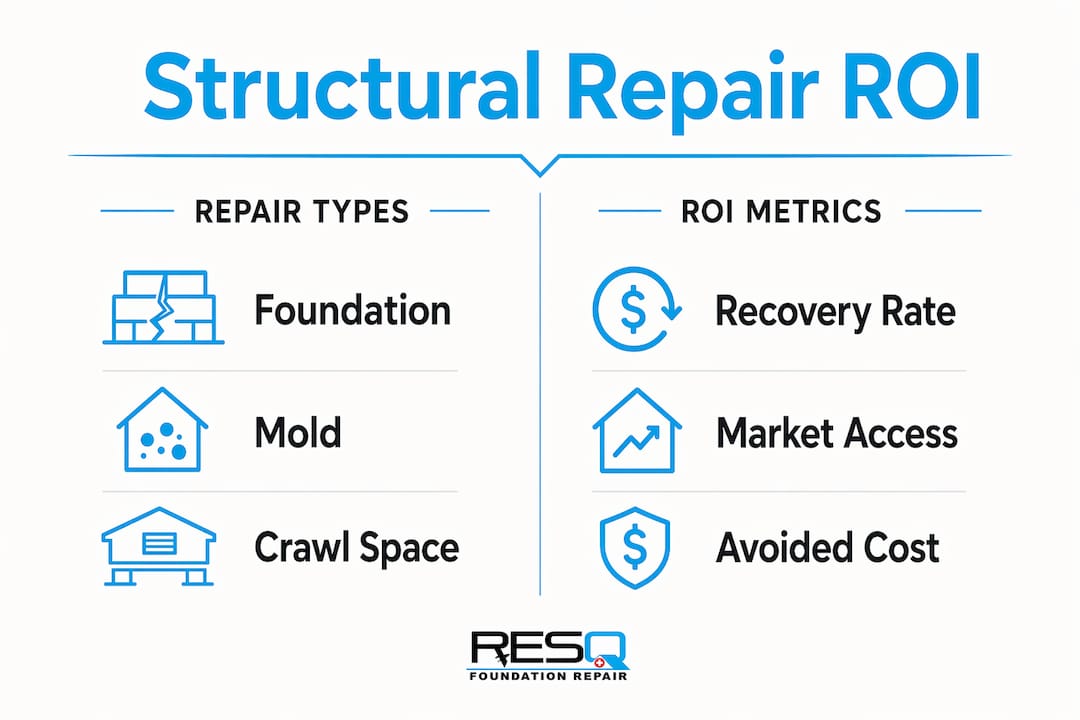
What separates structural repair ROI from kitchen or bathroom upgrades is its defensive nature. You are not adding luxury value. You are recovering value that foundation damage, mold, or water intrusion already stripped away. The recovery rates for key structural interventions vary, with mold remediation, crawl space encapsulation, termite remediation, and foundation crack repair all showing strong recovery rates—107% for mold remediation, 93% for crawl space encapsulation and termite remediation, and 89% for foundation crack repair, based on industry data.
These numbers reflect what buyers and appraisers actually reward. Foundationresq focuses on exactly these repair categories, which is why understanding the ROI of each one matters before you spend a dollar.
Table of Contents
- How much do structural repairs cost, and what drives the price?
- How structural repairs change what buyers and lenders see
- How to calculate ROI for foundation and structural repairs
- What happens financially when you delay structural repairs
- Making smarter investment decisions to maximize structural repair ROI
- Calculating ROI for foundation and structural repairs
- Different ways to measure ROI across repair types
- Real-world ROI outcomes from structural repairs
- Long-term maintenance costs and their effect on ROI
- Foundationresq protects your home’s value from the ground up
- Key Takeaways
- FAQ
How much do structural repairs cost, and what drives the price?
Foundation repair costs vary widely depending on the severity, from minor fixes costing a few thousand dollars to major underpinning work and full foundation replacements costing tens of thousands of dollars.

| Severity | Typical Cost Range | Common Examples |
|---|---|---|
| Minor | Costs for sealing hairline cracks and minor drainage fixes | |
| Moderate | Costs for wall reinforcement, pier additions, and leak repair | |
| Major | Costs for extensive pier systems and full foundation replacement |
Several factors push costs up or down:
Several factors influence foundation repair costs, including foundation type, severity of damage, soil conditions, accessibility, and local labor rates. It is also common to budget extra to cover collateral damage like drywall or flooring disturbed during repairs.
How structural repairs change what buyers and lenders see
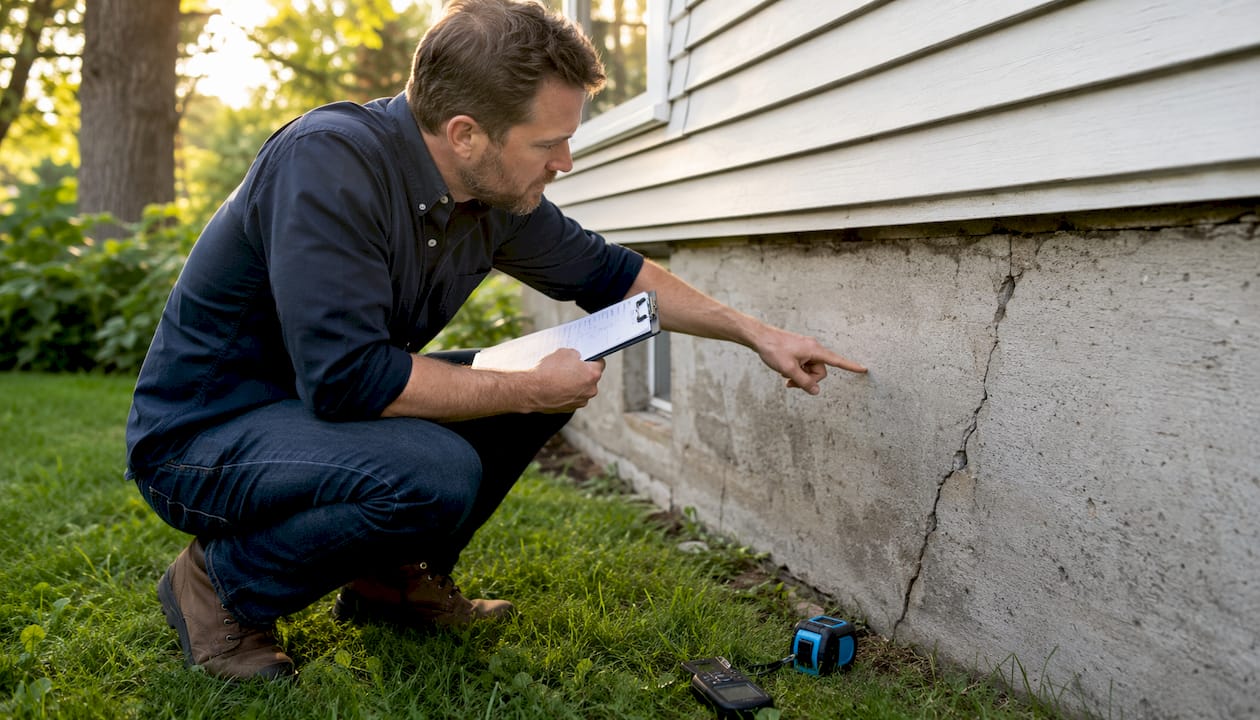
Unrepaired foundation problems can significantly reduce home value and cause some buyers to walk away entirely. Lenders frequently decline to approve mortgages on structurally compromised homes, which shrinks your buyer pool to cash-only offers at steep discounts.
Professional repairs often recover most of the lost home value and restore access to various financing options.
Structural repairs act as market access keys. A home with unresolved foundation issues often cannot be financed at all, regardless of its price. Fixing the problem does not just raise the number on the appraisal. It determines whether a transaction can happen.
The buyer confidence effect is real and measurable:
- Homes with documented repairs sell faster than those with disclosed but unresolved issues.
- Appraisers factor structural risk into valuations; an engineer’s stamped report removes that uncertainty.
- Buyers today ask about foundations. Showing receipts and a transferable warranty converts a liability into a selling point.
How to calculate ROI for foundation and structural repairs
The formula is straightforward: [(value added − project cost) ÷ project cost] × 100%. Walk through a realistic example. Say your home’s market value dropped $25,000 because of foundation settlement. You spend $12,000 on professional pier installation. After repairs, the appraised value recovers $22,000 of that loss.
ROI = [($22,000 − $12,000) ÷ $12,000] × 100% = 83.3% (While this specific example shows 83.3%, the most recent industry data reports average recovery rates of 107% for mold remediation, 93% for crawl space encapsulation and termite remediation, and 89% for foundation crack repair.)
That is a strong return for a repair that also restores financing eligibility. A few factors shape whether your actual outcome lands higher or lower:
- Repair quality: Engineered systems with professional installation outperform surface-level fixes every time. Cosmetic repairs do not resolve structural issues and can actually reduce buyer trust when discovered during inspection.
- Documentation: An engineer’s stamped survey and a transferable lifetime warranty convert perceived risk into a tangible market advantage.
- Market conditions: In a competitive seller’s market, recovered value tends to be higher. In a slow market, the primary gain is removing deal-killer obstacles rather than adding premium.
- Scope accuracy: ROI calculations that ignore collateral repair costs overstate returns. Budget the full project, including the 15–25% contingency, before running the numbers.
Pro Tip: Get a structural engineer’s inspection report before soliciting contractor quotes. It gives you an unbiased scope of work, helps you compare bids accurately, and becomes part of the documentation package that supports your resale value.
What happens financially when you delay structural repairs
Waiting costs more than fixing the problem now. Foundation damage does not stabilize on its own. Active movement accelerates, cracks widen, and water intrusion compounds into mold and wood rot. What starts as a $3,000 repair can become a $20,000 overhaul.
The financial consequences of delay extend beyond repair bills:
- Buyers who discover active movement during inspection typically demand a 10–30% price concession or walk away.
- Insurance carriers may deny coverage or increase premiums on homes with known unresolved structural issues.
- Mortgage refinancing becomes difficult or impossible when an appraisal flags structural concerns.
- Collateral damage accumulates: water intrusion leads to mold, mold spreads to framing, and framing damage adds thousands to the repair scope.
Pro Tip: Schedule a professional inspection at the first sign of trouble, whether that is sticking doors, diagonal cracks above windows, or uneven floors. Catching a problem at the $1,000–$3,000 stage versus the $20,000+ stage is the single highest-ROI decision you can make.
Making smarter investment decisions to maximize structural repair ROI
Not all repairs deliver equal returns, and the order in which you address them matters. Structural repairs that remove deal-killer issues, such as active foundation movement, water intrusion, or mold, should come before any cosmetic upgrade. A fresh kitchen does nothing for a buyer whose lender flags a compromised foundation.
Practical steps that protect your structural repair investment return:
- Hire licensed contractors with documented experience in engineered structural systems, not general contractors who subcontract the work.
- Obtain warranties that are transferable to the next buyer. This single document often does more for buyer confidence than the repair itself.
- Budget the full scope upfront, including the 15–25% contingency for collateral repairs. Mid-project surprises erode ROI fast.
- Time repairs strategically. Completing structural work 6–12 months before listing gives you time to document outcomes and address any secondary issues before they show up on inspection.
- Keep all paperwork. Engineer reports, permits, contractor invoices, and warranty documents form the evidence package that appraisers and buyers rely on.
Structural repair ROI is also about mortgage and insurance eligibility. A repaired home qualifies for conventional financing. An unrepaired one may not qualify at all, which limits your exit options and your equity access.
Pro Tip: Documented repairs are not just value enhancers. They are market access keys. A transferable warranty and an engineer’s stamped report can mean the difference between a full-price conventional sale and a cash-only distressed sale at a steep discount.
Calculating ROI for foundation and structural repairs
The ROI calculation for foundation work follows the same formula as any home improvement, but the inputs require more care. You need three numbers: the pre-repair value loss attributable to the structural issue, the total project cost including collateral repairs, and the value recovered after professional repair.
For return on foundation repair, the value recovery figure should come from a licensed appraiser or a comparative market analysis, not a contractor’s estimate. Contractors quote repair costs; appraisers measure value impact. Using both gives you a defensible ROI figure you can present to buyers and lenders.
Different ways to measure ROI across repair types
Not every structural repair delivers ROI the same way. Three measurement approaches are worth knowing:
Resale recovery rate compares the repair cost to the value added at sale. Mold remediation’s 107% recovery rate means the average homeowner recoups more than the repair cost in resale price. Crawl space encapsulation and termite remediation each recover 93% of costs, based on national data.
Market access value measures whether the repair restores financing eligibility. A $10,000 foundation repair that converts a cash-only sale into a conventional-financed sale at full market value can represent $30,000–$50,000 in realized value, even if the appraised number only moves modestly.
Avoided cost ROI calculates what you save by repairing now versus later. A $3,000 repair today that prevents $18,000 in future damage represents a 500% avoided-cost return, though it does not show up on a resale appraisal.
Each method captures a different dimension of structural repair investment return. Using all three gives you the clearest picture of whether a repair makes financial sense.
Real-world ROI outcomes from structural repairs
Consider a homeowner in a mid-tier US market whose home appraised at $280,000 before foundation settlement was discovered. The appraiser flagged a $35,000 value reduction. After a $14,000 pier installation and $3,500 in collateral drywall repairs, the total project cost was $17,500. The post-repair appraisal recovered $30,000 of the lost value.
ROI: [($30,000 − $17,500) ÷ $17,500] × 100% = 71.4%
The home also qualified for conventional financing again, expanding the buyer pool from cash-only to the full market. That market access shift is worth more than the appraisal number alone suggests.
A second scenario: a homeowner addresses mold remediation at $4,500 before listing. The repair recovers $4,815 in resale value (107% recovery rate) and removes a disclosure issue that had been causing buyers to walk. The home sells in 12 days versus the 90-day average for comparable homes with unresolved mold disclosures. Time on market is a real cost, and structural repairs reduce it.
Long-term maintenance costs and their effect on ROI
Structural repairs are not one-and-done investments. The long-term ROI picture includes ongoing maintenance costs that, if ignored, can erode the value you recovered.
After foundation repair, annual maintenance typically involves monitoring drainage, checking for new cracks, and maintaining gutters and grading to keep water away from the foundation. These costs are modest, often $200–$500 per year, but skipping them allows the original conditions to return.
Crawl space encapsulation and crawl space waterproofing require periodic inspection of vapor barriers and drainage systems, typically every 1–3 years. Dehumidifier maintenance in encapsulated spaces adds a small annual cost but prevents the moisture conditions that lead to mold and wood rot.
The key insight: structural repairs deliver their highest long-term ROI when paired with a maintenance plan. A repaired foundation that is monitored and maintained holds its value. One that is repaired and then neglected can develop new issues within 5–10 years, requiring another round of costly intervention.
Storm damage is a related risk. Addressing storm-related structural damage quickly reduces repair costs significantly, the same principle that applies to foundation and moisture issues: early action preserves ROI.
Foundationresq protects your home’s value from the ground up
When foundation damage, crawl space moisture, or mold is threatening your home’s value, the difference between recovering 85–95% of lost value and losing it permanently often comes down to who does the work and how it is documented. Foundationresq specializes in exactly the repairs that deliver the highest structural ROI: foundation repair, crawl space encapsulation, basement waterproofing, concrete leveling, and mold remediation, all backed by engineered systems and professional documentation.
Every repair Foundationresq completes comes with the paperwork that buyers, appraisers, and lenders need: engineer reports, warranties, and a clear record of the work performed. That documentation is what converts a repaired home from a question mark into a confident purchase. Foundationresq also offers financing options so the upfront cost of protecting your investment does not have to come all at once.
Schedule a free inspection to get a clear picture of your home’s structural condition and a realistic estimate of what repair and recovery look like for your specific situation.
Key Takeaways
Structural repair ROI is primarily defensive: it recovers value already lost to foundation damage, mold, or water intrusion rather than adding cosmetic premium, with recovery rates reaching 107% for mold remediation and 89% for foundation crack repair.
| Point | Details |
|---|---|
| ROI formula | Use (value added − project cost) ÷ project cost × 100% to calculate your structural repair return. |
| Recovery rates | Mold remediation recovers 107% of costs; crawl space encapsulation and termite remediation each recover 93%, and foundation crack repair recovers 89%. |
| Delay costs money | Unrepaired foundation issues cause 10–30% buyer price concessions and can block conventional financing entirely. |
| Budget the full scope | Add 15–25% above repair quotes for collateral damage like drywall and tile to get an accurate ROI calculation. |
| Foundationresq | Provides engineered foundation, crawl space, and mold repairs with full documentation to maximize resale recovery and financing eligibility. |
FAQ
What is a good ROI for structural repairs?
Recovery rates of 85–107% are common for professional structural repairs, with mold remediation averaging 107%, crawl space encapsulation and termite remediation each averaging 93%, and foundation crack repair averaging 89%. Any repair that restores financing eligibility and removes deal-killer inspection issues delivers strong ROI regardless of the percentage.
How much does structural damage repair typically cost?
Foundation repair costs vary widely depending on severity, from minor fixes costing a few thousand dollars to major underpinning work and full foundation replacements costing tens of thousands of dollars. Budget an additional 15–25% for collateral repairs like drywall or flooring.
What does a 7% ROI mean for a structural repair?
ROI means the percentage of repair costs you recover through preserved or increased home value after fixing foundation or moisture-related issues. For structural work, a net return above costs below industry averages is modest; most professional structural repairs targeting deal-killer issues deliver significantly higher recovery rates.
Is foundation repair worth it if I’m not selling soon?
Yes. Foundation damage worsens over time, and early repairs prevent far more expensive future work. A $3,000 repair today can prevent a $20,000 overhaul later, and maintaining structural integrity protects your ability to refinance, insure, and eventually sell at full market value.
How do documented repairs affect my home’s resale value?
Documented repairs with licensed contractors and transferable warranties typically recover 85–95% of lost value and restore access to conventional, FHA, and VA financing, expanding your buyer pool and reducing time on market. According to the latest industry data, mold remediation averages a 107% recovery rate, crawl space encapsulation and termite remediation each average 93%, and foundation crack repair averages 89%.