
Standing water isn’t the first sign of a failing crawl space; it’s often the final warning before a structural crisis. In our humid Tallahassee climate, moisture is a persistent threat that works quietly beneath your feet. You’ve likely felt a sense of unease when a heavy Florida rain leaves a lingering musty odor in your living room or when you notice your hardwood floors beginning to cup. It’s stressful to wonder if these small changes are actually early signs of water damage in crawl space areas that could lead to significant foundation failure.
According to research by Angi, roughly 20% of homeowners with foundation concerns report excessive dampness as a primary issue. We understand these concerns and provide the steady, professional guidance you need to protect your property. This guide offers a clear checklist to help you identify both subtle and obvious indicators of moisture intrusion. You’ll learn the specific risks of delaying repairs and discover how to implement permanent solutions, such as crawl space encapsulation or professional dehumidification, to ensure your home remains stable and dry for the long term.
Key Takeaways
- Understand why Tallahassee’s high water table and intense storms create a unique environment for groundwater seepage beneath your home.
- Identify the five critical signs of water damage in crawl space environments, including the presence of muddy soil and persistent indoor odors.
- Learn how the “Stack Effect” compromises your indoor air quality and why excess moisture often leads to higher monthly cooling costs.
- Utilize a safe homeowner checklist to distinguish between routine humidity and serious structural threats that require professional attention.
- Explore permanent remedies like crawl space encapsulation and sump pump systems to establish a lasting protective barrier for your foundation.
Understanding Crawl Space Water Dynamics in Tallahassee
Tallahassee presents a unique set of challenges for any homeowner. Our region is famous for its rolling hills and lush canopy, but beneath that beauty lies a complex geological environment. The combination of high annual rainfall and a high water table means the area under your home is under constant environmental stress. While many people only worry about moisture when they see a puddle, the reality is that water moves in multiple ways. It can seep upward from the ground, rush in from the surface, or simply hang in the air as heavy humidity.
Many homeowners struggle to identify the early signs of water damage in crawl space areas because the damage often begins out of sight. When Understanding Crawl Spaces and their role in your home’s ecosystem, you’ll see they are meant to provide ventilation and access. However, in North Florida, an open crawl space often acts like a sponge. Our humidity levels frequently exceed 90%, which means the air itself carries enough moisture to rot wood and support mold growth without a single drop of liquid water ever touching your floor joists.
The Impact of Tallahassee Soil on Your Foundation
Tallahassee is well known for its dense, red clay soil. This material is excellent for local pottery, but it’s difficult for foundation drainage. Clay is non-porous and holds onto moisture for long periods. When it rains, the clay around your foundation expands, putting immense pressure on your walls. As the soil dries, it shrinks, leaving gaps that allow the next storm’s water to flow directly toward your home. This cycle of expansion and contraction creates the perfect conditions for structural instability and moisture intrusion.
Surface Runoff vs. Groundwater Infiltration
There’s a big difference between water that comes from your gutters and water that rises from the earth. During our heavy summer thunderstorms, standard yard drainage systems are often overwhelmed. If your downspouts aren’t clear or the grading around your home has settled, surface runoff will pool against your foundation. Groundwater infiltration is different. Because of our high water table, the ground itself can become saturated from below. This forces liquid water through microscopic cracks in your foundation. Even if your yard looks dry on top, the soil inches below the surface might be soaked, leading to the first signs of water damage in crawl space structures like wooden joists and support piers.
5 Critical Signs of Water Damage in Your Crawl Space
Identifying the signs of water damage in crawl space environments requires looking beyond the obvious. While standing water after a heavy Tallahassee storm is a clear red flag, many indicators are much more subtle. These signals often manifest in your living area before you ever step foot under the house. Muddy soil is another major concern. When the ground beneath your home is constantly saturated, it loses its load-bearing capacity. This often leads to support piers sinking, which creates a chain reaction of structural issues. Ignoring these early warnings can lead to long term foundation instability and expensive remediation.
Identifying Wood Rot and Structural Decay
Sagging or bouncy floors in your living room aren’t just a cosmetic annoyance. They are often the result of moisture saturating your wooden floor joists. When wood absorbs water, its structural integrity vanishes. This leads to wood rot, which causes the joists to compress or “sag” under the weight of your home. If you notice a particular spot in your hallway that feels springy, it’s a sign that the support piers or beams below are failing due to decay. This structural compromise often requires professional foundation repair to stabilize the home and prevent further sinking.
The Telltale Sign of Efflorescence
Check your masonry walls or foundation blocks for a white, powdery substance. This is called efflorescence. It occurs when groundwater seeps through the porous concrete. As the water evaporates on the interior side of the wall, it leaves behind salt deposits. It’s a definitive indicator that liquid water is moving through your foundation walls, even if you don’t see a puddle. This process can eventually weaken the concrete blocks, leading to cracks and further moisture intrusion.
Indoor Air Quality and Musty Smells
Musty odors that linger in your living room are a classic symptom of the “stack effect.” Warm air rises and escapes through your attic, creating a vacuum that pulls air from the crawl space upward into your home. If your crawl space is damp, that humid, moldy air becomes the air you breathe. A survey by Angi found that 15% of homeowners with foundation issues specifically report mold, mildew, or fungus. If you smell earth or rot after a rain, it’s a primary indicator of moisture. Visible mold growth on your floor joists is the final stage of this process, indicating that the humidity levels have been high enough to support organic growth for an extended period.
The Hidden Costs: How Moisture Impacts Your Living Space
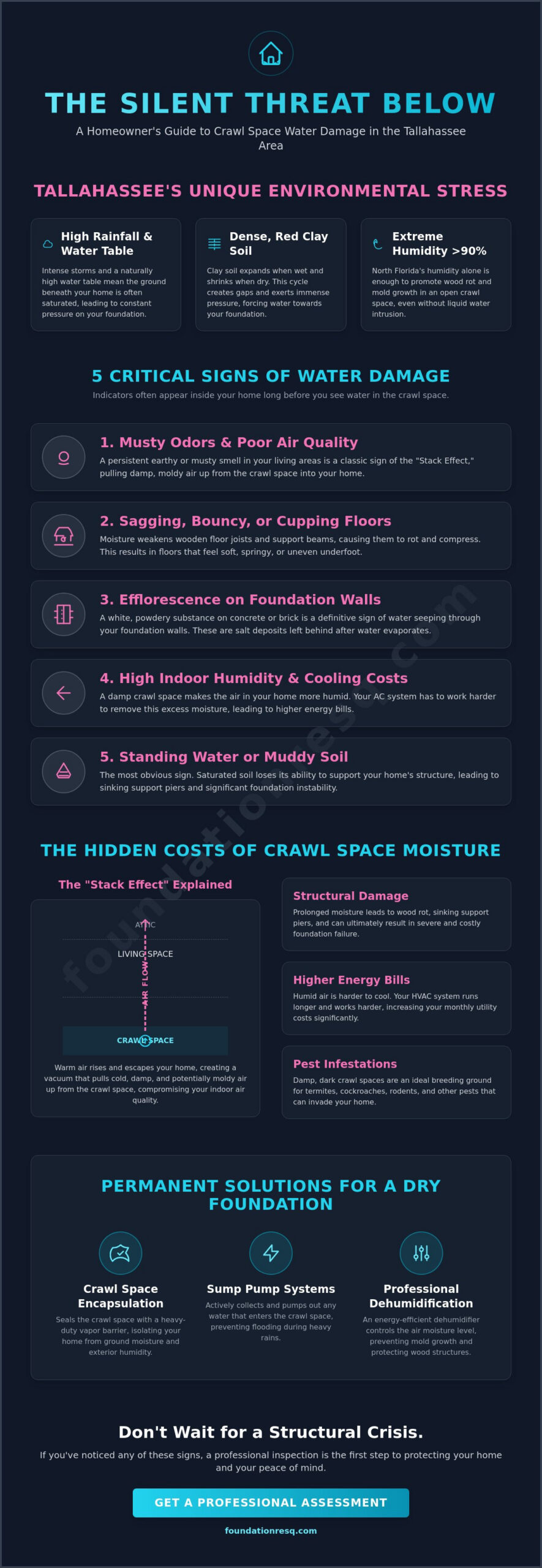
A damp crawl space isn’t just a structural concern; it’s a financial and health burden that affects your entire home. While the physical signs of water damage in crawl space environments are often hidden from view, the consequences are felt in every room above. The most significant driver of these issues is a phenomenon known as the “stack effect.” As warm air rises and escapes through your attic, it creates a vacuum that pulls air from the lowest point of your home upward. In many cases, up to 50% of the air you breathe in your living room actually originated in your crawl space.
This upward airflow carries more than just moisture. It transports allergens, odors, and microscopic particles that compromise your indoor environment. Beyond air quality, moisture actively destroys the materials designed to protect your home. Fiberglass insulation is particularly vulnerable. Unlike closed-cell foam, fiberglass batts absorb water like a sponge. Once saturated, the insulation loses its ability to resist heat transfer, making it essentially useless. Eventually, the weight of the water causes the batts to sag and pull away from the subfloor, leaving your home unprotected from the elements.
Health Risks: Mold Spores and Allergies
When humidity remains high, mold growth is inevitable. Mold thrives on the organic material found in wooden floor joists and paper-backed insulation. As the stack effect pulls air upward, it distributes mold spores throughout your home. This can lead to persistent respiratory issues, especially for children or those with existing allergies. Identifying the early signs of water damage in crawl space areas is a critical step in maintaining a healthy living environment for your family. A dry crawl space acts as a foundational barrier against these airborne irritants.
HVAC Efficiency and Humidity Control
Tallahassee summers are notoriously humid, and your air conditioner has to work twice as hard when the air inside is damp. It’s much more energy-intensive to cool humid air than dry air. If your crawl space is open and moist, your HVAC system is constantly fighting a losing battle against the rising humidity from below. This leads to significantly higher energy bills and increased wear on your equipment. By addressing the root cause of the moisture, you reduce the strain on your HVAC system and extend its operational lifespan. Additionally, damp wood is a primary attractant for pests. Termites and cockroaches are drawn to the soft, decaying wood that moisture creates, which can lead to further structural damage and the need for expensive pest control treatments.
Assessing the Damage: DIY Spot-Check vs. Professional Inspection
Taking a proactive approach to your home’s maintenance starts with a basic visual assessment. While you shouldn’t feel pressured to perform a deep crawl, a quick 10-minute walk around your property can reveal the early signs of water damage in crawl space areas. Before you begin, prioritize your safety. If you decide to look inside the access hatch, always wear a high-quality N95 mask, gloves, and long sleeves. Crawl spaces often contain sharp debris, standing sewage, or even displaced wildlife that can pose immediate risks to your health.
- External Check: Look for soil pulling away from the foundation or downspouts that discharge water less than five feet from your walls.
- Internal Check: Use a high-powered flashlight to scan for hanging insulation, dark stains on wooden beams, or the white salt deposits mentioned earlier.
- Structural Check: Observe if the support piers appear vertical or if they have begun to tilt and sink into the mud.
A simple flashlight scan is a good starting point, but it has limitations. Professional inspectors use precision tools to see what the naked eye cannot. We utilize professional-grade moisture meters to determine the exact water content of your wooden joists. Even if wood looks dry, it may have a high moisture percentage that invites rot. Additionally, we perform structural load assessments to ensure your piers are still capable of supporting the weight of your home without shifting.
When to Call a Professional Immediately
Some situations require more than a casual observation. If you discover standing water deeper than an inch, notice a sudden increase in floor bounciness, or see widespread mold growth, it’s time to act. These are indicators of an active threat to your home’s structural integrity. Delaying a professional review can lead to more complex remediation needs later on. If you suspect your foundation is at risk, you should schedule a professional inspection to get a definitive answer.
What Happens During a Foundation ResQ Inspection?
Our process is methodical and thorough. We don’t just look for symptoms; we identify the root cause of the moisture intrusion. We evaluate the topography of your Tallahassee lot, check the condition of your foundation walls, and measure the humidity levels throughout the space. This comprehensive approach allows us to design a remedy that addresses your specific geological challenges. We focus on providing a clear path toward a permanent, dry solution rather than a temporary fix.
Permanent Solutions for a Dry, Stable Foundation
Once you’ve identified the signs of water damage in crawl space areas, the focus shifts to permanent remediation. A quick fix rarely works in our local environment. You need a comprehensive strategy that addresses both liquid water and vapor. We approach this through a tiered system of protection, ensuring your home’s foundation remains stable for the long term. By moving from a state of concern to a state of informed resolution, you can protect your home’s structural integrity and your family’s health.
The Benefits of Full Encapsulation
Crawl Space Encapsulation is the gold standard for moisture control. It involves lining the floor and walls with a heavy-duty, reinforced vapor barrier. This creates a protective seal that separates your home’s structure from the damp earth. By sealing the vents and installing professional crawl space dehumidifiers, we can maintain the relative humidity at an optimal level. This dry environment prevents mold from thriving and stops wood rot from continuing, which effectively halts the decay of your floor joists and keeps the air in your living space clean.
Water Management with Sump Pumps and Drainage
In areas with high groundwater, a vapor barrier isn’t enough on its own. Sump pump systems are essential for active water management. These systems collect water and pump it safely away from your foundation before it can pool or create hydrostatic pressure against your walls. When paired with interior drainage, a sump pump provides a final line of defense against heavy seasonal rains. This ensures that even during a tropical storm, the area beneath your home remains dry and secure, preventing the muddy soil conditions that lead to foundation settlement.
Stabilizing Your Home with Structural Piers
If the signs of water damage in crawl space structures have already caused sagging or bouncy floors, moisture control is only the first step. You must also address the structural compromise. We use helical pier installation or push pier installation to stabilize the foundation and lift the home back toward its original position. Unlike temporary wooden supports that can rot again in the humid Florida air, these steel piers reach deep into stable soil layers to provide permanent support. This dual approach—fixing the moisture source while reinforcing the structure—is the only way to ensure your home remains a safe and stable environment for your family.
Secure Your Tallahassee Home’s Foundation Today
Identifying the signs of water damage in crawl space areas is the first step toward protecting your most valuable investment. Tallahassee’s unique clay soils and high water table require a specialized approach that goes beyond basic repairs. You now understand that musty odors, cupping floors, and white salt deposits are clear indicators that moisture is actively compromising your foundation’s integrity. Addressing these issues early prevents minor dampness from evolving into a structural crisis.
Our team brings specialized local expertise to every project, ensuring your remediation plan is tailored to North Florida’s specific environmental challenges. We offer comprehensive moisture and mold remediation solutions that prioritize long-term stability. You can move forward with confidence knowing your home is protected by Groundworks-backed structural warranties. It’s possible to transform a damp, failing crawl space into a dry, secure asset for your property.
Schedule your free crawl space inspection with Foundation ResQ today to establish a permanent barrier between your home and the elements. Taking action now ensures a dry, stable, and healthy foundation for years to come.
Frequently Asked Questions
Is standing water in my crawl space always a structural emergency?
Standing water isn’t always an immediate structural emergency, but it’s a definitive sign that your current drainage or grading has failed. When water pools against your foundation, it saturates the soil and weakens its load-bearing capacity. Over time, this leads to foundation settlement and the development of cracks in your walls. It’s a serious issue that requires a permanent remedy to prevent long term instability.
How long does it take for water to cause permanent wood rot?
Wood decay fungi generally require a moisture content of at least 20% to begin the rotting process. In the warm and humid environment of North Florida, untreated wooden joists exposed to these conditions can show significant structural degradation within six months to a year. Proactive moisture control is the only way to stop this decay before it requires expensive structural replacement.
Can I just use a regular fan to dry out my crawl space?
A standard fan is insufficient because it doesn’t actually remove moisture from the environment. It simply circulates humid air, which can actually spread mold spores more effectively throughout the space. To truly dry the area and keep it dry, you need a professional grade crawl space dehumidifier designed to pull gallons of water from the air every day.
Why does my house smell musty only after it rains in Tallahassee?
Post rain odors occur because the increased groundwater saturates the soil beneath your home. This moisture evaporates and is pulled into your living areas via the stack effect. If you notice these specific signs of water damage in crawl space areas after afternoon thunderstorms, it’s a clear indicator that your foundation isn’t properly sealed against the local elements.
Will crawl space encapsulation help lower my cooling bills in the summer?
Encapsulation significantly improves HVAC efficiency by reducing the humidity levels inside your home. Humid air holds more heat and is much harder to cool than dry air. By creating a sealed and dry environment, your air conditioner doesn’t have to work as hard to maintain a comfortable temperature. This results in lower monthly energy costs and less wear on your equipment.
Does homeowner’s insurance typically cover crawl space water damage?
Most standard insurance policies exclude damage caused by gradual seepage, groundwater, or high humidity. Coverage is typically reserved for “sudden and accidental” events like a burst pipe. Because most signs of water damage in crawl space environments develop slowly over time, the cost of remediation is usually the homeowner’s responsibility. It’s best to check your specific policy for gradual damage exclusions.
To help manage the financial side of these repairs, you may explore Emergency property restoration and mitigation service fees options to better understand the costs of professional remediation and recovery services.
What is the difference between a vapor barrier and full encapsulation?
A vapor barrier is a basic plastic sheet that covers the soil to slow down moisture evaporation. Full encapsulation is a comprehensive solution that seals the floors, foundation walls, and vents. This turns the crawl space into a conditioned part of the home’s envelope. It provides a much higher level of protection against rot, mold, and structural decay than a simple barrier alone.
How do I know if my sagging floors are from water or foundation settlement?
Sagging floors caused by water often feel “spongy” or bouncy because the wood itself has softened from rot. Foundation settlement usually presents as a firm but sloping floor or a gap between the floor and the baseboards. Both issues often occur simultaneously in damp environments. A professional inspection is the only way to determine if you need mold remediation, structural piers, or both.