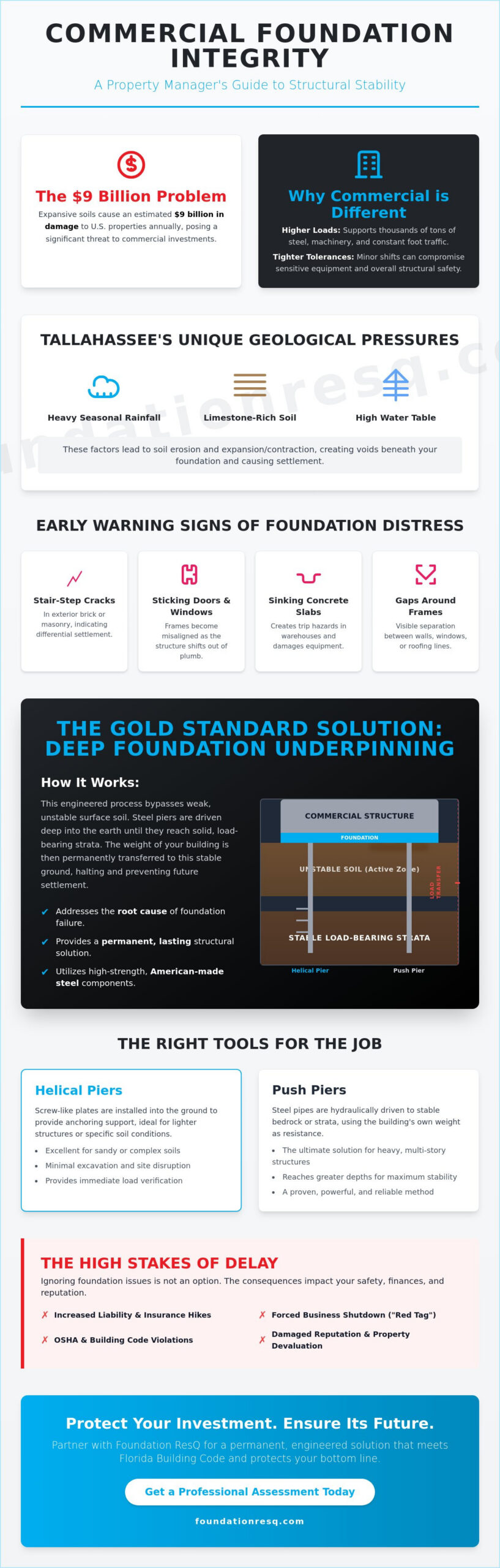
Imagine arriving at your Tallahassee property only to find a new, jagged crack tracing the masonry or a tenant complaining about a door that no longer latches. You realize that expansive soils, which cause an estimated $9 billion in annual damage across the country, are finally taking a toll on your structure. When you manage a property, the stakes for foundation repair for commercial buildings are incredibly high. You aren’t just worried about the physical structure; you’re concerned about tenant safety, liability, and the potential for a total shutdown of operations.
We understand that your priority is a resolution that doesn’t interrupt your bottom line. This article provides a clear path toward professional engineering solutions that stabilize your foundation and meet the rigorous requirements of the Florida Building Code 9th Edition. You’ll discover how specialized tools like helical piers and PolyRenewal lifting offer a permanent fix with a minimal footprint. We will preview the latest permit reforms and technical standards that ensure your property remains a safe, valuable asset for years to come.
Key Takeaways
- Learn why commercial structures require higher engineering tolerances and specialized stabilization compared to standard residential properties.
- Explore why deep foundation underpinning is the gold standard for foundation repair for commercial buildings to ensure permanent structural stability.
- Understand the specific impact of Tallahassee’s limestone-rich soil and high water table on your building’s slab integrity.
- Discover how modern piering and lifting techniques minimize excavation so you don’t have to close your doors during repairs.
- See how local geological knowledge combined with national resources provides a long-term remedy for your property’s structural health.
Identifying Foundation Distress in Commercial Structures
Commercial foundation repair is a specialized field of structural stabilization designed specifically for high-load buildings. It’s fundamentally different from residential work because the weight and stress requirements are significantly higher. While a home might rest on a simple timber frame, a commercial facility often supports thousands of tons of steel, heavy machinery, and constant foot traffic. The engineering tolerances are much tighter; even a minor shift can compromise the alignment of sensitive equipment or the safety of a multi-story structure.
In the Tallahassee region, heavy seasonal rainfall plays a major role in destabilizing commercial footings. When large volumes of water saturate the ground, it can lead to soil erosion or rapid expansion and contraction. This environmental pressure creates voids beneath the slab that eventually lead to settlement. To correct these issues, we rely on Advanced Engineering Solutions that bypass unstable surface soil to reach competent load-bearing strata. Without this specialized intervention, a building’s lifespan is drastically shortened.
Common Signs of Commercial Foundation Failure
Vigilance is your first line of defense against structural decline. You should regularly inspect your property for stair-step cracks in exterior brickwork or large-scale masonry. These patterns often indicate that specific sections of the building are settling at different rates. Indoors, keep an eye on heavy commercial steel doors or loading docks. If they’ve become difficult to open or no longer latch correctly, the frame is likely out of plumb. In warehouse environments, look for visible “dipping” or sinking in large concrete slabs, which can create trip hazards and damage forklifts. You might also see gaps forming between the building frame and the roofing lines or window casings.
The High Stakes of Commercial Structural Issues
The consequences of delaying foundation repair for commercial buildings go far beyond cosmetic damage. Unaddressed settlement increases your liability for tenant safety and can trigger substantial insurance premium hikes. If structural issues persist, local building inspectors have the authority to “red-tag” the property, which forces an immediate cessation of business operations. This not only halts your revenue but also damages your reputation with clients and tenants. Early detection is the most effective way to avoid OSHA or building code violations while protecting your property valuation and future refinancing opportunities. Taking a proactive approach ensures your investment remains a stable, profitable asset.
Advanced Engineering Solutions for Commercial Stabilization
Deep foundation underpinning serves as the primary remedy for structural instability in high-load environments. It’s a precise engineering process that shifts the weight of a building away from unstable surface soils and onto deep, competent load-bearing strata. This method is widely recognized as the most effective approach to foundation repair for commercial buildings because it addresses the root cause of settlement. We prioritize high-quality, American-made steel for all structural components. Using domestic steel ensures every pier and bracket meets strict metallurgical standards, providing the durability required for industrial facilities and multi-story structures.
The mechanics of this transfer involve driving steel piers deep into the earth until they reach a refusal point. This process bypasses the “active zone” of soil prone to expansion and contraction from Tallahassee’s groundwater fluctuations. By anchoring the structure to stable ground, we eliminate the risk of future settlement and restore the building’s original structural integrity. This methodical approach provides a permanent solution rather than a temporary patch, protecting the long-term health of the entire building envelope.
Deep Foundation Support with Helical and Push Piers
Selecting the right tool depends on geological conditions and building weight. The choice often involves helical piers vs push piers. Helical piers use screw-like plates for sandy soil or lighter loads. Alternatively, steel push piers are hydraulically driven into the ground for heavy multi-story structures. Our teams use advanced equipment for precise placement and immediate load verification, ensuring the structure is anchored to competent strata. Property managers planning a stabilization project should also review our detailed breakdown of helical pier installation cost to understand the real-world variables that influence project budgets in the Tallahassee area.
Carbon Fiber Reinforcement for Structural Walls
When walls exhibit bowing from lateral pressure, we use aerospace-grade carbon fiber for stabilization. This material is significantly stronger than steel but maintains a low profile, which is perfect for interior commercial spaces. These straps bond to the concrete, preventing movement without invasive excavation. This technique is a key component of modern foundation repair for commercial buildings. Visit our carbon fiber wall repair Tallahassee page for details. If you see cracks, scheduling a professional evaluation is a proactive remedy.
Soil Dynamics and Concrete Leveling in the Tallahassee Region
Tallahassee’s subsurface is largely defined by limestone, a porous rock that is highly susceptible to the chemical and physical effects of water. Over time, acidic rainwater dissolves this limestone, creating underground cavities or voids in a process known as karst topography. For heavy commercial structures, these voids represent a significant threat to long-term stability. When the soil can no longer support the building’s weight, settlement occurs. Professional foundation repair Tallahassee expertise is vital because it accounts for these specific regional dynamics that generic contractors might overlook.
Florida’s high water table adds another layer of complexity to property management. Constant moisture can soften the soil and wash away the fine particles that provide structural support for concrete slabs. This leads to uneven warehouse floors and cracked storefront walkways. To prevent future settlement, we use a process called void filling. This stabilization technique involves injecting material into the empty spaces beneath the slab to restore support. It’s a critical step in foundation repair for commercial buildings, ensuring the ground is reinforced before it leads to a structural failure.
Addressing Tallahassee’s Unique Geological Challenges
Heavy seasonal rains in North Florida move rapidly through the soil, causing internal erosion under large commercial slabs. This movement often leads to localized depressions or small sinkholes, which are particularly common in commercial parking lots and beneath heavy footings. Traditional mudjacking, which uses a heavy cement slurry, is often insufficient for these porous soils. The sheer weight of the slurry can actually cause further sinking in unstable areas. A lighter, more precise approach is required to protect the building envelope without overloading the soil.
PolyRenewal™: High-Density Foam for Commercial Slabs
We utilize PolyRenewal™, a high-density polyurethane foam, to address sunken concrete with surgical precision. Unlike heavy mudjacking materials, this foam is lightweight and exerts minimal pressure on the soil while providing immense lifting power. It’s a waterproof solution that won’t wash away during a typical Florida downpour. This makes it ideal for stabilizing loading docks, warehouse floors, and storefront walkways where business continuity is essential. It’s an advanced component of foundation repair for commercial buildings, offering a permanent remedy that restores safety and property value with minimal downtime.
Minimizing Business Disruption During Structural Repairs
Maintaining a steady flow of operations is the primary concern for any property manager facing structural issues. We understand that your building must remain “open for business” even when technical interventions are necessary. Traditional methods of foundation repair often involved massive excavation, heavy dust, and weeks of curing time. Modern foundation repair for commercial buildings has evolved to prioritize speed and a reduced physical footprint. By choosing advanced underpinning and lifting technologies, you can address critical safety issues without forcing tenants to relocate or halting daily commerce.
The difference in logistical impact between old-school trenching and modern piering is substantial. Traditional concrete pouring requires significant site preparation and long waiting periods for the material to reach its design strength. In contrast, our current engineering solutions focus on surgical precision. We can often perform stabilization from the exterior of the building, keeping interior hallways and retail spaces clear of construction debris. This approach ensures that your customers and employees can continue their routines with minimal awareness of the work happening beneath their feet.
Speed of Installation and Immediate Loading
One of the greatest advantages of steel pier systems is the ability to support immediate structural loading. Because these piers are mechanically driven to competent strata, they don’t require the days of “rest” associated with poured concrete footings. Once the piers are locked into place, the building’s weight is transferred instantly. Similarly, PolyRenewal™ high-density foam sets in as little as 15 minutes. This rapid curing time is essential for high-traffic areas like loading docks and warehouse floors. We use small-bore holes, roughly the size of a penny, to inject the foam, which eliminates the need for large-scale trenching or floor removal.
Non-Invasive Techniques for Occupied Buildings
We prioritize the safety and comfort of your occupants by maintaining exceptionally clean jobsites. Our teams use hydraulic and low-impact equipment to significantly reduce noise pollution, which is a common complaint in commercial settings. In many cases, we can stabilize the entire structure from the perimeter, avoiding any intrusion into leased spaces. If interior work is required, we can often coordinate evening or off-peak scheduling to further reduce the impact on your business hours. Protecting your investment shouldn’t come at the cost of your professional reputation. If you’re ready to secure your structure with minimal hassle, contact our team for a professional structural assessment today.
Partnering with Foundation ResQ for Long-Term Structural Health
Foundation ResQ stands as the Tallahassee authority on structural restoration for professional property managers and business owners. We combine deep local geological knowledge with the robust resources and technical backing of the Groundworks national network. This partnership allows us to offer industry-leading warranties and specialized engineering support that smaller contractors often lack. Property managers should view foundation repair for commercial buildings as a tactical maintenance step rather than a reactive crisis. Addressing minor settlement today prevents the massive structural failures that lead to red-tagging and lost revenue tomorrow. Our team acts as a steady, reliable partner in protecting the physical health of your building envelope.
We understand that every commercial project has unique requirements based on its footprint and intended use. Whether you’re managing a retail center, a warehouse, or an office complex, the goal remains the same: permanent stability. By choosing a partner who understands North Florida’s specific environmental challenges, you ensure that your structural remedies are built to last. We focus on long-term outcomes, providing the specialized guidance needed to navigate complex structural concerns with confidence and clarity.
The Foundation ResQ Commercial Evaluation Process
Our assessment process is thorough and methodical, designed to lead you from uncertainty toward an informed resolution. We begin with a detailed visual inspection of both interior and exterior structural indicators, looking for the subtle signs of distress mentioned earlier in this guide. Our technicians use advanced elevation mapping to pinpoint exactly where settlement is occurring and to what degree the structure has shifted. We also consider the local soil dynamics to understand why the settlement began. This data allows us to create a customized repair plan that addresses your building’s specific needs while respecting your operational budget and timeline.
Protecting Your Investment with Proven Systems
Securing your building’s foundation is a direct investment in its future resale and refinancing potential. We provide the peace of mind that comes with transferable warranties and professional engineering, ensuring your property remains a stable asset. Our team ensures that every repair remains compliant with the International Building Code (IBC), which is essential for maintaining your professional standing and tenant safety. We use only high-quality, American-made steel components and high-density polymers to provide a final line of defense against the elements. Don’t wait for a minor crack to become a major liability. Schedule your commercial structural evaluation with Foundation ResQ today.
Securing Your Property’s Future with Professional Engineering
Your commercial property represents a significant investment that requires proactive protection. We’ve explored how identifying early signs of distress and utilizing advanced technologies like steel piers can prevent minor settlement from becoming a major liability. By choosing non-invasive techniques such as PolyRenewal™ high-density foam, you ensure your business remains operational while the structural integrity of your building is restored. Investing in foundation repair for commercial buildings is not just about fixing cracks; it’s about guaranteeing the long-term safety and value of your asset.
Foundation ResQ combines Tallahassee local expertise with the technical backing of Certified Groundworks Engineers. Our A+ BBB rating reflects a long-standing commitment to quality and dependable service. Whether you’re dealing with warehouse slab settlement or complex structural shifts, we provide the permanent remedies needed to meet modern building codes. Don’t let unpredictable soil conditions compromise your success. Request a Free Commercial Structural Evaluation today to stabilize your foundation and protect your property’s longevity. We look forward to helping you secure a stable future for your business.
Frequently Asked Questions
How long does commercial foundation repair typically take?
Most commercial stabilization projects are completed within three to seven business days. The exact duration depends on the building’s footprint and the number of piers required for structural support. Because we use pre-engineered steel systems, there is no need to wait for concrete to cure. This allows our teams to work efficiently and restore structural integrity much faster than traditional excavation methods would permit.
Will I need to close my business during the foundation repair process?
You generally won’t need to close your doors during the repair process. We prioritize non-invasive techniques like exterior piering and PolyRenewal concrete lifting to minimize interior disruption. Most work occurs outside the building envelope or during off-peak hours. This approach ensures your tenants and customers remain safe and undisturbed while we perform essential foundation repair for commercial buildings beneath the structure.
Does insurance cover commercial foundation repair for buildings?
Standard commercial property insurance policies typically exclude foundation repair unless the damage resulted from a covered peril, such as a sudden pipe burst. Gradual settlement caused by soil erosion or limestone dissolution is often considered a maintenance issue. We recommend reviewing your specific policy with an insurance professional to determine if your structural concerns qualify for a claim under your current coverage terms.
What is the difference between residential and commercial foundation repair?
The primary difference lies in the load-bearing requirements and the complexity of the engineering standards. Commercial structures support significantly higher weights and must adhere to stricter International Building Code regulations. While residential work focuses on smaller footprints, foundation repair for commercial buildings involves heavy-duty steel components and precise hydraulic loading to stabilize large-scale industrial or multi-story facilities without compromising the building’s structural envelope.
How do helical piers work for large commercial structures?
Helical piers function like large screws that are mechanically driven into the earth until they reach competent load-bearing strata. These piers feature spiral plates that provide significant surface area for load distribution in unstable or sandy soils. Once the piers reach the required depth and torque, they are capped and attached to the building’s footing. This creates a permanent, stable anchor that prevents further settlement or shifting. For a comprehensive overview of what drives project budgets in this region, our guide to helical pier installation cost for Tallahassee properties covers the key variables in detail.
What causes foundation failure in Tallahassee commercial buildings?
Foundation failure in the Tallahassee region is frequently caused by the area’s unique karst topography. Acidic rainwater dissolves the underlying limestone, creating underground voids that lead to significant soil settlement. Additionally, Florida’s high water table can soften the ground beneath large concrete slabs. These environmental factors combine to undermine the building’s footings, eventually leading to the structural distress signals property managers often observe during inspections.
How much does commercial foundation repair cost on average?
The total investment for structural stabilization varies based on the building’s size, the depth of the stable soil, and the chosen repair method. Factors like the number of piers needed and the volume of high-density foam required for slab lifting will influence the final project scope. We recommend checking industry-standard resources for general regional averages and scheduling a professional evaluation to receive a customized plan for your property.
Can you repair a commercial slab that has already cracked?
We can absolutely repair and stabilize commercial slabs that have already developed cracks. Using high-density polyurethane foam, we lift the sunken sections of the slab back toward their original position and fill the underlying voids. For structural walls that have sheared or bowed, carbon fiber reinforcement provides a permanent remedy. These solutions not only close the visible gaps but also reinforce the concrete to prevent the cracks from returning.