
Did you know that up to 40% of the air you breathe inside your Tallahassee home actually originates in your crawl space? In North Florida, where humidity levels frequently climb above 70% year round, that air is often heavy with moisture. This leads to recurring mold growth and rising energy bills that leave many homeowners feeling like they’re fighting a losing battle. If you’ve struggled with conflicting information while looking for a crawl space dehumidifier sizing guide, you’re not alone. It’s a common challenge in our region’s unique climate where standard ratings don’t always tell the full story.
We understand that you want a solution that offers permanent protection rather than a temporary fix. This guide will help you master the technical requirements for moisture control by showing you exactly how to size a system based on your home’s specific moisture load. By following these steps, you can secure a dry, rot-free foundation and improved indoor air quality for your family. We’ll walk through the essential calculations and equipment standards needed to ensure your dehumidification system remains a steadfast line of defense for ten years or more.
Key Takeaways
- Learn how to calculate your crawl space’s total cubic volume and moisture load to choose a unit that handles North Florida’s specific environmental demands.
- Use this crawl space dehumidifier sizing guide to understand Pints Per Day (PPD) ratings and why AHAM standards are the benchmark for professional-grade performance.
- Discover how sealing and encapsulation reduce the moisture load on your equipment, extending the lifespan of your investment.
- Identify the essential features of professional-grade systems, such as internal condensate pumps, that prevent the most common points of failure.
- Master the technical requirements to maintain a consistent relative humidity below 55%, protecting your home’s structural integrity for years to come.
Why Dehumidifier Sizing is Critical for Florida Crawl Spaces
Crawl space dehumidification is the active process of removing water vapor from the air to maintain a relative humidity level below 55%. In the humid environment of North Florida, this isn’t just a luxury; it’s a requirement for preserving your home’s structural integrity. When humidity levels consistently exceed this threshold, the organic materials under your home begin to absorb moisture, creating a breeding ground for wood-destroying organisms. A professional crawl space dehumidifier sizing guide ensures you select a unit capable of handling these heavy moisture loads without failing under the pressure of our local climate.
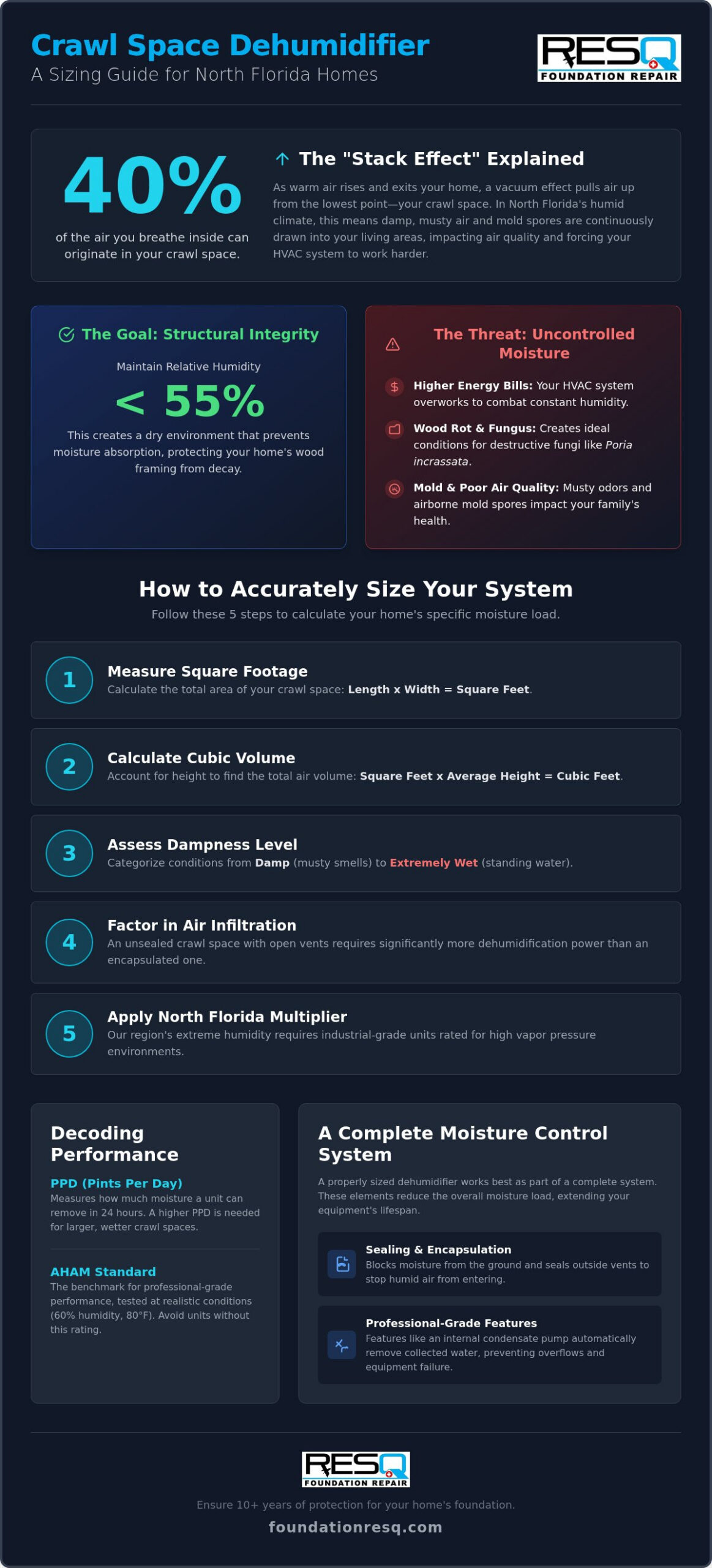
The “Stack Effect” is a primary reason why these conditions matter so much to your family’s comfort. As warm air rises and escapes through your attic, it creates a vacuum that pulls air from the lowest point of the structure upward. In many local homes, this means that up to 40% of the air you breathe in your living room was recently sitting in your Crawl space. If that area is damp, you’re effectively pulling mold spores and humid air directly into your home. This process forces your HVAC system to work harder, leading to higher energy bills and uneven cooling.
To ensure your primary HVAC system is prepared for the increased workload caused by high humidity, you can learn more about RMI Heating and Air Conditioning and their specialized services for maintaining reliable climate control.
Choosing an undersized unit often leads to a mechanical issue known as short-cycling. This happens when a machine starts and stops too frequently because it can’t quite reach the target humidity level. The constant strain causes the compressor to wear out prematurely, often failing long before its expected lifespan. This is why a crawl space dehumidifier sizing guide is essential for long-term protection; it helps you avoid the cost of replacing equipment every few years.
The Tallahassee Humidity Factor
Leon County experiences massive seasonal moisture spikes that can overwhelm standard residential equipment. Most store-bought dehumidifiers are designed for finished basements or living areas where temperatures are stable. However, crawl spaces are unconditioned environments where vapor pressure is significantly higher. During a typical Tallahassee summer, the air is so saturated that a standard unit will simply freeze up or run indefinitely without making a dent in the relative humidity. We focus on industrial-grade solutions that are specifically calibrated for these high-pressure environments.
Health and Structural Consequences of Incorrect Sizing
When moisture isn’t properly managed, the consequences are often hidden until they become expensive. High humidity levels are the primary catalyst for wood rot, specifically Poria incrassata, a destructive fungus that can compromise floor joist stability in a matter of months. If you notice soft spots in your flooring or a persistent musty odor, you may already need mold remediation Tallahassee FL to restore safety to your home. Properly sized dehumidification creates a protective barrier that keeps wood dry and prevents these structural failures from taking root in your foundation.
Calculating Your Crawl Space Volume and Moisture Load
Accurately determining the size of the equipment you need begins with hard data. While many homeowners start by looking at the square footage of their home’s footprint, a proper crawl space dehumidifier sizing guide must account for the total volume of air and the specific moisture conditions present. To get an accurate measurement, follow these five steps:
- Step 1: Measure the total square footage by multiplying the length of the crawl space by its width.
- Step 2: Determine the average ceiling height to calculate the total cubic volume (Length x Width x Height).
- Step 3: Assess the dampness level. Categories range from “Damp” (musty smell in humid weather) to “Extremely Wet” (standing water or visible seepage).
- Step 4: Factor in air infiltration. An unsealed space with open vents requires significantly more power than an encapsulated one.
- Step 5: Apply a sizing multiplier for North Florida. Because our regional humidity is so high, a unit that works in a drier climate will often be underpowered here.
Square Footage vs. Cubic Footage
The footprint of your home only tells half the story. A crawl space with a 3-foot clearance contains far less air than one with a 5-foot clearance, even if they cover the same 1,500 square feet of ground. If you only size based on area, you’ll likely end up with an undersized unit that runs constantly. The formula is simple. Multiply your square footage by the height. For example, a 1,500 square foot space with a 4-foot height has 6,000 cubic feet of air to treat. You must also consider irregular shapes caused by piers and footings, as these can create pockets of stagnant air that require better circulation. If you’re unsure about your measurements, scheduling a professional inspection can provide the precision needed for a long-term remedy.
Assessing Soil Moisture and Foundation Seepage
The source of your moisture also dictates the required capacity. High vapor emission from bare soil is a constant load, but foundation seepage through porous cinder block walls adds a different level of stress to the system. According to the EPA, The key to mold control is moisture control. If your walls show white, powdery efflorescence or water stains, you are dealing with “vapor drive,” where outside moisture is pushed through the masonry. These structural issues often indicate that foundation repair Tallahassee services are necessary alongside dehumidification to ensure the building remains stable. Addressing these entry points reduces the overall moisture load, allowing your dehumidifier to operate more efficiently.
Understanding Capacity: Pints Per Day (PPD) and Performance Ratings
When you consult a crawl space dehumidifier sizing guide, the most common metric you’ll encounter is Pints Per Day (PPD). This number represents the total volume of water a unit can extract from the air within a 24-hour period. However, not all PPD ratings are created equal. To protect your home’s structural integrity, you must understand how these units are tested and how they’ll perform in the unique environment of a North Florida crawl space. Because your system will likely run 24/7 during our humid summers, looking for an Energy Star certification is also vital. These units are built with higher-quality components that handle constant operation while keeping your utility costs manageable.
The AHAM vs. Saturation Debate
AHAM stands for the Association of Home Appliance Manufacturers, and it is the industry standard for realistic performance comparison. Many manufacturers advertise “Saturation” ratings, which measure water removal at 90°F and 90% relative humidity. These conditions are rare even in Tallahassee. AHAM testing occurs at 80°F and 60% relative humidity, providing a much more accurate picture of how a unit will perform in your home. A unit rated at 120 PPD at saturation might only pull 70 PPD in real-world conditions. Always look for the AHAM rating on technical spec sheets to ensure you’re making an informed decision.
Choosing the Right PPD for Your Square Footage
Once you have calculated your cubic volume, you can select the appropriate capacity. For most Tallahassee homes up to 2,500 square feet, a 70 PPD unit is often sufficient if the space is properly sealed. If your crawl space is larger or consistently “extremely wet,” you should consider a unit with 100 PPD or higher. In the Florida Panhandle, we generally recommend “oversizing” your unit slightly rather than “undersizing” it. A higher capacity unit reaches the target humidity faster and enters a standby mode, which is more efficient than a smaller unit running at its absolute limit.
Beyond PPD, you must also consider CFM, or Cubic Feet per Minute. This measures the volume of air the fan can move through the machine. High PPD is useless if the air isn’t circulating to the far corners of your foundation. Proper air distribution ensures that every floor joist and support pier remains dry, preventing the localized dampness that often leads to wood rot. By balancing PPD and CFM, you create a comprehensive barrier against the elements that maintains the stability of your building for the long term.
How Sealing and Encapsulation Affect Your Sizing Requirements
A common mistake homeowners make is assuming a dehumidifier can solve moisture problems in a vented environment. If your crawl space vents remain open, your equipment is essentially trying to dry the entire neighborhood. In the humid Tallahassee climate, where outdoor air can hold massive amounts of water vapor, an unsealed space provides a continuous supply of moisture. This makes any crawl space dehumidifier sizing guide almost irrelevant, as the moisture load becomes infinite. To achieve a dry environment, you must first create a controlled space where the machine can actually lower the relative humidity.
This is where crawl space encapsulation Tallahassee becomes a critical part of the solution. By sealing the vents and installing a heavy-duty liner, you drastically reduce the required PPD capacity. Instead of fighting the external environment, the dehumidifier only has to manage the small amount of moisture that permeates through the building materials. This synergy allows you to use a smaller, more efficient unit that consumes less energy and lasts much longer. Without sealing the space, even the most powerful industrial unit will struggle to keep humidity below the 55% threshold required to prevent mold.
The Role of the Vapor Barrier
Sealing the soil with a high-quality vapor barrier stops the primary source of moisture: ground evaporation. In North Florida, the soil stays damp most of the year, constantly releasing vapor into the air under your home. A properly installed 20-mil liner acts as a permanent shield, significantly lowering the “latent heat load” on your dehumidifier. This term refers to the energy required to remove moisture from the air without changing the temperature. When the ground is sealed, the latent load drops, meaning the unit reaches its target humidity level faster and stays in standby mode longer. This leads to substantial energy savings and prevents the mechanical wear associated with constant operation.
Vented vs. Conditioned Crawl Spaces
The difference between a traditional vented space and a conditioned one is stark. In unsealed spaces during Tallahassee summers, the air is so humid that it often reaches its dew point against cold HVAC ducts. This leads to “sweating” ducts, which can drip onto the floor and cause wood rot. A conditioned space eliminates this risk by maintaining a stable environment. For the best performance, we also recommend sealing the rim joists with spray foam or rigid insulation. This prevents air leakage at the foundation’s edge, ensuring your dehumidifier isn’t working against incoming Florida heat. If you’re ready to protect your home with a professional solution, contact Foundation ResQ today to discuss your encapsulation and dehumidification needs.
Professional Installation: Ensuring Long-Term Structural Stability
Selecting the correct capacity through a crawl space dehumidifier sizing guide is a vital first step, but the quality of the installation determines whether that equipment survives the harsh conditions under your home. Professional-grade units are built specifically for the high-stakes environment of a crawl space. Unlike retail models, these systems feature internal condensate pumps for automatic water removal and high-efficiency MERV filters. These filters do more than just protect the machine’s internal components; they scrub the air of allergens and spores before it migrates into your living area. This ensures that the protection you’re investing in provides a healthier environment for your family.
Drainage is the most common point of failure for DIY installations. If the extracted water isn’t moved effectively away from the building, it simply recycles back into the soil, increasing the moisture load the unit must handle. We often see systems where drainage lines are improperly sloped or terminate too close to the foundation. For a truly permanent remedy, these lines should be integrated with professional sump pump systems. This combination manages both bulk water intrusion and ambient humidity, creating a comprehensive barrier against the elements.
Drainage Solutions and Condensate Pumps
There are two primary ways to handle the water your dehumidifier collects: gravity drainage and pump-assisted drainage. Gravity systems are simple and reliable but require a consistent downward slope that many Tallahassee crawl spaces can’t provide due to uneven terrain. Pump-assisted drainage is often the superior choice for our region. These pumps can move water uphill or across long distances to ensure it is diverted at least 10 feet away from your foundation. To maintain this stability, we recommend an annual check of the drainage lines to ensure they remain clear of debris or sediment that could cause a backup.
To provide ongoing peace of mind, we include a digital hygrometer with our installations. This device allows you to monitor the relative humidity of your crawl space from the comfort of your living room. By keeping a remote eye on the numbers, you can verify that your system is maintaining that critical 55% threshold even during the peak of a North Florida summer.
While local expertise is essential for regional climate challenges, you can also visit Subfloor Ventilation Sydney to see how specialists in other high-humidity regions implement professional solutions to eliminate subfloor moisture and mould.
Why Foundation ResQ for Your Moisture Control?
As the steadfast local expert for North Florida, Foundation ResQ understands the specific geological and climate challenges facing Tallahassee homeowners. We don’t rely on “one-size-fits-all” retail solutions. Instead, we use industrial-grade dehumidifiers designed for longevity and performance in high-humidity zones. Our team provides a methodical, thorough approach to every project, focusing on long-term outcomes rather than quick fixes. We invite you to schedule a professional inspection to receive a custom sizing calculation and a comprehensive plan to protect your home’s structural health for ten years or more.
Secure Your Home’s Foundation Against Florida Humidity
Managing the moisture under your structure requires more than just a standard appliance. As we’ve explored, a proper crawl space dehumidifier sizing guide must balance cubic volume with the specific environmental loads found in the Florida Panhandle. By combining industrial-grade equipment with professional encapsulation, you create a permanent barrier that protects your floor joists and improves your indoor air quality. This approach moves beyond temporary fixes to provide a lasting remedy for your home’s structural health.
Foundation ResQ is a Tallahassee-owned and operated company. We are expert mold remediation and moisture control specialists who provide custom-engineered solutions specifically for North Florida’s humidity. Our methodical process ensures your system is sized correctly and installed with the precision needed for long-term stability. Schedule Your Free Crawl Space Inspection with Foundation ResQ Today to take the first step toward a dry, rot-free foundation. We’re here to help you protect your investment and ensure your home remains a safe, healthy environment for your family.
Frequently Asked Questions
How many pints per day dehumidifier do I need for a 1,500 sq ft crawl space?
A 70-pint unit is generally sufficient for a 1,500 square foot encapsulated crawl space. However, if the space is unsealed or particularly damp, you might need to move up to a larger capacity unit. This crawl space dehumidifier sizing guide emphasizes that cubic volume and moisture load are just as important as square footage. Choosing a unit that can handle the specific air volume ensures the system doesn’t run constantly.
Can I use a regular basement dehumidifier in my crawl space?
No, you shouldn’t use a standard basement dehumidifier in a crawl space environment. Crawl space units are specifically engineered to operate in lower temperatures and tighter clearances. They also feature heavy-duty components and internal pumps that aren’t found in retail basement models. These professional units are designed for the high-pressure humidity found under Tallahassee homes, where durability and stability are paramount for protecting your foundation.
What is the ideal humidity level for a crawl space in Florida?
The ideal relative humidity level for a Florida crawl space is between 45% and 55%. Maintaining this range prevents mold growth and protects the structural integrity of your floor joists. If levels rise above 60%, organic materials begin to absorb moisture, which leads to wood rot and pest infestations. A digital hygrometer is the best way to monitor these levels reliably and ensure your home remains a dry, safe environment.
How long do crawl space dehumidifiers typically last?
A professional-grade crawl space dehumidifier typically lasts between 10 and 15 years with proper maintenance. This is significantly longer than the 3 to 5 years you might get from a standard retail unit. Regular filter changes and annual drainage inspections help ensure the system remains a stable line of defense for your building’s foundation. Investing in a high-quality unit provides a better long-term outcome for your home’s physical health.
Do I need to run my crawl space dehumidifier all year in Tallahassee?
Yes, it’s best to keep your dehumidifier running year-round in Tallahassee. While summer brings the highest moisture load, North Florida winters can still be surprisingly humid. Most professional units include an automatic humidistat that only activates the compressor when levels exceed your set point. This ensures protection during rainy winters without wasting electricity during drier spells, maintaining a consistent protective barrier between your property and the elements.
Will a dehumidifier stop mold from growing on my floor joists?
A correctly sized dehumidifier will stop new mold from growing by removing the moisture it needs to survive. However, a dehumidifier won’t remove existing mold that has already taken root. If you already see growth on your floor joists, you’ll need professional mold remediation services to clean the wood. Once the wood is stabilized, the dehumidification system can maintain the dry environment necessary to prevent the mold from returning.
How much electricity does a crawl space dehumidifier use?
Modern Energy Star-certified dehumidifiers are highly efficient and typically cost between $10 and $20 per month to operate. The exact cost depends on how well your crawl space is sealed and the local utility rates. A fully encapsulated space allows the unit to reach its target humidity quickly and enter standby mode; this significantly reduces the overall energy consumption compared to a vented space that constantly pulls in humid air.
What happens if I put a dehumidifier in a crawl space that isn’t encapsulated?
Placing a dehumidifier in a crawl space that isn’t encapsulated is inefficient and often ineffective. As mentioned in our crawl space dehumidifier sizing guide, an unsealed space allows humid outdoor air to enter through the vents constantly. The unit will run indefinitely without ever reaching the target humidity level. This leads to high energy bills and premature mechanical failure of the compressor because the machine is essentially trying to dry the outdoors.