
Polyurethane foam leveling, known in the industry as polyjacking, is the most effective method for lifting and stabilizing sunken concrete slabs beneath residential and commercial properties. The polyurethane foam leveling benefits over traditional mudjacking are structural, not just cosmetic. Foam cures in 15–30 minutes, weighs just 2–4 lbs/ft³, and lifts slabs to within 1/8 inch of target elevation. For homeowners and property managers dealing with settled driveways, garage floors, pool decks, or interior slabs, those three facts change the entire repair equation.
1. Polyurethane foam leveling benefits start with soil stabilization
The most overlooked advantage of foam leveling is what it does not add to your soil. Traditional mudjacking slurry weighs 100–150 lbs/ft³, while polyurethane foam weighs just 2–4 lbs/ft³. That weight difference is not a minor detail. It is the reason slabs repaired with mudjacking often sink again within a few years.
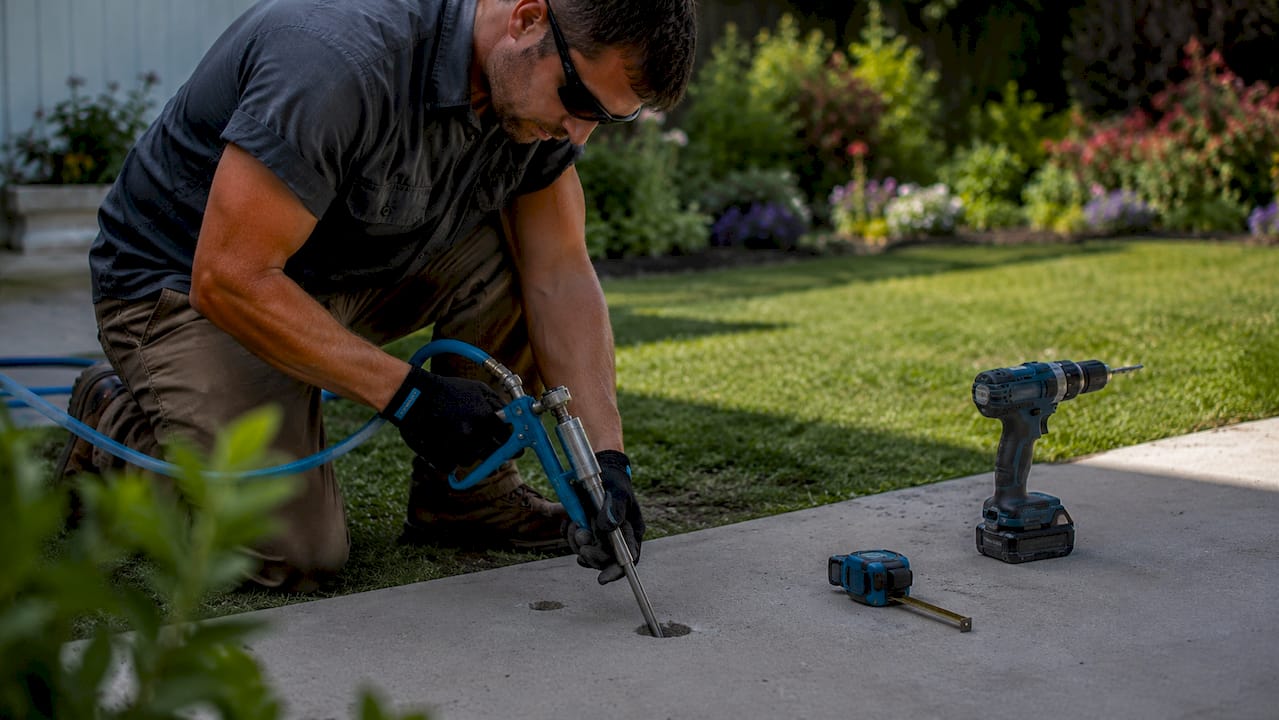
Heavy slurry compresses weak, compressible, or expansive clay soils further. The slab sinks a second time because the repair material itself became part of the load problem. Foam avoids this entirely. Its low density prevents re-settlement by adding virtually no new stress to the subgrade.
Properties built on Florida’s expansive clay soils, or any site with a high water table, are especially vulnerable to this cycle. Foam’s lightweight structure is a critical engineering advantage in those conditions, not just a convenience.
- Foam density: 2–4 lbs/ft³ vs. mudjacking slurry at 100–150 lbs/ft³
- Weak or saturated subgrades benefit most from low-load repair materials
- Expansive clay soils shift with moisture changes, making heavy fill a liability
- Foam bonds to the underside of the slab without adding compressive stress to the soil
Pro Tip: Ask your contractor to assess subgrade conditions before choosing a repair method. If your soil is soft, wet, or clay-heavy, foam leveling is the structurally correct choice, not just the faster one.
2. Rapid curing means same-day use of repaired surfaces
Foam cures in 15–30 minutes after injection, allowing foot and vehicle traffic the same day. Mudjacking requires 24–48 hours of cure time before the surface can bear any load. That gap matters enormously for busy households and rental properties where shutting down a driveway or garage for two days creates real problems.
A typical foam leveling project for a residential driveway or pool deck completes within a single day. That timeline includes drilling, injecting, patching, and cleanup. Mudjacking jobs of the same scope often require a return visit after the cure period to assess results and patch holes.
The practical impact is significant for property managers overseeing multi-unit buildings or commercial spaces. Tenants and customers face minimal disruption. There is no extended closure, no cones blocking access for 48 hours, and no waiting to find out whether the lift held.
- Surface ready for foot traffic: 15–30 minutes post-injection
- Surface ready for vehicle traffic: same day in most cases
- Full project completion: typically one day
- No return visit required to verify cure
Pro Tip: Schedule foam leveling repairs in the morning. By afternoon, the surface is fully cured and back in use, with no overnight restrictions.
3. Precision lifting gives you control that mudjacking cannot match
Foam injection follows a strategic grid pattern with real-time laser monitoring, allowing lifts accurate to within 1/8 inch. That level of control is not possible with mudjacking, where slurry volume and pressure are harder to regulate incrementally. The difference shows up most clearly on surfaces where drainage, thresholds, or finish grades matter.
Pool decks, for example, must slope away from the pool edge at a specific grade to prevent water pooling and trip hazards. A garage floor threshold needs to align precisely with the door track. Interior slabs near doorways require exact elevation to avoid binding doors or creating uneven transitions. Foam’s incremental injection process handles all of these scenarios without guesswork.
Property managers handling complex leveling applications consistently cite precision as the deciding factor when choosing foam over other methods. Even pressure distribution across the slab also reduces the risk of cracking during the lift, which is a real concern with older or thinner concrete.
Where precision lifting makes the biggest difference
- Pool decks: Slope correction to within 1/8 inch prevents water intrusion and trip hazards
- Garage floors: Threshold alignment with door tracks requires exact elevation control
- Interior slabs: Door clearance and floor transitions depend on tight tolerances
- Decorative concrete: Stamped or colored slabs need even lifts to avoid visible cracking
- Sidewalks and walkways: ADA compliance requires specific cross-slope and grade standards
| Surface Type | Tolerance Required | Why Foam Excels |
|---|---|---|
| Pool deck | 1/8–1/4 inch | Laser-monitored incremental injection |
| Garage floor | 1/8 inch at threshold | Controlled volume per injection port |
| Interior slab | 1/16–1/8 inch | Even pressure prevents cracking |
| Decorative patio | 1/4 inch | Small holes preserve surface finish |
4. Long-term durability and moisture resistance reduce repeat repairs
Closed-cell polyurethane foam maintains structural strength for 20+ years, while cement-based mudjacking materials degrade in 5–10 years in wet or humid conditions. The reason is chemistry. Closed-cell foam is hydrophobic, meaning it actively repels water rather than absorbing it. Mudjacking slurry is cement-based and porous, which means groundwater, soil chemicals, and biological agents break it down over time.
Florida’s climate makes this distinction especially relevant. High humidity, frequent rain, and seasonal flooding accelerate the degradation of porous fill materials. A mudjacking repair that looks solid in year two may be crumbling and washing out by year seven. Foam does not erode, does not wash away, and does not support mold or biological growth.
“Closed-cell polyurethane foam creates a permanent moisture barrier protecting the subgrade against infiltration and erosion. This is a key reason polyurethane foam leveling services come with extended or lifetime warranties compared to short-term mudjacking guarantees.”
The long-term cost math favors foam despite its higher upfront price. Foam leveling costs $5–$10 per sq ft versus $3–$6 per sq ft for mudjacking. A repair that lasts 20+ years versus one that needs redoing in 5–7 years eliminates one or two full repair cycles, saving money over the life of the property.
Understanding subfloor and subgrade conditions before selecting a repair method is the single best way to avoid paying for the same repair twice.
5. Small injection holes preserve surface appearance
Foam injection uses 5/8-inch diameter holes, which are 50–70% smaller than the 1.5–2-inch holes mudjacking requires. After injection, those small holes are patched with non-shrink grout and are nearly invisible once dry. Mudjacking holes are large enough to be obvious, especially on decorative or colored concrete.
This matters most for homeowners with stamped patios, exposed aggregate driveways, or interior polished floors. A repair that leaves visible patches across the surface defeats part of the purpose of preserving the existing concrete. Foam’s smaller footprint keeps the finished surface looking intact.
The reduced hole size also means less structural disruption to the slab itself. Drilling large holes through concrete weakens the slab at those points. Smaller holes preserve more of the slab’s original integrity, which is especially relevant for thinner residential slabs.
6. Foam leveling applications: when to choose this method
The advantages of foam leveling are most pronounced in specific site conditions. Not every leveling job requires foam, but certain situations make it the clear choice over alternatives.
- High-moisture environments: Crawl spaces, areas near downspouts, and flood-prone zones where mudjacking material would erode
- Weak or expansive subgrades: Clay-heavy soils or fill areas where additional weight causes further settlement
- Interior slabs: Basements and ground-floor slabs where mess and cure time are unacceptable
- Pool decks and patios: Decorative surfaces where hole size and finish quality matter
- Commercial and rental properties: High-traffic areas where same-day return to service is required
- Areas with previous mudjacking failures: Sites where slurry-based repairs have already failed once
Foam leveling does have practical limits. Very large voids beneath slabs may require multiple injection sessions. Slabs with significant structural cracking may need concrete leveling assessment before foam injection is appropriate. In complex situations, foam works best as part of a broader repair plan that may include foundation repair services addressing the root cause of settlement.
Pro Tip: Foam leveling fixes the symptom of a sinking slab, but the cause matters too. If poor drainage or a broken pipe is driving soil erosion beneath the slab, address that first or the new repair will fail on the same timeline as the old one.
Key takeaways
Polyurethane foam leveling outperforms mudjacking on every structural metric that matters for long-term home stability: weight, cure time, precision, durability, and moisture resistance.
| Point | Details |
|---|---|
| Lightweight foam protects soil | At 2–4 lbs/ft³, foam adds no meaningful load to weak or expansive subgrades. |
| Same-day cure eliminates downtime | Surfaces are ready for traffic within 15–30 minutes of injection. |
| Precision lifting prevents cracking | Laser-monitored injection achieves lifts accurate to within 1/8 inch. |
| Closed-cell foam lasts 20+ years | Hydrophobic structure resists water, erosion, and biological degradation. |
| Small holes preserve surface finish | 5/8-inch injection ports are 50–70% smaller than mudjacking holes. |
Why foam leveling is worth the investment
I have seen homeowners choose mudjacking because it costs less upfront, and I understand the logic. When a repair quote comes in 25–50% higher, the cheaper option looks appealing. But the cases where that decision backfires are not rare. They are predictable.
The properties most likely to need a second repair within five years are the ones with clay-heavy soil, poor drainage, or a history of moisture problems. Those are exactly the conditions where mudjacking slurry breaks down fastest and where foam’s structural advantages are most pronounced. Choosing the cheaper method on a property with those risk factors is not saving money. It is deferring a larger bill.
What I find most underappreciated about foam leveling is the precision factor. Homeowners focus on cost and cure time, which are real advantages. But the ability to lift a pool deck or garage threshold to within 1/8 inch without cracking the slab is genuinely difficult to achieve with any other method. That precision is what separates a repair that looks right from one that actually performs correctly for drainage, door clearance, and long-term load distribution.
My honest recommendation: get a professional assessment of your subgrade conditions before choosing a repair method. If your soil is soft, wet, or has shifted before, foam leveling is not the premium option. It is the appropriate one.
— Kayle
Foundationresq’s approach to foam leveling in Tallahassee
Foundationresq specializes in concrete leveling and foundation repair for homeowners and property managers across Tallahassee, FL. The team uses polyurethane foam injection to lift and stabilize settled slabs with minimal disruption to your property and daily routine.
Every project starts with a thorough site assessment to evaluate subgrade conditions, slab integrity, and drainage before any injection begins. That process is what separates a repair that holds for 20 years from one that fails in five. Foundationresq also offers financing options to make foam leveling accessible without delaying a repair that is already affecting your home’s safety and value. Schedule a free inspection to find out whether foam leveling is the right solution for your property.
FAQ
What is polyjacking and how does it differ from mudjacking?
Polyjacking is the industry term for polyurethane foam leveling, where expanding polymer foam is injected beneath sunken slabs to lift and stabilize them. Unlike mudjacking, which uses heavy cement slurry, foam weighs just 2–4 lbs/ft³ and cures in 15–30 minutes.
How long does polyurethane foam leveling last?
Closed-cell polyurethane foam maintains structural strength for 20+ years in most conditions. Its hydrophobic structure resists water infiltration and soil erosion, which are the primary causes of repair failure in humid climates.
Is foam leveling worth the higher cost compared to mudjacking?
Foam leveling costs $5–$10 per sq ft versus $3–$6 per sq ft for mudjacking, but its 20+ year lifespan versus 5–10 years for mudjacking eliminates one or two full repair cycles over the life of the property.
What surfaces are best suited for polyurethane foam leveling?
Pool decks, garage floors, interior slabs, driveways, and decorative patios are all strong candidates. Foam is especially effective on surfaces requiring tight elevation tolerances or located in high-moisture environments.
Can foam leveling fix a slab that has cracked?
Foam leveling can lift and stabilize slabs with minor cracking, but significant structural fractures require a professional assessment first. In those cases, foam injection may be part of a broader repair plan rather than a standalone solution.
Recommended
- Polyurethane Concrete Lifting: Pros, Cons, and How It Works – Tallahassee Foundation Repair | Foundation ResQ
- PolyRenewal vs. Mudjacking: Which Concrete Lifting Method is Best for Your Home? – Tallahassee Foundation Repair | Foundation ResQ
- Concrete Leveling in Tallahassee: The Homeowner’s 2026 Guide to PolyRenewal® – Tallahassee Foundation Repair | Foundation ResQ