The strongest material for your home’s foundation isn’t a heavy steel beam; it’s a fabric originally designed for aerospace engineering. If you’ve noticed your basement or crawl space walls starting to curve inward, you’re likely dealing with the intense hydrostatic pressure common in our state’s saturated soils. Choosing carbon fiber straps for foundation repair Florida homeowners trust allows you to stop this movement without the need for heavy machinery or destructive excavation. It’s a modern, low-profile remedy that provides a permanent shield against the elements.
It’s natural to worry about the high costs of structural work or the mess of invasive yard digging. You deserve a stabilized foundation that won’t move again, ensuring your home remains a safe and valuable asset. In this guide, you’ll discover how carbon fiber straps provide a non-invasive, permanent solution for bowing walls caused by our state’s unique soil and climate. We’ll examine the technical benefits of these aerospace-grade materials, their compliance with the latest Florida Building Code requirements, and how they maintain your property’s resale value without destroying your landscaping.
Key Takeaways
- Identify how Florida’s high water table and hydrostatic pressure create the specific forces that cause foundation walls to bow inward.
- Compare the high-tensile strength of aerospace-grade carbon fiber to traditional steel to understand why it’s the preferred stabilization method in 2026.
- See why carbon fiber straps for foundation repair Florida offer a non-invasive alternative to wall anchors, leaving your yard and landscaping completely undisturbed.
- Understand the critical professional steps required for a permanent fix, including structural assessments and precise surface preparation for a lifetime bond.
- Discover how an engineered reinforcement system restores your home’s structural integrity while protecting its resale value against the elements.
Understanding Bowing Walls and Hydrostatic Pressure in Florida
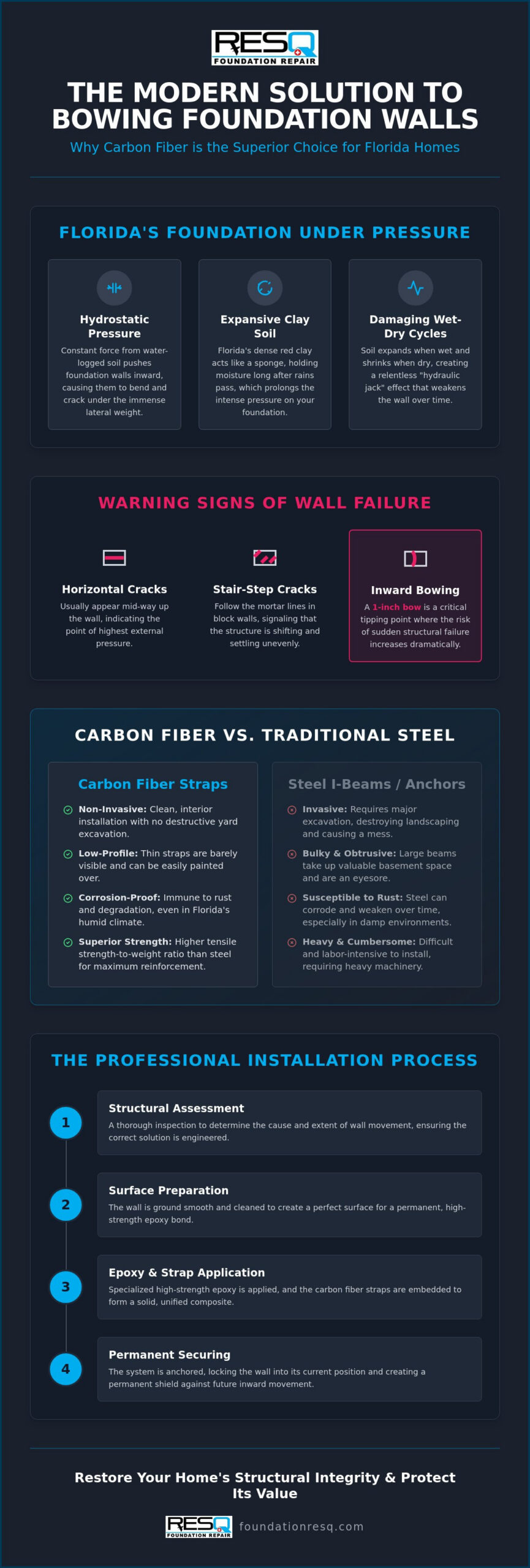
Hydrostatic pressure is the physical force exerted by standing water or saturated soil against your home’s foundation. In Florida, this isn’t just a minor technical term; it’s a constant environmental reality. When our heavy seasonal rains arrive, the soil surrounding your foundation becomes water-logged. This saturated earth is incredibly heavy and exerts immense lateral pressure against your basement or crawl space walls. Because concrete is strong under vertical loads but weaker against side-to-side forces, the wall eventually begins to curve or “bow” inward under the weight.
In Tallahassee, our specific soil composition significantly complicates this issue. While some coastal areas have sandy soil that drains quickly, our region is known for dense red clay. Clay is highly expansive and acts like a sponge, holding onto moisture long after a storm passes. This means your foundation faces prolonged pressure that doesn’t dissipate easily. A dangerous misconception many homeowners share is that a bowing wall will eventually “settle” or return to its original position on its own. Structural movement isn’t self-correcting. Once the integrity of the concrete or masonry is compromised, the wall will continue to weaken until a professional solution, such as carbon fiber straps for foundation repair Florida, is implemented to stabilize the structure.
The Impact of Florida’s Heavy Rainfall Cycles
North Florida experiences intense cycles of tropical downpours followed by periods of high heat. This creates a “wet-dry” cycle that is just as damaging to foundations as the freeze-thaw cycles seen in the North. During the rainy season, the clay expands and pushes against the home. In the dry season, the soil shrinks away, creating gaps that allow even more water to pool against the foundation during the next storm. Moisture-heavy soil acts as a hydraulic jack against concrete, slowly and methodically forcing the wall out of its original alignment. Over several years, these cycles cause the wall to lose its ability to resist the weight of the earth outside.
Warning Signs of Structural Wall Fatigue
Identifying the signs of wall fatigue early can prevent a total structural failure. The most common indicator of hydrostatic pressure is horizontal cracking, which usually appears mid-way up the wall where the inward pressure is most concentrated. You might also notice “stair-step” cracks that follow the mortar lines in brick or block work. While these cracks start small, they are clear signals of distress. The Engineering Behind Carbon Fiber Straps allows us to address these issues by reinforcing the wall’s tensile strength. Many engineers consider a 1-inch bow to be the tipping point for structural concern. At this stage, the wall’s center of gravity has shifted enough that the risk of sudden failure increases. Utilizing carbon fiber straps for foundation repair Florida provides a high-strength shield that arrests this movement before it reaches a critical state.
The Engineering Behind Carbon Fiber Straps for Foundation Repair
Carbon fiber isn’t just a modern construction material; it’s a high-performance composite system. Each strap is composed of thousands of high-tensile crystalline filaments that are woven into a flexible, incredibly strong fabric. When we apply carbon fiber straps for foundation repair Florida homeowners rely on, we’re essentially adding a structural exoskeleton to the building. This material is specifically designed to handle tension, which is the exact force that causes a foundation wall to fail when it’s pushed from the outside by saturated soil.
Understanding the root causes of Bowing Walls and Hydrostatic Pressure in Florida is essential for choosing a remedy that actually lasts. Traditional methods often rely on bulk and weight, but carbon fiber relies on pure engineering. The straps distribute the lateral load across the entire height of the wall, preventing the pressure from concentrating in one vulnerable spot. Once the system is installed, it works silently to maintain the building’s vertical alignment and prevent any further inward movement.
Tensile Strength: Why Carbon Fiber Outperforms Steel
Historically, steel beams were the standard for wall reinforcement. However, steel has several drawbacks in the Florida climate. It’s heavy, invasive to install, and susceptible to rust when exposed to the high humidity found in our crawl spaces. Carbon fiber is immune to corrosion and has a much higher tensile strength than steel. It doesn’t stretch or yield under pressure. If the wall cannot move, it cannot bow. It’s the same reason this material is the primary choice for aircraft wings and racing car chassis; it offers maximum strength without unnecessary weight or the risk of degradation over time.
How High-Strength Epoxy Creates a Structural Bond
The effectiveness of the strap depends entirely on how well it connects to the masonry. We use a specialized, high-strength epoxy that creates a chemical bond between the carbon fiber and the concrete. This isn’t a surface-level adhesive. The epoxy penetrates the pores of the wall, essentially welding the strap to the structure. Once this bond cures, the strap becomes an integral part of the wall itself. It won’t peel, shift, or lose its grip. If you suspect your walls are losing their battle against soil pressure, a consultation with the experts at Foundation ResQ can help determine if this engineered solution is right for your home.
This bond is permanent. Unlike mechanical anchors that might require periodic tightening or adjustment, a carbon fiber system is a set-it-and-forget-it remedy. It provides a long-term protective barrier that ensures your foundation remains stable for decades to come. Using carbon fiber straps for foundation repair Florida ensures that your home’s structural integrity is backed by some of the most advanced material science available today.
Carbon Fiber vs. Traditional Wall Anchors in Florida Soils
Traditional wall anchors have served as a standard repair for decades, but they come with a heavy physical cost to your property. To install an anchor, a contractor must excavate a large area of your yard, often ten feet or more away from the foundation, to bury a metal plate. In Florida, where homeowners invest heavily in landscaping, decks, and irrigation systems, this level of disruption is often a dealbreaker. By contrast, carbon fiber straps for foundation repair Florida projects are completed entirely from the interior of the home. There is no trenching, no heavy machinery in the garden, and no risk to your underground utility lines.
The engineering differences extend to how these systems interact with Florida’s unique geology. The Professional Installation Process for Carbon Fiber Reinforcement ensures that the repair is bonded directly to the masonry, making it independent of soil conditions. Traditional anchors rely on the passive resistance of the soil to hold the wall in place. If the soil becomes overly saturated or shifts due to our state’s high water table, the anchor’s effectiveness can diminish. Carbon fiber creates a permanent, high-tensile shield that doesn’t rely on external soil stability to do its job. It’s a “set and forget” remedy that doesn’t require the periodic tightening often associated with mechanical anchors.
Why Non-Invasive Solutions Win in Tallahassee
In our local Tallahassee neighborhoods, homes are often situated on lots with mature trees or tight property lines. Bringing in an excavator to install wall anchors isn’t just messy; it’s sometimes impossible. Carbon fiber is the superior choice for these environments because it can be installed in tight crawl spaces or finished basements where space is at a premium. Because there is no digging or curing of large concrete footers involved, our teams can typically complete a full stabilization project in a single day. This speed allows you to return to your normal routine without a weeks-long construction project looming over your home.
Aesthetic Benefits: Maintaining Your Home’s Value
One of the most significant advantages of carbon fiber is its low profile. The straps are only a fraction of an inch thick, meaning they don’t protrude into your living or storage space like steel I-beams or bulky anchor plates. This is a critical factor for foundation repair Tallahassee homeowners consider when protecting their property’s resale value. Once the high-strength epoxy has fully cured, the straps can be painted over or covered with wall finishes. Potential buyers see a clean, stable wall rather than an invasive mechanical repair. Choosing carbon fiber straps for foundation repair Florida ensures your home remains attractive on the market while staying structurally sound against the elements.
The Professional Installation Process for Carbon Fiber Reinforcement
A successful structural repair begins long before the first tool is lifted. At Foundation ResQ, we start every project with a comprehensive structural assessment. This step is vital because we must measure the exact degree of the inward bow and identify the specific points of maximum stress. Engineering a solution requires more than just identifying a crack; it requires understanding the load-bearing requirements of the entire building. This data allows us to determine the precise spacing and placement of the carbon fiber straps for foundation repair Florida homes need to remain stable against the weight of the surrounding soil.
The installation itself is a methodical process that prioritizes cleanliness and technical accuracy. Because we are creating a chemical bond between the carbon fiber and the masonry, the environment must be carefully controlled. Our teams follow a strict problem-solution framework to ensure that the final result is a permanent remedy rather than a temporary fix. If you have noticed movement in your foundation walls, you can schedule a professional structural assessment with our team to identify the best path forward for your home.
Precision Wall Preparation and Grinding
The structural epoxy we use requires a clean, porous surface to achieve its maximum bond strength. We use industrial-grade grinders to strip away years of paint, dirt, and efflorescence, exposing the raw concrete or block underneath. Removing these surface contaminants is essential; the epoxy must penetrate the pores of the wall to become an integral part of the structure. To maintain the cleanliness of your North Florida home, we utilize HEPA-filtered vacuum systems that capture dust at the source during the grinding process. Our technicians use laser levels to ensure each strap is installed perfectly vertical. This precision is required for optimal load distribution, as even a slight tilt can reduce the system’s ability to resist hydrostatic pressure.
Strap Application and Top/Bottom Anchoring
Once the wall is prepped, we apply a base coat of high-strength structural epoxy. The carbon fiber fabric is then “bedded” into this wet layer, ensuring every crystalline filament is fully encased in the resin. A critical safety step that distinguishes a professional installation is the use of top and bottom anchors. We secure the top of the strap to the home’s sill plate and the bottom into the concrete floor. This prevents the wall from sliding at the base or tilting at the top, which are common failure points in unanchored systems. We finish the process with a final saturation coat of epoxy that seals the entire system. This creates a maintenance-free, protective barrier that will not shift, peel, or degrade over time.
Restoring Your Home’s Integrity with Foundation ResQ
As a member of the Groundworks national network with deep roots in our community, Foundation ResQ understands that a home is more than just a structure. It’s a significant investment that requires expert protection from a steadfast local expert. When you choose carbon fiber straps for foundation repair Florida homeowners trust, you’re investing in a permanent remedy backed by regional specialized knowledge. Our team doesn’t just treat the symptoms of a bowing wall; we look at the soil, the drainage, and the unique environmental factors that threaten your home’s stability. We act as a final line of defense for your property’s structural health, ensuring that the elements stay outside where they belong.
The peace of mind that comes with a stabilized foundation is invaluable. Choosing an engineered, aerospace-grade solution means you no longer have to worry about the silent pressure of saturated soil or the fear of a sudden structural failure. We focus on long-term outcomes rather than quick fixes. By arresting the movement of your foundation walls now, you prevent a manageable structural concern from evolving into a catastrophic collapse. It’s a methodical, thorough approach to home protection that prioritizes your safety and your property’s longevity.
The Benefit of a Local Structural Assessment
Every neighborhood in our region presents its own set of geological challenges. Whether you live in the established neighborhoods of Betton Hills or the newer developments in Killearn, the soil composition under your home is unique. A one-size-fits-all approach doesn’t work for structural remediation in North Florida. We provide customized plans that address the specific hydrostatic forces acting on your specific lot. Often, a complete remedy involves more than just wall reinforcement. For many homeowners, combining structural straps with crawl space encapsulation Tallahassee is the most effective way to manage the moisture levels that drive soil expansion in the first place.
Long-Term Protection and Peace of Mind
These repairs do more than just hold up a wall; they protect your home’s future resale value. Because the carbon fiber system is nearly flush with the wall and entirely paintable, it maintains a clean, professional appearance that doesn’t alarm potential buyers. In fact, a professionally stabilized foundation is often a significant selling point, as it proves the home has been maintained by experts. The solution is permanent and creates a structural bond that lasts for the life of the building. Your home is your biggest investment, and it deserves a protection system that won’t degrade or fail over time. Don’t wait for the pressure to increase. You can Schedule your free foundation inspection with Foundation ResQ today. and secure the professional resolution your home needs.
Securing Your Home’s Future Stability
You now understand how hydrostatic pressure from Tallahassee’s dense red clay forces foundation walls to bow and why aerospace-grade materials offer the most reliable defense. By choosing a low-profile, non-invasive system, you protect your landscaping and property value while achieving a permanent structural bond. This technology doesn’t just mask the problem; it provides a definitive remedy for the forces pushing against your home. Utilizing carbon fiber straps for foundation repair Florida homeowners can trust ensures that your structure remains resilient against our state’s intense seasonal rainfall and high water table.
As a member of the Groundworks network, Foundation ResQ brings national reliability and local Tallahassee-specific structural expertise to every project. Our certified carbon fiber installation specialists provide a methodical approach that prioritizes long-term safety over quick fixes. We’re committed to restoring the integrity of your building with precision and care. It’s time to stop worrying about structural movement and start enjoying the peace of mind that comes with a stabilized home.
Protect your home with a free foundation inspection from Foundation ResQ. Taking action today prevents minor wall fatigue from becoming a major structural failure. Your home is your most significant investment; let us help you keep it standing strong for decades to come.
Frequently Asked Questions
Do carbon fiber foundation straps really work?
Yes, carbon fiber straps are an engineered solution that provides immense tensile strength to masonry walls. This material was originally designed for the aerospace industry to handle extreme stress without stretching. When bonded to a foundation wall with structural epoxy, the straps effectively arrest inward movement and stabilize the building’s skeletal frame. They are a proven remedy for walls showing early to moderate signs of bowing.
How much do carbon fiber straps for foundation repair cost in Florida?
The total investment for this repair varies based on the length of the wall and the severity of the structural movement. While carbon fiber is often more cost effective than traditional steel beams or massive excavation projects, a precise cost can only be determined through a professional structural assessment. Factors like wall preparation, the number of straps required, and the installation of top and bottom anchors will influence the final project scope.
Are carbon fiber straps better than wall anchors?
Carbon fiber is often the superior choice for Florida homeowners who want to protect their landscaping and outdoor living spaces. Unlike wall anchors, which require significant yard excavation and periodic maintenance, straps are installed entirely from the interior and remain maintenance free. They are particularly effective in the tight property lines and dense clay soils common in the Tallahassee area where heavy machinery cannot reach.
Can I paint over carbon fiber foundation straps?
Yes, you can easily paint over the straps once the structural epoxy has fully cured. Because the material is only a fraction of an inch thick, it creates a very low profile on the wall surface. Homeowners often apply a layer of masonry paint or a wall finish to blend the reinforcement into the rest of the basement or crawl space, maintaining a clean and professional appearance.
How long do carbon fiber foundation repairs last?
Carbon fiber repairs are considered a permanent solution for foundation stabilization. When installed by certified professionals, these systems have a design life that can exceed 75 years. The material is immune to rust, rot, and corrosion, which is a critical benefit in the high humidity and moisture heavy environments found throughout Florida. Once the bond is established, the reinforcement becomes a lasting part of the home’s structure.
Will carbon fiber straps stop my wall from bowing further?
Yes, the primary function of carbon fiber straps for foundation repair Florida homeowners utilize is to arrest further bowing. The material has a high tensile strength, meaning it does not stretch or yield under the pressure of saturated soil. By distributing the lateral load across the entire height of the wall, the system provides a rigid barrier that stops the inward curve from progressing toward a structural failure.
Do carbon fiber straps need to be anchored to the floor and ceiling?
Professional installation requires anchoring the straps to both the top sill plate and the bottom concrete floor. This dual anchoring system is a critical safety feature that prevents the wall from shifting at the base or tilting at the top. Without these anchors, the wall could still move even if the center is reinforced. Securing both ends ensures the entire vertical plane of the wall remains locked in place.
How many carbon fiber straps do I need for my foundation wall?
The number of straps required is determined by the length of the affected wall and the degree of structural distress. Industry standards typically suggest spacing the straps every three to four feet along the bowing section. However, a local structural expert must evaluate the specific load requirements of your home to ensure the reinforcement is sufficient to counter the unique hydrostatic pressure levels in your area’s soil.