
Biocide application means spraying, wiping, or fogging a chemical agent onto mold to kill or inhibit it. The direct answer for most homeowners: routine spraying isn’t recommended by federal guidance, and removal plus moisture control does the real work. Right now, pull out what you can see, find and stop the water source, and call a professional if the area is large or contaminated by sewage.
Key Takeaways
Effective mold treatment depends on physical removal and moisture control first, with biocide application reserved for limited, specific circumstances rather than routine use.
| Point | Details |
|---|---|
| Biocides kill, they don’t remove | Chemical treatment can reduce surface microbial activity but leaves dead mold behind, which is still allergenic. |
| Fix moisture before anything else | Regrowth is likely within weeks if the underlying leak or humidity source isn’t corrected. |
| Porous materials usually need removal | Drywall, insulation, and wood framing host mold growth that surface spraying can’t reach. |
| Follow EPA and IICRC S520 guidance | Both discourage routine biocide use and treat it as a last, situational step after cleaning. |
| Foundation ResQ prioritizes source control | Inspections focus on moisture correction and physical removal, using EPA-registered biocides only in specific cases like sewage contamination. |
Table of Contents
- What Is Biocide Application Mold Treatment, Exactly?
- When Should You Apply Biocides During Mold Cleanup?
- When Are Biocides Recommended, and When Should You Skip Them?
- Can Biocides Actually Remove Mold From Your Home?
- What Safety Gear Do You Need for Biocide Use?
- How Do Professionals Handle Biocides Differently Than DIY?
- Environmental Impact and Disposal of Biocides
- Are Biocide Products Regulated for Home Mold Treatment?
- What Happens After You Apply a Biocide?
- Foundation ResQ’s Approach to Biocide Use
- Get a Straight Answer About Your Mold Problem
- Sources
- FAQ
What Is Biocide Application Mold Treatment, Exactly?
A biocide is any chemical that destroys or suppresses living organisms, and in mold treatment, that means fungicides, disinfectants, and some specialty coatings marketed for indoor microbial control. These products fall into two functional camps. Fungicidal biocides kill mold outright. Fungistatic ones don’t kill it. They just slow reproduction and growth, which means the mold can come roaring back the moment conditions favor it again.
Because biocides destroy living organisms, they’re legally classified as pesticides under the Federal Insecticide, Fungicide, and Rodenticide Act (FIFRA). That classification isn’t a technicality. It means:
- Products must carry an EPA registration number
- Labels must specify approved indoor uses and surfaces
- Manufacturers must list required protective equipment and ventilation steps
- Using a product outside its labeled directions can violate federal law
Common categories include chlorine-based disinfectants, quaternary ammonium compounds, and specialty antimicrobial sprays sold specifically for mold jobs.
When Should You Apply Biocides During Mold Cleanup?
Biocide application methods generally fall into four camps, and the surface you’re treating determines which one makes sense.
- Wiping works on hard, cleanable surfaces and lets you physically remove spores along with any residue.
- Spraying covers larger areas faster but risks aerosolizing spores into the air you’re breathing.
- Fogging disperses a fine mist through a room, which sounds thorough but often just relocates contamination rather than eliminating it.
- Antimicrobial coatings create a residual barrier, though they address surface growth only, not what’s happening inside a wall cavity.
Surface type matters more than most people expect. Non-porous materials like tile, glass, and metal can be cleaned and disinfected effectively because mold sits on top of the surface. Porous materials, drywall, insulation, carpet padding, wood framing, are a different story. Mold sends microscopic hyphae into the material itself, and no amount of surface spraying reaches what’s growing underneath. That’s why remediation guides generally call for removing and replacing porous materials rather than treating them chemically.
Pro Tip: Always clean and remove visible mold and debris before applying any biocide. Chemical agents need direct contact time to work, and a layer of grime or organic material blocks that contact and wastes the product entirely.
When Are Biocides Recommended, and When Should You Skip Them?
The U.S. EPA is direct on this point: using biocides or chemicals to kill mold, including chlorine bleach, is not recommended as routine practice during cleanup. Biocides belong in a narrow set of circumstances, and only after physical removal and moisture correction, not instead of them.
Municipal guidance echoes the same order of operations. Philadelphia’s mold remediation guidelines treat biocide application as a late step that happens after source removal and cleaning, and specifically discourage gaseous or aerosolized biocides in occupied spaces.
Run through this checklist before deciding whether chemical treatment applies to your situation:
- Size of the contaminated area. Small, contained spots rarely justify chemical intervention beyond cleaning.
- Water category. Clean water damage differs from sewage-contaminated (Category 3) water, where bacterial and pathogen risk changes the calculus.
- Occupant risk profile. Homes with immune-compromised residents, infants, or elderly occupants may warrant a more cautious, sometimes chemically assisted approach.
- Material type. Porous materials generally need removal, not spraying.
The ANSI/IICRC S520 standard, the industry benchmark for professional mold remediation, reinforces this: physical removal and cleaning are the primary remediation approaches, and biocides are considered case by case, never as a default step.
Can Biocides Actually Remove Mold From Your Home?
Killing mold and removing mold hazard are two different things, and conflating them is where a lot of DIY mold treatment goes wrong. A biocide can knock down active microbial growth on a surface, but dead mold is still allergenic and, in some species, may cause other health effects. The EPA’s remediation guide for schools and commercial buildings states plainly that cleanup must focus on removing mold, not just killing it, since a background spore level remains even after moisture problems are fixed.
There’s also the penetration problem. Biocides applied to a surface don’t reach mold growing inside insulation, behind drywall, or deep in a stud cavity. You end up with a treated surface layer and an untouched interior colony.
Here’s what realistic outcomes look like after chemical treatment alone, without removal or moisture correction:
- Surface microbial activity temporarily reduced
- Visible staining and odor sometimes unchanged
- Regrowth likely within weeks if humidity or leaks persist
- Allergenic particles from dead mold still present in dust and air
Sterilizing a home isn’t the goal, and it isn’t achievable anyway. Remediation aims to bring indoor spore counts back down near outdoor background levels, and that happens through removal and drying, not chemistry.
What Safety Gear Do You Need for Biocide Use?
If you do use a biocide, EPA guidance requires ventilating the area, exhausting air outdoors during and after application, and wearing PPE that matches the product’s hazard level. At minimum, that means:
- Goggles that seal against splashes
- Chemical-resistant gloves (nitrile, neoprene, or natural rubber, not household latex)
- A respirator rated for the specific chemical when the label calls for one
- Long sleeves and pants to limit skin contact
Never mix bleach with ammonia or ammonia-containing cleaners. That combination produces chloramine gas, which is genuinely dangerous in an enclosed space and sends people to the emergency room every year. The CDC’s mold and health guidance covers occupant exposure risks in more detail if you’re dealing with sensitive household members.
Before you buy anything, check for an EPA registration number on the label and read the indoor-use directions closely. Products formulated for agricultural or industrial fungicide use aren’t approved for indoor residential application, and using them that way isn’t just risky, it’s a label violation.
How Do Professionals Handle Biocides Differently Than DIY?
A licensed remediation crew follows a sequence, and biocides, when they show up at all, land near the end rather than at the start.
- Inspection and assessment to identify the extent and cause of moisture intrusion
- Containment to stop spores from spreading to unaffected areas
- Source removal of contaminated porous materials
- Cleaning of remaining surfaces with detergent and physical agitation
- Optional biocide application in limited scenarios, such as sewage contamination or immune-compromised occupants
- Verification and clearance testing to confirm the job actually worked
Many remediation professionals treat biocides as a final sanitizing pass rather than a substitute for removal, consistent with ANSI/IICRC S520 principles, which emphasize source removal and building science over chemical shortcuts.
If you’re hiring outside help, check for:
- Active licensing and liability insurance in your state
- Familiarity with IICRC S520 protocols
- A clear containment and disposal plan before work starts
- Post-remediation clearance sampling for larger or contaminated jobs
You can read more about how a full remediation process works and how it compares to chemical-only removal methods.
What Does a Product Like BioCide 100 Actually Claim?
BioCide 100 is a commercial fungicide marketed for treating mold and mildew on surfaces, typically applied by spray or wipe application on non-porous or semi-porous materials. Manufacturers position it for use after cleaning, not as a standalone fix.
Before trusting any product for indoor use:
- Confirm it carries an active EPA registration number
- Check whether it’s labeled for the surface you’re treating
- Note that it won’t reach mold growing inside porous materials like drywall or wood framing
- Follow contact time and ventilation instructions exactly as printed
Environmental Impact and Disposal of Biocides
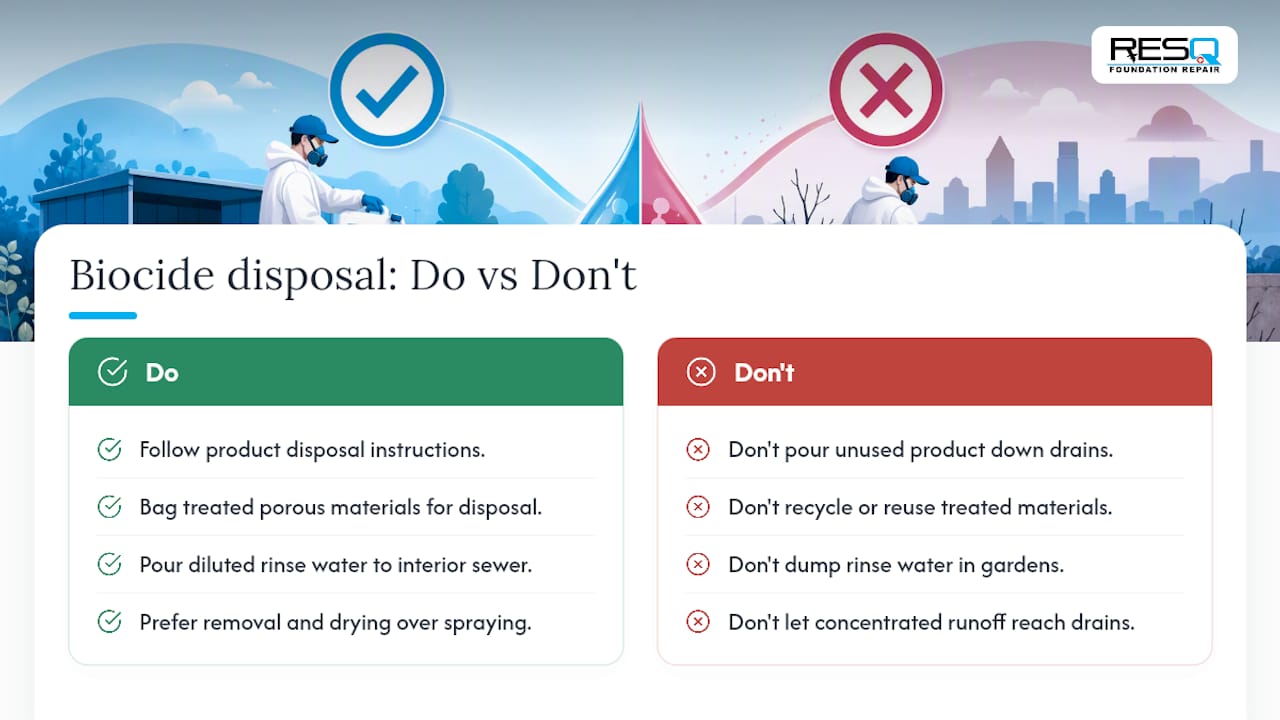
Biocides don’t stop being active once they’ve done their job on your wall or tile. These are compounds designed specifically to kill living organisms, and that property doesn’t disappear when you rinse a sponge or pour leftover solution down a drain.
Wastewater treatment plants aren’t always equipped to fully break down fungicidal compounds, and concentrated biocide runoff can affect aquatic organisms if it reaches storm drains or septic systems. That’s part of why labels specify disposal instructions, and why pouring unused product straight into a sink or toilet is a mistake many homeowners make without realizing it.
Removed porous materials, drywall, insulation, carpet, that have been treated with a biocide should generally be bagged and disposed of as household waste rather than recycled or reused, since the chemical residue travels with the material. Some municipalities have specific guidelines for disposing of larger quantities of chemically treated demolition debris, particularly from commercial jobs.
Rinse water from cleaning tools used with biocides shouldn’t go into gardens or storm drains. Many labels specify pouring diluted rinse water down an interior drain connected to a municipal sewer system, which is treated differently than surface runoff.
The more practical environmental point is this: the less biocide you use, the less disposal burden you create. A remediation approach centered on physical removal and drying, rather than routine chemical spraying, generates less hazardous waste and less environmental exposure across the board. That’s one more reason federal and industry guidance both lean toward minimal chemical use rather than treating biocides as a first response.
Are Biocide Products Regulated for Home Mold Treatment?
Yes, and the regulatory framework is stricter than most homeowners assume. Because biocides destroy living organisms, they fall under FIFRA, the federal law governing pesticides, which means the EPA reviews and registers each product before it can legally be sold for indoor microbial control.
That registration process covers labeled uses, approved surfaces, required protective equipment, and maximum concentration limits. A product registered for agricultural fungicide use isn’t automatically approved for residential indoor application, and using it that way steps outside the label, which is both a safety risk and, technically, a legal violation.
Some states and municipalities layer additional restrictions on top of federal rules, particularly for larger commercial remediation jobs or for products applied by licensed pest control operators rather than general contractors. If you’re hiring a remediation company, it’s worth asking whether the biocide products they use carry current EPA registration numbers and whether their technicians are certified to apply them.
The practical takeaway: check the label before you buy, and check it again before you apply. An EPA registration number isn’t a formality. It’s the difference between a product that’s been vetted for indoor human exposure and one that hasn’t.
What Happens After You Apply a Biocide?
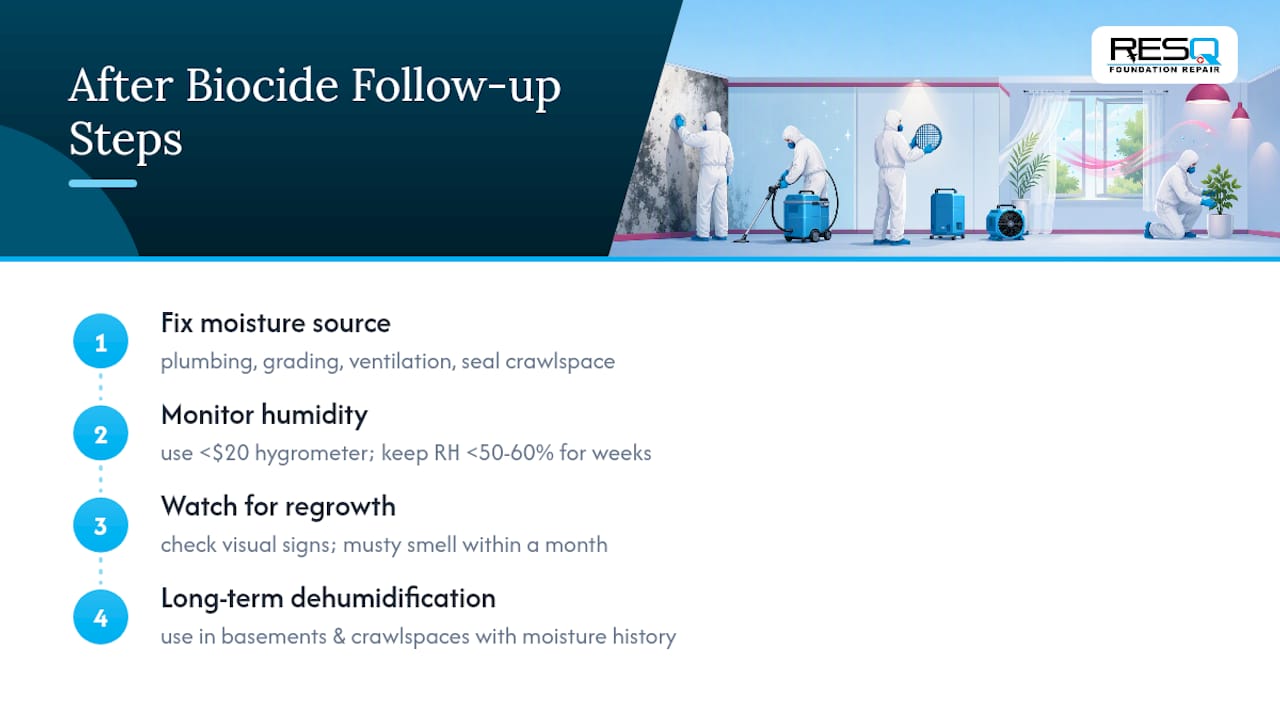
Application isn’t the finish line. Whatever chemical treatment you or a professional used, the follow-up work is what actually determines whether mold comes back.
Start by addressing the moisture source directly, since mold has no reason to return once conditions no longer support it. That might mean fixing a plumbing leak, improving grading around your foundation, adding ventilation to a bathroom, or encapsulating a damp crawl space. Skipping this step is the single most common reason mold treatment fails, chemical or otherwise.
Monitor humidity levels in the treated area for several weeks afterward. A hygrometer costing under $20 tells you whether indoor relative humidity is staying below the 50 to 60 percent range that discourages mold growth. If it keeps climbing back above that band, something in the space, ventilation, insulation, drainage, still needs attention.
Watch for visual or odor signs of regrowth, particularly around the original site and any adjacent porous materials that weren’t replaced. A musty smell returning within a month is a strong signal that either moisture wasn’t fully resolved or the biocide only addressed a surface layer while growth continued underneath.
For homes with a documented history of moisture problems, ongoing dehumidification is often the most reliable long-term prevention step, especially in crawl spaces and basements where humidity naturally runs higher than living areas. You can learn more about how mold spreads through home structures to understand which areas of your home need the closest monitoring going forward.
Foundation ResQ’s Approach to Biocide Use
We prioritize source control, physical removal, and moisture correction over chemical treatment on every job, because that’s what actually stops mold from coming back. Biocides aren’t off the table entirely. When sewage contamination, healthcare-adjacent settings, or immune-compromised occupants are involved, an EPA-registered product might be part of the plan, but always after removal, never in place of it. If you’re not sure whether your situation calls for chemical treatment or just needs the water problem fixed, a free inspection settles the question fast.
Get a Straight Answer About Your Mold Problem
Chemical sprays and DIY fogging kits promise a quick fix, but they rarely address why mold showed up in the first place. Foundationresq takes a different route: a full inspection that identifies the actual moisture source, whether that’s a leaking crawl space, a failing basement wall, or poor drainage around your foundation, so you’re not just treating a symptom on repeat every summer.
Our remediation work pairs with crawl space dehumidification and basement waterproofing services designed to keep humidity out of the equation permanently, which is the one variable chemical treatment alone can never control. For ventilation-related moisture issues specifically, resources like this bathroom ventilation guide from our partners at Trinity Inspections cover practical steps you can take today.
If you’re seeing recurring mold, smelling something musty you can’t place, or just want a professional opinion before spending money on chemicals, request a free inspection and we’ll walk you through exactly what your home needs.
Sources
These are the primary references behind the guidance in this article, and worth reading directly if you want the full technical detail:
- Mold Remediation in Schools and Commercial Buildings Guide: Chapter 3 | US EPA
- IICRC S520
- ANSI/IICRC S520 2024 professional mold remediation (blog)
This article is general information, not a substitute for advice from a qualified doctor. Consult a qualified healthcare professional about your own circumstances before acting on anything here.
FAQ
When Should You Use a Biocide for Mold?
Biocides are appropriate only in limited situations, such as sewage contamination, healthcare settings, or homes with immune-compromised occupants, and always after physical mold removal and moisture correction, according to EPA guidance.
Is BioCide Toxic to Humans?
Yes. Biocides are regulated as pesticides under FIFRA because they’re designed to destroy living organisms, which means they carry real toxicity risk to people too, and require proper PPE and ventilation during use.
Will BioCide 100 Kill Black Mold?
Products like BioCide 100 can kill surface mold, including black mold species, on non-porous or lightly porous surfaces, but they won’t reach growth embedded inside drywall, insulation, or wood framing.
Where Can I Buy BioCide 100 Mold Cleaner?
BioCide 100 is sold through professional restoration supply distributors and some specialty cleaning retailers; always confirm the product carries a current EPA registration number before purchasing for indoor use.
Should I Hire a Professional Instead of Using a Biocide Myself?
For contamination larger than a few square feet, sewage-related water damage, or homes with vulnerable occupants, a professional following IICRC S520 protocols is safer and more effective than DIY chemical treatment, and Foundationresq offers free inspections to help you decide.
Recommended
- What Does the Mold Remediation Process Involve? – Tallahassee Foundation Repair | Foundation ResQ
- Mold Removal Methods Compared: What Actually Works – Tallahassee Foundation Repair | Foundation ResQ
- Black Mold in Crawl Space Removal: A Professional Remediation Guide – Tallahassee Foundation Repair | Foundation ResQ
- How to Evaluate Past Mold Remediation Effectiveness – Tallahassee Foundation Repair | Foundation ResQ