
Get a site-specific geotechnical report before you pour anything or sign a repair contract. Every real answer to a clay soil problem, whether it’s new construction or a cracking slab, starts with soil borings, lab testing, and an engineer’s stamp. Skip that step and you’re guessing at the depth of an active zone that can move a foundation two inches or more in a single wet season.
If you already own a house on an expansive clay foundation site, or you’re planning to build on one, here’s what to do in the next two weeks:
- Order test borings and lab testing (Atterberg limits, expansion index) from a licensed geotechnical engineer.
- Hold off on major grading, landscaping, or irrigation changes until you know your soil’s swell potential.
- Schedule a consult with a geotechnical engineer, not just a foundation contractor, before choosing a repair or design method.
Roughly a quarter of U.S. homes sit on expansive soils, and about 10% of new homes built on these sites go on to suffer significant damage. Foundation RESQ inspects homes across North Florida, South Georgia, and Alabama and can point you toward the geotechnical testing you need before any structural work begins.
Key Takeaways
Expansive clay foundation problems are solvable, but only when the foundation design is matched to a site-specific geotechnical report rather than a generic repair method.
| Point | Details |
|---|---|
| Test before you build or repair | Order geotechnical borings and lab testing (Atterberg limits, expansion index) before any foundation decision. |
| Know your active zone | Pier and void depths must extend past the active zone into stable soil, not stop inside it. |
| Pair structure with drainage | Grading, gutters, and perimeter drains must accompany any structural fix, not replace it. |
| Match the fix to the data | Deep piers, pier-and-beam, void forms, and post-tensioned slabs each suit different PVR and active zone profiles. |
| Get a professional read first | Foundation RESQ offers free inspections across North Florida, South Georgia, and Alabama and flags when a stamped geotechnical report is needed. |
Table of Contents
- What Makes Expansive Clay Soil So Damaging?
- How Do I Confirm I Have Expansive Clay Soil?
- What Foundation Cracks and Sticking Doors Actually Mean
- Moisture Control Is Not Optional, Even With a Good Foundation Design
- Which Foundation Type Actually Works on Expansive Clay?
- Can You Treat Expansive Soil Before You Build?
- What Should You Budget for Testing and Repairs?
- What to Ask Before Hiring an Engineer or Contractor
- What the Research Actually Shows About Expansive Soil Risk
- What Contractors See When Homeowners Skip Geotechnical Testing
- How Foundation RESQ Supports Homeowners on Expansive Clay Sites
- Sources
- FAQ
What Makes Expansive Clay Soil So Damaging?
Expansive clay swells when it absorbs water and shrinks when it dries out. That cyclic volume change, not the weight of your house, is what cracks slabs, jams doors, and tilts porches. The clay minerals responsible, mostly montmorillonite, have a layered molecular structure that lets water molecules wedge between the layers and force the soil to expand, sometimes by 10% or more in volume between dry and saturated states.
Engineers call the depth over which soil moisture actually fluctuates the active zone. In much of the Southeast, that zone runs anywhere from three to fifteen feet deep, depending on climate, drainage, and vegetation. A foundation that doesn’t account for the active zone’s true depth is a foundation built on a guess.
The damage shows up in a few predictable ways:
- Heave and uplift push slab edges or footings upward when clay swells beneath them, especially after heavy rain following a dry spell.
- Edge effects create the most movement at a foundation’s perimeter, where moisture swings are most extreme, leaving the center of a slab relatively stable while the edges rise or fall.
- Differential movement bends structural elements when one part of a foundation moves more than another, cracking drywall, racking door frames, and shearing brick veneer.
The scale of this problem is not small. Historical estimates put nationwide expansive soil damage as high as $9 billion annually, and older transportation research pegged infrastructure damage alone at $2.3 billion a year, with roughly 250,000 new homes built on expansive soils annually during that era. Clay soil foundation problems aren’t a regional curiosity. They’re one of the most expensive geotechnical hazards in American residential construction.
How Do I Confirm I Have Expansive Clay Soil?
Hire a licensed geotechnical engineer to drill test borings and run laboratory analysis. There’s no reliable way to eyeball this. Two lots on the same street can carry very different swell potential depending on factors like clay mineralogy and soil profile depth.
A usable geotechnical report should include:
- Multiple test borings, typically drilled to 15 to 20 feet or below the anticipated active zone.
- Atterberg limits testing (ASTM D4318) to establish the plasticity index, the single best predictor of swell potential.
- Particle size analysis (ASTM D422) and expansion index testing (ASTM D4829) to confirm clay content and measure actual swell behavior in the lab.
- A calculated Potential Vertical Rise (PVR) or Potential Vertical Movement (PVM) estimate, which tells your engineer how much the ground could realistically move.
- A defined active zone depth and identification of the stable bearing stratum beneath it.
- Written foundation recommendations tied directly to those numbers, not generic boilerplate.
Pro Tip: On a typical residential lot, request borings near each corner of the planned footprint, at least one under the center of the structure, and one close to any existing downspout or low-lying drainage area. Moisture concentrates unevenly, and a single boring in the middle of the lot can miss the worst pocket of clay by twenty feet.
Expect a full geotechnical investigation for a residential lot to take from a few days for fieldwork up to a few weeks for the final stamped report, depending on lab backlog and borings specified. It’s the cheapest insurance policy in the entire project.
What Foundation Cracks and Sticking Doors Actually Mean
Not every crack means structural trouble, but expansive clay makes it harder to tell the difference without a trained eye. Hairline cracks in drywall corners, doors that stick seasonally, and small gaps around trim are common and often cosmetic, especially if they open and close with the weather.
Watch for these instead:
- Cracks wider than a quarter inch, especially diagonal cracks running from door and window corners.
- Floors that visibly slope or that a marble rolls across on its own.
- Brick veneer cracking in a stair-step pattern.
- Doors and windows that no longer close at all, regardless of season.
Industry practice in some regions treats roughly 4.5 inches of PVR as a rough ceiling for slab-on-grade systems before an engineered solution becomes standard practice, though your engineer’s own report should set the number that applies to your soil and structure.
Progressive movement, cracks that keep widening season after season rather than settling into a stable pattern, is the single clearest signal that a foundation needs professional evaluation now, not next spring.
Moisture Control Is Not Optional, Even With a Good Foundation Design
Consistent moisture management matters as much as the structural design itself. A perfectly engineered pier system can still underperform on a site where irrigation soaks the soil unevenly, because the swelling still happens, just closer to the surface where you’ll feel it in slabs and walkways that aren’t isolated from the active zone.
The core defenses are not complicated:
- Grade the soil to slope away from the foundation with a noticeable gradient for the first several feet.
- Extend gutters and downspouts a reasonable distance away from the foundation, not just off the roofline.
- Install perimeter drains where grading alone can’t move water away fast enough.
- Zone irrigation so sprinklers don’t concentrate water against one side of the house.
- Keep large trees and their root systems a healthy distance from foundations, since roots pull moisture unevenly from the soil and can dry out clay pockets right under a footing.
Water is the trigger for every shrink-swell cycle. Once a structure sits on an active site, changing the soil’s moisture behavior after the fact is far costlier and less predictable than designing around it from day one. That’s why moisture management belongs in the design phase, not the punch list.
Pro Tip: Clean gutters twice a year at minimum, more often under oak or pine cover, and walk your foundation perimeter after every heavy rain to check that water is actually reaching the downspout extensions instead of pooling against the slab. A landscaping approach that accounts for foundation drainage can prevent a surprising share of the moisture problems that show up as foundation complaints two years later.
Which Foundation Type Actually Works on Expansive Clay?
Every viable strategy for expansive soil does one of three things: it bypasses the active zone entirely, isolates the structure from swelling soil, or stabilizes the soil enough to reduce movement before building. Here’s how the main options stack up.
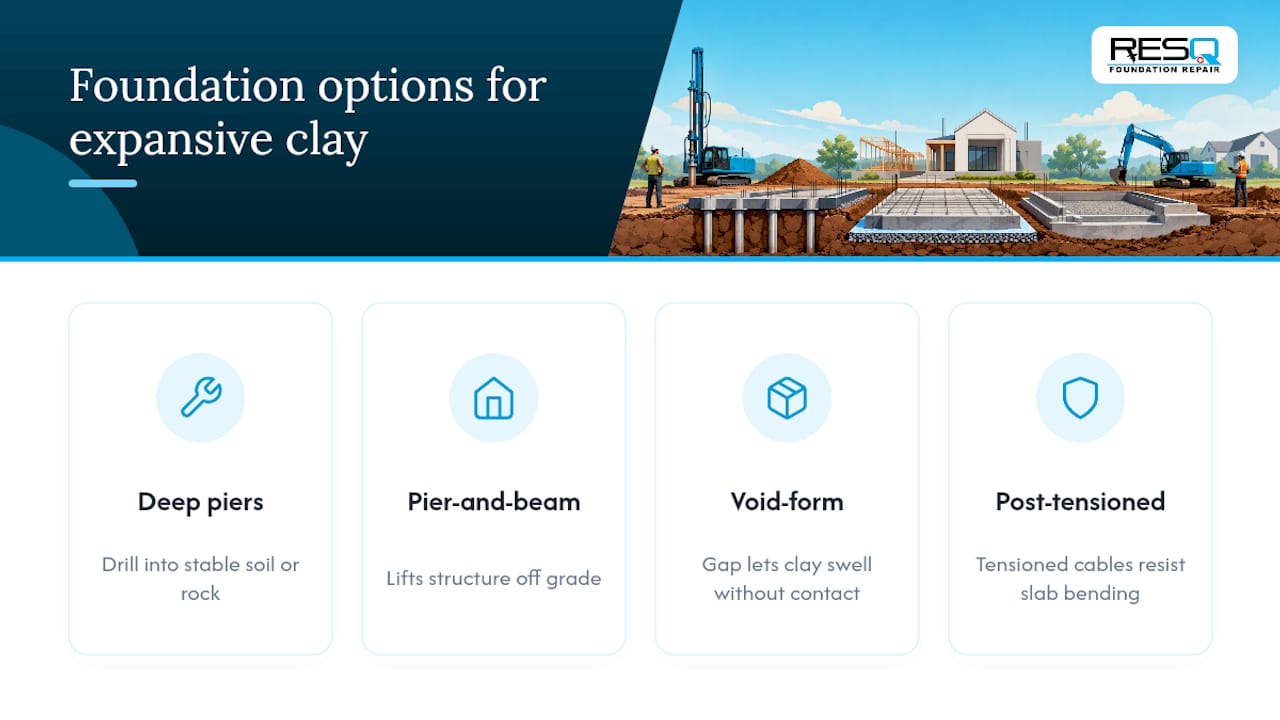
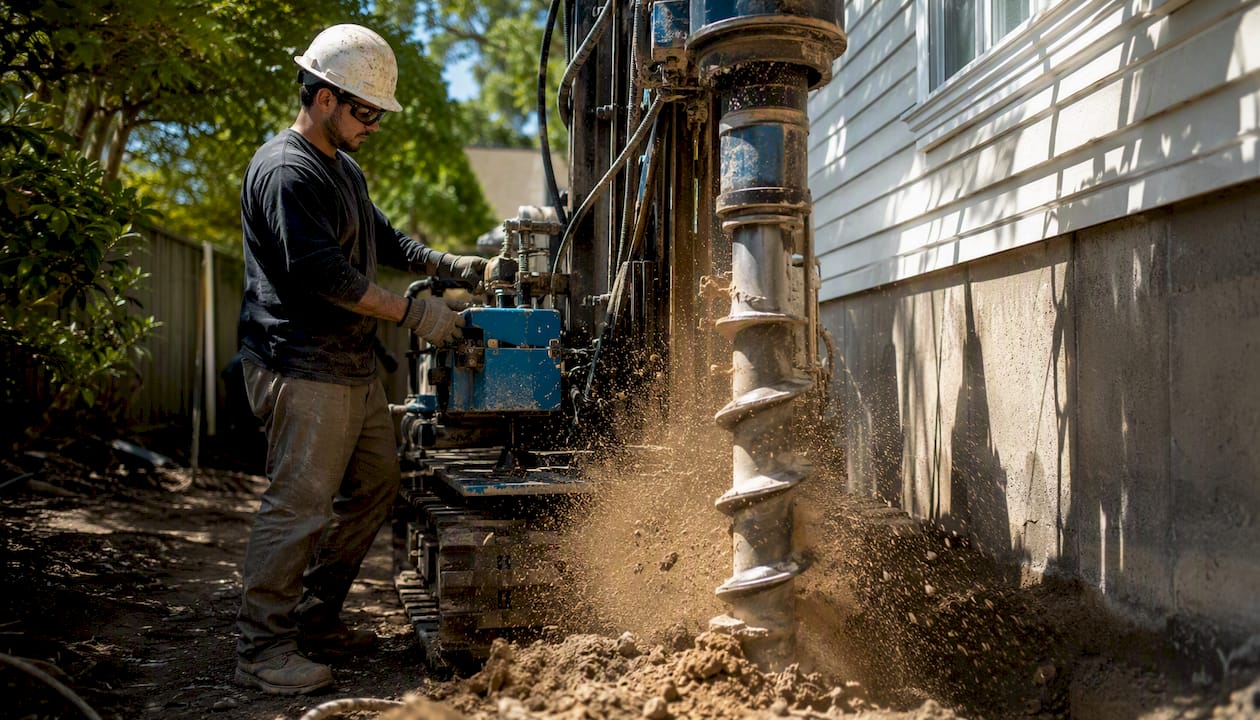
Deep piers and piles work by drilling through the entire active zone into stable bearing soil or rock below. This is often the most reliable fix for severe cases, but only if the piers actually extend past the active zone. Piers that stop short and terminate inside expansive clay can let uplift forces grip the pier shaft and pull sections of the structure upward, which defeats the entire purpose of the design.
Pier-and-beam construction lifts the living space above grade on a crawl space, physically separating the structure from direct contact with swelling soil. It’s a proven approach in markets that deal with unstable soils regularly, and it also simplifies future access for plumbing and mechanical repairs, a real advantage over slab construction when something goes wrong underneath the house.
Void-form systems create engineered gaps beneath a slab or grade beam, sized so the clay has room to swell without ever touching the structure above it. These systems are frequently paired with drilled piers or grade beams rather than used alone, since the void handles vertical swell while the piers or beams carry the structural load.
Post-tensioned slabs use steel cables tensioned within the concrete to resist the bending stress that differential soil movement creates. They’re common in new residential construction on moderately expansive sites, though they manage movement rather than eliminate the cause of it.
The right choice depends on your PVR value, active zone depth, and how much montmorillonite content your lab report shows. High PVR sites (generally above that 4.5 inch regional benchmark) usually call for deep piers or a hybrid void-plus-pier system rather than a standalone slab solution. Hybrid combinations, such as chemical soil stabilization under a void-form slab, are becoming more common where budgets don’t stretch to full deep-pier systems but PVR is too high for a standalone slab.
Can You Treat Expansive Soil Before You Build?
Soil remediation can reduce swell potential, but it rarely eliminates the risk entirely on its own. Most successful projects pair remediation with structural isolation rather than relying on soil treatment alone.
The common methods each target a different part of the problem:
- Lime or cement stabilization reduces plasticity by chemically altering the clay’s mineral structure, cutting swell potential in the treated layer.
- Chemical grouting introduces stabilizing agents into the soil to reduce suction and moisture sensitivity without full excavation.
- Over-excavation and replacement removes expansive clay to a specified depth and replaces it with engineered fill, though this gets expensive fast once depth requirements exceed a few feet.
- Granular pile anchors drive columns of compacted granular material into the clay to resist uplift; optimized designs have shown heave reductions above 90% in modeled testing, though real-world performance depends heavily on anchoring into stable strata beneath the active zone.
Remediation changes the soil’s behavior. It does not change the fact that the soil is still clay. That distinction is why most engineers pair chemical or mechanical treatment with a structural design that isolates the building anyway.
Cold, wet job sites limit how well lime and cement stabilization cure, and environmental permitting can restrict some chemical grouting near water sources. Remediation tends to buy years of improved performance, not permanent immunity.
What Should You Budget for Testing and Repairs?
Geotechnical investigation is the smallest line item and the one that protects every dollar spent afterward. Costs scale with how deep the active zone runs and how many piers or how much over-excavation a site needs.
Rough planning ranges for the Southeast:
- Geotechnical investigation: a few hundred to around two thousand dollars for a typical residential lot, depending on the number of borings.
- Drainage and grading corrections: usually the least expensive category, often a few thousand dollars for gutters, extensions, and perimeter grading.
- Foundation repair or underpinning: cost climbs with pier count and depth; deeper active zones requiring more piers drive this range higher than any other single factor.
- Soil remediation (lime/cement or over-excavation): cost depends heavily on treated area and depth, with over-excavation becoming disproportionately expensive past a few feet.
Testing and design typically take two to four weeks combined; permitting adds another few weeks depending on your jurisdiction; construction timelines vary widely by scope, from a few days for drainage work to several weeks for deep pier installation. The biggest cost driver across nearly every project is active zone depth. Every additional foot a pier has to reach adds drilling time, material, and labor.
What to Ask Before Hiring an Engineer or Contractor
Demand a site-specific, stamped design tied directly to your geotechnical report. A generic repair proposal with no reference to your actual PVR value or active zone depth is not an engineered solution, no matter how confident the salesperson sounds.
Ask these questions before signing anything:
- Where exactly were the test borings placed, and how many were there?
- What is the site’s PVR or PVM value, and what active zone depth does the report identify?
- Do proposed pier depths extend past the active zone into stable bearing material?
- How were uplift forces calculated for the proposed design?
- If void forms are specified, what void depth was calculated, and based on what swell data?
- What reinforcement strategy addresses differential movement across the slab or grade beams?
Watch for these red flags:
- No stamped engineering drawings, only a contractor’s sketch.
- A vague or missing PVR number when you ask directly.
- Pier depths that conveniently match a standard installation length rather than your site’s actual active zone.
- No moisture-control plan included alongside the structural fix.
Before hiring anyone, verify the engineer holds an active PE (Professional Engineer) license, ask for references or documented case results, confirm liability insurance, and ask whether financing options exist for larger jobs.
What the Research Actually Shows About Expansive Soil Risk
Expansive soils are neither rare nor evenly distributed. National estimates put damage as high as $9 billion annually, and regional analysis shows the risk is climbing, not holding steady. A Louisiana census-block study found swelling potential concentrated in southeastern and coastal areas and projected a roughly 15% increase in swelling potential by 2050 in those zones, driven by shifting precipitation patterns.
That study’s own mitigation recommendations track closely with what geotechnical engineers already specify nationwide:
- Pile support that reaches past the active zone.
- Void systems beneath slabs.
- Perimeter drainage to manage surface water.
- Soil conditioning where full structural isolation isn’t feasible.
The consistent thread across every credible source: generic fixes fail, and site-specific design tied to real lab data succeeds.
What Contractors See When Homeowners Skip Geotechnical Testing
The pattern repeats constantly: a homeowner patches a crack, the door sticks again eighteen months later, and by then the movement has spread to the framing above. Skipping the geotechnical report doesn’t save money. It just delays the real cost and adds interest.
Insist on stamped plans before any repair contract gets signed, and make sure the moisture-control plan gets installed alongside the structural fix, not as an afterthought. Two things homeowners can do today: clean gutters and downspout extensions now, and walk the foundation perimeter after the next hard rain to see where water actually pools.
How Foundation RESQ Supports Homeowners on Expansive Clay Sites
If you’re already seeing warning signs, whether that’s a stubborn door, a hairline crack that keeps widening, or a slab edge that’s clearly not level anymore, Foundation RESQ inspects homes across North Florida, South Georgia, and Alabama and identifies which movement pattern matches expansive clay behavior versus other causes.
A free inspection typically walks the foundation perimeter, documents crack patterns and floor elevation, and flags whether your situation needs a full geotechnical investigation before any structural work begins. Foundation RESQ then offers engineered repair paths that match what the soil data calls for, including underpinning and deep pier systems, permanent stabilization solutions, and paired drainage and crawl-space moisture control to keep the active zone from working against the repair. Financing options are available for larger structural jobs.
One thing worth being upfront about: a contractor’s inspection is not a substitute for a stamped geotechnical report on a project involving new construction or major structural redesign. Foundation RESQ will tell you when that’s the right next step rather than skip past it. If you’re seeing foundation movement now, schedule a free inspection and get a clear read on what your home actually needs.
Sources
Ask your engineer specifically for PVR/PVM values and ASTM test results (D4318, D422, D4829) rather than a general soil description.
FAQ
What problems does expansive soil actually cause?
Expansive soil cracks slabs and foundations, jams doors and windows, tilts floors, and can crack brick veneer in a stair-step pattern as the clay repeatedly swells and shrinks with moisture changes.
What is expansive clay?
Expansive clay is soil rich in montmorillonite or similar clay minerals that absorb water and swell significantly, then shrink again as they dry, creating cyclic ground movement that stresses foundations.
Is clay a good soil to build on?
Clay alone isn’t disqualifying, but highly expansive clay requires an engineered foundation, such as deep piers or void-form systems, rather than a standard shallow footing or slab.
How do you treat expansive soil?
Treatment options include lime or cement stabilization, chemical grouting, over-excavation and replacement, and granular pile anchors, usually combined with structural isolation like deep piers or void forms rather than used alone.
How do I know if my home’s cracks are from expansive clay?
Cracks that widen seasonally, doors that stick worse after rain, and sloping floors near the foundation perimeter point to expansive clay; a geotechnical evaluation and inspection from a company like Foundation RESQ can confirm the cause.
Recommended
- Foundation Settlement Repair in Tallahassee: Permanent Solutions for Shifting Soil
- Common Foundation Repair Mistakes to Avoid in 2026 – Tallahassee Foundation Repair | Foundation ResQ
- Foundation Stabilization: A Comprehensive Guide for Tallahassee Homeowners in 2026 – Tallahassee Foundation Repair | Foundation ResQ