What if the “repair” you just paid for is actually making your home’s structural problems worse? A patch of mortar or a quick injection of foam might hide a crack, but it won’t stop your home from sinking into Florida’s unpredictable limestone karst. Many homeowners find themselves trapped in a cycle of “quick fixes” that fail as soon as the next heavy rain saturates the soil. If you’re looking for permanent foundation repair solutions, you need to look beneath the surface to where the real instability lies. It’s frustrating to deal with contractors who offer temporary band-aids when you need an engineered remedy that addresses the root cause of settlement.
We understand that your home is your most significant investment and the place where your family should feel safest. It’s exhausting to navigate the conflicting advice between mudjacking and piering while worrying about your property’s market value. This guide provides the clarity you need to distinguish between cosmetic repairs and true structural stabilization. You’ll learn how engineering-grade solutions like helical and push piers bypass unstable topsoil to reach competent load-bearing strata. By the end of this article, you’ll have the confidence to choose a permanent fix that ensures your home remains stable and secure for a lifetime.
Key Takeaways
- Understand how Florida’s karst topography and seasonal rain cycles create the geological instability behind most foundation failures.
- Identify the critical difference between temporary “quick fixes” and permanent foundation repair solutions that anchor your home to stable, load-bearing strata.
- Compare engineering-grade methods like helical and push piering to see how they provide a lifetime of structural security.
- Learn why comprehensive protection includes wall stabilization using advanced technologies like carbon fiber reinforcement.
- Discover how to navigate local building codes and geological challenges with a methodical, expert-led approach to structural restoration.
Understanding Foundation Failure in Florida’s Unique Geological Landscape
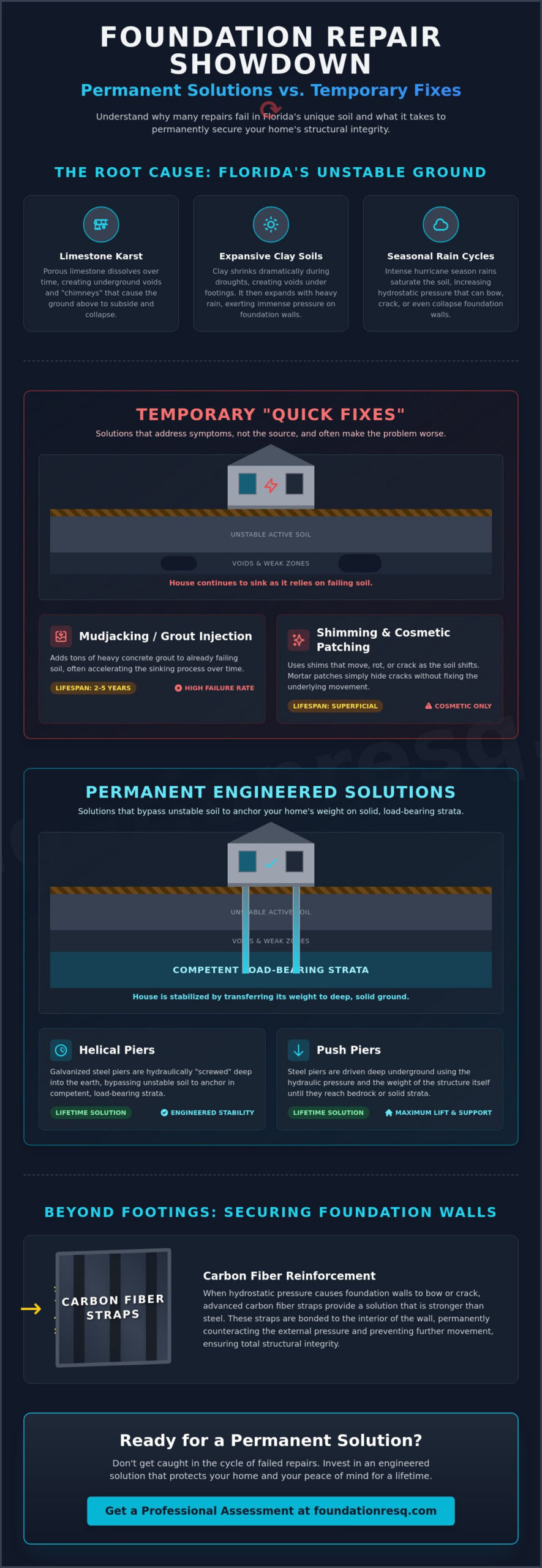
Tallahassee homes rest on a geological foundation that is constantly in motion. Our region sits atop a limestone karst platform, a porous rock structure that’s inherently susceptible to dissolution over time. When groundwater moves through this limestone, it can create underground voids or “chimneys” in the soil. This process leads to ground subsidence, which is far more dangerous than the minor settling expected in newer builds. While some movement is normal as a structure finds its footing, true subsidence occurs when the ground beneath your home can no longer support its weight. Standard concrete slabs often fail in these conditions because they lack the deep-tier support required to bridge these geological gaps. This is why many homeowners eventually seek permanent foundation repair solutions that move beyond surface-level fixes.
Understanding the core foundation engineering principles is essential for any homeowner in the Panhandle. It’s not just about the weight of the house; it’s about how that weight interacts with the shifting earth below. When the soil fails, the house must follow, leading to the structural distress signals many residents find in their living rooms and basements.
The Impact of Soil Composition on Home Stability
Tallahassee’s soil isn’t uniform. We see a mix of loose sandy soils and highly expansive clays. During North Florida’s intense summer droughts, clay soils lose moisture and shrink significantly. This shrinkage creates large voids directly under your home’s footings, leaving the heavy concrete suspended without support. Conversely, during hurricane season, heavy rains saturate the ground. This increases hydrostatic pressure, which is the force of water pushing against your foundation walls. This pressure can cause walls to bow or crack. Without a strategy that accounts for these moisture cycles, any repair will be temporary.
When “Normal Settling” Becomes a Structural Emergency
It’s easy to dismiss a small crack as just the house settling. However, there are clear markers that indicate a structural emergency. You should look for stair-step cracks in your exterior brickwork or diagonal cracks that start at the corners of door frames and windows. In homes with crawl spaces, you might notice a “bouncing” or soft feeling in the floors. These aren’t just cosmetic nuisances; they’re signs that your home’s primary support system is failing. Identifying these issues early is the only way to avoid the exponentially higher costs of a total structural collapse. Addressing the root cause now ensures your home remains a safe, stable environment for your family.
Permanent vs. Temporary: Why Some Foundation Repairs Fail
A repair is only as good as the ground it stands on. In the world of structural restoration, a permanent solution is defined as one that bypasses active soil layers to reach stable, competent strata deep underground. Many homeowners are lured by lower-cost options that address the symptoms of settlement rather than the source. These methods fail because they still rely on the same unstable Florida soils that caused the original damage. True permanent foundation repair solutions eliminate soil dependency by transferring the entire weight of the structure onto an engineered piering system.
One common mistake is falling into the “mudjacking trap.” This process involves injecting a heavy grout mixture into the topsoil to lift a slab. While it might look effective for a year or two, it’s often a temporary fix that lasts only 2 to 5 years. By adding tons of heavy concrete to already failing soil, you’re actually accelerating the subsidence process. Eventually, the ground collapses further under the combined weight of the house and the grout. Similarly, structural shimming with wood or concrete blocks is a reactive measure. As the soil continues to shift during Tallahassee’s rain cycles, those shims move, rot, or crack, leaving you back at square one.
The Limitations of Surface-Level Concrete Leveling
It’s vital to distinguish between cosmetic leveling and structural stabilization. PolyRenewal concrete lifting is an excellent, lightweight remedy for sinking walkways, pool decks, or interior floor slabs. However, it isn’t designed to support the massive load of a sinking perimeter wall or a chimney. Traditional “slab jacking” simply cannot provide the upward force or the long-term stability required for a home’s primary footings. If you aren’t sure which method your home requires, it’s best to consult with a structural specialist who can identify if you need deep-tier support or a simple surface lift.
Engineering for a Lifetime: The Underpinning Standard
The industry standard for a lasting remedy is underpinning. This process involves driving steel piers deep into the earth until they hit bedrock or a load-bearing soil layer. These piers act as a “fixed point” for your home, unaffected by the expansion and contraction of the surface clay. Because Florida’s environment is incredibly humid, we use galvanized steel to prevent corrosion and ensure the system’s integrity for decades. A permanent solution doesn’t just fix the house for you; it protects the home’s value for the next owner. This is why high-quality permanent foundation repair solutions always include a transferable warranty, providing peace of mind that the structural health of the building is secured for the long haul.
Engineering Stability: Helical and Push Piering Systems
Engineering stability requires more than just filling a gap; it requires a mechanical connection to the earth. When we discuss permanent foundation repair solutions, we are specifically referring to piering systems that bypass the active “moving” soil layers described in the previous sections. These systems are designed to provide a stable platform regardless of how much the surface soil expands or contracts during Tallahassee’s intense weather cycles. By anchoring your home to deeper, more competent earth, we remove the unpredictability of Florida’s surface geology.
Helical Piers: Versatility in Tallahassee Soil
A helical pier is a screw-like steel shaft used for deep-foundation support. Unlike traditional methods that rely on gravity, these are mechanically “screwed” into the ground using specialized hydraulic equipment. This method is particularly effective for lighter structures, such as single-story homes, porches, or new additions. One of the primary benefits of helical pier installation is its inherent uplift resistance. When Florida’s soil becomes saturated during hurricane season, the helical blades act like an anchor, preventing the structure from shifting upward or floating as soil volume increases.
Homeowners often prefer this method because it requires minimal excavation. We don’t have to bring in heavy earth-moving equipment that would destroy your Tallahassee landscaping. The process is clean, quiet, and incredibly precise. During the installation, we monitor the “torque-to-capacity” ratio. This scientific approach allows our team to monitor the resistance in real-time, ensuring that each pier is driven until it meets the exact structural requirements to support your home’s specific load.
Push Piers: Maximum Support for Heavy Structures
For heavier, multi-story buildings, push piers are often the superior choice for long-term stabilization. Instead of being screwed in, these piers use the actual weight of the building as a counter-force to drive high-strength steel sections deep into the ground. Choosing between helical piers vs push piers depends largely on the weight of the structure and the depth of the bedrock or competent strata.
The goal is to reach a soil layer that’s dense enough to be non-compressible. This ensures your home rests on a foundation that won’t budge, even if the surrounding soil washes away. This technology isn’t just for residential use. We have successfully used push pier systems to stabilize a large-scale commercial foundation, where the structural demands and weight loads are significantly higher. Whether it’s a family home or a business, these permanent foundation repair solutions provide the structural integrity needed to protect your property for decades.
Beyond the Footings: Protecting the Whole Foundation
Vertical stabilization via piers is only one half of the equation. If your foundation walls are bowing inward due to the hydrostatic pressure mentioned earlier, leveling the floor won’t solve the lateral instability. Comprehensive permanent foundation repair solutions must address the entire structural envelope. This means looking at the walls that hold the earth back and the environment beneath your floors to ensure a total remedy. A stable home requires a balanced approach that protects every component of the building’s support system.
Carbon Fiber Wall Reinforcement
Carbon Fiber Wall Reinforcement is a modern, non-invasive method to stop foundation walls from failing. Originally developed for aerospace applications, these high-strength strips are bonded directly to the interior of your foundation walls. They’re incredibly thin, meaning they don’t take up valuable square footage in your basement or crawl space. For homeowners on tight Tallahassee property lots, this is often the preferred choice over traditional wall anchors. Anchors require extensive exterior excavation and several feet of clearance outside the home to be effective. Carbon fiber provides a low-profile, permanent fix that integrates with the wall’s structure to prevent further inward movement.
Moisture Management and Foundation Longevity
Structural permanence is impossible without effective moisture control. When water pools in a crawl space, it softens the foundation soil, making even the best piering systems work harder than necessary. High humidity also leads to organic rot in the wooden support beams that hold up your floors. This is where crawl space encapsulation becomes a vital part of a structural plan. By sealing the area with a heavy-duty vapor barrier and installing a sump pump and dehumidifier, you create a dry, stable environment for your home’s bones. This prevents the soil from turning into a soft, unsupportive slurry during Florida’s heavy rain seasons.
This approach does more than just protect the wood and soil. It significantly improves the air quality inside your living spaces by preventing mold spores and damp air from rising through the floorboards. A dry foundation is a durable foundation. By combining moisture control with structural reinforcement, we provide permanent foundation repair solutions that stand the test of time. If you’ve noticed dampness or a musty odor under your home, it’s time to schedule a professional inspection to ensure moisture isn’t undermining your structural integrity.
The Foundation ResQ Path to a Permanent Solution
Choosing the right partner for structural restoration is just as important as choosing the right equipment. At Foundation ResQ, we operate as your steadfast local expert, combining a deep understanding of Tallahassee’s specific geological challenges with the engineering power of the Groundworks network. This partnership allows us to provide national-grade engineering backing while maintaining the personal, neighborly service you expect from a local Florida business. Our approach focuses on delivering permanent foundation repair solutions that are custom-engineered for your property’s unique soil profile and structural needs.
We believe in transparency from the very first handshake. This includes providing clear information regarding the helical pier installation cost and available financing options for 2026. Our goal is to ensure that a safe, stable home is accessible to every family in our community. We don’t believe in high-pressure sales; instead, we provide the data and professional guidance you need to make an informed decision for your home’s future.
The Inspection: Finding the Root Cause
A permanent fix starts with an accurate diagnosis. During a professional foundation inspection, our specialists use advanced tools like industrial laser levels and moisture meters to map the “health” of your home. We aren’t just looking for cracks in the drywall. We’re investigating the underlying reason for those cracks. By mapping floor elevations and measuring soil moisture levels, we can identify exactly where the ground is failing. This allows us to create a remedy-based plan that fixes the cause of the settlement rather than just masking the symptoms. Every Tallahassee property is different, and your repair plan will be specifically designed to address the unique stressors affecting your foundation.
Restoring Your Peace of Mind
Our commitment to your home doesn’t end when the equipment leaves your driveway. We provide structural restoration that’s designed to last as long as the house itself. One of the most significant benefits of our work is the transferable lifetime warranty. This document is a powerful asset if you ever decide to sell your home, as it provides future buyers with documented proof of structural stability. It transforms a potential liability into a verified selling point. Our mission is to provide a final line of defense against the elements, ensuring your family has a safe place to call home for generations to come. Schedule your free permanent foundation assessment with Foundation ResQ today to take the first step toward lasting stability.
Securing Your Home’s Future Stability
Your home is more than just a building; it’s the foundation of your family’s life. Throughout this guide, we’ve explored why surface-level patches often fail and how engineering-grade piers provide the only reliable path to structural health. By bypassing Florida’s shifting karst topography and addressing lateral wall pressure, you can effectively stop settlement in its tracks. These permanent foundation repair solutions don’t just fix a crack; they restore the physical integrity of your entire property for the long haul.
Since 2013, Foundation ResQ has served the Tallahassee community with local expertise backed by the national engineering power of Groundworks. We believe every homeowner deserves the peace of mind that comes with a transferable lifetime warranty and a house that stands on solid ground. Don’t let structural uncertainty undermine your most significant investment any longer. Our team is ready to provide the methodical, expert guidance your property requires to remain safe and secure. Request Your Free Foundation Inspection today and take the first step toward a more stable future for your home.
Frequently Asked Questions
Is foundation repair really permanent?
A foundation repair is considered permanent when it employs engineered underpinning to bypass active soil layers. Methods like push piers or helical piers transfer the structure’s weight to deep, stable strata that aren’t affected by surface moisture cycles. While cosmetic fixes like mudjacking are temporary, these permanent foundation repair solutions provide a lifetime of structural security for your home.
How much does a permanent foundation repair solution cost in Tallahassee?
The total investment for foundation restoration depends on several technical factors specific to your property. These include the number of piers required, the depth of the load-bearing strata, and the current level of structural damage. Because Tallahassee has unique geological conditions, a professional on-site assessment is the only way to determine an accurate project scope tailored to your home’s specific needs.
Can I stay in my home during the piering installation?
Yes, you can typically remain in your home throughout the entire installation process. Most piering work is performed from the exterior of the building, which minimizes disruption to your daily routine. Unlike major renovations or new construction, this specialized structural work is methodical and contained. You won’t need to relocate or find temporary housing while we secure your home’s stability.
What happens if I ignore my foundation cracks until next year?
Ignoring structural warning signs often leads to exponentially higher repair costs and increased safety risks. As Florida’s seasonal rains and droughts continue to cycle, the voids beneath your footings will likely expand. What starts as a small crack can quickly progress into significant wall bowing, roofline misalignment, or even partial collapse. Early intervention is the most cost-effective way to protect your home’s value.
Do helical piers work in Florida’s sandy or clay-heavy soils?
Helical piers are specifically designed to excel in Florida’s challenging soil compositions. The screw-like blades provide excellent torque and pull-out resistance in both loose sand and expansive clay. They’re particularly effective in our region’s karst topography, as they can be driven deep enough to find the competent strata required for a truly stable foundation that won’t shift with the seasons.
Will foundation repair increase my home’s resale value?
Stabilizing your foundation is one of the most effective ways to preserve and potentially increase your property’s market value. A home with documented structural issues is often difficult to sell or finance. By implementing permanent foundation repair solutions with a transferable lifetime warranty, you remove a major liability and provide future buyers with the confidence that the building’s core is structurally sound.
Is carbon fiber better than steel beams for bowing walls?
Carbon fiber reinforcement is an excellent, low-profile alternative for many bowing walls. It’s significantly less intrusive than traditional steel beams and doesn’t require messy exterior excavation. Because the strips are bonded directly to the wall, they provide immense tensile strength without taking up valuable space in your crawl space or basement. It’s a modern remedy that stops inward wall movement permanently and effectively.
How long does a typical helical pier installation take?
Most residential helical pier projects are completed within one to three days. The exact timeline depends on the number of piers being installed and the depth required to reach stable soil layers. Because the process uses specialized hydraulic equipment and requires minimal excavation, it’s much faster and cleaner than traditional foundation replacement methods. You’ll see immediate results in the stability of your home.