
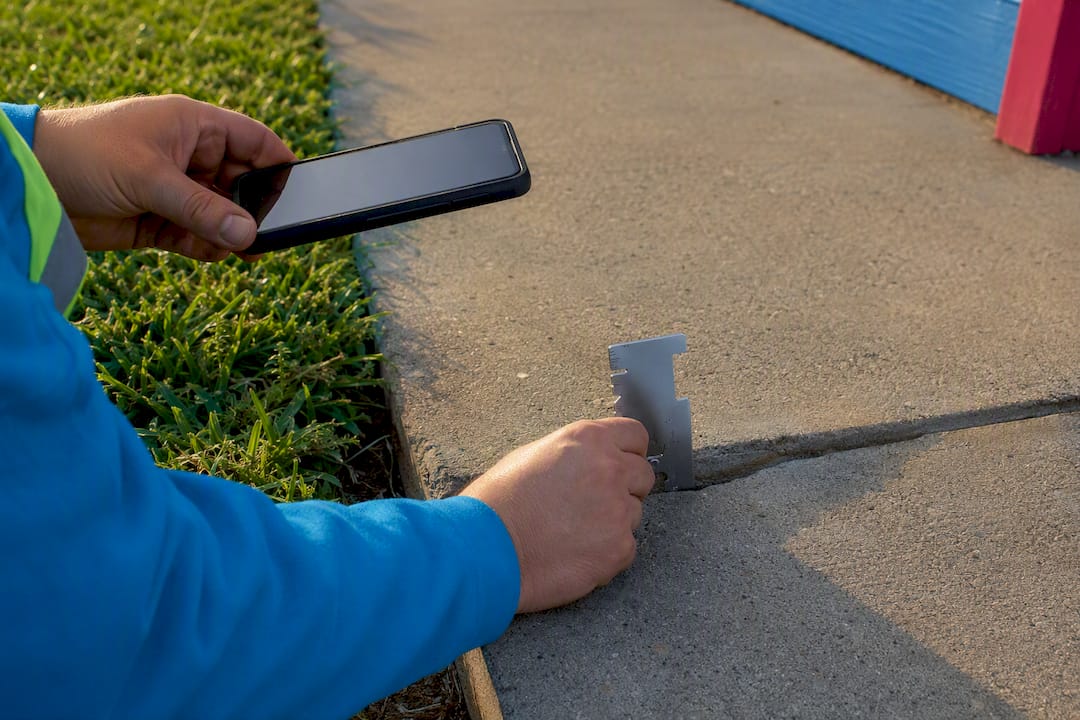
Fix any vertical offset of a quarter inch or more, since that is the threshold most inspectors and the ADA treat as functionally hazardous. Raised slabs usually call for precision cutting; sunken slabs call for polyurethane injection or mudjacking; badly cracked or spalled panels need full replacement. Before you call anyone, measure the offset, photograph it next to a tape measure or coin for scale, and note the exact location.
TL;DR:
- Sidewalk offsets of a quarter inch or more are considered hazardous and require prompt repair to prevent liability, with some cities setting thresholds at half an inch.
- Common causes of sinking or heaving slabs include tree roots, soil settlement, freeze-thaw cycles, poor original compaction, and utility work, each demanding specific repair methods.
- The most effective fix depends on the problem: grinding for minor rises, precision cutting for heaves, slab lifting for settlements, and replacement only for structurally failed slabs.
- Proper documentation of measurements, photos, repair reasons, and ADA compliance is critical for liability protection and obtaining permits.
- Repair costs range from inexpensive grinding to more costly replacement, with the choice driven by hazard severity, slab condition, root cause, disruption tolerance, and ADA compliance needs.
Table of Contents
- What Counts as a Sidewalk Trip Hazard and How to Measure It
- What Causes Sidewalks to Sink or Buckle in the First Place
- Who Is Liable for a Sidewalk Trip Hazard, and What Should You Document?
- Grinding, Cutting, Lifting, or Replacing: Which Repair Actually Fixes the Problem
- How to Choose the Right Sidewalk Repair and What It Will Cost
- Stopping Sidewalk Damage Before It Starts Again
- Foundation RESQ Case Examples and What to Expect From a Qualified Contractor
- What I’ve Learned Advising Property Owners on Trip Hazards
- Get a Free Sidewalk Inspection From Foundation RESQ
- Sources
- FAQ
What Counts as a Sidewalk Trip Hazard and How to Measure It
A quarter inch of vertical change is the number that matters most. The 2010 ADA Standards list 1/4 inch as the maximum allowed change in a walking surface without a beveled edge, and anything above that without a transition is out of compliance. Cities set their own posting thresholds on top of that federal floor. Portland’s sidewalk repair manual, for instance, uses a half inch vertical separation to trigger hazard posting, which shows how much local ordinances can diverge from the ADA’s baseline.
Measuring a suspected sidewalk trip hazard takes about two minutes if you do it right:
- Lay a straightedge or level across the joint and measure the gap underneath with a tape measure or ruler.
- Photograph the defect with a coin, tape measure, or ruler in frame so the scale is unambiguous later.
- Take one wide shot showing the surrounding panels, nearby trees, and any drainage features.
- Log the exact address, panel number if visible, and date.
A quarter inch offset with a clean, unbroken edge can sometimes be monitored for a season, especially in low-traffic areas. Anything closer to a half inch, any offset with a sharp or crumbling edge, or a defect in a high-traffic path needs either immediate repair or a temporary control, like a bright paint marking, a cone, or a rubber wedge ramp, until the permanent fix happens.
What Causes Sidewalks to Sink or Buckle in the First Place
Most sidewalk defects trace back to one of five causes, and knowing which one you’re dealing with changes the entire repair decision.
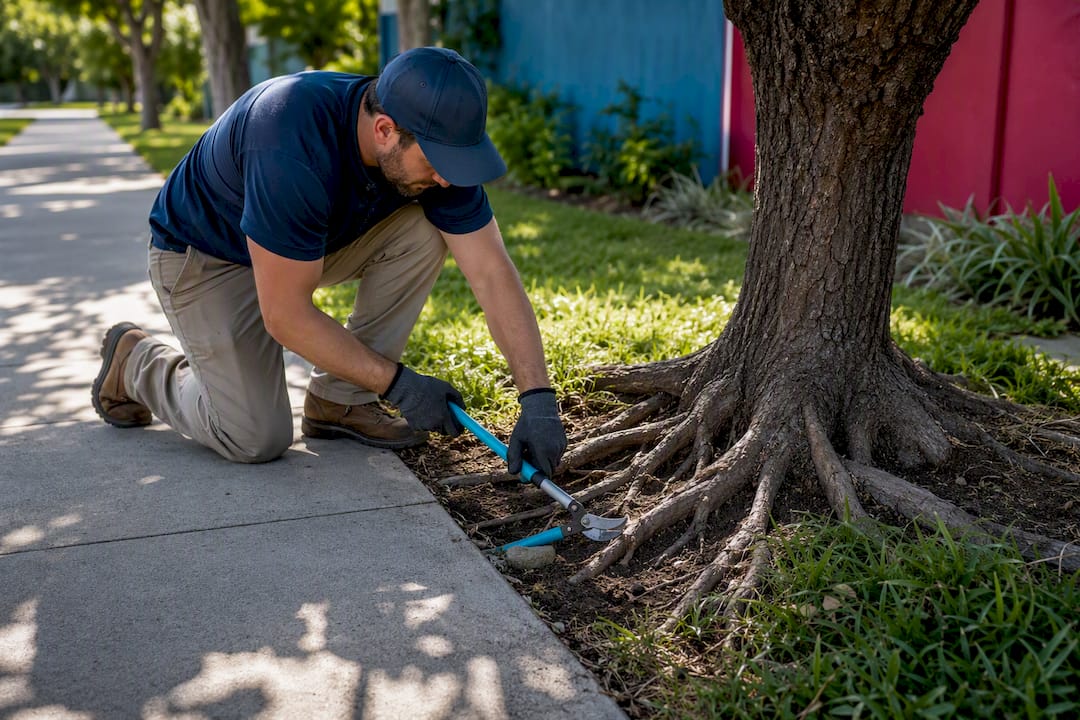
- Tree roots. Surface roots push slabs upward from underneath, usually near mature trees planted too close to the walk.
- Soil settlement. Loose or poorly compacted fill under a slab lets it sink over years, often unevenly across a single panel.
- Freeze-thaw cycling. Water trapped under a slab expands and contracts with temperature swings, gradually heaving or cracking the concrete.
- Poor original compaction. Sidewalks poured over inadequately compacted base material settle faster and less predictably than properly prepped ones.
- Utility work. Trenching for pipes or cables disturbs the soil base and rarely gets recompacted to original density.
Walk the affected stretch and check for these signs:
- Crack pattern (a single clean break versus a spider web of hairline cracks)
- A hollow sound when you tap the slab with a hammer, which can indicate a void underneath
- How far the affected joint runs, not just the trip point itself
- Spalling or crumbling at the slab edge
- Standing water or erosion channels nearby
- Tree canopy and root flare within 10 feet
- Whether the problem appeared suddenly after a hard freeze or gradually over a dry summer
Pro Tip: If a slab sounds hollow in more than one spot or you see cracking radiating from multiple corners, that’s not a cosmetic fix. Get a geotechnical or structural assessment before choosing a repair method, since lifting or patching a slab with a collapsed sub-base often fails again within a year.
Who Is Liable for a Sidewalk Trip Hazard, and What Should You Document?
Responsibility for a defective sidewalk depends heavily on local ordinance, and that’s one of the more misunderstood parts of property maintenance. In many cities, the municipality owns the sidewalk but the adjacent property owner carries the legal duty to maintain it, meaning a homeowner or property manager can be on the hook even for a walk they don’t technically own. Legal analysis of sidewalk fall claims confirms that responsibility tracks whoever holds that maintenance duty, not necessarily whoever holds title to the land underneath.
ADA obligations add another layer. When a property owner alters a path of travel, accessibility rules generally require that the accessible route extend to the site’s point of entry, unless doing so would be disproportionate to the overall project cost. The 20 percent rule is the commonly cited benchmark: if bringing the full path into compliance would cost more than 20 percent of the original alteration, the ADA Standards allow a scoped exception, though the owner still has to document why.
That documentation matters more than most owners realize. Keep:
- Date-stamped photos of the defect before and after repair
- Measurements taken at the time of inspection
- Any witness statements if an incident already occurred
- Repair invoices and contractor scope sheets
- Copies of municipal notices or permit correspondence
Industry guidance on trip hazard management points out that proof of an ADA-compliant finish, kept on file, is one of the strongest tools an owner has if a claim ever surfaces.
Grinding, Cutting, Lifting, or Replacing: Which Repair Actually Fixes the Problem
Five repair methods cover almost every sidewalk trip hazard, and picking the wrong one just means paying for the job twice.
Grinding or scarifying shaves down a raised edge with a mechanical grinder. It’s fast and cheap, and Portland’s manual permits grinding for rises up to an inch, specifying a 6 inch grind-back for a half inch rise and a 12 inch grind-back for a full inch. The catch is that grinding can’t fix what’s happening underground, so a slab pushed up by a root often re-heaves within a year or two. It also has an edge-reach limit: grinders can’t always chase a raised edge all the way to the panel boundary, which can leave a residual noncompliant lip even after the visible trip point is gone.
Precision cutting, sometimes called horizontal saw cutting, removes the raised portion of a panel edge to create a flush, permanent transition. Because it addresses the entire edge rather than just the peak, precision cutting tends to hold up longer than grinding and causes less disruption than tearing out a slab. When a project has both a raised panel from heave and a settled one nearby, contractors often pair cutting with lifting to solve both problems in a single visit.
Slab lifting, whether through traditional mudjacking or polyurethane foam injection, is the fix for sunken panels rather than raised ones. Foam injection cures fast, often reopening the walkway within an hour or two, while mudjacking takes longer to cure and carries a different long-term settlement profile. Neither method works if the underlying void is too large or the soil issue is ongoing, like an active drainage problem.
Patching and polymer ramps are stopgaps, not solutions. A beveled polymer wedge can neutralize a small offset temporarily while you schedule a permanent fix, but adhesive failure and UV degradation mean these rarely last more than a season or two outdoors.
Full replacement becomes necessary once a slab is cracked through, badly spalled, or sitting on a sub-base too degraded to support lifting. It costs more and takes longer, since new concrete needs curing time before it can bear foot traffic, but it’s the only option when the structure itself has failed. Learn more about how concrete leveling compares with replacement before committing to either path.
How to Choose the Right Sidewalk Repair and What It Will Cost
Match the fix to five factors before signing off on a method:
- Hazard height. A quarter inch offset has more options than a two inch drop.
- Slab condition. Sound concrete can be cut or lifted; cracked-through concrete usually can’t.
- Root cause. Settling needs lifting; heaving needs cutting or replacement, since lifting a heaved slab doesn’t address the upward pressure.
- Disruption tolerance. Grinding and foam injection reopen a walkway same-day; replacement closes it for days.
- Accessibility outcome. If the repair needs to satisfy an ADA path-of-travel requirement, cutting or replacement guarantees a flush result more reliably than grinding does.
Rough cost ranges vary by region and site access, but general patterns hold: grinding tends to run cheapest per linear foot, precision cutting and foam injection land in the middle, and full slab replacement costs the most due to demolition, disposal, and curing time. Cost drivers for structural repairs shift based on access, permit requirements, and how many panels are affected, so a single-panel fix and a block-long project won’t scale the same way.
Permits usually enter the picture when the work touches public right-of-way concrete, which most sidewalks are. Expect a permit application, a pre-work inspection in some jurisdictions, and a final inspection to confirm the finish meets code before the city signs off. Municipalities that publish their own manuals, as Portland does, spell out exactly what finish and slope tolerances their inspectors check.
Stopping Sidewalk Damage Before It Starts Again
Prevention is cheaper than a repeat repair, and most of it comes down to trees and water. Root barriers installed 3 to 5 feet from a sidewalk redirect growth downward instead of sideways into the slab, and choosing smaller-canopy species for new plantings near walkways avoids the problem altogether. If you already have a mature tree causing heave, selective root pruning by a certified arborist can buy years before the next lift is needed. Managing tree-related foundation risk applies the same logic to structures near a home’s perimeter.
On the water side, regrading soil away from a walkway and fixing gutters that dump runoff near a slab edge stops the freeze-thaw and erosion cycle that causes repeat settlement. A seasonal walk-through, ideally after the first hard freeze and again after spring rains, catches new offsets while they’re still a quarter inch instead of a full inch. Keep a simple log with dates and photos so a pattern of settlement shows up before it becomes a liability problem.
Foundation RESQ Case Examples and What to Expect From a Qualified Contractor
A typical job looks like this: inspection finds a sunken panel near a driveway approach, measurement confirms a three-quarter inch drop, and the crew performs a polyurethane lift that reopens the walkway within an hour, with before-and-after documentation submitted for municipal sign-off.
A qualified contractor’s report should include:
- Measured offset and photos with scale reference
- The repair method chosen and why
- ADA compliance outcome for the finished surface
- Warranty terms and permit handling, if the job required one
Ask any contractor for scope, timeline, and warranty in writing before work begins.
What I’ve Learned Advising Property Owners on Trip Hazards
Partial fixes are the trap most owners fall into. Grinding down a hazard to “pass” a quick look while leaving the underlying cause untouched just delays the next liability exposure, and it rarely satisfies a real ADA review. Match the method to the cause: lift for settling, cut or replace for heave, and don’t grind a problem you’re going to face again in eighteen months. Keep every measurement, photo, and invoice. That paper trail is what protects you if a claim ever lands on your desk.
— Kayle
Get a Free Sidewalk Inspection From Foundation RESQ
Grinding down a hazard and hoping it holds costs less upfront but often means paying for the same repair twice. Foundationresq inspects the slab, measures the exact offset, and recommends the method that fixes the cause, whether that’s a poly-lift for a settled panel or a full concrete leveling job for a section with multiple failed panels.
Every inspection includes measurements, dated photos, a written repair recommendation, and a realistic timeline, the same documentation you’d want on file if a municipal inspector or an insurance adjuster ever asks. Foundationresq also handles the permit conversations directly with your city so you’re not chasing paperwork on your own. If the scope turns out larger than expected, financing options are available to spread out the cost. Request a free inspection and get a written estimate before your next sidewalk hazard turns into a claim.
Sources
- 2010 ADA Standards for Accessible Design
- Sidewalk repair manual — City of Portland
- Trip Hazard Removal Methods – Precision Concrete Cutting
- Trip and fall on uneven sidewalk: who is responsible? — LegalClarity
FAQ
How much does sidewalk repair cost?
Costs vary by method and region: grinding is the cheapest option per panel, precision cutting and polyurethane lifting cost more but last longer, and full slab replacement runs highest due to demolition and curing time.
What is considered a trip hazard on a sidewalk?
A vertical change of 1/4 inch or more without a beveled transition meets the ADA’s threshold for a hazardous walking surface, though some cities post hazards starting at 1/2 inch.
Can you sue if you trip on an uneven sidewalk?
You can pursue a claim, but success depends on who held the legal duty to maintain that section of walkway, which varies by local ordinance and often falls on the adjacent property owner even when the city owns the sidewalk.
Am I responsible for fixing my sidewalk?
In many municipalities, yes. Cities frequently own the sidewalk but place maintenance duty on the adjacent property owner, so check your local ordinance before assuming the city will handle a repair.