
Most hairline vertical cracks under about 1/16 inch are cosmetic shrinkage, not structural failure. That changes fast with three red flags: horizontal orientation, measurable widening over weeks or months, or any offset where one side of the crack sits higher than the other. See any of those, plus wall bowing or active water flow? Mark the crack, photograph it with a ruler for scale, and call a structural engineer before you patch anything.
TL;DR:
- Horizontal cracks, cracks wider than 1/8 inch, or those with observable offset often indicate active soil pressure, settlement, or structural movement requiring professional intervention.
- Monitoring involves consistent measurement of crack width and offset every three to six months, with frequent reassessment if water intrusion or additional cracking occurs.
- Small, dry, vertical hairline cracks under about 1/16 inch are usually caused by shrinkage and typically do not threaten structural stability if they remain stable over time.
- Injection repairs are suitable for dormant cracks, with epoxy for structural restoration and polyurethane for leaks, while active or shifting cracks may need reinforcement or stabilization methods like wall anchors.
- Engaging a structural engineer is critical if cracks show displacement, widening, or wall bowing, while stable vertical cracks with no movement can often be addressed by waterproofing or simple patching.
Table of Contents
- How Do You Tell a Hairline Crack From a Structural One?
- How Do You Monitor a Foundation Crack Over Time?
- What Repair Options Fit a Hairline or Narrow Crack?
- What Do Repairs Cost and How Long Do They Take?
- When Should You Call an Engineer vs. a Contractor?
- Why Most Crack Panic Is Misplaced, but Some Isn’t
- How Foundation RESQ Handles Crack Inspections and Repairs
- Sources
- FAQ
How Do You Tell a Hairline Crack From a Structural One?
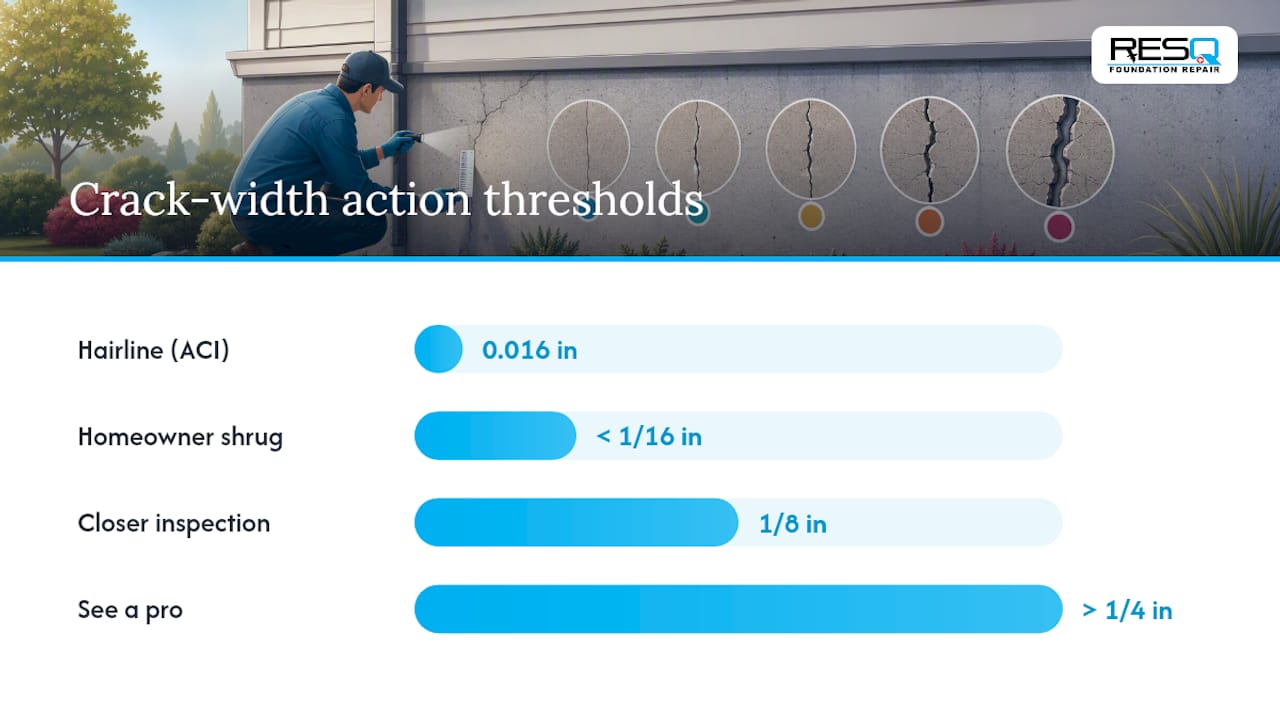
Width matters less than most homeowners think. The American Concrete Institute’s ACI 224R guidance treats crack widths up to roughly 0.016 inches, about the thickness of a dime’s edge, as reasonable for dry, unexposed concrete. That is the technical definition of “hairline.” Homeowners tend to use rounder numbers: under 1/16 inch generally warrants a shrug and a note on the calendar, 1/8 inch deserves a closer look, and anything past 1/4 inch belongs on a professional’s schedule.
Orientation tells you more than width ever will. A vertical crack running straight down a poured wall almost always traces back to concrete shrinking as it cures, a process that starts within the first year and rarely signals ongoing trouble. A horizontal crack is a different animal entirely: it usually means lateral soil pressure is pushing against the wall from the outside, a mechanism explained in FHWA’s geotechnical research on soil pressure and hydrostatic loading. Diagonal or stair-step cracks, especially in block or brick foundations, point toward differential settlement, meaning one part of the foundation is sinking faster than the rest.
Here’s the detail that actually separates a cosmetic crack from a costly one: displacement often matters more than width. A narrow crack where one edge has shifted forward or backward relative to the other can indicate active movement, while a wider but perfectly level crack might just be old and settled. Run your finger across the crack. If you feel a ridge or a step, that’s offset, and it changes the conversation.
Watch for these companion symptoms, since a lone crack rarely tells the full story:
- Doors or windows that stick or won’t latch properly
- Multiple parallel cracks appearing in a cluster rather than one isolated line
- Visible bowing or leaning in a basement or crawl space wall
- Water seeping through the crack during or after rain
- New cracks branching off an existing one
The most common causes, in order of frequency: concrete curing shrinkage, initial settlement as soil compresses under a new structure, hydrostatic pressure from saturated soil pushing against walls, and freeze-thaw cycles that expand trapped moisture inside the concrete. Engineering compilations on structural concrete note that many hairline cracks stay confined to the surface paste layer and never penetrate the structural mass of the wall at all.
How Do You Monitor a Foundation Crack Over Time?
Don’t reach for a repair kit yet. A crack you just noticed might have been sitting there stable for years. Set up a simple monitoring routine first:
- Clean the crack with a dry brush so you’re measuring concrete, not dust and debris.
- Mark both ends with a pencil line and write the date next to each mark.
- Measure the width at two or three points using a caliper or a printed crack gauge, both cheap and more precise than eyeballing it.
- Take a photo with a coin or ruler in frame for scale, then repeat that exact framing every time.
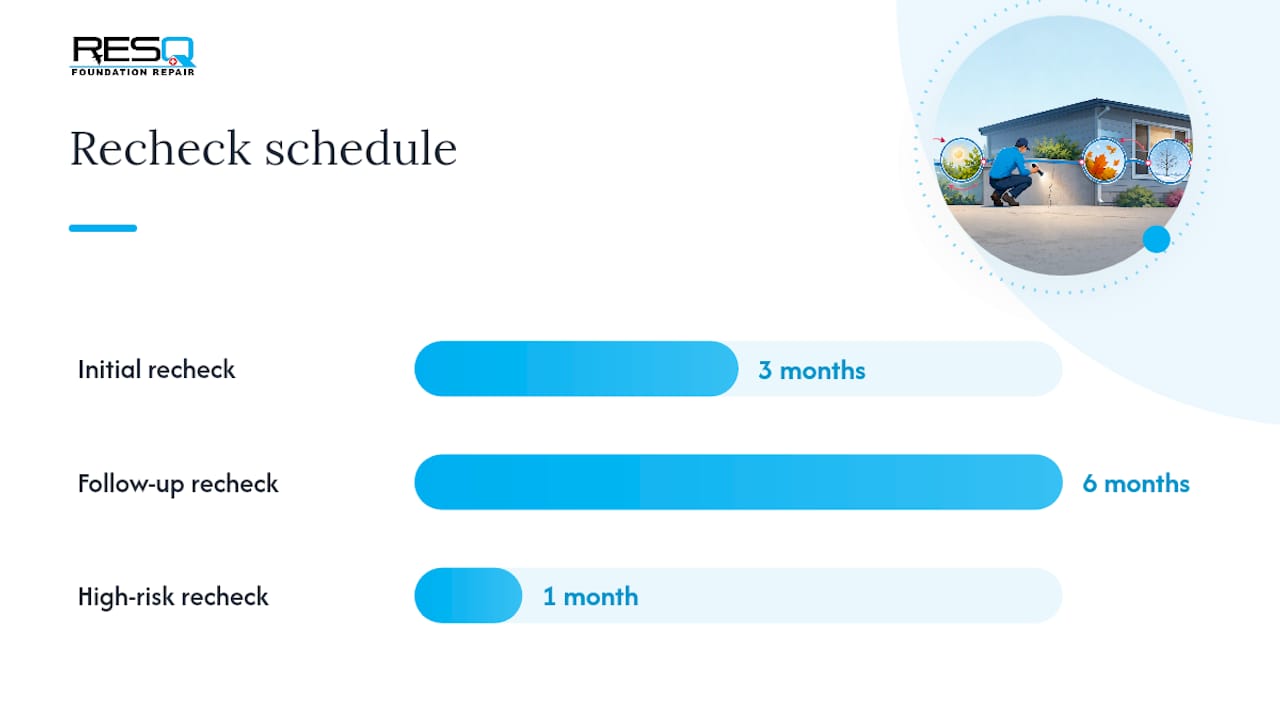
- Recheck at the three-month mark, then again at six months, tightening that schedule to monthly if you spot water or new cracking nearby.
Practitioners rely on this same logic. ASCE’s guidance on evaluating structural distress treats a single width measurement as nearly useless on its own. What matters is the trend: is the gap growing, staying put, or shifting laterally between checks.
Pro Tip: Draw a small arrow on the wall pointing at each crack mark before you photograph it. Six months from now, when you’re squinting at a folder of nearly identical basement photos, that arrow saves you from measuring the wrong hairline crack entirely.
If your remeasure shows the gap has widened, a new crack has appeared beside the original, or you now feel an offset that wasn’t there before, monitoring is over. That’s your signal to call in a professional.
What Repair Options Fit a Hairline or Narrow Crack?
The right fix depends entirely on whether the crack is stable, active, or leaking, and matching the repair to the correct category is where most DIY attempts go wrong.
For small, stable, dry cracks, hydraulic cement or a surface patching compound applied from a tube can seal the surface and stop minor moisture wicking. These kits typically run $30 to $100 and work fine on true hairline cracks that have shown zero movement across a monitoring period. They won’t do anything for a crack with offset or active widening, because they don’t address whatever is pushing the wall.
For cracks that need real structural filling, professionals use injection systems, and the choice of material matters:
- Epoxy injection restores structural continuity in a dormant crack. It’s rigid once cured and, performed to an engineer’s specification, can effectively reunite the two sides of the crack into one solid mass again.
- Polyurethane injection is the better call for an active water leak. It expands as it cures, chasing moisture through the crack path and sealing flow rather than just filling a static gap.
Professional injection work generally costs several hundred dollars per crack, a range driven by access difficulty, crack length, and whether water is actively present.
For cracks tied to genuine structural movement, injection alone won’t cut it. Carbon-fiber straps reinforce a bowing wall without full excavation. Wall anchors use steel rods driven into stable soil beyond the foundation to pull a leaning wall back toward plumb. Helical piers get driven below the footing to lift and stabilize a settling section entirely. All three require an engineer’s load calculations first. Skipping that step and hiring a crew to install anchors “because a video made it look simple” is how homeowners end up paying twice: once for the wrong fix, once for the foundation settlement repair that follows when it fails.
Interior injection handles most hairline and moderate cracks. Exterior excavation and waterproofing become necessary when hydrostatic pressure is the root cause and the fix needs to happen from outside the wall, not just at the crack itself.
What Do Repairs Cost and How Long Do They Take?
Budgeting starts with knowing which category your crack falls into, since the price gap between a DIY patch and a structural fix is enormous.
Those cost ranges shift based on a few specific factors worth flagging to any contractor giving you a bid:
- Access difficulty, since finished basements or tight crawl spaces add labor time
- Active water presence, which often requires drainage work alongside the crack fix
- Soil conditions around the foundation, particularly expansive clay common in the Southeast
- Whether the scope requires stamped engineering drawings before permitting
If a crack triggers the red flags above, get a structural engineer’s written report before soliciting contractor bids. That report becomes your spec sheet, letting you compare quotes on equal terms instead of guessing whether one contractor’s “$4,000 fix” and another’s “$9,000 fix” are even solving the same problem. For a deeper cost breakdown by repair method, see Foundation ResQ’s guide to crack repair pricing.
When Should You Call an Engineer vs. a Contractor?
Different symptoms point to different professionals, and calling the wrong one first wastes time and money.
Call a structural engineer first if you see:
- Horizontal cracks anywhere in a foundation wall
- Stair-step cracks in block or brick with visible offset
- A crack that has measurably widened between monitoring checks
- Any wall bowing, leaning, or bulging inward
- A crack wider than 1/4 inch combined with displacement
Call a foundation or waterproofing contractor first if you have:
- A dry, stable vertical hairline crack with no movement across a monitoring period
- A vertical crack that leaks water but shows no offset or growth
Before any inspection, gather your monitoring photos, dated measurements, and a written list of related symptoms (sticking doors, sloping floors, cracked drywall). This Old House’s guidance on structural engineer inspections notes that a documented history speeds up diagnosis and gives the engineer something concrete to compare against future changes. Ask the inspector directly whether the crack shows displacement, what caused it, and whether a written report is available. That report often matters for insurance claims and is frequently required before a municipality issues a repair permit for structural work.
Why Most Crack Panic Is Misplaced, but Some Isn’t
Here’s what gets lost in most foundation crack advice online: homeowners either panic over a hairline crack that’s been stable since the house was poured, or they ignore a horizontal crack because “it’s just a hairline” without checking the one variable that actually matters, which is whether it’s moving. Width is the easiest thing to measure and the least reliable thing to act on alone.
The stepwise approach works because it filters out noise before it costs you money. Monitor first. Most cracks resolve themselves as “nothing happened” over a six-month window, and that outcome is worth confirming with a $10 crack gauge before anyone starts talking about carbon fiber straps. But the flip side deserves equal weight: waiting on a horizontal crack or a wall showing offset because “it’s not that wide yet” is the mistake that turns a $600 injection job into a $15,000 underpinning project.
Foundation RESQ built its inspection-first process around exactly this filter. We would rather tell a Tallahassee homeowner their hairline crack needs nothing but a follow-up photo in six months than sell a repair nobody needs. That only works when the diagnosis comes before the sales pitch, not after it.
— Kayle
How Foundation RESQ Handles Crack Inspections and Repairs
If your crack has tripped a red flag, or you’d rather have a professional confirm it hasn’t, Foundation RESQ offers free inspections across North Florida, South Georgia, and Alabama, backed by financing options for repairs that don’t fit a same-week budget. Foundation RESQ is the direct alternative to guessing your way through a DIY kit that might not match your actual diagnosis.

Our process starts with that inspection, followed by a written assessment that explains what’s causing the crack and whether it’s cosmetic or structural. From there, you get a line-item quote covering exactly what’s needed, whether that’s a straightforward polyurethane injection or full structural stabilization with carbon fiber or piers. Every repair carries a warranty, and if water intrusion is part of the picture, our basement waterproofing services address the drainage side so the crack doesn’t reopen. If financing makes sense for your scope of work, review Foundation RESQ’s financing options before your inspection so you know your choices going in. Schedule your free inspection today and get a clear answer instead of a guess.
Sources
- Foundation Damage & Repair Guide — InspectApedia
- Foundation Crack Repair Guide — Dry Basement Hub
- Structural engineer: foundation inspection guidance — This Old House
FAQ
Should I Worry About Hairline Cracks in My Foundation?
Not usually. Vertical hairline cracks under about 1/16 inch, with no offset and no water intrusion, are typically shrinkage from curing and stay stable over time.
Are Foundation Cracks Always Serious?
No. Severity depends on orientation, width, and movement, not the mere presence of a crack. Horizontal cracks, offset, active widening, or wall bowing are the signs that indicate a serious problem.
How Can I Tell if a Foundation Crack Is Structural?
Check for displacement (one side higher or shifted from the other), horizontal or stair-step orientation, measurable growth between monitoring checks, or accompanying symptoms like bowing walls and sticking doors.
What Does a Concerning Foundation Crack Actually Look Like?
A concerning crack runs horizontally or in a stair-step pattern, shows a visible offset you can feel with your finger, has widened since you first marked it, or leaks water actively rather than just showing dampness.
How Often Should I Remeasure a Crack I’m Monitoring?
Recheck at three months and again at six months for a baseline, and shorten that interval to monthly if you notice water intrusion, new cracking, or any other structural symptom.