What if that thin vertical line on your garage wall isn’t just a sign of your home “settling,” but a roadmap of the shifting red clay beneath Leon County? Finding a new gap in your drywall or exterior brick often triggers an immediate sense of anxiety about property value and the cost of stabilization. It’s frustrating to receive conflicting advice on whether a crack is a simple cosmetic fix or a sign of a failing structure. At Foundation ResQ, a Groundworks company, we believe homeowners deserve a clear, professional path toward a stable home.
This guide identifies if your vertical foundation crack repair Tallahassee needs are a structural emergency or a manageable maintenance task. We’ll look at how Tallahassee’s unique Orangeburg fine sandy loam affects your home’s health and which permanent solutions, like carbon fiber wall reinforcement or helical piers, actually work in our local environment. By the end of this article, you’ll have a clear diagnosis of your crack type and the peace of mind that comes from knowing exactly how to protect your investment under the latest 2026 building standards.
Key Takeaways
- Learn to identify if a fissure is a harmless settling line or a sign of vertical movement that requires professional attention.
- Discover why vertical foundation crack repair Tallahassee homeowners need must account for the high plasticity of local Leon County soils to ensure a permanent fix.
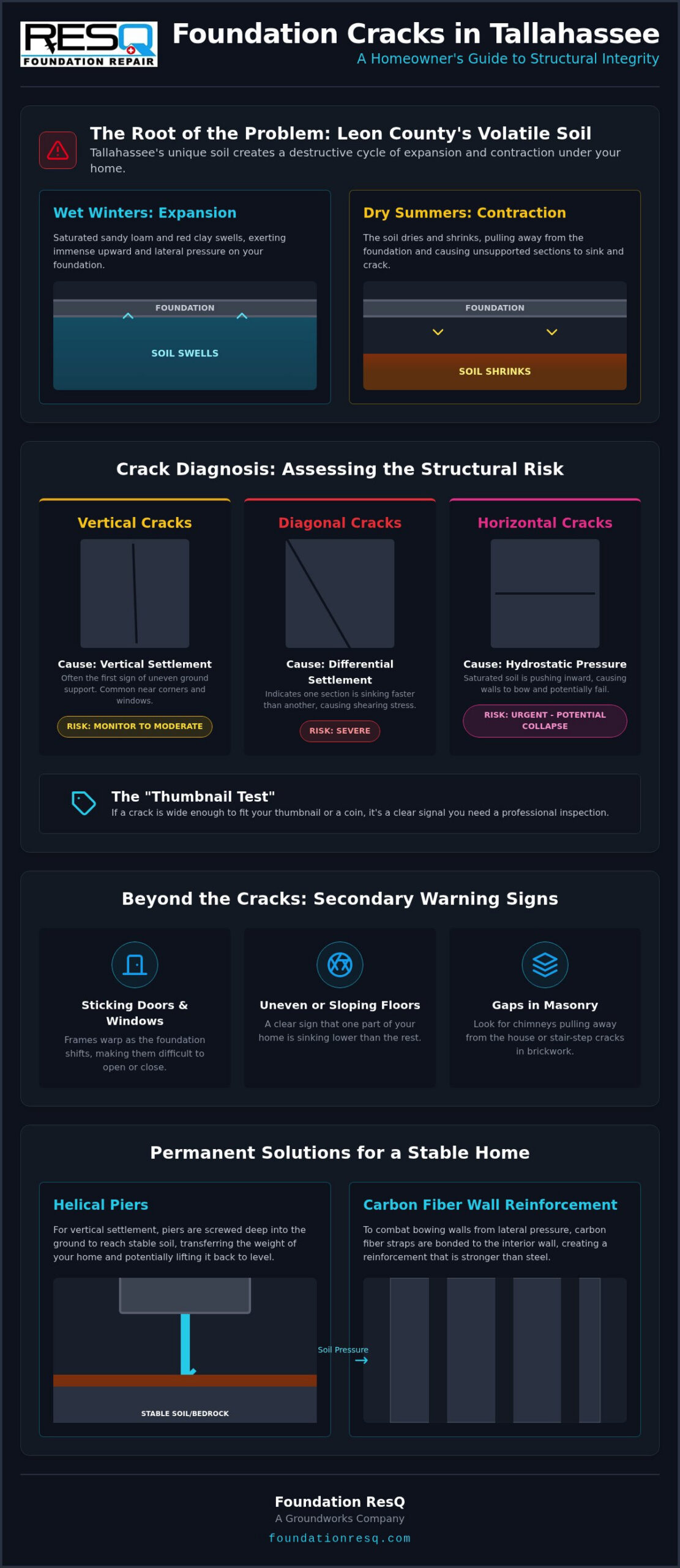
- Understand how Tallahassee’s wet winters and dry summers create a destructive cycle of soil expansion and contraction beneath your home.
- Explore professional stabilization methods from Foundation ResQ, a Groundworks company, including Helical Piers and Carbon Fiber Wall Reinforcement.
- Gain practical strategies for managing drainage and soil moisture to prevent future cracks from developing in your foundation.
Understanding Vertical Foundation Cracks in Florida Homes
A vertical foundation crack is a fissure that runs straight up and down or at a slight diagonal angle of less than 30 degrees. These openings commonly appear in Tallahassee homes near corners, window frames, or along basement walls. While horizontal cracks usually indicate lateral hydrostatic pressure pushing against a wall, vertical cracks are almost always a sign of vertical settlement. Understanding the principles of Soil mechanics helps explain why this happens. When the ground beneath your home shifts or compresses unevenly, the rigid concrete foundation must bend or break to accommodate that movement.
Many homeowners fall for the common “settling” myth, believing that every new crack is just a house finding its place. While minor hairline fissures can occur as concrete cures, ignoring larger vertical openings can lead to a structural emergency. In our region, the unique composition of the soil means that a small gap today can quickly become a significant liability. Seeking a professional evaluation for vertical foundation crack repair Tallahassee is the best way to determine if your home’s integrity is at risk before the damage spreads.
Is a Vertical Crack Always an Emergency?
Not every line in your concrete requires an immediate overhaul, but you should know how to tell the difference. Shrinkage cracks are usually very thin and occur shortly after a home is built. Structural settlement cracks, however, tend to be wider and may appear years later. You can use the “thumbnail test” as a quick home check. If a crack is wide enough to fit your thumbnail or the edge of a coin, it’s a clear signal that you need a professional inspection. You should also watch for “active” cracks. If a fissure seems to expand or contract after one of Tallahassee’s heavy seasonal rains, the underlying soil is likely unstable.
Common Signs Accompanying Vertical Foundation Cracks
Foundation issues rarely happen in isolation. If you notice vertical cracks, you should also inspect the rest of your living space for these secondary symptoms:
- Sticking doors and windows: When a foundation settles, door and window frames often fall out of alignment, making them difficult to open or close.
- Uneven or sloping floors: If a marble or a ball rolls toward one side of the room, it often correlates with the wall damage seen outside.
- Exterior masonry gaps: Look for chimneys that appear to be pulling away from the house or gaps in the brickwork that mirror the internal cracks.
At Foundation ResQ, a Groundworks company, we specialize in identifying these patterns to provide a permanent remedy. Catching these signs early allows for more straightforward stabilization before the structural health of your home is compromised. We focus on addressing the root cause of the movement rather than simply patching the surface.
Vertical vs. Horizontal Cracks: Assessing the Structural Risk
Comparing vertical and horizontal cracks is about identifying the direction of the force acting on your home. Vertical cracks usually indicate settlement, meaning the ground beneath a specific section of your foundation has shifted downward. In contrast, horizontal cracks are a sign of lateral hydrostatic pressure, where saturated soil pushes inward against your basement or crawl space walls. While vertical cracks are often caused by settlement, they serve as the primary entry point for moisture and pests in Tallahassee crawl spaces. If left unaddressed, these openings allow the humid Florida air to compromise your home’s internal environment.
The danger of a vertical crack increases when it begins to tilt. A diagonal crack often signals that simple vertical settlement is transitioning into a more severe structural failure. This movement can indicate that a corner of the home is breaking away or that the footing has failed completely. At Foundation ResQ, a Groundworks company, our engineers evaluate these patterns to determine the root cause. Surface-level patching of vertical cracks often fails within one Tallahassee season because the patch cannot withstand the ongoing movement of the soil. A cosmetic fix only hides the symptom while the structural problem continues to grow beneath the surface.
The Mechanics of Vertical Settlement
When a foundation footing sinks, it pulls the wall apart vertically. This usually occurs through differential settlement, where one part of the home sinks faster than the sections around it. This uneven movement creates immense tension in the concrete or masonry. You will often see vertical cracks appearing in pairs on opposite sides of the sinking section. This “bridge” effect shows exactly where the soil has lost its ability to support the weight of the structure. Identifying these patterns early is essential for effective vertical foundation crack repair Tallahassee homeowners can rely on for long-term stability.
Comparison Guide: Vertical, Horizontal, and Stair-Step
Understanding the urgency of different crack types helps you prioritize your home repairs. Use the following guide to assess the fissures in your foundation:
| Crack Direction | Typical Cause | Urgency Level |
|---|---|---|
| Vertical | Foundation Settlement | Moderate |
| Horizontal | Lateral Soil Pressure | High |
| Stair-step | Sinking Corners | High |
Because Tallahassee experiences heavy rain followed by intense dry periods, the soil is constantly in flux. This cycle puts repetitive stress on your foundation. Professional stabilization is the only way to stop this movement. By addressing the soil density and structural support, we create a permanent barrier against future shifting, ensuring your home remains level and secure for years to come.
Why Tallahassee’s Red Clay Soil Causes Vertical Settlement Cracks
Tallahassee isn’t built on the sandy flats found in South Florida. Our “Red Hills” region sits on Orangeburg fine sandy loam, a heavy, clay-bearing soil known for its high plasticity. This means the soil behaves like a sponge. During our wet North Florida winters, the clay absorbs moisture and expands. When the scorching dry summers arrive, the soil loses that water and shrinks significantly. This repetitive “yo-yo” effect creates constant vertical movement beneath your home. As the soil pulls away during dry spells, the foundation loses its support, leading to the vertical fissures many homeowners discover in their garage or basement walls.
Construction methods also play a role in how these cracks form. Many neighborhoods across Tallahassee’s rolling hills were built using “cut and fill” techniques. Builders cut into a hill and move that loose soil to fill a lower spot to create a level building site. If that fill soil wasn’t compacted perfectly, the section of the house sitting on the “fill” side will eventually sink faster than the rest of the structure. This differential settlement is a leading driver for vertical foundation crack repair Tallahassee. Additionally, the massive oak tree roots in neighborhoods like Betton Hills contribute to soil desiccation by drawing moisture out of the clay during droughts, causing the ground to collapse further.
The Role of Tallahassee’s Heavy Rainfall
Our intense Florida storms can dump several inches of rain in a single hour. If your drainage system is failing, that water pools against the foundation and washes away the supporting soil beneath your footings. This erosion leaves a void that the heavy concrete foundation eventually fills by sinking. Clay shrinkage during our periodic North Florida droughts remains the top cause of these vertical openings. Excess moisture doesn’t just affect the exterior; it often migrates into the home’s substructure. This makes crawl space encapsulation Tallahassee a vital service to consider alongside foundation stabilization to prevent humidity from damaging your floor joists.
Geological Challenges in Leon County
Leon County’s geology includes a complex layer of limestone bedrock beneath the clay. In areas where the clay layer is thin, the interaction between the rock and the shifting soil creates uneven support. Homes built on the steep slopes common in North Tallahassee are particularly susceptible to vertical shear cracks as gravity pulls the structure toward the lower elevation. At Foundation ResQ, a Groundworks company, we understand these local geological nuances. We don’t just offer temporary patches. We utilize permanent structural solutions like Helical Piers to bypass unstable clay and anchor your home to competent soil or bedrock, ensuring your foundation remains level regardless of the weather.
Professional Methods for Vertical Foundation Crack Repair
Professional vertical foundation crack repair Tallahassee residents can trust involves a methodical process that addresses the root cause of movement. At Foundation ResQ, a Groundworks company, we don’t believe in surface-level patches that will inevitably fail. Our approach starts with a comprehensive structural inspection and soil density testing. This allows us to understand exactly how the Leon County red clay has shifted and where the foundation requires additional support. We focus on the soil first because the crack is merely a symptom of the ground’s inability to support the structure.
The stabilization process typically involves driving Helical Piers or Push Piers deep into the earth. These systems bypass the unstable “yo-yo” soil layers mentioned earlier, reaching competent load-bearing soil or bedrock. Once the structure is stabilized, we reinforce the wall to prevent future shearing and finish with professional sealing and cosmetic restoration. This methodical sequence ensures that the repair is as durable as the home itself, providing a permanent barrier against the elements and further shifting.
Helical Piers vs. Push Piers for Tallahassee Homes
Choosing the right piering system depends on your home’s specific construction and the underlying soil conditions. A helical pier installation is often ideal for lighter residential structures or areas where soil conditions require the pier to be screwed into the ground. These piers feature screw-like plates that provide immediate stability upon installation without requiring the weight of the building to drive them down.
In contrast, push piers utilize the existing weight of your home to drive steel sections deep into the ground until they reach a stable strata. This method is highly effective for heavier homes experiencing significant settlement. Regardless of the type chosen, piering is the only permanent solution for vertical settlement cracks because it transfers the building’s load away from the failing soil. It provides a steady foundation that Tallahassee’s shifting clay can’t compromise.
Carbon Fiber Wall Reinforcement
For interior basement or crawl space walls, carbon fiber wall repair Tallahassee provides a modern, low-profile solution to “lock” vertical cracks in place. Carbon fiber straps have a higher tensile strength than steel, yet they install flush against the wall with zero footprint. This science-backed method prevents the wall from shearing or bowing further, acting as a structural shield that maintains the home’s integrity.
By combining these advanced technologies, we provide a remedy that lasts. If you’ve noticed new fissures in your walls, it’s time to schedule a professional foundation inspection to protect your property value and long-term safety. Our local experts understand Leon County’s geology and provide the precise stabilization your home needs to stand firm.
Preventing Future Foundation Issues in Leon County
Preventing structural failure requires more than just a one-time fix; it involves managing the environment around your home. Tallahassee’s expansive red clay thrives on consistency. When the soil becomes too dry, it shrinks and pulls away from the concrete, leading to the settlement issues discussed earlier. During drought periods, you might actually need to “water your foundation” with a soaker hose to maintain soil volume. Conversely, during heavy rain, gutters and downspout extensions are your first line of defense. They ensure that water doesn’t pool at the base of your walls, which prevents the soil from becoming oversaturated and losing its weight-bearing capacity.
Foundation health is also deeply tied to crawl space moisture control. If the earth beneath your home is constantly damp, the wooden structure above can warp and shift, putting additional stress on the foundation walls. Annual inspections are vital for Florida Panhandle properties because environmental conditions change rapidly. Catching a small fissure early often means the difference between a simple maintenance task and a major vertical foundation crack repair Tallahassee project. Consistent monitoring ensures that the protective barriers you’ve put in place remain effective year after year.
Managing Drainage and Grading
A positive slope is essential for long-term stability. Your yard should drop at least six inches over the first ten feet away from the foundation. If your property has “low spots” or standing water after a storm, it’s a signal that soil erosion is occurring beneath the surface. For homes with high water tables or poor natural drainage, installing French drains or Sump Pump Systems provides a reliable remedy. These systems redirect water before it can exert hydrostatic pressure or cause the vertical movement that leads to structural cracks. Proper grading acts as a shield, keeping the destructive forces of Florida’s weather at a distance.
Choosing a Specialized Tallahassee Contractor
Structural integrity is too important to leave to a general handyman. These types of repairs require technical precision and specialized equipment that most general contractors don’t possess. Choosing Foundation ResQ means you benefit from the national-level backing of Groundworks and a long-term warranty, combined with our deep local knowledge of Tallahassee’s unique geology. We focus on permanent outcomes that restore your home’s health and protect its value. Don’t wait for a small crack to become a structural emergency. Schedule your free foundation inspection with Foundation ResQ today and gain the peace of mind that comes from professional stabilization.
Protecting Your Tallahassee Home for the Long Term
Tallahassee’s unique geology, particularly the expansive Leon County red clay, makes foundation movement a common reality for many homeowners. We’ve explored how identifying the difference between minor settling and structural failure is the first step toward a permanent remedy. By choosing structural stabilization methods like Helical Piers or Carbon Fiber Wall Reinforcement over temporary cosmetic patches, you ensure that your home remains secure against the seasonal expansion and contraction of Florida’s soil.
Addressing a vertical foundation crack repair Tallahassee project doesn’t have to be a source of anxiety when you have a dependable partner. Foundation ResQ, a Groundworks company, combines specialized local knowledge of North Florida soils with national-level backing to provide reliable, long-term results. We offer free, no-obligation structural assessments to give you a clear, professional diagnosis of your home’s health. Our Groundworks-backed lifetime warranties ensure that your structural stabilization is protected for the life of the building.
Don’t let structural uncertainty compromise your property value or peace of mind. Get a Free Foundation Inspection in Tallahassee today and take the first step toward a stable, worry-free home. We’re here to provide the steady guidance you need to protect your home’s integrity.
Frequently Asked Questions
Is a vertical crack in my foundation normal for a Tallahassee home?
Vertical cracks are frequent in Leon County due to the shrink-swell cycle of Orangeburg fine sandy loam. However, common doesn’t mean safe. These fissures indicate that your home is moving vertically. While a hairline crack might be a sign of initial concrete curing, any opening wider than a thumbnail suggests active settlement. Professional vertical foundation crack repair Tallahassee experts should evaluate these signs to ensure the structural integrity of your building isn’t compromised.
How much does vertical foundation crack repair cost in Tallahassee?
The cost of structural remediation depends on the depth of the settlement and the number of piers required for stabilization. Minor cosmetic sealing is significantly less expensive than a full-scale piering project. Because every property in the Red Hills region has unique soil density and load requirements, we provide free, no-obligation inspections. This allows us to provide an accurate, written estimate tailored to your home’s specific structural needs and geological conditions.
Can I use epoxy to fix a vertical foundation crack myself?
Epoxy injections only address the visible symptom and don’t provide structural support. In Tallahassee’s shifting clay, an epoxy patch will likely crack again when the soil next contracts during a dry spell. For a permanent remedy, the foundation must be stabilized at the soil level using Helical Piers or Push Piers. Using a DIY kit often delays the necessary professional stabilization, potentially leading to more expensive repairs later as the settlement continues.
Do vertical cracks always mean my house is sinking?
Vertical cracks don’t always mean your house is sinking, but they’re the most common indicator of vertical settlement in North Florida. Some very thin fissures in newer homes are simply the result of concrete shrinkage as it cures. However, if the crack is wider at the top than the bottom, or if it’s accompanied by sticking doors, it’s a sign that one section of the footing is dropping faster than the rest.
How long does it take to repair a foundation crack professionally?
Most professional foundation stabilization projects in Tallahassee are completed within one to three days. The timeline depends on the number of Helical Piers or Push Piers needed to reach load-bearing strata. Our crews work efficiently to minimize disruption to your daily routine while ensuring every component is installed to Groundworks’ high standards. Once the structural work is done, cosmetic sealing of the cracks usually takes just a few additional hours to complete.
Will a vertical foundation crack affect my home’s resale value in Florida?
Unrepaired foundation issues can significantly decrease your home’s resale value, as Florida law requires sellers to disclose known material defects. Many buyers will walk away from a property with visible structural cracks or demand steep price reductions. Conversely, having a transferable, lifetime warranty from a reputable company like Foundation ResQ can actually reassure buyers. It proves the home is permanently stabilized, protecting the buyer’s future investment and your current equity.
What happens if I ignore a vertical crack in my basement wall?
Ignoring a vertical crack allows moisture, humid Florida air, and pests to enter your home’s sub-structure. Over time, the crack will likely widen as the cycles of soil expansion and contraction continue. This can lead to secondary issues such as mold growth, wood rot in floor joists, and even interior drywall damage. What starts as a manageable repair can eventually evolve into a structural emergency that requires much more invasive and costly remediation.
Does home insurance cover vertical foundation crack repair in Tallahassee?
Standard homeowners insurance policies in Florida typically don’t cover foundation repair caused by normal soil settlement or geological shifts. Coverage is usually reserved for sudden and accidental events, such as a major plumbing leak beneath the slab. It’s important to review your specific policy or speak with your agent. Regardless of coverage, addressing vertical foundation crack repair Tallahassee early is the most cost-effective way to prevent the damage from spreading beyond the foundation itself.