
You can buy a house with foundation issues only when three things line up: a licensed structural engineer confirms the movement is stable rather than active, a documented repair estimate fits inside your budget or a renovation loan, and either the seller or your lender clears a path around the appraisal barrier. If any one of those is missing, walk. Get an engineer report and multiple contractor bids before you go further.
TL;DR:
- Buyers should ensure foundation movement is confirmed stable by a licensed engineer before proceeding, with documented repair estimates fitting their budget or renovation loan limits.
- Active foundation movement, such as ongoing cracks or shifting, significantly increases the risk and expense, making repairs more complex and costly than stable issues.
- Expect foundation repairs to cost between $6,000 and $14,000 for typical piering, with secondary repairs adding 20% to 50%, requiring careful budget planning beyond initial estimates.
- FHA and VA loans require the property to be stable and insurable, making repairs or escrow holdbacks necessary before closing; conventional loans offer more flexibility for stabilization.
- Showing evidence of a thorough engineer report, multiple contractor bids, permits, and warranties improves negotiation power and likelihood of smooth approval during the purchase process.
Table of Contents
- What Are Foundation Issues, and Why Do They Matter?
- How Do You Spot Foundation Problems When Touring a Home?
- Who Do You Hire, and What Does Repair Actually Cost?
- Which Loans Work for a House With Foundation Damage?
- Should You Negotiate Repairs or Ask for a Price Cut?
- How Long Does Foundation Repair Take, and Can You Live There?
- How Foundationresq Scopes and Documents a Repair
- Are There Tax Implications for Buying or Repairing a Damaged Foundation?
- Will Foundation Problems Raise Your Insurance Premiums?
- How Should You Weigh Your Own Risk Tolerance?
- Primary Sources and Further Reading
- Sources
- FAQ
What Are Foundation Issues, and Why Do They Matter?
Not all foundation damage means the same thing. A hairline crack in drywall from normal house settling is cosmetic. A stair-step crack running through brick mortar, a bowing basement wall, or a slab that has heaved four inches on one side is structural, and structural is where lenders, insurers, and future buyers start asking hard questions.
The most common categories buyers run into:
- Settlement — the soil under part of the foundation compresses unevenly, tilting or dropping sections of the house.
- Heave — expansive clay soil swells with moisture and pushes the foundation upward, often unevenly.
- Bowing or leaning walls — usually basement or crawl space walls under lateral soil pressure, sometimes worsened by poor drainage.
- Slab issues — cracking, sinking, or upheaval in slab-on-grade construction, frequently tied to plumbing leaks under the concrete.
- Under-slab plumbing leaks — a slow leak can erode supporting soil for years before anyone notices a crack.
Root causes trace back to drainage problems, expansive or poorly compacted soil, tree roots pulling moisture from the ground near the footing, and aging plumbing. The distinction that matters most to your purchase decision isn’t the crack pattern. It’s whether the movement is active (still happening, tracked by monitoring or new displacement) or stable (occurred in the past, has been addressed, and shows no continued shift). Active movement scares lenders and insurers because nobody can price a moving target. Stable movement, especially with a repair history and documentation, is a completely different conversation.
How Do You Spot Foundation Problems When Touring a Home?
Most buyers walk through a showing focused on kitchens and closets. A five-minute detour to check structural basics can save you from a contract you’ll regret.
Interior red flags to check room by room:
- Doors and windows that stick, won’t latch, or have visible gaps at the frame.
- Cracks running diagonally from door and window corners, especially wider at one end.
- Sloping or bouncy floors. Set a marble on the floor and see if it rolls.
- Cracks in drywall near ceiling-wall joints that reappear after being patched (check for fresh spackle).
- Musty odors, staining, or efflorescence (white, chalky mineral deposits) on basement or crawl space walls.
Exterior red flags:
- Stair-step cracks in brick or block, especially wider than a quarter inch.
- A chimney separating from the house or leaning independently.
- Visible gaps between the foundation and porch, garage slab, or steps.
- Soil that slopes toward the house instead of away from it, or gutters that dump water right next to the foundation.
Crawl spaces and basements deserve extra time. Look for standing water, sagging insulation, wood rot on joists, and any sign of active mold growth, which often signals a moisture problem tied to the foundation rather than a one-time flood.
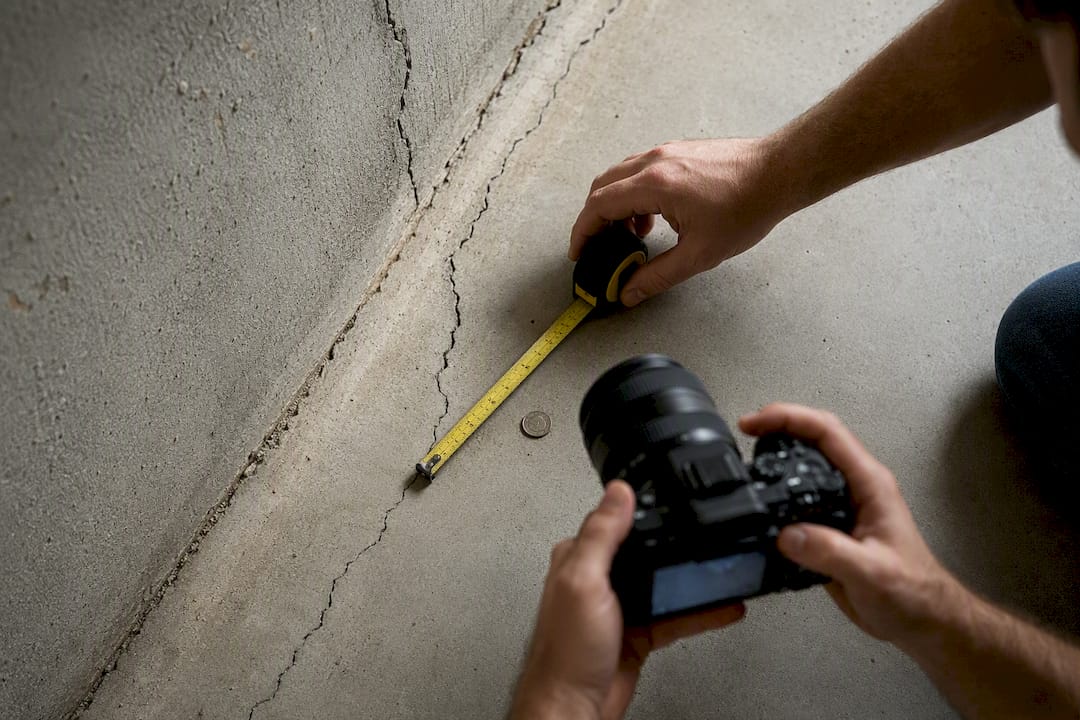
Photograph everything with a tape measure or coin in frame for scale, note the date, and label each image by room or exterior wall. This becomes evidence for your inspection contingency and gives your inspector or engineer a head start.
Pro Tip: Bring a small level and a marble in your pocket during the tour. A level pressed against a doorframe or wall corner tells you more in ten seconds than a Realtor’s reassurance ever will.
Who Do You Hire, and What Does Repair Actually Cost?
A general home inspector can flag foundation concerns, but they aren’t qualified to diagnose cause or certify a repair scope. That job belongs to a licensed structural engineer, and skipping this step is the single most common mistake buyers make.
Here’s the sequence that protects you:
- Get the home inspection first. If it flags foundation concerns, don’t argue with the seller yet. Move to step two.
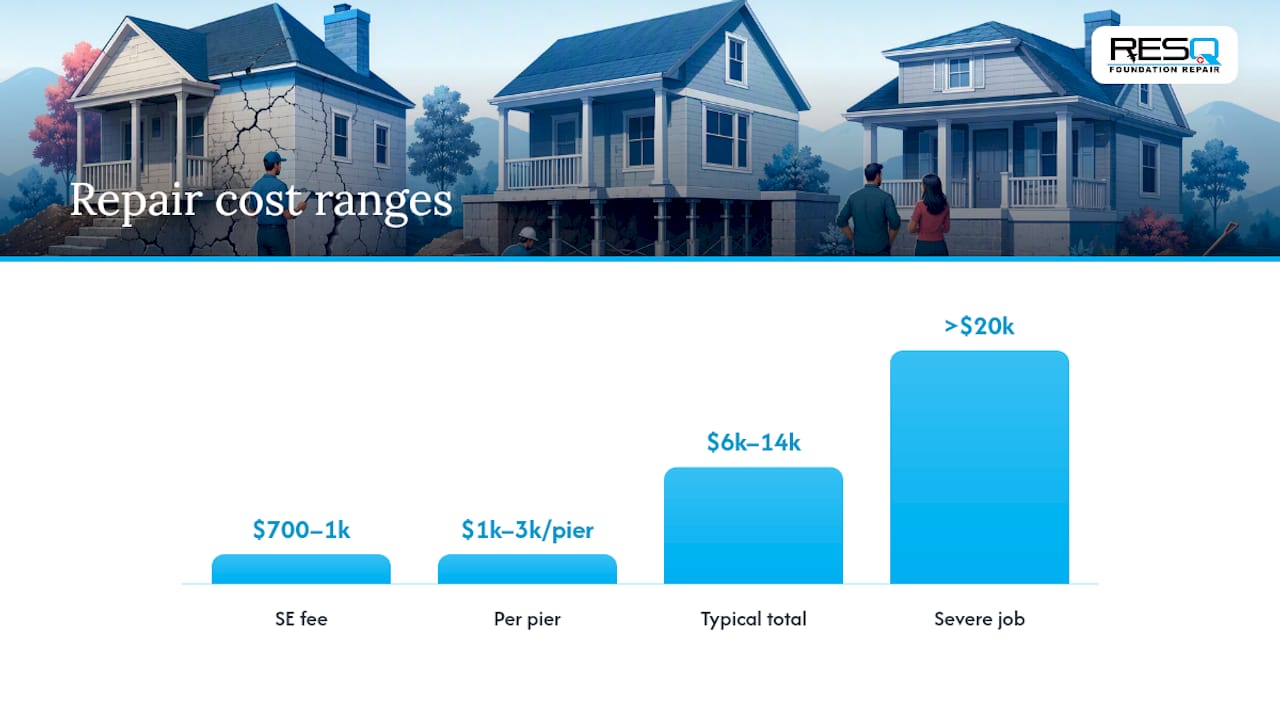
- Hire a licensed structural engineer (SE). Fees typically run roughly $700 to $1,000 depending on region and report complexity. Insist the report states explicitly whether movement is active or stable, includes measurements and photo documentation, and recommends a specific repair scope with materials.
- Collect two to three independent contractor bids based on the engineer’s scope, not vague verbal estimates. Each bid should be itemized: piering or underpinning cost, drainage correction, permit fees, and labor broken out separately.
- Compare bids against the engineer’s recommendation, not just against each other, since a suspiciously cheap bid often means a contractor is skipping steps the engineer specified.
What repairs actually cost: Helical or push piers typically run $1,000 to $3,000 per pier, with most residential jobs landing between $6,000 and $14,000 total. Severe underpinning or full drainage reconstruction can exceed $20,000. On top of that, plan for secondary repairs. Practitioner data shows ancillary work, like re-leveling floors, patching drywall, and rehanging doors, commonly adds 20% to 50% on top of the structural repair bill.
That ancillary uplift is the number most buyers forget to budget for, and it’s often the difference between a repair estimate that felt manageable and a final invoice that blew past the contingency they set aside.
Which Loans Work for a House With Foundation Damage?
Buying a home with foundation problems isn’t automatically a cash-only deal, but your loan program dictates how much flexibility you get. FHA, VA, and USDA loans all require the property to be safe, sound, and secure, which means the appraiser has to flag structural defects. Under FHA Handbook 4000.1, appraisers must flag standing water, bulging foundation walls, and cracked masonry, and any of those can trigger a repair condition that must be resolved before closing.
Conventional loans give underwriters more discretion. Minor, stabilized settling might not stop a conventional deal the way it would stop an FHA one.
If repairs are needed and you don’t want to pay cash upfront, three renovation-loan paths exist:
- FHA Limited 203(k) — covers smaller, non-structural repairs, generally capped lower and without a required consultant.
- FHA Standard 203(k) — built for major structural work; requires a HUD consultant to oversee scope and draws, and funds are disbursed from escrow as work completes.
- Conventional HomeStyle Renovation or CHOICERenovation — allow structural repairs financed into a conventional mortgage, appraised on an “as-completed” basis rather than current condition.
The lender’s escrow holdback is what makes any of this work: money for repairs sits in escrow and releases as contractors hit milestones, verified by inspection. Some lenders will allow a holdback for minor items and still close on schedule. Active structural failure, though, typically has to be resolved before closing unless you’re routing through a renovation loan built for exactly that scenario.
Alert your loan officer the moment an inspection flags foundation concerns, not after you’ve already got a signed engineer report. Renovation loans need lead time, consultant coordination, and lender sign-off on contractor bids, and that process moves slowly if you start it late.
Should You Negotiate Repairs or Ask for a Price Cut?
Once you have an engineer report and contractor bids in hand, you have four realistic negotiation paths, plus one factor that should override all of them: whether the seller cooperates at all.
- Seller completes repairs before closing. Require permits, a transferable warranty, and a post-repair engineer sign-off before you’ll accept the work as done.
- Price reduction. You take the discount and manage repairs yourself after closing, which works best if you’re not relying on a strict FHA/VA appraisal path.
- Seller credit at closing. Functions like a price cut but can sometimes be structured to help with closing costs too.
- Escrow holdback. Funds are set aside at closing and released once repairs are verified complete, useful when a small fix is holding up an otherwise clean deal.
To size your ask, practitioners recommend using the median of your contractor bids, weighted toward the higher end (100% to 120% of median), then adding a 10% to 25% contingency for surprises found once work starts.
Above 20%, especially with active movement still unresolved, that’s usually a walk unless you’re getting the house at a steep enough discount to justify a full renovation-loan project.
Pro Tip: Buyers who show up with multiple bids and a signed engineer report get better outcomes than buyers who show up with a single number. Sellers negotiate against evidence, not opinions.
How Long Does Foundation Repair Take, and Can You Live There?
Simple pier installations on an occupied home can wrap in a few days to two weeks. Full underpinning, drainage overhauls, or slab replacement stretch into several weeks, and permitting delays, weather, or hidden damage discovered mid-project can push that further.
Whether you can stay in the house during work depends on scope. Living in a house through intensive foundation work is possible but often loud, dusty, and disruptive, and professionals commonly recommend temporary relocation for major structural jobs, especially with kids, elderly occupants, or anyone with respiratory sensitivity.
A few things insurance and disclosure law won’t tell you upfront:
- Homeowners policies generally exclude gradual settlement and soil movement, treating it as a maintenance issue rather than a covered peril.
- Flood and earthquake coverage are separate policies entirely, with their own triggers and exclusions.
- Some insurers won’t bind a new policy on a home with unresolved foundation damage until repairs are complete.
- Sellers who know about material foundation defects and hide them are violating disclosure law in most states, even on an “as-is” sale. As-is affects repair obligations, not disclosure obligations.
If a seller’s disclosure form looks thin on a house with obvious cracking, ask for clarification in writing before you waive further contingencies.
How Foundationresq Scopes and Documents a Repair
Field crews at Foundationresq typically approach foundation work through piering, crawl space encapsulation, concrete leveling, and waterproofing, matched to what the engineer’s report and site conditions call for.
Before accepting any contractor’s proposal, confirm:
- Permits pulled and posted, not just promised.
- A transferable warranty, since resale value depends on the next buyer inheriting that protection.
- Engineer sign-off after the work, not just before.
- Before-and-after photos and a written, itemized scope.
Pro Tip: Walk away from any contractor who skips permits or won’t coordinate directly with your structural engineer. That combination is the clearest red flag in the entire repair process.
Are There Tax Implications for Buying or Repairing a Damaged Foundation?
Foundation repairs on a primary residence generally count as capital improvements rather than deductible expenses in the year you pay for them. That distinction matters at resale: capital improvements get added to your home’s cost basis, which reduces your taxable gain when you eventually sell.
If you buy the house at a discount specifically because of foundation damage, your purchase price, and therefore your starting cost basis, is lower. The repair costs you pay afterward get added back to that basis over time. Keep every invoice, permit, and engineer report indefinitely; you’ll want that paper trail whenever you sell, since the IRS and your accountant will both want documentation tying repair costs to your basis calculation.
Rental or investment properties work differently. Some repair costs may be deductible as current-year expenses rather than capitalized, depending on whether the work restores the property to its prior condition or constitutes an improvement beyond that. That line is genuinely blurry in tax law, and it’s worth a conversation with a tax professional before you file, not after.
There’s no special federal tax credit for buying a house with foundation problems specifically. Any benefit comes through the ordinary capital-gains and cost-basis mechanics that apply to home improvements generally, not through a program targeted at structural repairs.
Will Foundation Problems Raise Your Insurance Premiums?
Foundation issues affect your insurance in two separate ways: whether you can get coverage at all, and what that coverage actually pays for.
Getting bound coverage can be the first obstacle. Insurers routinely require proof that active foundation damage has been repaired before they’ll write or renew a homeowners policy on the property. If you’re closing on a house with unresolved structural movement, expect your insurance agent to ask for the same engineer report your lender wants.
Once you have a policy, coverage gets narrower than most buyers assume. Standard homeowners policies typically exclude damage from gradual settling, soil movement, and normal wear, treating foundation deterioration as a maintenance issue the homeowner should have caught early rather than a sudden covered loss. A pipe bursting and undermining your slab might be covered. The slab settling over years from expansive clay soil almost certainly isn’t.
That gap is why documented repairs matter beyond the sale itself. A house with a stabilized foundation, backed by an engineer’s post-repair sign-off and a transferable warranty, is a much easier property to insure than one with a vague repair history or none at all. Some insurers will ask for that documentation directly before issuing a quote, and having it ready can be the difference between a smooth renewal and a denied application.
How Should You Weigh Your Own Risk Tolerance?
I’d proceed on a stable, documented $8,000 repair with a cooperative seller and a clear FHA path. I’d walk from active movement with no engineer sign-off, no matter how much I liked the kitchen. Keep every contingency intact, document each step, and verify the repair yourself once it’s done, not just when the contractor says so.
— Kayle
Primary Sources and Further Reading
- HUD: Section 203(k) Rehabilitation Mortgage Program
- Foundation Repair Financing Options: 2026 Guide
- What Affects Foundation Repair Cost: 2026 Guide
If you’re weighing a purchase in North Florida, South Georgia, or Alabama and want a second opinion on what a repair scope should actually cost, Foundationresq’s inspection and repair services can walk you through piering, waterproofing, and crawl space options before you finalize an offer. Their documented case studies also show what a properly permitted, warrantied repair looks like on paper, which is exactly what you’ll want in hand before you ask a seller for a credit.
Sources
- HUD: Section 203(k) rehabilitation mortgage program
- Will a bank finance a house with foundation problems? – LegalClarity
- Rocket Mortgage — Buying a home with foundation issues
FAQ
Is It Worth Buying a House With Foundation Issues?
It’s worth it when a licensed engineer confirms stable (not active) movement, the documented repair cost fits your budget or a renovation loan, and the seller or lender clears the appraisal path. Outside those conditions, the risk usually outweighs any discount on price.
Is It Illegal to Sell a House With Foundation Problems?
No, selling a house with foundation problems isn’t illegal on its own, but intentionally concealing known material defects is illegal in most states, even in an “as-is” sale.
Can You Live in Your House While Foundation Repair Is Done?
Yes, for smaller jobs like a handful of piers, most households stay put. For major structural work, professionals commonly recommend temporary relocation due to noise, dust, and access restrictions.
Can a House With Foundation Problems Be Fixed?
Most foundation problems can be repaired with the right method, whether that’s piering, underpinning, or drainage correction, provided a structural engineer diagnoses the cause first. The real question isn’t whether it can be fixed but whether the cost and timeline make sense for your budget and loan program.