Imagine standing in your basement or crawl space after a week of heavy Florida rain and noticing a new, stair-step crack running along your concrete block wall. It isn’t just a cosmetic issue. It’s a clear sign that the saturated soil outside is exerting enough hydrostatic pressure to compromise your home’s structural integrity. You’re likely feeling the weight of uncertainty, wondering if your foundation can withstand the next hurricane season or if a costly collapse is imminent. Understanding the specific bowing wall repair options for concrete block foundations is the first step toward reclaiming your home’s safety.
It’s completely normal to feel overwhelmed by the technical jargon and various repair technologies on the market. You need a solution that addresses the hollow core of your concrete blocks rather than just patching the surface. In this guide, we’ll detail the most effective, permanent methods to stabilize your foundation and restore your property value. We’ll explore how advanced carbon fiber reinforcement and professional piering systems act as a final line of defense against shifting soil. By the end, you’ll have the clear, expert guidance needed to choose a remedy that offers lasting peace of mind.
Key Takeaways
- Understand how Leon County’s expansive red clay and heavy rainfall create hydrostatic pressure that forces concrete block walls inward.
- Learn to identify critical warning signs, like horizontal cracking and stair-step patterns, before they lead to structural failure.
- Compare professional bowing wall repair options for concrete block foundations, including low-profile carbon fiber reinforcement and heavy-duty wall anchors.
- Discover why Tallahassee’s unique geological conditions require a customized engineering approach rather than a one-size-fits-all fix.
- Gain peace of mind by implementing permanent stabilization methods that protect your home’s value and structural integrity during hurricane season.
Why Concrete Block Foundations Bow: The Science of Hydrostatic Pressure
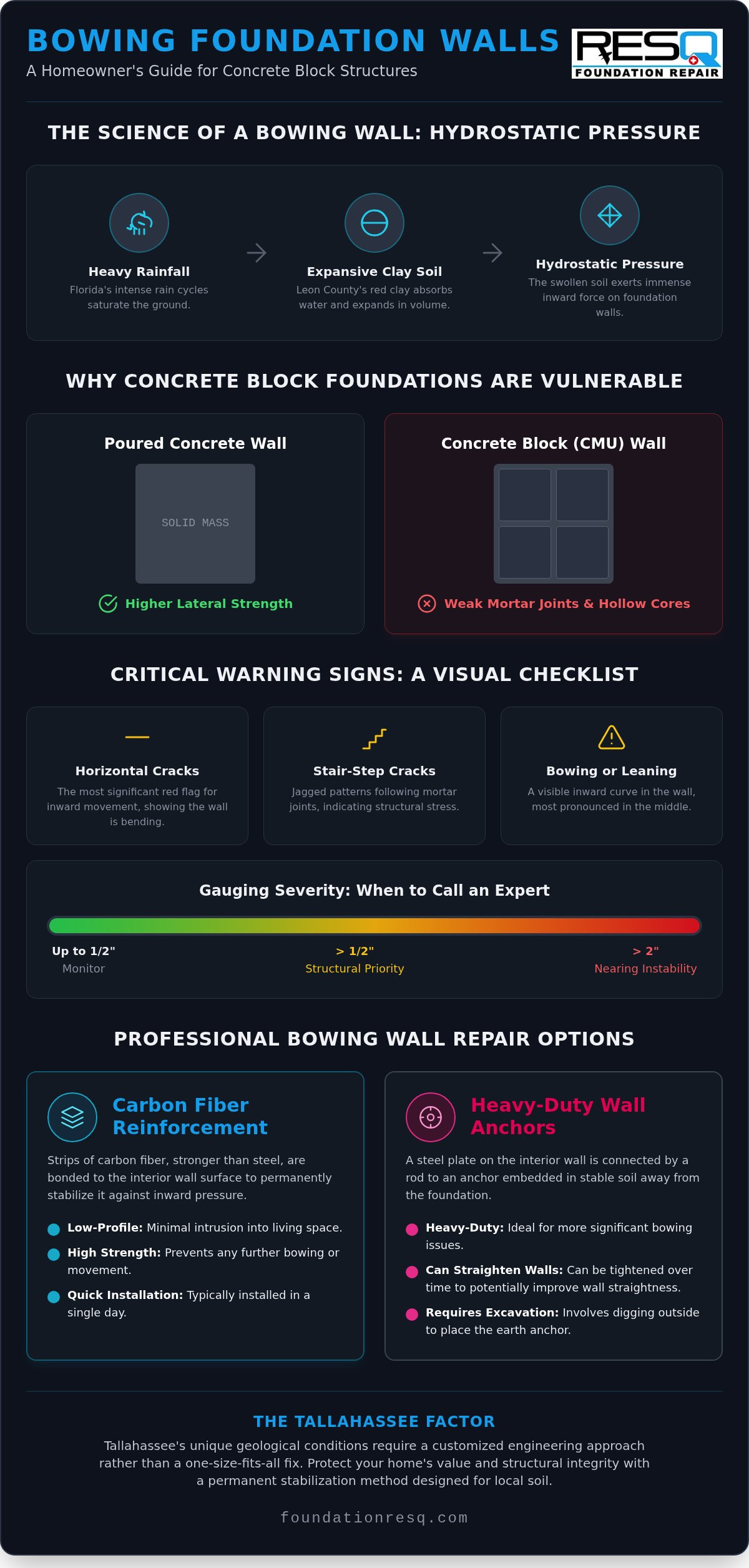
Leon County homeowners face a specific geological challenge: expansive red clay soil. Unlike sandy soils that drain quickly, clay absorbs massive amounts of moisture during Tallahassee’s intense rain cycles. As this clay holds water, it expands in volume, exerting immense force against your home’s underground structure. This force is the primary driver behind foundation movement. When this pressure exceeds the strength of your walls, they begin to deflect inward. Understanding the bowing wall repair options for concrete block foundations starts with recognizing why these specific structures fail.
Concrete block foundations, or CMU walls, are particularly susceptible to stair-step cracking. These cracks follow the mortar joints between blocks, creating a jagged pattern that signals the wall is no longer able to support the weight of the earth outside. If left unaddressed, this inward movement can lead to total structural failure.
The Impact of Florida’s Heavy Rain Cycles
Florida’s weather patterns oscillate between extreme saturation and rapid drying. This cycle causes the soil to swell and shrink repeatedly, which creates a pumping action against the foundation. Over time, this movement weakens the mortar joints that hold your blocks together. Poor gutter drainage often compounds the issue by dumping gallons of water directly into the soil next to the foundation, which drastically increases the local water table and the resulting pressure. In the context of our local water table, hydrostatic pressure is the relentless force exerted by water-saturated soil as it pushes horizontally against your foundation walls.
Hollow Core vs. Poured Concrete: The Block Advantage and Disadvantage
There is a significant structural difference between poured concrete and block foundations. While poured walls are a solid mass, concrete blocks are hollow. This design makes the mortar joints the weakest link in the entire system. Because the blocks are hollow, they lack the lateral strength of a solid poured wall. This is why bowing often manifests most clearly at the third or fourth course of blocks from the floor. This is where the pressure from the surrounding earth is often at its peak. As the wall bends, internal pressure can build up within the hollow cores if water seeps inside, further stressing the material from within. Effective bowing wall repair options for concrete block foundations must address these specific hollow-core vulnerabilities to ensure a permanent remedy.
Identifying the Signs: Is Your Bowing Foundation Wall an Emergency?
Spotting foundation trouble early is essential for protecting your home’s value and safety. While some minor settlement is common in older Florida properties, certain patterns indicate that the soil pressure we discussed previously has reached a critical level. Horizontal cracking along the mortar joints is the most significant red flag for inward movement. Unlike vertical cracks that often relate to simple settling, horizontal lines show that the wall is actively bending under weight. This movement is often most pronounced in the middle of the wall where the pressure is greatest.
Measurement is the most reliable way to gauge the severity of the issue. A wall that has moved more than 1/2 inch from its original vertical position is no longer just a cosmetic concern; it is a structural priority. If you notice a bow that exceeds 2 inches, the wall is nearing a point of instability where standard bowing wall repair options for concrete block foundations transition from simple stabilization to more complex remediation. You should also watch for secondary symptoms on upper floors. Sticking windows or doors often suggest that the foundation movement is pulling the entire frame of your house out of alignment.
Visual Checklist for Homeowners
You can perform a basic assessment by looking for these specific movement patterns in your basement or crawl space:
- Diagonal corner cracks: These often start at the top corners of the foundation and move downward toward the center of the wall.
- Tipping at the sill plate: This occurs when the top course of blocks leans inward while the rest of the wall remains relatively straight.
- Sliding at the base: Look for a visible shift or gap where the bottom block course meets the concrete floor slab; this is often called a shear crack.
The Tipping Point: When to Call a Structural Expert
Waiting for visible daylight to appear through foundation cracks is a dangerous strategy that often leads to higher repair costs. Aesthetic settlement usually involves small, vertical hairline cracks that don’t widen over time. Structural failure, however, involves horizontal displacement and widening gaps that compromise the building’s safety. A professional foundation inspection provides the clarity needed to distinguish between these two scenarios. A structurally compromised wall is a foundation element that has lost its intended load-bearing capacity due to excessive lateral deflection or the failure of its internal reinforcement and mortar joints. Addressing these signs early allows you to utilize more efficient bowing wall repair options for concrete block foundations before the damage becomes irreversible.
Comparing Concrete Block Repair Options: Carbon Fiber vs. Wall Anchors
Selecting a permanent remedy for a shifting foundation requires a clear understanding of your home’s specific structural needs. Every foundation is unique, but professional remediation typically falls into three categories: surface reinforcement, external anchoring, or mechanical bracing. The goal is always the same: to stop the inward movement and restore long-term stability. Choosing between the various bowing wall repair options for concrete block foundations depends on the severity of the deflection and the space available around your property.
For walls with moderate movement, we focus on stabilization. For more advanced cases where the wall has shifted significantly, we look toward systems that can provide active tension or mechanical support. Each method has its own set of requirements and benefits that impact the final result.
Carbon Fiber Wall Reinforcement: The Modern Choice
Carbon fiber straps represent a significant advancement in structural engineering. These straps are incredibly thin yet stronger than steel. During installation, a professional bonds the straps directly to the face of the concrete block using a high-strength epoxy. This bond creates a permanent tension barrier that prevents the wall from bowing further inward. Because the straps bond to the entire surface of the blocks they cover, they effectively distribute the load and prevent the mortar joints from opening further.
This method is particularly effective for Carbon Fiber Wall Repair Tallahassee projects because it is non-invasive. Unlike older technologies, there’s no need for heavy machinery or excavation. It’s the preferred choice for homeowners with finished basements or those who want a low-profile look. Once the straps are installed and painted, they’re nearly invisible, preserving your living space while providing industrial-grade stabilization.
Wall Anchors and Tiebacks: Leveraging External Tension
Wall anchors are a traditional remedy that uses the strength of the soil in your yard to stabilize the foundation. This system involves a ‘deadman’ anchor buried in the earth several feet away from the house. A steel rod connects this anchor to a plate on the inside of the bowing wall. By tightening the rod, we can exert enough tension to stop further movement and, in some cases, pull the wall back toward its original position over time.
However, Tallahassee lot sizes can sometimes make wall anchors difficult to install. If your home is close to a property line or has significant landscaping, there might not be enough room for the external plates. In these scenarios, or when the bowing is severe, we may recommend I-beam wall braces or helical tiebacks. I-beams provide heavy-duty mechanical support by spanning from the floor to the joists. Helical tiebacks offer an industrial-strength solution for the most challenging soil conditions. Selecting the right bowing wall repair options for concrete block foundations ensures that your home remains a safe, stable environment for decades to come.
The Tallahassee Factor: How Local Soil and Drainage Impact Repair
Tallahassee presents a unique set of environmental challenges that directly impact the longevity of your home’s structure. While coastal Florida areas deal primarily with sand, Leon County is defined by its thick, expansive red clay. This soil type acts like a sponge, absorbing massive amounts of water and swelling with significant force. When you combine this geology with our region’s high annual rainfall, the ground surrounding your foundation remains saturated for extended periods. This constant moisture accelerates the pressure on your walls, making the selection of appropriate bowing wall repair options for concrete block foundations a matter of regional necessity rather than just a general home improvement.
Local expertise is required to navigate these geological strata effectively. A solution that works in the sandy loam of South Florida might fail against the heavy hydraulic load of North Florida’s clay. Our team understands that a permanent remedy must account for the specific way these soils expand and contract during our seasonal rain cycles.
Moisture Management as a Foundation Defense
Controlling how water moves around your property is the first step in structural protection. Gutter extensions serve as a vital tool in this defense. They ensure that roof runoff is deposited at least six to ten feet away from your foundation, which prevents the soil immediately adjacent to your block walls from becoming a heavy, saturated mass. Without proper drainage, even the strongest repair can face unnecessary stress.
Maintaining consistent soil moisture levels is also critical for stability. If the soil under your home dries out while the soil outside remains wet, the resulting pressure differential can cause walls to shift. Implementing crawl space encapsulation helps regulate these internal conditions and creates a protective barrier against moisture. Proper grading is another essential remedy, ensuring the landscape slopes away from the house to prevent water from pooling against the block foundation.
Tallahassee Lot Considerations
Our local geography also includes practical challenges for repair crews. Historic neighborhoods like Midtown or Myers Park often feature narrow lots that limit access for heavy machinery. This makes non-invasive bowing wall repair options for concrete block foundations, such as carbon fiber reinforcement, particularly valuable for homeowners with limited yard space. Additionally, large tree roots from Tallahassee’s famous canopy can push against foundation walls or create voids in the soil as they grow and decay.
Navigating local building codes and permit requirements is another essential layer of the repair process. Structural stabilization in Leon County must meet specific engineering standards to ensure the remedy is permanent and safe. If you suspect your walls are moving, it’s time to contact a local foundation specialist for a comprehensive assessment. Expert guidance ensures that your repair plan addresses the unique environmental pressures of the Big Bend region while restoring your home’s structural health.
Professional Stabilization: The Foundation ResQ Remedy
Resolving a structural issue requires more than a standard construction approach. It demands a methodical, engineering-backed strategy that addresses the specific physics of your home. At Foundation ResQ, we begin every project with a comprehensive inspection. Our specialists map the exact crack patterns in your concrete blocks and use precision tools to measure wall deflection down to the millimeter. This data allows us to move beyond guesswork and develop a customized engineering plan. Because every property faces different hydrostatic loads, your bowing wall repair options for concrete block foundations must be tailored to your home’s unique footprint and soil conditions.
Our local Tallahassee expertise is supported by established industry standards and years of specialized experience in structural remediation. When our crews arrive at your home, you can expect a structured, professional environment. We treat your property with the respect it deserves, ensuring that every stabilization component is installed according to strict safety protocols. This high level of precision provides the long-term protection and peace of mind you need to feel safe during Florida’s unpredictable storm seasons.
Step-by-Step Installation of Carbon Fiber Reinforcement
Carbon fiber is a sophisticated remedy that requires careful execution to reach its full structural potential. The process follows a specific sequence to ensure a permanent bond:
- Surface Preparation: We grind the face of the concrete blocks to remove paint, debris, or loose mortar. This creates a porous, clean surface that allows the adhesive to penetrate the block.
- Epoxy Application: A high-strength structural epoxy is applied to the prepared area. This material acts as the bridge between your foundation and the reinforcement.
- Strap Integration: The carbon fiber strap is pressed into the epoxy. Once cured, this strap becomes an unbreakable tension barrier that prevents any further inward movement.
- Finishing: The low-profile nature of the strap allows it to be painted over easily. This ensures the repair remains nearly invisible while maintaining the wall’s structural integrity.
Why Permanent Stabilization Beats a ‘Quick Fix’
Many homeowners are tempted to simply ‘tuck-point’ or fill foundation cracks with fresh mortar. While this might hide the problem temporarily, it’s a dangerous strategy. Filling a crack does nothing to stop the external soil pressure that caused the crack in the first place. In fact, it often masks the symptoms of a worsening structural failure. Choosing a professional foundation repair Tallahassee solution ensures that the root cause of the bowing is addressed. Permanent stabilization not only protects your family’s safety but also preserves your home’s resale value by providing documented structural health. Don’t leave your home’s stability to chance. Schedule your free, no-obligation foundation inspection with Foundation ResQ today.
Secure Your Home’s Structural Future
A bowing wall is a significant structural concern, but it is a problem with a definitive remedy. We have explored how Tallahassee’s expansive red clay and intense rain cycles create the relentless hydrostatic pressure that forces concrete block foundations inward. Recognizing the early signs of movement, like horizontal cracks or tipping at the sill plate, allows you to act before a localized issue becomes a total structural failure. Your home’s safety depends on addressing these environmental pressures with professional precision rather than temporary patches.
By evaluating the various bowing wall repair options for concrete block foundations, you can select a permanent solution that fits your property’s specific needs. Whether you choose non-invasive carbon fiber reinforcement or heavy-duty wall anchors, the key is utilizing an engineering-backed approach. Our team of local Tallahassee structural experts provides permanent solutions that restore your home’s integrity and your peace of mind. You don’t have to face these structural challenges alone; expert help is ready to assist. Take the first step toward a stable foundation and Request Your Free Foundation Inspection with Foundation ResQ today to protect your property’s value for years to come.
Frequently Asked Questions
Can a bowing concrete block wall be fixed without being replaced?
Yes, most bowing walls can be permanently stabilized using engineered systems like carbon fiber straps or wall anchors. Total replacement is usually a last resort for walls that have suffered a complete structural collapse. By intervening early, you can utilize bowing wall repair options for concrete block foundations that reinforce the existing structure. These methods stop further movement and restore the wall’s integrity without the massive expense and disruption of a full foundation excavation.
What is the most common cause of bowing walls in Tallahassee?
The primary cause is the high concentration of expansive red clay soil combined with Tallahassee’s heavy annual rainfall. This clay absorbs water and expands, creating intense hydrostatic pressure against your foundation. Because concrete blocks are hollow, they lack the lateral strength to resist this horizontal force indefinitely. Over time, the pressure pushes the wall inward, leading to the characteristic bowing and stair-step cracking patterns seen in many local homes.
How much can a foundation wall bow before it is considered dangerous?
A wall that has deflected more than 1/2 inch from its vertical position is generally considered a structural priority. Once the bow exceeds 2 inches, the wall is nearing a critical point of instability. At this stage, the risk of a sudden collapse increases, especially during periods of heavy saturation or storm activity. It’s essential to have a professional measure the deflection accurately to determine which bowing wall repair options for concrete block foundations are most appropriate for your safety.
Does carbon fiber really work on hollow concrete blocks?
Yes, carbon fiber is highly effective for reinforcing hollow concrete block walls when installed by professionals. The straps are bonded to the surface with high-strength epoxy, creating a tension barrier that prevents the blocks from shifting further. This method is particularly useful because it addresses the weakness of the mortar joints. By distributing the external pressure across the entire reinforced area, carbon fiber prevents the horizontal cracks from widening and stabilizes the wall’s core.
How long does it take to repair a bowing foundation wall?
Most stabilization projects are completed within one to two days, depending on the number of straps or anchors required. Non-invasive methods like carbon fiber reinforcement are typically the fastest to install because they don’t require heavy excavation or yard work. Our crews focus on a methodical process that ensures every component is secured correctly. This efficiency allows you to restore your home’s structural health with minimal disruption to your daily routine.
Will homeowners insurance cover the cost of bowing wall repair?
Standard homeowners insurance policies rarely cover foundation repairs related to hydrostatic pressure or soil movement. These issues are typically classified as maintenance or long-term wear rather than sudden, accidental losses. However, it’s always wise to review your specific policy or speak with your agent to confirm your coverage details. Investing in permanent stabilization now can prevent far more expensive damage that would also likely fall outside of standard insurance protection.
Is it better to use wall anchors or carbon fiber straps?
The best choice depends on the severity of the bow and your property’s layout. Carbon fiber straps are ideal for walls with moderate bowing because they are low-profile and require no digging. Wall anchors are a powerful alternative that uses the soil in your yard to pull the wall back toward its original position. In Tallahassee, narrow lots or heavy landscaping might make carbon fiber the more practical, non-invasive remedy for many homeowners.
Can poor drainage cause my foundation walls to bow inward?
Poor drainage is a leading contributor to foundation wall failure. When gutters dump water directly next to your foundation, the soil becomes over-saturated and exerts significantly more weight against the block walls. This localized pressure is what causes the wall to bend inward over time. Maintaining clear gutter extensions and proper landscape grading are essential steps to protect your foundation from the relentless force of Florida’s heavy rain cycles.