
Prolonged drought can cause real foundation settlement, and it happens through a specific mechanism: expansive clay soil loses moisture, shrinks, and stops supporting the slab or footings above it. If you’re seeing new cracks or sticking doors during a dry spell, photograph the damage now, check for gaps between soil and foundation, and start even perimeter moisture control if your local water rules allow it. Progressive cracking means it’s time to call a professional inspector.
TL;DR:
- Soil type significantly affects foundation risk, with expansive clay soils being the most prone to movement during drought conditions.
- Short-term moisture fluctuations often cause reversible cracks, but repeated deep drying cycles can lead to permanent settlement requiring professional repair.
- Proper foundation watering involves short, frequent cycles around the entire perimeter, especially on sun-exposed sides, to prevent differential movement.
- Visible cracks, sticking doors, uneven floors, and gaps between the foundation and soil signal potential progress toward permanent damage, especially if worsening over time.
- Most drought-induced settlement isn’t covered by homeowners insurance, so preventative maintenance and professional inspections are key to avoiding costly repairs.
Table of Contents
- How Does Drought Cause Foundation Settlement?
- What Are the Warning Signs of Drought-Related Settlement?
- What Can You Do Right Now to Protect Your Foundation?
- When Should You Call a Professional for Foundation Repair?
- Who’s Behind This Guidance?
- Does Soil Type Beyond Clay Affect Foundation Risk?
- Can You Design or Retrofit a Foundation to Resist Drought Damage?
- What This Playbook Gets Right That Others Miss
- Get a Free Foundation Inspection From Foundation RESQ
- Sources
- FAQ
How Does Drought Cause Foundation Settlement?
The soil under your house isn’t inert. Certain clay minerals, particularly smectite and montmorillonite, are built to swell when wet and shrink when dry, and the volume change is dramatic enough to pull structural support out from under a slab. In severe drought, clay can lose enough volume to drop the ground surface by an inch or more, and that drying almost always starts at the perimeter of a house before working inward.
That perimeter pattern is exactly why edges of a slab tend to crack before the middle does. Sun exposure, wind, and nearby tree roots all pull moisture from the soil at different rates around the same foundation, which creates differential movement instead of even settling. One corner drops while another holds steady, and the foundation twists rather than sinks flat.
Speed matters too. Flash droughts, where high heat and evapotranspiration strip soil moisture over just weeks instead of months, are especially dangerous because the clay shrinks faster than a slab can flex to absorb the change. That’s when you see cracks appear almost overnight rather than creeping in gradually.
Three factors that raise your risk during any dry season:
- Soil type. Expansive clay soils move far more than sandy or well-draining soils under the same drought conditions.
- Drought duration. Multi-year droughts push the “active zone” of shrinkage deeper, increasing the odds that movement becomes permanent.
- Existing landscaping. Mature trees close to the foundation compete aggressively for whatever moisture remains in the soil.
Here’s the good news: movement caused by short-term drying is often cyclical and reverses once moisture returns. It’s the repeated, deep drying cycles over multiple seasons that tend to cause the kind of settlement that needs an actual repair rather than a watering schedule. Reviewing how expansive clay affects a foundation before you build or landscape can save a lot of grief later.
What Are the Warning Signs of Drought-Related Settlement?
Not every crack means disaster, but some patterns are worth tracking closely. Watch for these signs, especially if they show up during or right after a dry stretch:
- Diagonal or stair-step cracks in brick, block, or drywall, usually running from a corner of a window or door.
- Doors and windows that stick or no longer latch the way they used to.
- Uneven or sloping floors, which you can sometimes feel just walking barefoot across a room.
- Visible gaps opening up between the foundation and the soil around it, sometimes wide enough to see daylight.
- New cracks in exterior masonry, stucco, or the foundation itself that weren’t there before the dry spell started.
Regional reporting from Oklahoma this year found that foundation repair calls spike noticeably during drought months, and the warning signs homeowners describe match this list almost exactly.
The real question is whether the movement is cyclical or progressive. Take a date-stamped photo of any crack, note its width with a ruler, and recheck it after the next rain. If the crack closes up or stays the same, that’s cyclical movement responding to moisture, and it’s less urgent. If it keeps widening regardless of rainfall, that’s progressive movement, and it usually points to permanent soil deformation that needs a professional look.
Gaps big enough to let in water or pests, or any misalignment that affects how a door or window functions, are your signal to stop monitoring and start calling.
What Can You Do Right Now to Protect Your Foundation?
The single most effective drought defense is boring: keep the soil moisture around your foundation even, all season, on all sides.
- Run a soaker or drip line 12 to 18 inches from the slab edge, not right against it, and let it cycle on short, frequent runs rather than one long soak. Clay absorbs water slowly, and dumping a lot of water on bone-dry soil all at once can actually cause heave instead of steady rehydration, according to foundation watering guidance from North Texas contractors dealing with exactly this soil type.
- Encircle the whole house, not just the side that looks driest. Uneven watering is often what causes differential movement in the first place.
- Adjust for sun and wind exposure. South and west sides typically dry out faster and need more frequent watering than shaded north sides.
- Mulch beds near the foundation to slow evaporation, which stretches the value of every watering cycle.
- Check your grading and gutters. Soil should slope away from the house, and downspouts should carry water well past the foundation line rather than dumping it at the base.
- Manage tree roots. If mature trees sit close to the house and appear to be pulling moisture from the soil, a vertical root barrier is usually a better first move than removing the tree outright.
Pro Tip: Don’t rip out a large, established tree near your foundation without a plan. Sudden removal lets the soil rehydrate and swell back up, which can cause its own round of movement. A root barrier addresses the moisture competition without triggering that rebound.
Before you start any watering program, check your municipality’s drought restrictions. Many areas limit outdoor watering hours or days during declared droughts, and foundation watering isn’t always exempt. Keep a simple log of what you’re doing and when. If you ever need a professional inspection or an insurance conversation, dated notes and photos carry real weight.
When Should You Call a Professional for Foundation Repair?
A proper inspection covers more ground than a homeowner walkthrough. Expect a technician to check your soil type, map existing cracks, take floor-level readings across the house, and evaluate your drainage setup before drawing any conclusions about whether movement is cyclical or progressive.
If the verdict is progressive settlement, several established repair methods come into play depending on what’s actually moving:
- Driven steel or helical piers underpin a settled foundation by transferring its weight down to more stable, load-bearing soil below the active shrink zone.
- Polyurethane foam injection or slab lifting raises sunken concrete flatwork, walkways, and slabs back toward level.
- Soil replacement or improvement addresses cases where the existing soil has degraded too much to reliably support the structure, something geotechnical research on long-term drought documents in soil shrinkage extending well over a meter deep in extended dry periods.
- Drainage remediation tackles the root cause so the same movement doesn’t repeat next season.
Set realistic expectations before you sign anything. If interior finishes like drywall or tile were installed after the house had already settled, lifting the foundation back toward its original elevation can crack those finishes even though the structural repair itself is sound. A good contractor documents pre-repair conditions and explains that trade-off up front rather than letting you find out afterward. Reviewing permanent foundation repair options before your inspection helps you ask sharper questions when the estimate arrives.
One more reality check: most standard homeowners insurance policies exclude earth movement, including drought-driven settlement, from coverage. Budget for repair costs directly rather than assuming a claim will cover it.
Who’s Behind This Guidance?
This article draws on established soil science and field-tested mitigation practices, not guesswork, and it’s written from the perspective of Foundation RESQ, a foundation repair and structural stabilization company serving homeowners and property managers across North Florida, South Georgia, and Alabama.
A few things worth knowing about how the company approaches drought-related work:
- Foundation RESQ specializes in foundation settlement repair, crawl space remediation, concrete leveling, basement waterproofing, and mold removal, with an emphasis on matching repair technique to the specific soil and damage pattern rather than applying one method everywhere.
- The company publishes detailed guidance on avoiding common repair mistakes, which reflects a focus on educating homeowners before they sign a contract, not just after.
- Its resources cover related moisture issues too, including basement dehumidification, since drought and moisture management often intersect on the same property.
- Structural guides like the one on porch settlement repair show the same diagnostic approach applied to smaller structural elements that show drought stress before the main foundation does.
Does Soil Type Beyond Clay Affect Foundation Risk?
Expansive clay gets most of the attention, and rightly so, but it’s not the only soil that reacts to drought. Sandy soils drain fast and generally hold their shape reasonably well when dry, which makes them a lower risk category for shrink-related settlement, though they can still shift if erosion or poor compaction is already a problem.
Silty soils sit in between. They don’t swell and shrink as dramatically as clay, but they compact more easily under load once moisture drops, especially if a home sits on fill soil that wasn’t properly compacted during construction. Loam, the mixed soil type common across a lot of residential lots, behaves more predictably than clay but still loses some structural stability as it dries out completely.
The practical takeaway is that soil composition, not just rainfall totals, determines how a given house responds to drought. Two homes a few miles apart can see wildly different outcomes from the same dry season if one sits on expansive clay and the other on sandy loam. That’s part of why a soil-type check is one of the first things a real inspection should include, rather than assuming every crack traces back to the same clay-shrinkage story. If you’re unsure what’s under your slab, that’s a question worth asking before you invest heavily in a watering regimen that may not be your soil’s biggest risk factor.
Can You Design or Retrofit a Foundation to Resist Drought Damage?
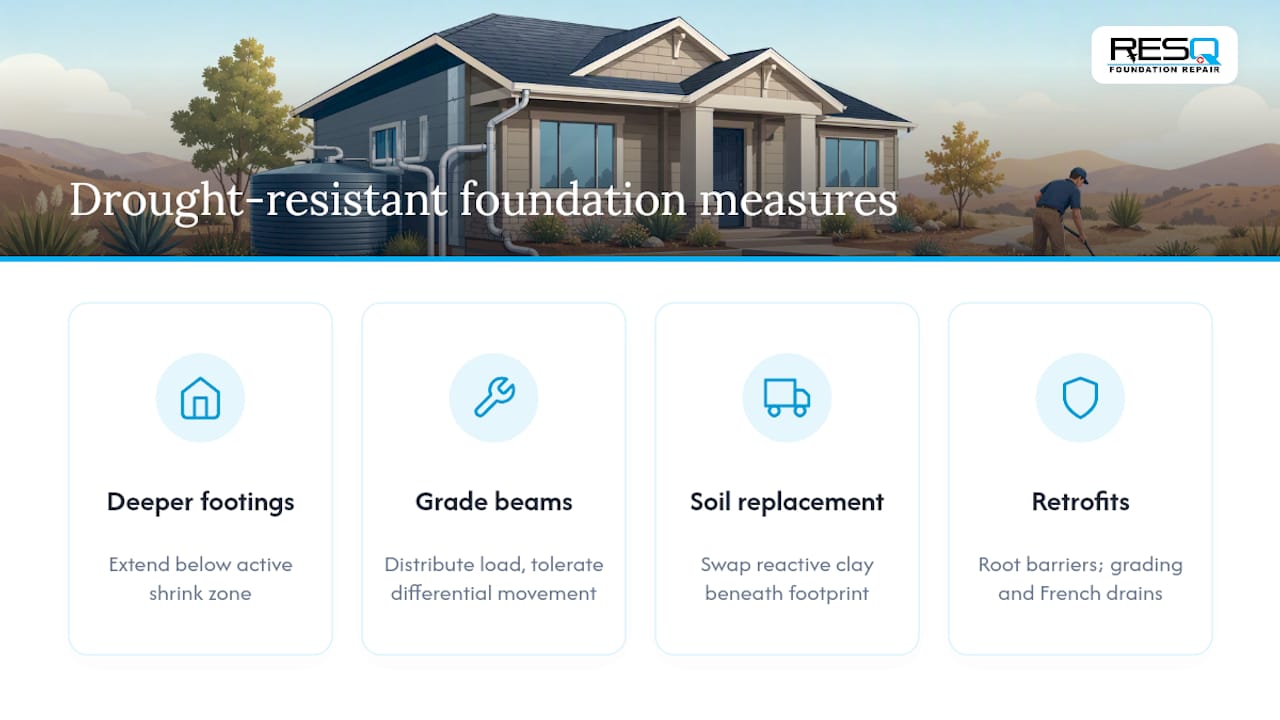
Preventive design beats reactive repair, and there are a handful of proven approaches that reduce drought vulnerability from the start. Deeper footings that extend below the typical active shrink zone give a foundation something more stable to rest on, since the top layer of soil is where most of the moisture swing happens.
Grade beams and stiffened slab designs distribute load more evenly across a foundation, which helps a structure tolerate some differential soil movement without cracking. In new construction on known expansive clay, some builders also recommend soil replacement or amendment beneath the footprint before pouring, swapping out the most reactive clay for a more stable material.
For existing homes, retrofitting options are more limited but still meaningful. Root barriers installed between mature trees and a foundation cut down on the moisture competition that drives uneven drying, reducing lateral extraction without forcing an immediate tree removal that could itself trigger a rehydration swell. Improved grading and permanent drainage systems, like French drains routed well away from the slab, address the water side of the equation year round rather than just during a declared drought. None of these retrofits are cheap, but they’re consistently less expensive than the underpinning work needed after settlement has already set in.
What This Playbook Gets Right That Others Miss
Most drought advice online tells homeowners to “keep soil moist” and stops there, which is true but useless without specifics. The real value is in the details: 12 to 18 inches from the slab, short frequent cycles, more water on the south and west exposures, mulch to stretch every gallon. Generic advice gets ignored because it doesn’t tell you what to actually do this week.
The bigger gap in conventional coverage is the false binary between “just water it” and “call a foundation company.” Most homes fall in the middle, showing cyclical movement that responds to better moisture management and never needs a pier installed. Jumping straight to alarm mode over a hairline crack that closes after rain wastes money on inspections that don’t need to happen yet.
My take: document everything before you do anything else. Photos and crack measurements taken now become the evidence that separates a manageable dry-season adjustment from a structural problem, and that documentation is what makes a later inspection, or insurance conversation, actually productive instead of guesswork.
— Kayle
Get a Free Foundation Inspection From Foundation RESQ
If you’ve been tracking cracks or sticking doors through this dry spell and the movement isn’t reversing after rain, it’s time for a professional set of eyes on the problem. Inspections typically include visual crack mapping, basic floor-level checks, and straightforward recommendations, without a high-pressure sales pitch.

You’ll walk away knowing whether what you’re seeing is cyclical drought movement you can manage with better watering and drainage, or something that needs underpinning, slab lifting, or drainage remediation. Explore the full range of foundation and structural repair services to see what applies to your situation, and if cost is a concern, financing options are available so a needed repair doesn’t have to wait for a better budget season. Schedule your free inspection today and get a clear answer instead of a guess.
Sources
For deeper technical background, the USGS drought resource covers soil moisture mechanics, and the Geo-Institute’s shrink-swell soils guidance details mitigation principles referenced throughout this article.
- USGS — Drought (soil moisture and related impacts)
- Geo-Institute — Living with shrink-swell soils (updated guidance)
- TriStar Built — How to water a foundation in North Texas drought
- Call The Local — Why the clay under your slab is shrinking this year
FAQ
Can Drought Really Cause Foundation Damage?
Yes. Prolonged drought dries out expansive clay soil beneath a foundation, and that shrinkage removes the support a slab or footing depends on. Severe drying can drop the ground surface by an inch or more, which is enough to crack masonry and misalign doors.
How Close Should I Water My Foundation During a Drought?
Run a soaker or drip line about 12 to 18 inches from the slab edge, not directly against it. Short, frequent watering cycles keep clay evenly moist without risking the heave that a sudden deep soak can cause.
How Do I Know if a Crack Is Serious?
Take a date-stamped photo and measure the width, then check again after the next rain. A crack that closes up or stays the same is cyclical movement and less urgent; one that keeps widening regardless of rainfall is progressive and needs a professional inspection.
Does Homeowners Insurance Cover Drought-Related Foundation Settlement?
Usually not. Standard homeowners policies typically exclude earth movement, including settlement caused by soil shrinkage, so most homeowners need to budget for repairs directly rather than count on a claim.
What Does Foundation RESQ Check During a Free Inspection?
A Foundation RESQ inspection typically includes visual crack mapping, basic floor-level checks, and drainage observations to determine whether movement is cyclical or progressive. You can request one through the services page to get a specific recommendation for your property.