
Sandy soil can contribute to foundation movement, but the soil label alone doesn’t explain why cracks or settlement are appearing. For foundation repair for sandy soil to last, the cause of movement matters. Changes in water flow, erosion, compaction, and the way the structure was built can all affect support beneath a foundation.
If you’re unsure whether sandy ground is responsible, that uncertainty is understandable. A repair chosen before site conditions are understood may not address the underlying issue. A qualified assessment should consider the pattern of movement, the foundation type, drainage and moisture conditions, and relevant construction details before recommending a remedy.
This guide explains how soil and water can affect a foundation, what an inspection should establish, and how stabilization or underpinning options may fit different conditions. Helical or push piers, for example, may be considered when the assessment supports them, but neither is the automatic answer for every sandy-soil property. For homes and buildings in or near Tallahassee, a site-specific evaluation is a sensible first step toward matching the repair to the actual cause.
Key Takeaways
- Sandy soil describes texture, not whether the ground can adequately support a particular foundation.
- Consider visible movement alongside drainage, surrounding grade, and construction details to understand what may be contributing to the problem.
- Foundation repair for sandy soil should be selected based on site and structural findings, not the soil label alone.
- Compare repair options by the conditions they address. Piers may be considered when evaluation findings support stabilizing the affected foundation areas.
- Dated photos and notes about where changes appear can help you share useful observations with an evaluator.
How sandy soil can affect a foundation without telling the whole story
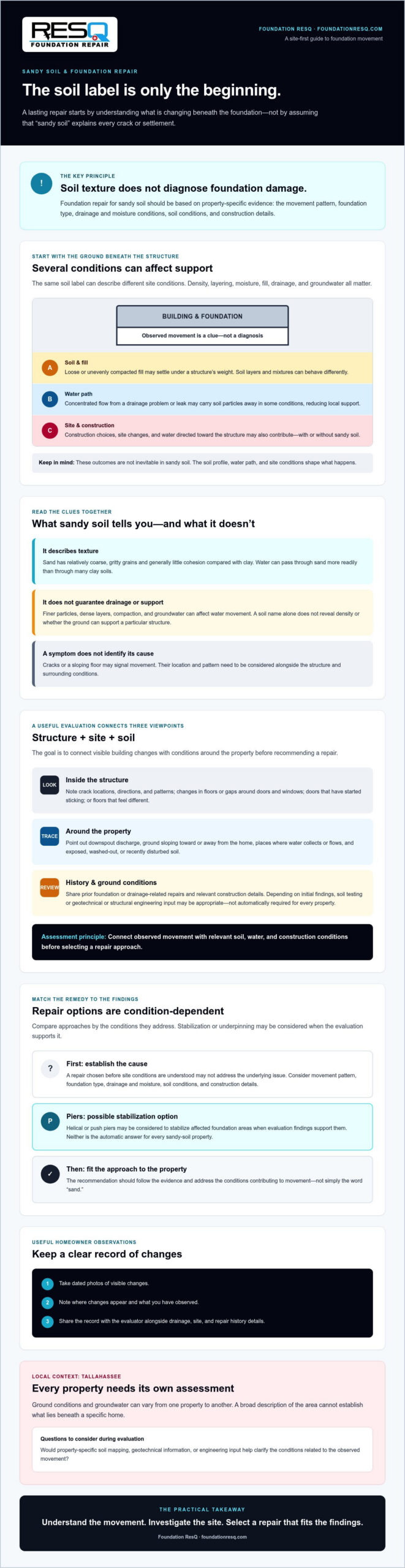
A sandy soil description alone can’t diagnose foundation damage. Sand is a soil texture, not a verdict on how well the ground beneath a particular home supports its foundation. Soil density, layering, moisture, construction history, and drainage all shape site performance. That’s why foundation repair for sandy soil should begin with evidence about the property, not an assumption based on a soil label.
What makes sandy soil different from other soil types?
Sand consists of relatively coarse mineral grains that feel gritty. Unlike clay, whose fine particles can stick together and change volume as moisture changes, clean sand generally has little cohesion. Water can pass through it more readily than through many clay soils, but grain size alone doesn’t guarantee good drainage. Finer particles, dense layers, compaction, and groundwater conditions can affect how water moves through a site.
Soil mechanics describes how soil responds to loads and environmental conditions. In practical terms, a soil’s name doesn’t reveal its density or its ability to support a particular structure. Natural ground, placed fill, and mixtures of sand with silt or clay may behave differently. Fill that wasn’t adequately compacted, or that varies across a building footprint, can provide uneven support. The principles of soil mechanics help explain why foundation performance depends on more than soil texture.
When can sandy soil contribute to foundation movement?
Movement may become a concern when support beneath part of a foundation changes. For example, loose or poorly compacted fill may settle under a structure’s weight. In some conditions, concentrated water flow from a drainage problem or leak may carry soil particles away, potentially leaving a local area with less support. These outcomes aren’t inevitable in sandy soil. They depend on the soil profile, water path, and site conditions.
Other factors can also contribute. Construction choices, site changes, and water directed toward the structure may play a role, whether or not sandy soil is present. A crack or sloping floor can signal movement, but neither identifies its cause on its own. Consider the location and pattern of symptoms alongside the structure and surrounding conditions.
Foundation repair decisions depend on site evidence, not soil labels alone. A careful assessment connects observed movement with relevant soil, water, and construction conditions before a repair approach is selected.
How soil, water, and site conditions are assessed beneath a home
A useful evaluation looks beyond an individual crack. It relates visible changes in the building to the ground around it, including how water moves across the property and whether the soil surface or nearby areas appear disturbed. This helps distinguish what a homeowner can observe from what requires professional diagnosis.
What should a foundation evaluation examine?
An evaluator may consider where cracks appear, their direction and pattern, and whether floors or gaps around doors and windows have changed. Share whether a door has started sticking or a floor feels different, but treat these as observations rather than proof of a particular cause.
Conditions outside matter too. Point out where downspouts release water, whether the ground slopes toward or away from the home, and where water tends to collect or flow. Note exposed, washed-out, or recently disturbed soil, along with prior foundation or drainage-related repairs. These details can help the evaluator consider possible connections without assuming that any single observation explains the movement.
A sound assessment connects the structure, the site, and the soil conditions before it recommends a repair. Depending on what the initial evaluation finds, soil testing or input from a geotechnical or structural engineer may be appropriate. These steps aren’t automatically required for every property. Their value depends on the questions that remain and the evidence available.
What local Tallahassee context should homeowners ask about?
Tallahassee is not one uniform ground condition. Soil and groundwater can vary from one property to another, so a broad description of the area can’t establish what lies beneath a specific home. Ask whether property-specific soil mapping, geotechnical information, or engineering input would help clarify conditions relevant to the observed movement.
Also ask whether grading, drainage patterns, or previous fill could be contributing factors at your address. If the property has been regraded, fill was placed near the home, or water consistently gathers in one area, share that history. It may help guide the evaluation, but it doesn’t establish a diagnosis by itself.
Before an assessment, make a brief record: take dated photos of cracks and other changes, note where they occur, and write down when you first noticed them. Include changes in drainage, water flow, or earlier repairs. This documentation supports a clearer discussion, but it doesn’t replace an on-site evaluation or determine whether foundation repair for sandy soil is appropriate.
For property-specific concerns in the Tallahassee area, homeowners can learn about Foundation ResQ’s foundation repair services and discuss whether a professional assessment may help identify the next step.
Which foundation repair approaches may fit sandy-soil conditions?
The right approach depends on what the evaluation finds: the type and location of movement, the structure, water conditions, and the soil supporting the affected area. No repair method should be prescribed from the word “sandy” alone. For foundation repair for sandy soil, the soil description is context, not a repair specification.
| Repair category | What it addresses | Evidence that may support consideration |
|---|---|---|
| Helical or push piers | Stabilization of supported foundation areas | Assessment findings indicate foundation movement and support conditions that justify pier installation. |
| Wall reinforcement | Reinforcement of a foundation wall | Wall condition and structural evaluation support reinforcement as part of the repair plan. |
| Concrete lifting | Uneven or sunken concrete | The affected concrete and its movement are assessed to determine whether lifting is appropriate. |
| Moisture management | Water or moisture conditions around or beneath the structure | Observed water patterns or crawl-space moisture are relevant to the site concerns. |
When might helical or push piers be considered?
Helical and push piers are foundation stabilization methods that may be considered when structural and site findings support them. They’re intended to stabilize the foundation areas they support, not to serve as an automatic fix for every home on sandy ground. A recommendation should account for the structure, the pattern of movement, installation access, and verified site conditions. Foundation ResQ offers both helical and push pier installation; suitability depends on professional findings.
How do moisture and drainage solutions fit the repair plan?
Structural stabilization and moisture management address different concerns. A pier may help stabilize a supported foundation area, while evaluating water flow may help identify conditions that could contribute to movement. Addressing water conditions doesn’t replace structural diagnosis, and stabilization alone may not resolve a separate moisture issue. Grading, downspout discharge, and water routing are useful assessment topics, but the appropriate response should follow site-specific findings.
For crawl spaces, moisture concerns may also call for a separate look at the space’s conditions. Crawl space encapsulation is one service category to discuss when that type of moisture issue is relevant, but it isn’t a substitute for foundation stabilization when structural movement is present.
Foundation ResQ provides foundation repair and structural stabilization in Tallahassee. To discuss a property-specific concern and possible next steps, explore Foundation ResQ foundation repair.
What homeowners can document before seeking sandy-soil foundation repair
Clear notes and dated photos can help an evaluator understand what has changed and where. You don’t need to determine whether sandy soil caused the issue. Focus on recording what you see and sharing relevant property history. These details can support an inspection, but they can’t replace a professional evaluation.
Which signs and site details should you record?
- Map visible changes. Note where cracks appear and photograph them with the date. Record changes in floor level, doors or windows that stick, and gaps you’ve noticed.
- Describe water patterns. Note where water pools or flows after rain, where downspouts discharge, and whether the ground near the home appears to have changed.
- Share property history. Include prior foundation repairs, drainage changes, landscaping work, or construction on fill if you know about it. Approximate dates can help put changes in context.
- Keep to observations. Write “water collects near the corner” rather than concluding that water caused a crack. Appearance alone can’t establish the cause.
Take photos from consistent viewpoints if you’re recording changes over time. Don’t wait for a long monitoring period before seeking an evaluation if you’re concerned. Documentation is useful context, not a substitute for assessment.
What questions should you ask during an inspection?
A useful conversation should explain how the recommendation follows from the findings. Ask the evaluator:
- What evidence connects the observed movement to soil, water, construction history, or another possible cause?
- What other explanations or repair approaches were considered, and why does the proposed approach fit the findings?
- What work is included, what are its limitations, and are there follow-up or maintenance expectations?
For foundation repair for sandy soil, a clear explanation should connect the property’s symptoms and site conditions to the recommended work, rather than relying on a broad soil description alone. If an answer isn’t clear, ask for it to be explained in plain language before deciding how to proceed.
Don’t dig beside the foundation or attempt structural repairs without qualified guidance. Unplanned digging or alterations could disturb the area further or create safety risks. If you’re in Tallahassee and have documented signs of movement, contact Foundation ResQ about foundation repair to discuss your concern and possible next steps.
How Foundation ResQ can help assess foundation concerns in Tallahassee
For a Tallahassee property owner, the next step isn’t to select a repair based on a soil description. It’s to discuss the building’s specific signs of movement and the conditions around it. Foundation ResQ provides foundation repair and structural stabilization for existing residential and commercial structures in Tallahassee. A professional evaluation can help connect site findings to a repair plan suited to the diagnosed concern.
What Foundation ResQ services may relate to foundation movement?
Foundation ResQ offers helical and push pier installation as foundation stabilization services. Either may be considered when the structure, observed movement, and site conditions support that approach. Neither is automatically the right choice because a property has sandy soil. The appropriate recommendation depends on professional findings about the issue and the affected foundation area.
For some foundation wall conditions, carbon fiber wall reinforcement may be relevant. It addresses a different structural concern and shouldn’t be presented as a general remedy for sandy soil. The key is matching the service to the diagnosed problem: a wall issue, movement requiring stabilization, or another condition may call for a different response. Ask how the proposed work relates to the evidence found at your property.
What is a practical next step for a Tallahassee homeowner?
Bring useful context to the conversation. Dated photos can show where cracks or other changes appear, while notes about when you noticed them can help describe their progression. Share known property history, such as earlier repairs, changes to drainage or landscaping, and construction on fill. Mention where water collects or flows near the building. These observations can inform a discussion, but they don’t establish the cause on their own.
If movement appears to be changing, or you’re unsure what is causing it, consider seeking a professional assessment rather than choosing a repair from the soil label alone. Ask for a clear explanation of how the findings support the recommended scope and whether other options were considered. A measured, site-specific discussion can help you understand the next step without assuming that every crack requires the same repair.
Foundation ResQ serves the Tallahassee area with foundation repair and structural stabilization. To discuss your property’s concerns and request an evaluation, Request a foundation evaluation.
Choose a repair plan grounded in your property’s conditions
Sandy soil alone can’t explain cracks or settlement, and it shouldn’t dictate the repair. The right foundation repair for sandy soil starts by connecting the structure’s movement with site conditions, water patterns, and construction history. Dated photos and clear notes can help an evaluator understand what you’ve observed, while professional findings guide whether stabilization or another approach fits.
Foundation ResQ provides foundation repair and structural stabilization in Tallahassee, including helical and push pier installation when supported by the property’s conditions. If movement is changing or its cause remains uncertain, a site-specific evaluation can help clarify a sensible next step. Request a foundation evaluation to discuss your property with Foundation ResQ.
With a careful assessment and a repair plan matched to the evidence, you can move forward with greater confidence in protecting your home.
Frequently Asked Questions
Can sandy soil cause a house foundation to settle?
Yes, sandy soil can contribute to settlement under certain conditions, but its presence alone doesn’t mean a foundation will move. Uneven or inadequately compacted fill, changing water conditions, or localized soil loss may affect support beneath part of a structure. Construction and drainage issues can also contribute. An evaluation should consider the building’s movement alongside site conditions before identifying a cause or recommending a repair.
Is sandy soil always a problem for a foundation?
No, sandy soil isn’t automatically a foundation problem. Soil performance depends on more than texture, including density, layering, water conditions, and how the site was prepared. Natural ground and placed fill may behave differently, and sandy soils vary from property to property. A foundation can perform well on sandy ground. The relevant question is whether evidence at the specific site points to changing or uneven support.
How can I tell whether sandy soil is affecting my foundation?
You can note possible signs of movement, such as new or changing cracks, uneven floors, sticking doors, or gaps, but those symptoms can’t identify sandy soil as the cause. Record where changes appear and when you noticed them. Also note water pooling, downspout discharge, and disturbed ground nearby. A qualified professional can compare these observations with the structure and site conditions to investigate possible causes.
What foundation repair works best for sandy soil?
There isn’t one repair that works best for every property described as sandy. The appropriate option depends on the foundation, movement pattern, water conditions, and verified site findings. Helical or push piers may be considered when the assessment supports stabilizing affected foundation areas. Other concerns may call for a different approach. For foundation repair for sandy soil, ask how the proposed method addresses the diagnosed issue.
Do homes on sandy soil need helical piers?
No, a sandy-soil description alone doesn’t mean a home needs helical piers. Helical piers are one foundation stabilization service that may be considered if structural and site findings support their use. The recommendation should account for the building, observed movement, access, and relevant ground conditions. A professional evaluation helps determine whether piers fit the situation or whether another response is more appropriate.
Can drainage problems make foundation movement worse in sandy soil?
They can contribute to conditions that affect foundation support, depending on the site. Concentrated water flow may carry soil particles away in some circumstances, while pooling water can indicate a drainage concern worth investigating. Neither observation proves the cause of movement. Have water patterns, downspout discharge, and grading considered as part of the evaluation. Addressing moisture conditions may complement structural work, but it doesn’t replace structural diagnosis.
When should I call a foundation repair professional in Tallahassee?
Consider contacting a professional if cracks or other signs of movement are changing, or if you can’t determine what’s causing them. Share dated photos, locations of symptoms, known repair or construction history, and observations about drainage. Foundation ResQ provides foundation repair and structural stabilization in Tallahassee, including helical and push pier installation when findings support those methods. A site-specific assessment can help clarify possible next steps.