
Replacement isn’t the only answer when a slab settles. Concrete lifting for HOA communities in Southwood can raise and stabilize concrete that remains structurally sound, while severely damaged slabs may need replacement. The right solution depends on the slab’s condition and what is happening beneath it.
Uneven sidewalks and shared paths can create trip hazards, while low spots may collect water or direct it toward buildings. A repair should address these concerns without replacing concrete that can still be preserved.
This guide explains how lifting works, from drilling small access holes to injecting material beneath the slab and patching the openings. You’ll also learn how to assess walkways across a community, what can shape the repair plan, and when insurance may cover the work. HOA boards and property managers can use these details to decide based on the concrete’s condition, not simply because it has settled.
Key Takeaways
- Assess whether a settled slab is still sound before choosing lifting or replacement; severe cracking can change the repair plan.
- Review uneven sidewalks and walkways for trip hazards, and note where water collects or flows toward buildings.
- Understand how drilling, injecting lifting material, and patching access holes can restore support beneath qualifying concrete.
- Insurance coverage depends on the cause of the movement and the policy, so storm-related damage may be treated differently from ordinary settling.
Is concrete leveling covered by insurance?
Concrete leveling is not typically covered by insurance, according to Angi. Coverage may be possible if a storm or natural disaster caused the shifting and the policy specifically covers that event. Before filing a claim, an HOA should document the cause, affected slabs, and visible damage. Policies may treat ordinary settling differently from sudden storm damage.
Polyurethane foam injection can lift and stabilize a settled slab that remains sound, while severely deteriorated concrete may need replacement. Expanding foam fills voids beneath the surface and raises the slab, preserving usable concrete and improving its appearance. A badly cracked slab may be too damaged to lift. In that case, replacement addresses damage injection cannot restore.
Concrete leveling and underpinning address different problems. Leveling raises a concrete surface, such as a sidewalk or patio. Underpinning supports a building foundation when the foundation itself needs stabilization. If a walkway has settled but the nearby structure remains stable, leveling may address the walkway. Movement in the foundation calls for a structural assessment. Surface repair does not resolve every underlying structural issue.
Does the Southwood HOA require approval before lifting or repairing concrete? The HOA’s governing documents and approval process determine whether shared-area work needs board authorization. The board can document the location and proposed scope before scheduling repairs.
What permits or inspections are required for concrete lifting in Southwood? Requirements depend on the project scope and applicable local rules in Tallahassee. Identify whether the work affects shared property or other regulated areas, then establish any permit or inspection requirements before work begins.
Who is responsible for concrete repairs in Southwood: the HOA or the homeowner? The governing documents and property boundaries determine responsibility. A shared sidewalk may fall under HOA maintenance, while a slab assigned to an individual lot may be the homeowner’s responsibility.
Which concrete lifting contractors serve the Southwood community? Choose a contractor that serves Southwood, assesses the slab’s condition, explains whether lifting or replacement is suitable, and outlines the repair scope. The board should compare proposals by location, cause of settlement, and remedy, not just surface appearance.
Trip-hazard repair for sidewalks and walkways
Uneven concrete can interrupt a sidewalk or walkway and create a trip hazard. A drop of an inch at an entryway, threshold, or driveway edge can also affect drainage.
Safety and Liability Concerns
Start by noting each raised edge, sunken section, and change in walking direction. For example, a height difference where a shared sidewalk meets a driveway deserves attention because residents may cross it often. Record the location and condition so the HOA can prioritize the route.
Trip hazards can raise safety concerns and potential liability questions for property owners or associations. Clear records of reported defects, inspections, and repair decisions help show how the HOA addressed a known issue. Keep the affected walkway visible and consider whether pedestrians can use another route while repairs are planned.
The key repair decision is whether the existing slab can be raised and stabilized or needs replacement. Leveling can address suitable settled sections without removing all the concrete. Severely cracked or deteriorated slabs may not be appropriate for lifting. An inspection should consider the slab’s condition, the height difference, and whether settlement directs water toward a building.
Reporting Sunken Sidewalks
Southwood residents can report a sunken sidewalk through the HOA’s management or board process and request approval before arranging work on shared property. Include the walkway’s location, the nearby building or entrance, and a clear description of the uneven section. Photos taken from the direction pedestrians approach can show how the edge meets the adjoining surface.
For a useful estimate, document the affected area and note whether the slab is cracked, settled, or holding water. The HOA can group reports by route and assess which locations need attention first. A written response can clarify whether the sidewalk is shared or assigned to a homeowner and which approval steps apply.
Where sidewalk sections are suitable for lifting, the repair can raise them to create a more even walking surface. The aim is to address the elevation change while preserving sound concrete, rather than replacing slabs simply because they have settled. The HOA should record the repaired location and check adjoining edges, including transitions where trip hazards might otherwise be overlooked.
Water and structural damage from settling slabs
A settled slab can affect more than the walking surface. In Southwood, tracing water movement and the cause of settlement helps an HOA plan a suitable repair.
Causes of Concrete Settlement
Water erosion can wash away soil beneath existing concrete, leaving voids that allow a slab to settle. Poorly compacted soil can compress over time, while tree roots may draw moisture from soil and cause it to shrink. Leaking water lines can add moisture and contribute to erosion.
For HOA properties, look for patterns across sidewalks, driveways, and shared paths. Roof runoff directed toward a driveway edge can soften the subgrade and wash away fine particles. If several nearby sections show movement, record their locations and drainage conditions together. This can help distinguish a local void from a broader problem beneath the community’s concrete.
Pool Deck Settlement
A pool deck requires attention to both slab movement and water flow. Check where water collects after use or rain, and whether uneven sections direct it toward nearby structures instead of away. A low area beside the pool may indicate settlement, while a gap or change in slope can help show where support beneath the deck has shifted.
For an HOA assessment, document the affected deck sections, adjoining walkways, and visible drainage paths. Compare those observations with nearby settled slabs. Lifting can restore support beneath suitable concrete, but the deck’s condition and the cause of movement determine the repair approach.
Drainage problems can extend beyond a single low spot. Uneven concrete may hold water or send runoff toward a building, creating moisture concerns. An HOA review should record pooling, the direction water travels, and whether nearby slabs are also sinking. At driveway edges, roof runoff can wash fine soil from beneath the concrete and leave unsupported areas.
Expanding foam injection can fill voids and support suitable slabs, while lifting raises settled areas. Mudjacking is another lifting method, but the underlying soil and moisture source still matter. If erosion continues, water may keep removing support beneath the repair area. Mapping affected slabs across the community helps prioritize work and identify drainage patterns to address alongside concrete repairs.
Concrete lifting process: drill, pump, and patch
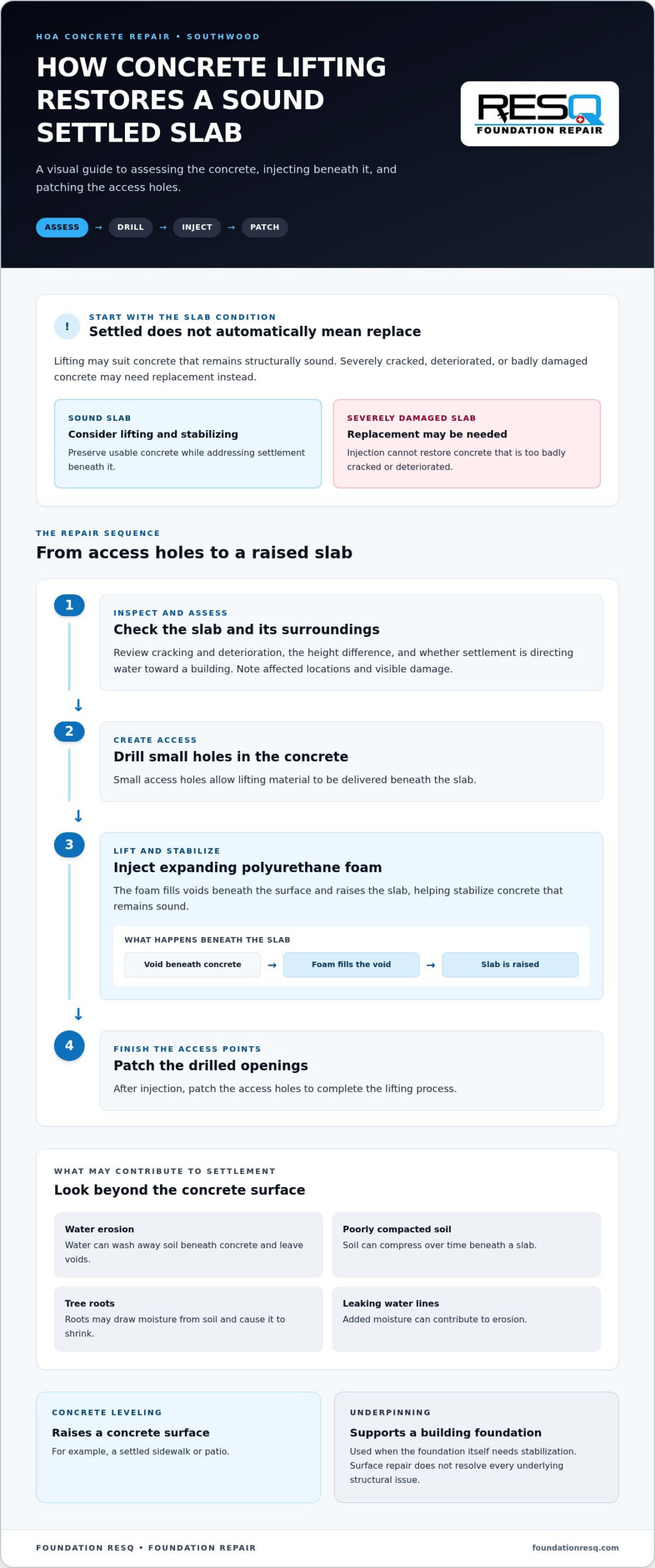
Concrete lifting restores support beneath a settled slab without removing sound concrete. For HOA sidewalks, patios, and driveways, the work has three main steps: drill access holes, inject lifting material beneath the slab, then patch the openings.
First, the crew assesses the slab and identifies where it has settled or lost support. Polyurethane foam injection uses small drilled holes to reach the spaces beneath existing concrete. Hole locations and quantity depend on the slab’s layout and the areas needing support. Cracked or severely deteriorated concrete may not be suitable for lifting.
- Drill: Access holes are placed through the slab at planned injection points. Their position gives the lifting material a path into voids beneath the sunken section.
- Pump: Polyurethane foam is injected below the surface. As the material expands, it fills voids and can raise the slab in controlled increments. Careful monitoring helps limit disruption to nearby concrete and residents.
- Patch: After the slab reaches the target position, the access holes are sealed. The repaired surface remains functional, and the foam cures quickly.
For HOA planning, identify nearby entrances, shared walkways, and driveways residents use during the work. A clear route plan can reduce disruption while crews access the affected slabs. Unlike replacement, lifting works with existing concrete, so the first question is whether the slab is sound enough to preserve.
How long does concrete lifting take, and when can residents use the repaired surface? Raising concrete with polyurethane foam often takes a couple of hours, and the slab is ready immediately upon completion. The actual work time depends on the repair area and the number of sections involved.
For a settled slab that may be suitable for lifting, request an assessment of the concrete to discuss the repair approach and affected areas.
Foundation ResQ: Foundation repair
Foundation ResQ provides foundation repair when movement affects a building, not just a sidewalk or walkway. If an HOA notices shifting near a structure, widening cracks, or recurring movement, an important next step is to distinguish a surface-level concrete issue from foundation movement.
For structural stabilization, Foundation ResQ offers helical pier and push pier installation as part of its foundation repair services. These options address foundation concerns rather than simply raising an exterior slab. If moisture has contributed to damage inside a property, Foundation ResQ also provides mold remediation that addresses both mold and its moisture source.
Share the location and visible signs with the board so it can identify whether the concern involves shared concrete, a building foundation, or both. Contact Foundation ResQ to discuss foundation repair for your community.
Plan the next step for your community
For an HOA, a useful next step is to turn scattered observations into clear repair priorities. Record affected locations, note whether movement is limited to concrete or appears near a building, and share the findings with the board. This gives the community a practical starting point for deciding what needs attention and who should coordinate it.
Concrete lifting for HOA communities in Southwood can be part of that plan when settled slabs remain suitable for repair. If signs point to movement in a building foundation, Foundation ResQ also provides foundation repair and helical pier installation. Where moisture has led to mold concerns, its Mold Remediation Services address the mold and moisture source.
Bring the location and nature of the concern to Foundation ResQ to discuss an appropriate next step for your property. Contact Foundation ResQ about your community’s concrete concerns. A thoughtful assessment can help your HOA move forward with a focused, property-specific plan.
Frequently Asked Questions
Does Every Settled Slab Need to Be Replaced?
No. A settled slab may be suitable for lifting if its concrete remains sound and can be stabilized. Replacement is generally more appropriate for slabs with extensive deterioration, broken sections, or damage that prevents reliable lifting. For example, a board reviewing a sunken patio should assess the slab’s condition across the area, not just the height difference at one edge.
THE BEST WAY TO REPAIR SUNKEN CONCRETE?
The right repair depends on why the concrete sank and whether the slab can be preserved. Lifting may suit a sound slab that has lost support underneath; replacement addresses concrete too damaged to retain. Before choosing, map the affected area, inspect for cracks, and note nearby drainage changes. This context helps match the repair to the actual problem rather than appearance alone.
What is the difference between Mudjacking and Polyurethane Concrete Raising?
Mudjacking pumps a cement-and-sand slurry beneath concrete, while polyurethane raising injects expanding foam through access holes. The materials differ in weight: mudjacking material averages 100 pounds per cubic foot, compared with about 2 pounds per cubic foot for the foam described here. That lighter material adds less pressure to soil, a relevant consideration where underlying support is already weak.
What’s the most affordable way to level a concrete floor?
Preserving a sound slab through leveling may be less expensive than removing and replacing it, while a severely damaged floor may not be a good candidate. The price depends on the slab’s condition, the repair area, access, and the method used; a project-specific quote sets the price. Compare the work needed to restore the existing floor with the scope of replacement.
What types of concrete lifting are available, such as polyurethane foam or mudjacking?
Common lifting methods include mudjacking and polyurethane foam injection. Mudjacking pumps a cement-based slurry beneath a slab; foam injection uses expanding polyurethane to fill spaces and support existing concrete. Both methods aim to raise settled sections, but the slab’s condition, the size and location of voids, and soil conditions influence which approach fits. Severely cracked concrete may need replacement instead.
Which Southwood sidewalks, driveways, patios, or pool decks commonly need concrete lifting?
Any Southwood sidewalk, driveway, patio, or pool deck may need attention if sections settle, separate from adjoining concrete, or develop uneven transitions. Concrete lifting for HOA communities in Southwood can address shared pedestrian routes and common-use slabs when the concrete remains suitable for lifting. Residents can help the board by identifying the exact location and describing how the surface is used.