What if the hairline cracks appearing in your living room are actually early warnings that the limestone beneath your feet is shifting? It’s a common concern for homeowners across the Sunshine State, where our unique geology often puts structural integrity at risk. When you start noticing these signs, your first thought is likely the cost of foundation repair in Florida and whether the fix will actually last. No one wants to pay for a temporary patch that fails a few years down the road.
We understand the anxiety that comes with seeing your largest investment under threat. It’s frustrating to face a problem you can’t see, especially when you’re worried about being overcharged for a solution you don’t fully understand. This article provides a clear path forward. You’ll learn how to distinguish between cosmetic fixes and permanent structural solutions, understand the variables that dictate professional pricing in 2026, and find a Tallahassee expert who prioritizes the long-term safety of your home.
Key Takeaways
- Identify how the severity of structural settlement and the selection of repair methods, like helical piers or PolyRenewal concrete lifting, determine the scope of your project.
- Gain a realistic perspective on the cost of foundation repair in Florida by exploring the variables that differentiate a cosmetic fix from a structural resolution.
- Learn how Florida’s limestone karst platform and Tallahassee’s red clay create unique challenges that require specialized local expertise to resolve permanently.
- Protect your home’s equity by understanding the high return on investment associated with foundation stabilization and the risks of delaying critical repairs.
- Discover the importance of prioritizing long-term structural health over temporary patches to ensure the safety and longevity of your property.
What Determines the Cost of Foundation Repair in Florida?
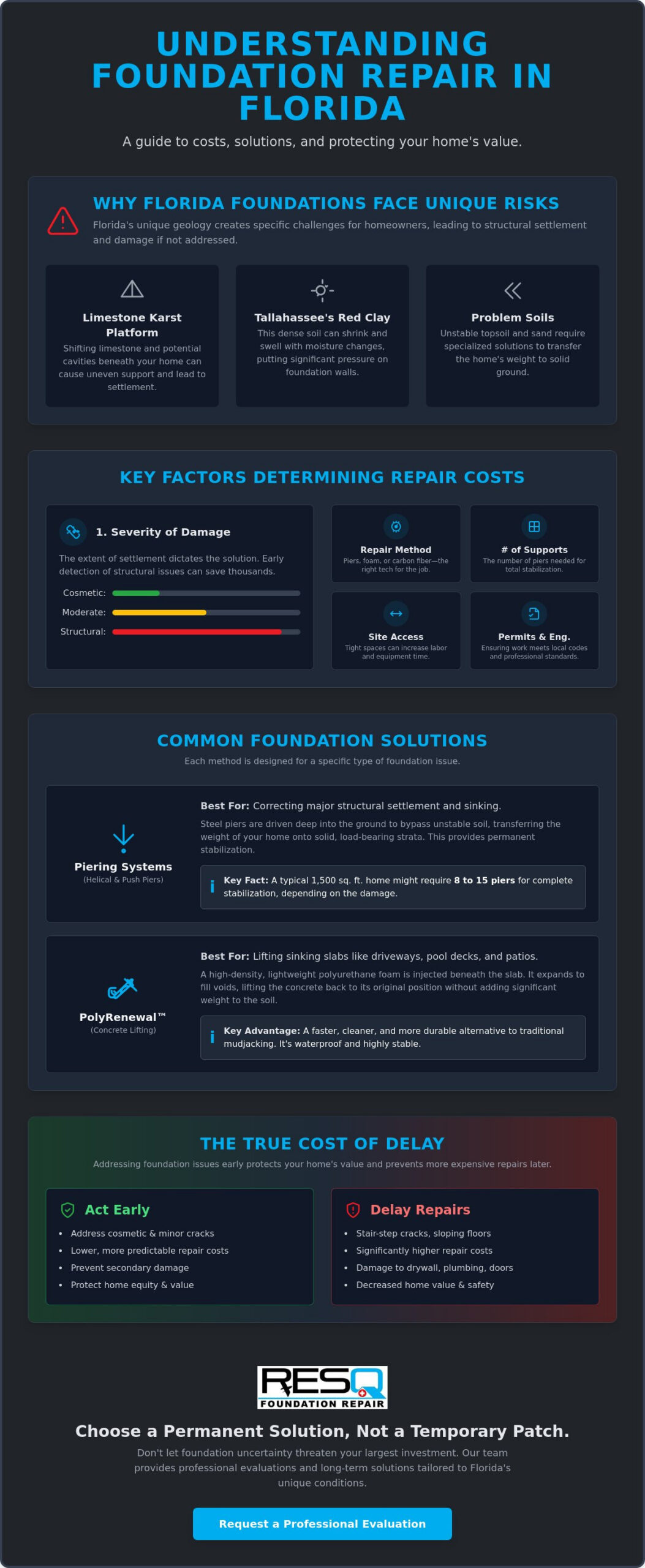
Every home functions as a unique structural system. This means the cost of foundation repair in Florida isn’t a fixed number but a calculation based on several physical variables. The primary driver is the degree of structural settlement your property is experiencing. When the soil beneath a slab can’t support the building’s weight, it leads to sinking that requires professional intervention. The specific remedy chosen, such as Helical Pier Installation or PolyRenewal concrete lifting, will align with the specific needs of your soil and structure.
The number of support points required is another critical factor. To achieve permanent stabilization, our team must calculate how many piers are needed to transfer the home’s weight to stable load-bearing strata. In Tallahassee, the local landscape often presents challenges. If your property has limited access due to narrow alleys or heavy foliage, the time and equipment needed for excavation will increase. These logistical details ensure the repair is performed safely and thoroughly without compromising the rest of your property.
The Severity of Structural Damage
Distinguishing between cosmetic flaws and structural failures is vital for budgeting. Small hairline cracks might only require minor monitoring, but stair-step cracks in your masonry are clear indicators of significant shifting. Internal failures, like floors that slope or doors that won’t latch, often suggest that the foundation has moved several inches. Catching these issues while they are still external can save you thousands of dollars in secondary repairs. Once the movement affects the interior finishes, cabinetry, and plumbing, the scope of the project expands significantly.
Labor and Equipment Mobilization
Stabilizing a home’s perimeter requires specialized hydraulic machinery and a highly trained crew. Mobilizing this equipment to your site involves careful planning, especially when navigating the dense red clay common in Leon County. We also account for the engineering and permitting requirements mandated by local building codes. These steps aren’t just bureaucratic hurdles; they are your guarantee that the stabilization is performed to the highest professional standards. Investing in proper engineering and deep-driven piers ensures a long-term solution that protects your home for decades.
Average Price Ranges for Common Foundation Solutions
The cost of foundation repair in Florida depends heavily on the specific technology required to address your home’s unique structural needs. While every project is different, understanding the primary categories of repair helps you budget for a permanent solution. For most homeowners, the choice comes down to deep-foundation piering, high-density polyurethane injection, or structural wall reinforcement. Each method offers a different level of stabilization based on the weight of the structure and the condition of the underlying earth.
Piering Systems: Helical and Push Piers
When a structure settles, Helical Pier Installation or Push Pier Installation provides a way to bypass unstable topsoil. Helical piers are particularly effective for lighter structures or new home additions because they are screwed into the ground. Push piers, however, use the weight of the house itself to drive steel tubes deep into the earth. The final depth required to reach stable strata is a major price factor. Because of Florida’s problem soils, piers often need to go deeper than in other states to find a secure anchor point. A typical 1,500-square-foot home might require anywhere from 8 to 15 piers to achieve full stabilization, depending on the severity of the localized settlement.
PolyRenewal Concrete Lifting and Leveling
For sinking pool decks, driveways, or interior slabs, PolyRenewal Concrete Lifting offers a highly cost-efficient alternative to full slab replacement. Unlike traditional mudjacking, which uses a heavy grout slurry, PolyRenewal utilizes a lightweight, waterproof foam. It’s a faster and cleaner process that doesn’t add significant weight to the soil. This durability makes it a smarter long-term investment for Florida homeowners dealing with shifting sands or limestone cavities. If you’re noticing uneven surfaces, you can request a professional evaluation to see if lifting is a viable remedy.
Carbon Fiber Wall Reinforcement
Carbon Fiber Wall Reinforcement is a low-profile, high-strength solution for structural integrity. It’s often used when crawl space or basement walls begin to bow inward due to hydrostatic pressure from the surrounding soil. Pricing for this method is generally lower than total wall reconstruction because it requires no exterior excavation. The straps are bonded directly to the wall, providing an incredibly strong barrier against further movement. This approach stabilizes the wall permanently without sacrificing interior square footage.
With your foundation’s structural integrity restored, you can begin to envision the possibilities for your lower level; for those interested in the financial side of finishing these spaces, BCR Basements offers a helpful calculator to estimate renovation costs.
Crawl Space Encapsulation also serves as a critical preventative cost-saving measure. By controlling moisture, you protect the wooden support beams from rot and mold, which can eventually lead to foundation failure. Investing in moisture control now prevents the need for much more expensive structural repairs in the future.
The Florida Variable: How Local Geology Impacts Your Quote
While national data provides a baseline for the average cost to repair a house foundation, Florida residents face geological factors that shift quotes significantly. Our state sits on a limestone platform that is notoriously porous. This geology, combined with high water tables, creates a unique set of challenges for structural stabilization. In Tallahassee, we often deal with clay that behaves differently than the sandy soils found along the coast. This regional variation is why a local assessment is vital. It’s the difference between a professional remedy and a temporary guess.
The high water table in our region also impacts the longevity of your home’s support system. Excess moisture in a crawl space leads to wood rot in support beams, which often mimics the symptoms of foundation settlement. By addressing the root cause with a Sump Pump System or Crawl Space Encapsulation, we protect the structural integrity of the home from the ground up. This comprehensive approach ensures that you aren’t just treating a symptom but securing the entire building against Florida’s volatile environmental conditions.
North Florida Soil Conditions
Tallahassee is known for its “Red Clay,” which is an expansive soil. These clays act like a sponge; they swell when it rains and shrink during our dry spells. This constant volume change puts immense pressure on your foundation walls. Over time, the soil can even erode from beneath a slab after heavy tropical storms, leaving a void that causes the concrete to crack. Because these conditions are localized, a standard pier depth might not reach the stable soil needed to support your home. We prioritize finding the exact load-bearing strata to ensure your repair remains permanent and reliable.
Sinkhole Activity and Karst Topography
Karst topography refers to the limestone cavities that exist deep underground throughout the state. These hidden voids are the primary cause of sudden settlement or sinkhole activity. When calculating the cost of foundation repair in Florida, the presence of karst features often requires deeper piering to ensure the structure is anchored to solid rock rather than a hollow pocket. This level of precision requires a contractor who understands how to interpret local geological data. At Foundation ResQ, we analyze these environmental factors to provide a quote that reflects the actual depth and material required for your specific property.
The True Cost of Delay: ROI and Home Value Protection
Delaying a foundation project is often the most expensive decision a homeowner can make. What begins as a minor settlement crack can evolve into a massive structural failure if left unaddressed. The cost of foundation repair in Florida compounds over time because the underlying geological instability doesn’t resolve itself. Every inch of further settlement strains other critical systems in your home, leading to a cascade of secondary repairs that extend far beyond the concrete slab. Stabilizing the structure early is a matter of protecting your largest financial asset from preventable depreciation.
Investing in a permanent remedy is almost always more cost-effective than a series of temporary “quick fixes.” While a cosmetic patch might hide a crack for a season, it doesn’t stop the house from sinking. Over several years, the cost of reapplying patches and fixing recurring drywall cracks can exceed the price of a structural solution. Modern financing options help bridge this gap, making permanent stabilization accessible and preventing the need for much more invasive reconstruction later.
Impact on Real Estate and Resale Value
Florida’s Real Estate Disclosure Act requires sellers to be transparent about known structural issues. You can’t hide foundation problems under a new layer of carpet or fresh paint. Most buyers will walk away from a home with uncertified structural concerns, or they’ll demand a price reduction that far exceeds the actual cost of the repair. Providing a transferable warranty for a permanent solution like Push Pier Installation gives potential buyers the peace of mind they need to proceed. For a deeper look at how these repairs affect your property’s worth, see our Professional Foundation Repair in Tallahassee: A Guide for 2026.
Preventing Secondary Structural Damage
A shifting foundation acts as a slow-motion earthquake for the rest of your house. As the perimeter settles, it pulls on the wall studs, which warps door frames and shatters window seals. These gaps allow conditioned air to escape and moisture to enter, driving up utility bills and inviting pests. Even more concerning is the strain on plumbing lines; a few inches of movement can snap PVC pipes under your slab, leading to hidden water damage. Choosing a structural remedy now prevents these expensive complications. You can schedule a structural assessment to identify these risks before they become emergency repairs.
Crawl Space Encapsulation also plays a vital role in long-term protection. By sealing out Florida’s humidity, you prevent the floor joists from sagging and eliminate the environment where mold thrives. This proactive step saves you from the high costs of mold remediation and wood replacement, ensuring the entire structural system remains dry and durable for decades.
Choosing Permanent Solutions with Foundation ResQ
When you address the cost of foundation repair in Florida, you’re making a choice between a temporary fix and a permanent remedy. At Foundation ResQ, our approach centers on long-term structural health. We don’t believe in cosmetic patches that only mask the symptoms of settlement. Instead, we focus on the underlying cause of the instability to ensure your home remains safe and level for decades. Our team combines technical precision with a deep sense of duty toward the families we serve in the Tallahassee community.
Our local roots are a significant advantage for homeowners. Because we understand the specific behaviors of North Florida’s expansive clay and the risks posed by karst topography, we don’t rely on guesswork. We pair this regional specialized knowledge with a commitment to industry-leading engineering standards and professional certifications. This ensures you receive the most advanced stabilization technologies available while maintaining the approachable, neighborly service you expect from a local business. You receive the protection of professional-grade resources delivered by experts who live and work in your own backyard.
Our Specialized Stabilization Methods
We utilize a variety of proven structural solutions to restore your property’s integrity. Each method is selected based on the specific requirements of your building’s weight and the condition of the soil strata beneath it. Our stabilization toolkit includes:
- Helical and Push Pier Installation: These systems provide high-capacity support by transferring the building’s load to stable soil or bedrock deep underground.
- PolyRenewal Concrete Lifting: We use this waterproof, high-density foam to restore safety and level surfaces to sinking driveways, pool decks, and interior slabs.
- Crawl Space Restoration: Beyond the foundation, we improve air quality and structural health through crawl space encapsulation Tallahassee homeowners trust for long-term moisture control.
Start Your Home’s Recovery Today
The first step toward a stable home is a professional, no-obligation structural evaluation. During this inspection, our experts examine your property’s perimeter, interior walls, and soil conditions to identify the root cause of any shifting. We then provide a customized repair plan tailored to the specific needs of your home and your budget. This methodical process ensures you have all the information necessary to make an informed decision about your property’s health. Don’t wait for minor cracks to become major structural failures. Schedule your free foundation inspection with Foundation ResQ today and secure the future of your home.
Securing Your Home’s Structural Future
Choosing to stabilize your property is a significant step toward long-term peace of mind. By evaluating the cost of foundation repair in Florida through the lens of permanent solutions rather than temporary patches, you protect your home’s value and prevent the compounding expenses of secondary structural failure. Whether you’re dealing with Tallahassee’s expansive red clay or the hidden risks of karst topography, addressing settlement early ensures your building remains a safe and stable asset for your family.
Foundation ResQ provides the technical expertise and specialized local knowledge required to defend your home against Florida’s unique environmental pressures. Our certified structural experts use proven stabilization methods and offer transferable lifetime warranties that instill confidence in any future homeowner. You don’t have to face structural uncertainty alone; professional help is available to restore the integrity of your foundation and protect your investment for decades to come.
Get a Free Foundation Repair Estimate for Your Tallahassee Home to begin your property’s recovery. We’re ready to help you implement a structural remedy built to last.
Frequently Asked Questions
How much does a typical foundation repair cost in Florida?
The total cost of foundation repair in Florida is determined by the specific scope of the structural damage and the stabilization method required. Variables such as the number of piers needed to reach load-bearing strata and the accessibility of the site for hydraulic equipment play a major role in the final quote. Every property requires a unique calculation to ensure the remedy provides a permanent resolution rather than a temporary patch.
Does Florida homeowners insurance cover foundation repair?
Standard homeowners insurance policies in Florida typically do not cover foundation repairs caused by normal settlement or earth movement. However, coverage may be available if the damage is the direct result of a covered peril, such as a confirmed sinkhole, provided you have the appropriate riders. It is best to review your specific policy details with your insurance provider to understand your protection against geological events.
Is it worth fixing a foundation on an older Florida home?
Fixing the foundation of an older home is a vital investment that preserves the building’s structural integrity and long-term market value. Structural settlement in older properties often leads to cascading issues like roof leaks and plumbing failures that are much more expensive to remediate later. A professional stabilization project ensures the home remains a safe and durable asset for decades to come.
How long does a foundation repair project take to complete?
Most residential foundation stabilization projects are completed within two to five days, depending on the number of support points required. Methods like PolyRenewal concrete lifting can often be finished in a single day with minimal disruption to your property. Larger projects involving deep piering or extensive crawl space work may require more time for precise installation and structural testing.
What happens if I ignore foundation cracks in my Florida home?
Ignoring foundation cracks allows minor structural issues to compound into significant failures that threaten the safety of the entire building. Over time, shifting foundations cause warped door frames, shattered window seals, and broken underground plumbing lines. Early intervention with a professional remedy is the most cost-effective way to prevent these secondary damages from devaluing your investment.
Can I sell a house in Florida with foundation problems?
You can sell a house with foundation issues, but the Florida Real Estate Disclosure Act requires you to be transparent about these known defects; for those navigating the legal complexities of property transactions and business law, check out Matthew Fornaro, P.A.. Unaddressed structural problems often lead to lower offers or cause potential buyers to lose financing. Providing documentation of a certified repair backed by a transferable warranty makes your home much more competitive in the local real estate market.
What is the difference between helical piers and push piers for Florida soil?
Helical piers are screwed into the ground and are ideal for stabilizing lighter structures or new additions without needing the weight of a building for installation. Push piers use the actual weight of the house to drive steel tubes deep into the load-bearing strata. Both methods are effective in Florida’s diverse soil, though the choice depends on the specific structural load of your home.
How does crawl space encapsulation affect my home’s overall value?
Crawl space encapsulation increases your home’s value by creating a permanent barrier against Florida’s high humidity and soil moisture. This process protects the wooden support system from rot and mold while improving the building’s overall energy efficiency. Prospective buyers view a dry, encapsulated crawl space as a sign of a well-maintained and structurally sound property.