
Did you know that up to 50 percent of the air circulating through your living room actually originates in your crawl space? In a climate where humidity regularly exceeds 80 percent, Florida homeowners often feel caught between the fear of mold and the reality of a rising electric bill. It’s common to worry that a unit running constantly will drain your bank account, especially with 2026 residential energy rates averaging between 15.2 and 16 cents per kilowatt-hour. Finding the balance between structural protection and monthly affordability is a priority for every responsible property owner.
We understand that you want a protected home without the mystery of unpredictable monthly expenses. This guide provides a clear breakdown of the cost to run dehumidifier in crawl space Florida properties, offering exact monthly estimates and maintenance expectations. You’ll discover how professional moisture control acts as a stabilizer for your home’s integrity and why the right setup can actually lower your overall energy consumption by about 15 percent. We will also examine the long-term ROI of preventing structural decay and how these systems serve as a final line of defense for your foundation.
Key Takeaways
- Understand how Florida’s high humidity and current 2026 energy rates impact the daily runtime and overall electricity consumption of your unit.
- Learn the specific mathematical formula to calculate your monthly bill based on the wattage and efficiency of professional-grade versus retail dehumidifiers.
- Discover why full encapsulation is the most effective way to lower the cost to run dehumidifier in crawl space Florida homes by creating a controlled, dry environment.
- Identify the recurring maintenance tasks, such as filter replacements and professional inspections, that prevent expensive mechanical failures.
- See why professional sizing and integrated drainage are critical to ensuring your system provides long-term structural protection without wasting energy.
Understanding Crawl Space Dehumidifier Operating Costs in Florida
Calculating the total expense of moisture control involves more than just the initial purchase price. For a Florida homeowner, operating costs are a combination of monthly electricity usage, routine maintenance, and periodic filter replacements. In our specific region, these variables are influenced heavily by the local environment. While a unit in a drier state might cycle on only occasionally, the cost to run dehumidifier in crawl space Florida is tied directly to our near-constant high humidity levels. Understanding these factors helps you plan for long-term home protection without being surprised by your utility bill.
The relationship between relative humidity (RH) and energy consumption is straightforward. When the air under your home contains more water vapor, the dehumidifier’s compressor and fan must operate for longer durations to extract that moisture. This increases your kilowatt-hour (kWh) consumption. Because Florida humidity often exceeds 80 percent, a unit here may run significantly more hours per day than the national average. Standard retail models often struggle with this workload. They aren’t designed for the continuous operation required in a Tallahassee crawl space, which often leads to higher energy waste and premature mechanical failure compared to professional-grade systems.
Why Crawl Spaces in Tallahassee Require Specialized Units
North Florida presents a unique set of psychrometric challenges. Our crawl spaces often stay cooler than the outside air, but they remain saturated with moisture from the surrounding soil. How dehumidifiers work involves using cooling coils to condense water out of the air, but in a damp crawl space, the equipment must be rugged enough to handle high-volume water extraction without freezing or short-cycling. Relative Humidity is the percentage of water vapor present in the air relative to the maximum amount the air could hold at that specific temperature, and it serves as the primary trigger for your unit’s operation. Specialized units are built with heavy-duty components that maintain efficiency even when the environment is punishing.
The High Cost of Doing Nothing
It’s helpful to view the monthly operating cost as an insurance policy for your home’s skeleton. When moisture is left unmanaged, the financial consequences escalate quickly. Homeowners who skip dehumidification often face a high cost of mold remediation in crawl space later on, which far exceeds the annual cost of electricity. Beyond mold, consistent moisture leads to wood rot and structural instability in your floor joists. There is also a hidden impact on your primary living space. Damp air from the crawl space eventually migrates upward, forcing your main HVAC system to work harder to remove humidity from your bedrooms and kitchen, which drives up your overall household energy spend.
Calculating Your Monthly Electric Bill Impact
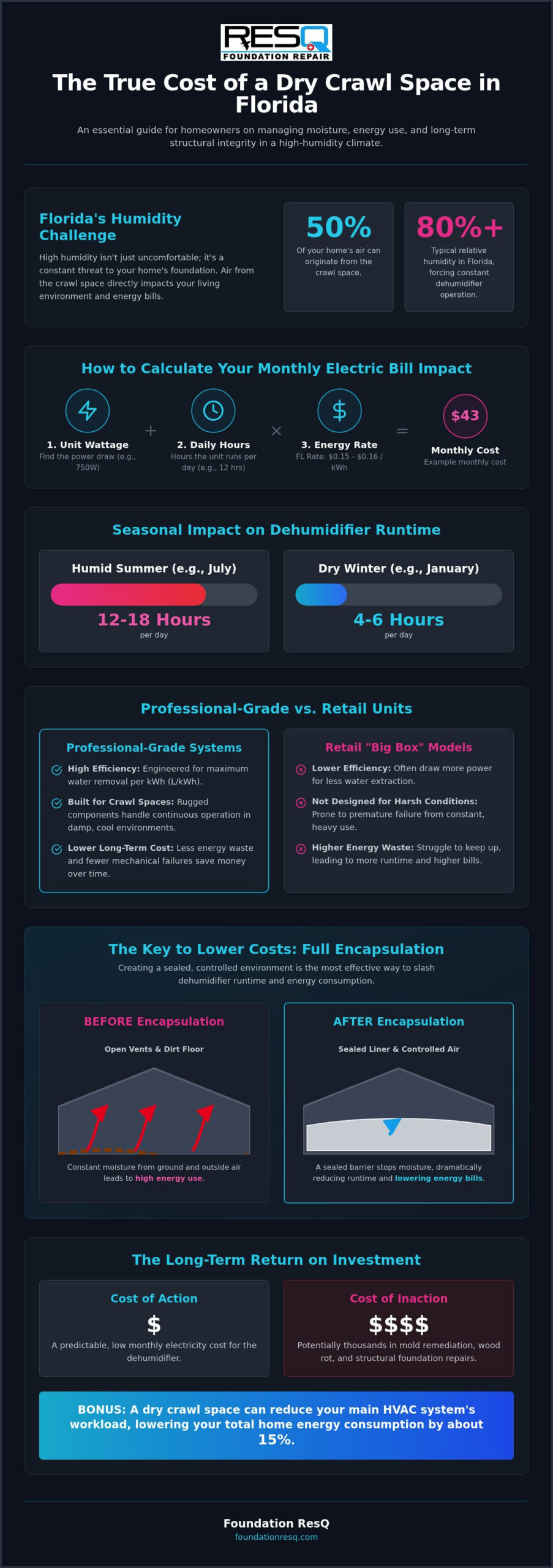
Understanding the exact math behind your utility bill helps remove the uncertainty of home maintenance. To find the daily cost, you multiply the unit’s wattage by the number of hours it runs, then divide by 1,000 to find the kilowatt-hours (kWh). In Tallahassee, where 2026 residential rates hover between 15.2 and 16 cents per kWh, this calculation is vital for budgeting. While a retail “big box” model might seem cheaper initially, these units often have higher power draws relative to their water extraction capacity. Professional-grade units are engineered to move more air while drawing fewer watts, which directly impacts the cost to run dehumidifier in crawl space Florida residents pay each month.
Seasonal fluctuations also play a major role in your energy expenses. During a humid July, your unit may run for 12 to 18 hours a day to combat the heavy moisture in the air. In contrast, a drier January might only require 4 to 6 hours of operation. This means your bill will naturally peak during the summer months when the Florida atmosphere is most saturated. By tracking these cycles, you can better predict your annual maintenance budget and ensure your system remains a stable protector of your home’s structural integrity.
Energy Star Ratings and Efficiency
Efficiency in 2026 is measured by the Liters per Kilowatt-hour (L/kWh) metric, which defines exactly how many liters of water a unit can remove from the air for every one kWh of electricity consumed. Energy Star certified units are designed to exceed baseline standards, often removing significantly more moisture than non-certified counterparts. Investing in a high-efficiency model serves as a protective measure for your finances. Over the lifespan of the equipment, the energy savings typically offset the higher initial investment compared to power-hungry, entry-level models.
Estimated Monthly Cost Breakdown
The square footage of your crawl space and the local Tallahassee humidity peaks dictate how hard your unit must work. An open-vented crawl space forces the unit to treat the entire Florida atmosphere, leading to much higher cycles and increased wear on the components. If you’re looking for ways to stabilize these costs, exploring crawl space encapsulation in Tallahassee can create a dry envelope that significantly reduces the workload on your equipment.
| Usage Scenario | Estimated Monthly kWh | Estimated Monthly Cost (at $0.16/kWh) |
|---|---|---|
| Low Usage (Encapsulated) | 60 – 90 kWh | $9.60 – $14.40 |
| High Usage (Vented) | 180 – 300+ kWh | $28.80 – $48.00 |
As the table suggests, the difference in operating costs between a sealed and unsealed space is substantial. A properly sized unit in an encapsulated environment runs only when necessary, maintaining a consistent humidity level without constant power draw. This methodical approach to moisture control ensures your home remains protected while keeping your monthly utility impact manageable and predictable.
Why Encapsulation is the Key to Lower Running Costs
Many Florida homeowners believe that vents allow a crawl space to “breathe.” This is known as the open vent fallacy. In our subtropical climate, vents act as open gateways for heavy, moisture-laden air to flood your home’s foundation. When you run a unit in an unsealed environment, the cost to run dehumidifier in crawl space Florida properties can skyrocket. This happens because the machine is essentially trying to dehumidify the entire external atmosphere. By sealing these openings, you create a controlled environment where moisture is managed rather than invited.
Professional crawl space encapsulation Tallahassee solves this issue by creating a “dry envelope.” This barrier transforms the space below your home into a conditioned zone. Instead of running for 18 or more hours a day, a unit in an encapsulated space typically cycles for only 4 to 6 hours. This drastic reduction in run-time is the primary driver of long-term savings. Furthermore, a dry crawl space offers secondary savings for your primary HVAC system. Because dry air is easier to cool than damp air, your upstairs air conditioner doesn’t have to work as hard to maintain a comfortable temperature.
Vapor Barriers and Air Sealing
A 20-mil vapor barrier provides a heavy-duty shield that stops ground moisture from evaporating into your crawl space air. This protection is bolstered by sealing the rim joists, which prevents Tallahassee’s humid air from seeping through the wooden perimeter of your foundation. The energy ROI of this system is measurable and immediate. Industry data shows that encapsulation can reduce overall household energy bills by approximately 15 percent by stabilizing the environment beneath your floorboards. This makes the initial investment a methodical step toward permanent structural health and lower monthly overhead.
Dehumidifier Run-Time Comparison
The difference in operation between vented and encapsulated spaces is stark. In a vented scenario, your dehumidifier is in a constant struggle against an infinite supply of outdoor moisture. In an encapsulated scenario, the unit only manages a fixed volume of trapped air. The “Stack Effect” is the natural process where air warms and rises through your home, creating a vacuum that pulls damp, unconditioned air from the crawl space up into your bedrooms and kitchen. Sealing the crawl space stops this upward pull, protecting your indoor air quality while ensuring your dehumidifier only runs when absolutely necessary.
Beyond Electricity: Maintenance and Long-Term Expenses
Managing the cost to run dehumidifier in crawl space Florida requires a long-term perspective on mechanical upkeep. While your monthly electric bill is the most visible expense, the durability and efficiency of your system depend on consistent maintenance. In our subtropical environment, units process thousands of gallons of water annually. This heavy workload makes routine service a necessity rather than an option. A neglected unit loses efficiency quickly, leading to higher power consumption and eventually causing the compressor to burn out prematurely.
Filter management is the simplest way to protect your investment. Most professional systems use MERV-8 filters to trap dust and debris, while some homeowners opt for HEPA filters to capture smaller mold spores and allergens. In a Florida crawl space, these filters typically require replacement every six to twelve months. Another critical component is the condensate pump. This small motor is responsible for moving extracted water out of your foundation. If algae or sediment clogs the drainage line, the pump can fail, leading to water pooling inside your crawl space and potentially damaging the dehumidifier itself.
The lifespan of your equipment is a major factor in your total cost of ownership. Retail models found in big-box stores are generally designed for basement use in cooler climates and often fail within three to five years when subjected to Florida’s humidity. In contrast, professional-grade units are built with corrosion-resistant coils and heavy-duty components, typically lasting 10 to 15 years. While the initial investment for a professional unit is higher, the extended lifespan and lower frequency of repairs make it the more dependable choice for protecting your home’s structural integrity.
The Annual Maintenance Checklist
A professional inspection once a year ensures your system operates at peak performance. This methodical approach identifies small issues before they become expensive failures. A standard checklist includes:
- Drainage Line Inspection: Clearing clogs or algae growth to ensure water exits the home properly.
- Humidistat Calibration: Verifying that the sensor accurately reads the air’s moisture level to prevent unnecessary run-time.
- Coil Cleaning: Removing dust from the heat exchange coils to maintain the unit’s ability to condense water efficiently.
Repair Costs vs. Replacement
Even the best equipment eventually faces wear on fan motors or sensors. When a unit reaches the end of its lifespan, you must decide between a repair and a full upgrade. Modern 2026 models often feature improved energy efficiency that makes replacement a more stable financial choice than patching up an aging machine. Professional installation also brings the benefit of labor warranties, providing a protective barrier against unexpected costs. If you’re concerned about the current health of your system, you can schedule a professional crawl space inspection to evaluate your equipment’s performance.
Maximizing Efficiency with Professional Tallahassee Installation
The efficiency of your moisture control system depends heavily on the precision of the initial setup. A common mistake is selecting a unit based solely on square footage without considering the specific volume and humidity load of a North Florida crawl space. Proper sizing is the first step in managing the cost to run dehumidifier in crawl space Florida residents face. An under-sized unit will run 24/7 as it struggles to reach the target humidity, leading to early mechanical burnout. Conversely, an over-sized unit will short-cycle, turning on and off so frequently that it never effectively removes moisture from the air and puts unnecessary strain on the compressor.
Integrated drainage is another critical factor for long-term dependability. A dehumidifier shouldn’t just collect water; it must move that water away from your foundation permanently. Professional installation ensures that drainage lines are positioned correctly to avoid conflicts with other systems, such as sump pumps. When these systems work in tandem, they prevent bulk water from evaporating into the air, which reduces the workload on your dehumidifier. Foundation ResQ optimizes the placement of each unit to ensure maximum airflow throughout the entire crawl space, which allows the sensors to read the environment accurately and minimize power draw.
Moisture control is often the final piece of a larger structural health plan. If your home has already experienced settling or joist rot due to years of high humidity, combining dehumidification with professional foundation repair in Tallahassee provides a total solution. Addressing the structural damage while simultaneously removing the cause of the decay creates a protective barrier for your property. This methodical approach ensures that your home remains stable and dry for decades to come.
The Foundation ResQ Solution
Our team develops customized moisture control plans that account for the specific soil conditions and climate challenges of the Tallahassee area. We don’t believe in a one-size-fits-all approach. By integrating our dehumidifiers with advanced Sump Pump Systems, we handle bulk water before it has a chance to impact your humidity levels. As part of the Groundworks network, we provide the peace of mind that comes with established local expertise and industry-leading warranties. This ensures your investment is protected by a company that understands the regional environment.
Taking the Next Step for Your Crawl Space
The most effective way to determine your home’s specific needs is through a professional evaluation. We offer a free inspection to assess your crawl space and provide a clear path toward a dry, healthy environment. We also provide financing options to make encapsulation and professional dehumidification accessible for every homeowner. A dry home is not just a more comfortable place to live; it’s a more valuable and structurally sound asset. Taking action now prevents the high costs of future remediation and ensures your monthly utility expenses remain predictable and manageable.
Securing Your Home’s Future and Financial Health
Managing the humidity beneath your home is a methodical process that pays dividends in structural stability and air quality. The key to keeping expenses low is creating a controlled environment through encapsulation, which allows your unit to work efficiently rather than fighting the entire Florida climate. By choosing professional-grade equipment and committing to annual maintenance, you ensure that your moisture control system remains a dependable protector of your foundation for decades.
Understanding the long-term cost to run dehumidifier in crawl space Florida homes is the first step toward a more durable property. While electricity and maintenance are ongoing factors, they are small investments compared to the high stakes of structural decay. You don’t have to navigate these technical choices alone.
As Tallahassee’s local moisture control experts, we provide Groundworks-backed permanent solutions that offer lasting peace of mind. Protect your home from Florida humidity—Schedule your Free Inspection with Foundation ResQ today! We’re ready to help you evaluate your specific needs with a free, no-obligation crawl space inspection. Your property deserves the highest level of protection, and we’re committed to helping you maintain a healthy, stable home.
Common Questions About Dehumidifier Operating Costs
Is it expensive to run a dehumidifier in a Florida crawl space?
Operating a unit is generally affordable, especially when compared to the high costs of structural repairs or mold remediation. In Tallahassee, with 2026 residential rates averaging around 16 cents per kWh, a unit in an encapsulated space might only cost $10 to $15 monthly. The cost to run dehumidifier in crawl space Florida properties is mostly a reflection of how well the space is sealed. If the crawl space remains open to the elements, costs rise significantly because the unit never stops running.
Should I run my crawl space dehumidifier 24/7 in Tallahassee?
You should leave the unit powered on at all times, but it shouldn’t actually run 24/7. The device uses an internal humidistat to monitor air moisture levels. It cycles on when levels exceed your target and shuts off once the air is dry. In a properly sealed Tallahassee crawl space, the unit may only operate for 4 to 6 hours daily. Leaving it on ensures that humidity spikes don’t lead to wood rot or mold growth during our humid afternoons.
How much does a crawl space dehumidifier add to my electric bill monthly?
For most Tallahassee homeowners with encapsulated crawl spaces, the addition is between $10 and $20 per month. This estimate is based on current 2026 residential utility rates of about 15.2 to 16 cents per kWh. High-efficiency, professional-grade models use less power than older retail units to move the same volume of air. If your crawl space is vented, the machine will work much harder to combat Florida’s 80 percent outdoor humidity, which could double those monthly operating costs.
What happens if I turn off my crawl space dehumidifier during the winter?
Turning off your unit in the winter is risky because Florida’s “dry” season still sees humidity levels high enough to support mold growth. While our winters are cooler, Tallahassee often experiences humid rainy spells. Without active dehumidification, moisture can accumulate in the soil and wood joists. It’s better to let the unit’s humidistat decide when to run. If the air is naturally dry, the unit won’t cycle on, so you won’t waste any electricity anyway.
Does a dehumidifier in the crawl space help lower my AC bill?
Yes, a dry crawl space can reduce your overall household energy bills by approximately 15 percent. Damp air from the crawl space naturally rises into your living areas through the “stack effect.” This forces your primary air conditioner to work much harder to remove humidity from your home’s interior. By drying the air at the source, your AC runs more efficiently. This helps offset the cost to run dehumidifier in crawl space Florida homeowners pay on their utility bills.
How long does a professional-grade crawl space dehumidifier last in Florida?
A high-quality, professional-grade unit typically lasts between 10 and 15 years with proper maintenance. These systems are built with corrosion-resistant coils specifically for the punishing North Florida climate. Retail models designed for basements often fail in just 3 to 5 years because they aren’t equipped for constant high-volume water extraction. Choosing a durable unit installed by local experts ensures long-term protection for your foundation and reduces the frequency of expensive equipment replacements.
Can I use a regular room dehumidifier in my crawl space to save money?
You shouldn’t use a standard room dehumidifier because it isn’t designed for the unique environment of a crawl space foundation. Retail units lack the necessary airflow capacity and durability to handle Tallahassee’s high soil moisture. They also lack integrated drainage pumps, meaning they’ll shut off as soon as a small internal bucket fills up. In the long run, these cheaper models cost more because they burn out quickly and fail to prevent structural decay or mold growth effectively.
What is the ideal humidity level for a Florida crawl space?
The target relative humidity for a crawl space is between 50 and 55 percent. Mold generally begins to grow when humidity levels stay above 60 percent for extended periods. In Tallahassee, outdoor humidity is frequently above 80 percent, so maintaining this lower internal target is critical. Keeping the air in this range protects your floor joists from wood rot and ensures the air rising into your home is healthy and dry for your family.