
Foundation heave is often repairable, but the right fix depends entirely on what is pushing the foundation up in the first place. If you see new cracks, doors that suddenly stick, or floors that slope, stop any obvious water source near the foundation, photograph the damage with dates, and arrange a professional diagnosis before paying for any structural repair.
TL;DR:
- Most heave repair efforts should focus on correcting moisture issues first, such as grading and drainage improvements, before considering structural solutions.
- Accurate diagnosis involves elevation surveys, crack mapping, and soil testing to identify whether active heave or past damage is the cause, preventing unnecessary underpinning.
- Seasonality, crack patterns, and ongoing movement are key indicators of active soil-driven heave, which can worsen with weather changes if untreated.
- Repair costs range from quick drainage fixes to longer-term structural underpinning, with monitoring over months helping to confirm stabilization before major interventions.
- Insurance typically does not cover frost heave or soil-related foundation damage unless caused by covered sudden events; professional diagnosis is essential to determine the necessary fix.
Table of Contents
- What foundation heave actually means and what causes it
- How do you tell active heave from cosmetic cracking?
- What a professional diagnosis actually involves
- What are the real repair options for heave?
- How do you prevent foundation heave from coming back?
- How long does heave repair take, and what does it cost?
- Why I recommend diagnosis before demolition
- How Foundation RESQ approaches heave repair
- FAQ
- Sources
What foundation heave actually means and what causes it
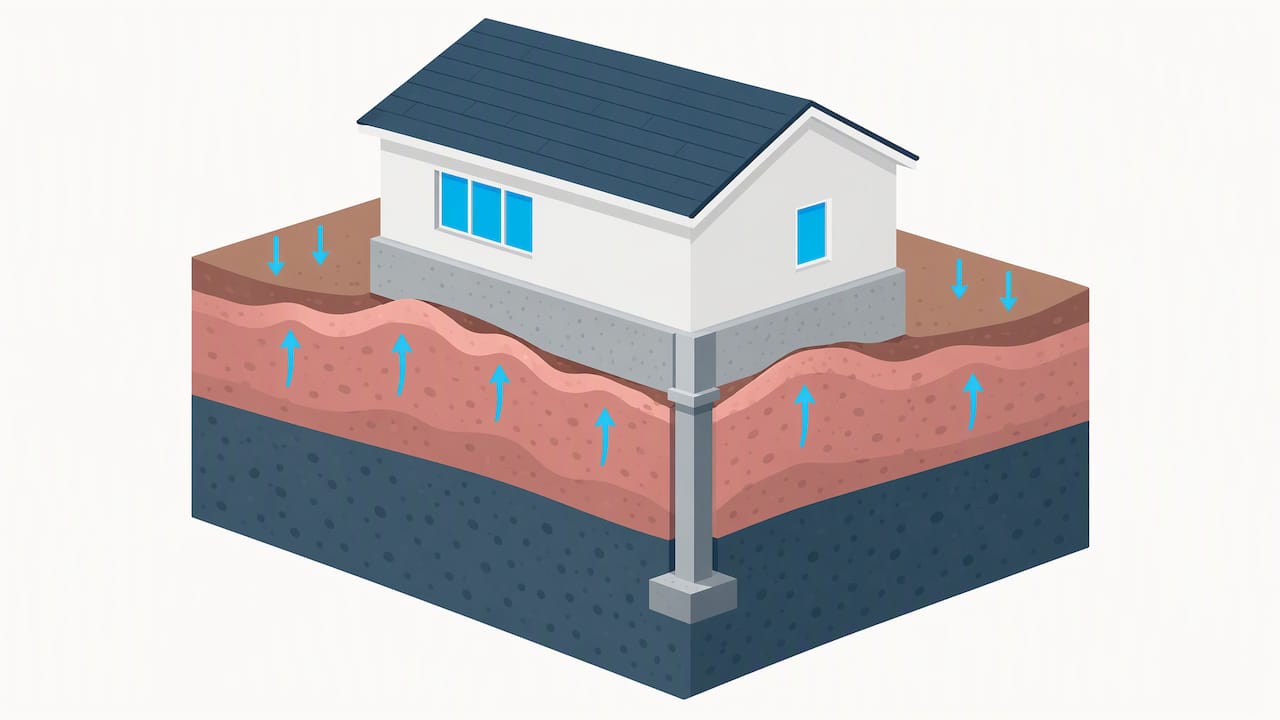
Heave is upward foundation movement, usually from soil swelling after it absorbs moisture. That is different from subsidence or settlement, both downward movements caused by soil drying, shrinking, or compressing under load. Getting this distinction right matters because the repair for upward movement is often the opposite of the repair for downward movement, and treating one as the other can make the house worse, according to guidelines from the ASCE Texas Section.
Two mechanisms drive most heave:
- Expansive clay soils pull in water through suction, almost like a sponge, and swell as they absorb it; uneven swelling under different parts of a foundation creates the uplift that cracks slabs and walls.
- Frost heave forms when water in the soil freezes into ice lenses that expand and lift whatever sits above them; heated, occupied basements rarely see this because indoor heat limits how deep frost can penetrate, per Building America’s retrofit guidance.
The depth to which soil moisture actively changes with the seasons is called the active zone, and it defines how deep any permanent repair needs to reach. A contractor who diagnoses heave by looking only at the cracks, rather than figuring out which mechanism is moving the soil, is working backward. The crack pattern is a clue, not the diagnosis.
Building on expansive clay means the soil type itself should shape your maintenance habits long before cracks appear.
How do you tell active heave from cosmetic cracking?
Not every crack means your foundation is actively moving. Some damage happened once and stopped; other damage is ongoing and will keep getting worse until the cause is addressed.
Watch for these signals:
- Horizontal cracks near the top of basement walls, especially ones that widen over a season, often point to soil pressure from swelling clay rather than normal settling.
- Doors and windows that stick seasonally and then loosen again suggest moisture-driven movement tied to wet and dry cycles.
- Doming or edge-lift patterns, where the center or perimeter of a slab rises relative to the rest, are classic heave signatures described in Army technical manual TM 5-818-7.
- Cracks that reopen after you patch them mean the underlying movement is still active, not finished.
- New gaps between trim and walls, or floors that visibly slope more than they did last year, indicate progression worth tracking.
Seasonality is the biggest clue. Movement that gets worse after heavy rain, after a dry summer, or after a hard freeze and then partially reverses is a strong sign the soil, not the structure, is driving the damage.
Pro Tip: Keep a simple log: photograph each crack next to a tape measure every few months, and note the date and recent weather. That record is often more useful to an engineer than the crack itself.
What a professional diagnosis actually involves
A proper diagnosis starts in the field, not with a sales pitch for piers. A qualified inspector will check elevations across the slab or foundation walls, map existing cracks and their widths, review the home’s drainage and plumbing history, and look at nearby trees and root systems that might be drying or wetting the soil unevenly.
Typical field steps include:
- Elevation surveys using a laser level or manometer to chart high and low points across the foundation.
- Crack mapping that records width, direction, and location relative to doors, windows, and corners.
- A review of grading, gutter discharge points, and any history of plumbing leaks near the foundation.
- Inspection of vegetation and root intrusion that could be pulling moisture from the soil unevenly.
When damage is significant or unclear, engineers may recommend a Level C geotechnical investigation, which includes soil borings and lab testing rather than a visual walk-through alone. Monitoring is also common: repeated elevation readings over weeks or months establish benchmarks that show whether the ground is still moving or has stabilized.
Lab testing for expansive soils typically includes liquid limit and plasticity index measurements, along with suction testing, which together estimate how much a given soil will swell and how deep that swelling reaches, according to guidance on diagnosing heave, subsidence, and settlement. Knowing the depth of the active zone is what separates a repair that lasts from one that fails again in a few years, since any underpinning has to be founded below that depth to work.
Misdiagnosis is a real risk when field evidence is skipped. Forensic investigation and documented monitoring exist specifically to prevent homeowners from paying for a structural fix that does not match the actual movement mechanism.
What are the real repair options for heave?
Repair choices generally fall into four groups, and the order they’re usually tried matters as much as the methods themselves.
Moisture management comes first in almost every case. Correcting grading so water flows away from the foundation, extending downspouts, installing French drains, fixing plumbing leaks, adjusting irrigation schedules, and installing root barriers near large trees all address the root cause rather than the symptom. The Geo-Institute’s guidance on shrink-swell soils identifies uniform soil moisture around and under a foundation as the single most effective way to limit shrink-swell damage, since non-uniform moisture, not moisture itself, is what causes differential movement.
Soil stabilization methods such as chemical injection or lime treatment can reduce a soil’s tendency to swell, but they have limits with highly expansive clays and are typically paired with moisture control rather than used alone.
Structural solutions become necessary when movement is severe or ongoing despite moisture fixes. These include:
- Underpinning with deep piers or piles that bypass the active zone entirely, reaching stable soil below where seasonal moisture changes stop affecting the ground.
- Full foundation lifting, which requires piers founded well below the active zone, often 1.5 to 2 times its depth, to avoid future uplift forces reasserting themselves.
- Slab leveling with polyurethane foam injection for cosmetic and minor structural correction once the underlying cause has been controlled.
Monitored wait-and-see is a legitimate strategy, not a delay tactic. Once the moisture source is removed, some heave events stabilize on their own over a period of months, and committing to expensive piers before confirming the ground has settled can mean paying for work that was never necessary.
Pro Tip: If a contractor proposes underpinning before ruling out a simple drainage fix, ask what moisture source they’ve ruled out and how.
Interior and exterior basement waterproofing often complements structural work by keeping the moisture source away from the foundation long term, and a drainage and grading fix done to code is frequently the first and cheapest step before anything structural is even considered.
How do you prevent foundation heave from coming back?
Most prevention comes down to controlling where water goes, not keeping it away entirely, since uniform soil moisture matters more than bone-dry soil.
- Grade the soil so it slopes away from the foundation at a gentle, consistent pitch rather than pooling against the walls.
- Extend downspouts so they discharge water several feet away from the foundation, using splash blocks or a connection to a sump line rather than letting water drop straight down next to the wall.
- Adjust irrigation so sprinkler heads and drip lines don’t concentrate water right next to the foundation, especially in beds planted close to the house.
- Space trees and large shrubs away from the foundation and consider root barriers where mature trees are already close, since roots drawing moisture unevenly can be as damaging as too much water.
- Walk the perimeter after major storms or a dry spell to check that grading and drainage are still doing their job, and schedule a recheck if you notice new gaps, puddling, or cracks.
A basement dehumidification system can help manage indoor humidity that otherwise migrates into surrounding soil, rounding out an exterior drainage plan with interior moisture control.
How long does heave repair take, and what does it cost?
Cost and timeline both depend on how deep the fix has to reach. Drainage corrections like regrading or downspout extensions are usually finished in a day or two. Monitoring periods run longer, often spanning several months, since tracking elevation benchmarks over multiple seasons is the standard way to confirm whether movement has actually stopped, according to diagnostic guidelines for heave and settlement.
Structural work, when it’s needed, takes longer and costs more because of several factors:
- Access to the foundation, including excavation around walls or crawl space clearance.
- The depth required for piers to reach below the active zone.
- Engineering design and calculations specific to the soil and structure.
- The scope of drainage work bundled into the same project.
- Local permitting requirements for structural modifications.
Some homeowners spend months or even a year or more in a monitored wait phase before committing to piers, and that patience often pays off when the movement stabilizes once the moisture source is gone.
Why I recommend diagnosis before demolition
The instinct when a door starts sticking is to call someone who installs piers. I’d push back on that instinct every time. A documented diagnosis, elevation readings, crack logs, drainage history, costs very little compared to structural work and often reveals that the fix is a downspout extension, not a pier system.
Homeowners care about three things: keeping disruption to a minimum, controlling cost, and getting a result that actually lasts. Those goals point the same direction. Skipping the diagnosis to jump straight to underpinning risks spending on the wrong problem, while skipping monitoring risks living with worsening damage longer than necessary. The measured path, document first, remove the moisture source, monitor, then escalate only if the ground proves it needs it, is slower to start but far less likely to need a second round of repairs.
— Kayle
How Foundation RESQ approaches heave repair
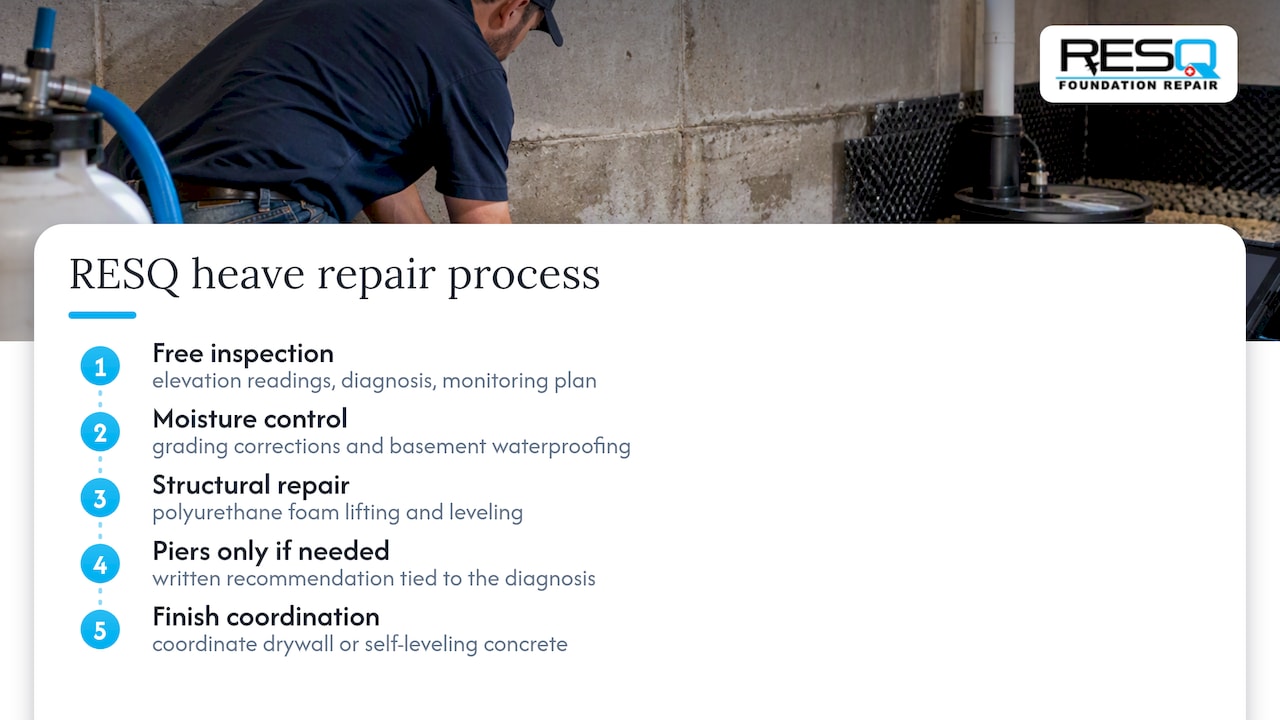
We start every heave case the same way: a free inspection that documents what’s actually moving, why, and what it will take to stop it. For homeowners dealing with sticking doors, cracked slabs, or sloping floors, that inspection gives you elevation readings, a written diagnosis, and a monitoring plan before anyone talks about structural work.
From there, our team handles the moisture side with grading corrections and basement waterproofing, and the structural side with polyurethane foam concrete lifting and leveling when a slab needs it. If piers or deeper stabilization are the right call, we put that recommendation in writing alongside the diagnosis that led to it, so you know exactly what you’re paying for and why. Once drywall or flooring needs attention after structural work, coordinating with a drywall repair specialist or discussing self-leveling concrete before new flooring can round out the project.
Request a free inspection to get your diagnosis started, or check our financing options if you’re planning ahead for a larger repair.
FAQ
Is frost heave covered by insurance?
Standard homeowners insurance generally treats frost heave as an earth movement exclusion, similar to how most policies handle settlement and soil expansion. Coverage details vary by policy and insurer, so checking your specific policy language or asking your agent directly is the only reliable way to know.
Will homeowners insurance pay for foundation repair?
Most standard homeowners policies exclude foundation damage caused by soil movement, including heave and settlement, because these are considered gradual, preventable issues rather than sudden covered perils. Damage from a sudden covered event, like a burst pipe that then contributes to soil movement, may be handled differently, so reviewing your policy’s specific exclusions matters.
Can you fix slab heave?
Slab heave is frequently repairable, and the right fix depends on the cause: moisture-driven heave often resolves once the water source is controlled, while deeper or more severe cases may need structural releveling or underpinning. A professional diagnosis that identifies the active zone depth is the step that determines which approach will actually last.
Will concrete settle after frost heave?
Concrete lifted by frost heave often partially settles back down once the ice lenses causing the lift thaw and the soil moisture returns to normal, though it doesn’t always return to its original position. Whether further leveling is needed depends on how much permanent movement occurred and whether the soil beneath has been disturbed.
Sources
For homeowners who want to go deeper on the technical side of diagnosing and repairing heave, these references cover the mechanisms, field methods, and repair standards referenced throughout this guide:
- Guidelines for the Evaluation and Repair of Residential Foundations (ASCE-related guidance)
- Living With Shrink–Swell Soils (Geo-Institute)
- TM 5-818-7: Foundations in Expansive Soils (Army technical manual)
- Which Way Is It Moving? Guidelines for Diagnosing Heave, Subsidence and Settlement