
A useful foundation check is not a diagnosis. It is a clear record of what is changing. A small crack, a sticking door, or dampness can have different causes, and one observation alone may not tell you whether the foundation is involved. A foundation inspection checklist for homeowners can help you look consistently without treating every routine change as a reason for alarm.
It’s understandable to wonder which signs matter or whether you might miss something important. A calm visual walkthrough can help you note where changes appear, when you first noticed them, and whether they seem to be growing or recurring. That record gives a qualified professional useful context if you decide to seek an assessment.
This guide shows you what to observe around the exterior, inside the home, and in an accessible basement or crawl space. You’ll learn how to document cracks, sticking doors and windows, uneven floors, and moisture clues while keeping the limits of a visual check in mind. The goal is a repeatable way to understand what may need attention, not to diagnose the structure or attempt repairs yourself.
Key Takeaways
- Use a foundation inspection checklist for homeowners to follow the same route around the exterior and through accessible rooms.
- Record each observation with its location, date, approximate size, and a photo so you can compare it over time.
- Note moisture and drainage clues alongside visible cracks or changes, since different conditions can overlap.
- Look for patterns after relevant events, such as heavy rain, without assuming what caused a change.
- Share repeated or changing observations with a qualified professional, who can assess the conditions before a repair approach is chosen.
What a Foundation Inspection Checklist Can, and Cannot, Tell You
A consistent visual walkthrough can help you sort through possible foundation concerns. Rather than interpreting every mark or uneven surface, use a foundation inspection checklist for homeowners to record what you see, where it appears, and whether it changes over time. This is observation and documentation, not a structural diagnosis.
Foundations support a home and transfer its loads to the ground. For background on how different building foundations work, see this overview. Your checklist doesn’t require you to identify your foundation type or assess how it was built. Its purpose is to create a clear record that can help you ask informed questions of a qualified professional.
What homeowners can safely observe
Look for visible changes in interior walls, floors, doors, and windows, as well as exterior masonry and the ground around the home. You might note a wall crack, a door that has started to stick, a floor that seems uneven, or water collecting near the foundation. These observations are useful to document, but an isolated cosmetic change doesn’t prove there is a foundation problem or reveal its cause.
Compare what you see with dated photos, earlier notes, or prior inspection records. A crack that looks unchanged over time is different information from one that appears to be widening, but neither observation alone establishes what repair, if any, is needed. Record the location and description, then leave conclusions about the structure to a professional.
Before starting, gather a phone or camera, a notepad, and a flashlight. Stick to areas you can reach safely. Don’t move heavy objects or disturb building materials to uncover a suspected issue. The aim is to notice and document, not to test the home or attempt repairs.
When a visual checklist is not enough
A visual walkthrough can’t reveal concealed framing, below-ground conditions, or the cause of movement. Moisture, drainage, materials, and other factors can contribute to similar visible signs, so a checklist can’t determine which explanation applies. A checklist records symptoms, but it cannot diagnose structural causes.
Stay out of a crawl space if access is unsafe, the area is wet, or components appear visibly damaged. Don’t step onto unstable surfaces or enter a confined area to get a closer look. Photograph what’s visible from a safe position and note anything you couldn’t access. If observations recur, change, or raise concerns, share your records with a qualified professional for assessment. Your notes help frame questions; they don’t prescribe a repair.
A Room-by-Room and Exterior Foundation Inspection Checklist
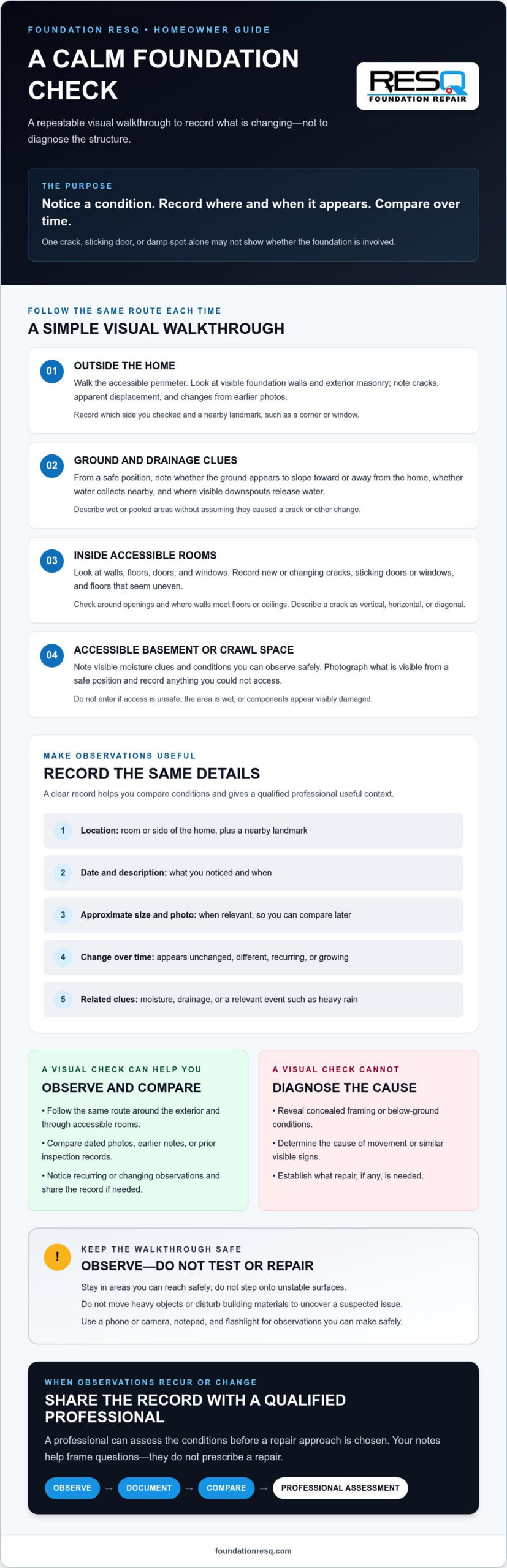
Follow the same route each time so you can compare the same areas: start outside, then move through accessible interior spaces. This gives your foundation inspection checklist for homeowners a clear structure without asking you to decide what a condition means. For each observation, record the date, exact location, approximate size if relevant, and whether it seems unchanged or different from an earlier check.
Outside the home: perimeter, grading, and visible foundation
- Walk the accessible perimeter. Look at visible foundation walls and exterior masonry for cracks, apparent displacement, or changes compared with earlier photos. Note which side of the house you’re checking and a nearby landmark, such as a corner or window.
- Observe the ground. From a safe position, note whether the soil appears to slope toward or away from the home, and whether water seems to collect near the structure. Record what you see without assuming the grading caused a crack or another change.
- Check downspout discharge. Note where each visible downspout releases water and whether the nearby area appears wet or pooled. Describe the condition rather than treating it as proof of a foundation problem.
Foundation designs vary, and the visible portion of a home may not tell you what lies below ground. The Designing Buildings Wiki explains different types of foundations and factors that influence their design. You don’t need to identify yours to complete this visual checklist. Focus on recording visible conditions consistently.
Inside the home: walls, floors, doors, and windows
- Check walls and openings. Look for new or changing cracks along walls, around doors and windows, and where walls meet floors or ceilings. Note the room and whether a crack appears vertical, horizontal, or diagonal.
- Observe floors and transitions. Record areas that seem uneven and any changes where flooring meets a doorway or another surface. Don’t move furniture or remove finishes to investigate.
- Try doors and windows during ordinary use. Note if one newly sticks, rubs, or is harder to close. A single instance doesn’t establish a structural concern, so record whether the issue happens again.
Take photos from a consistent angle and distance. If you can do so safely, include a ruler or another familiar reference beside a visible crack. Revisit the same spots during later checks. A note such as “north bedroom, above doorway, hairline crack, unchanged from prior photo” is more useful than a general entry like “crack in house.”
If repeated observations raise questions, your dated notes can help frame a conversation about foundation repair options with a qualified professional.
How to Separate Foundation Observations from Moisture and Maintenance Clues
A crack, damp area, or sticking door is an observation, not an explanation. Foundation and moisture concerns can occur together, so use your foundation inspection checklist for homeowners to record both what you see and where it occurs. Note nearby signs of water, such as pooling outside or visible dampness indoors, without assuming one condition caused another.
The ASHI Standard of Practice provides a reference for the components and conditions covered in a home inspection. Your personal notes can help organize what you’ve noticed, but they don’t replace an assessment of the home.
Possible structural changes versus moisture clues
Use this comparison to keep observations separate from questions that may need professional evaluation. A crack’s appearance alone can’t reliably identify its cause or severity.
| What you observe | What may need professional evaluation |
|---|---|
| A crack in a wall, floor, or visible foundation surface | Whether its location, pattern, or change over time indicates a structural concern |
| Water on a surface, dampness, or a musty odor | Where moisture is coming from and whether it is affecting building materials |
| Apparent wood deterioration or staining | How extensive the condition is and whether concealed areas are affected |
| Water collecting near the home or a downspout discharge point | Whether drainage conditions need attention and how they relate to other observations |
Record related clues together. For example, note both a wall crack and nearby dampness, including their locations and whether either appears to change. That context can help a qualified professional decide what to investigate, without requiring you to make a diagnosis.
What to note in an accessible crawl space
From a safe access point, look for standing water, visible moisture, or apparent wood deterioration. Don’t enter a confined, wet, mold-affected, or otherwise unsafe space to complete the checklist. Record what you can see from a safe position and note any areas you couldn’t access.
If crawl space moisture is a concern, the Tallahassee crawl space encapsulation guide offers related information. For persistent moisture or visible mold, see the Tallahassee mold remediation guide. These conditions deserve attention on their own; they don’t, by themselves, prove foundation failure.
How to Document Findings and Decide What Needs Follow-Up
A clear record helps you distinguish a one-time observation from a change worth discussing with a professional. Use the same format each time you check, and keep notes and photos together. This makes your foundation inspection checklist for homeowners a practical record of conditions, not an attempt to judge structural severity.
Build a useful home condition log
Use a simple floor plan or consistent room names to identify each location. For exterior notes, name the side of the home and a nearby feature. Add one entry for each observation, including:
- Date and location: For example, “October 1, north wall, near the living room window.”
- Description and approximate size: Describe what you can see, such as a crack’s direction and approximate length, without labeling it severe or harmless.
- Photo: Take the picture from a consistent distance and angle. Include a ruler or familiar reference object only if it’s safe and appropriate.
- Comparison: Mark the condition as new, apparently stable, or apparently changing based on earlier records.
Note relevant events, such as heavy rain, in a separate field alongside your observations. If you later notice water near a downspout or a change in a crack, record both and their dates. The timing may provide useful context, but it doesn’t prove the event caused the condition.
When to seek a qualified assessment
Routine monitoring can help you see whether an observation appears unchanged. Seek qualified professional advice if a concern recurs or visibly changes, especially if you notice related changes in more than one area. If a wall appears displaced or an area seems unsafe, keep clear and seek guidance rather than approaching it to take measurements or attempting a repair.
Bring your dated notes and photos to the conversation. A professional can assess the conditions and determine what further investigation may be appropriate. Symptoms alone don’t establish a cause or identify a repair. For background on foundation movement and possible repair considerations, read this Tallahassee foundation repair guide.
If your documented concerns relate to foundation movement, explore Foundation ResQ’s foundation repair information to learn about the company’s repair offerings for Tallahassee homeowners.
What Happens After a Foundation Concern Is Identified?
Your notes are a starting point for a conversation, not a repair plan. A qualified professional can review the documented changes, examine relevant conditions, and explain whether further evaluation is needed. Bring dated photos and describe what you’ve noticed over time. A foundation inspection checklist for homeowners helps organize that information, but symptoms alone can’t determine the cause or establish which solution is appropriate.
Questions to ask during a professional evaluation
Clear questions can help you understand the assessment and weigh next steps. Consider asking:
- What evidence supports your assessment, and what other possible explanations did you consider?
- Is additional evaluation recommended? If so, what would it clarify?
- What options may suit the findings, what is each option intended to address, and what are its limitations?
- Do moisture or drainage observations affect the recommended approach?
- What findings and recommendations will be documented for my records?
Ask for explanations in plain language, and take time to review the findings before deciding. If a recommendation doesn’t clearly connect to the observed conditions, ask how it addresses them.
Match a proposed solution to the findings
Different approaches address different conditions. Foundation stabilization may be considered for certain movement concerns, wall reinforcement for particular wall conditions, and moisture-control measures for relevant moisture issues. These categories aren’t interchangeable, and visible cracks or other symptoms alone don’t establish that any one is needed. The assessment should guide the recommendation.
If your notes include a bowing-wall concern, this carbon fiber wall repair guide explains one type of wall reinforcement. It’s background information, not a diagnosis or recommendation for your home.
For Tallahassee homeowners, Foundation ResQ offers foundation repair and stabilization, including helical and push pier installation, as well as carbon fiber wall reinforcement and crawl space moisture-control services. To discuss your documented concerns and ask about appropriate next steps, contact Foundation ResQ.
Turn Your Notes Into a Confident Next Step
A foundation inspection checklist for homeowners helps replace guesswork with a consistent record. Note where a condition appears, photograph it for comparison, and track whether it seems stable or changing. Include moisture and drainage observations too, since those clues can help a qualified professional understand the broader picture.
Remember that a visual checklist isn’t a diagnosis, and a crack or sticking door alone doesn’t determine what work a home needs. If concerns persist or appear to progress, share your records with a qualified professional and ask how their recommendations relate to the findings.
Foundation ResQ serves Tallahassee homeowners with foundation repair and stabilization, including helical and push pier installation. Related offerings include carbon fiber wall reinforcement and crawl space moisture control. Contact Foundation ResQ to discuss your foundation concerns and ask about appropriate next steps.
A careful record and a measured next step can help you protect your home’s long-term stability without rushing to conclusions.
Frequently Asked Questions
What should I look for during a foundation inspection?
Check visible foundation areas, interior walls and floors, doors and windows, drainage, and moisture clues in spaces you can access safely. Record each observation’s location and date, then compare photos over time. A foundation inspection checklist for homeowners helps organize what you’ve noticed in your Tallahassee home, but it can’t establish a condition’s cause or severity. Seek qualified advice if changes recur, progress, or raise safety concerns.
How often should homeowners inspect their foundation?
Do a consistent visual walkthrough periodically and after events that prompt concern, such as noticeable water intrusion. There’s no universal schedule that applies to every home. Dated photos and a simple log make it easier to compare the same locations over time than relying on memory. If a condition appears to be progressing, don’t wait for your next routine check to ask a qualified professional for guidance.
Can I inspect my foundation myself?
You can safely observe accessible areas and document visible conditions, such as a crack, damp spot, or door that newly sticks. Don’t enter an unsafe crawl space, disturb structural elements, or try to diagnose what you can’t see. A visual checklist can’t assess soil, concealed framing, or structural capacity. If a condition is changing or access or the building seems unsafe, leave the assessment to a qualified professional.
Are foundation cracks always a sign of structural damage?
No. A crack by itself doesn’t establish structural damage, its cause, or its severity. Its location, appearance, surrounding conditions, and changes over time may be useful context, but a homeowner’s checklist can’t interpret those factors conclusively. Take dated photos and note where the crack appears. If it changes, recurs, or accompanies other concerning observations, share your records with a qualified professional for assessment.
What should I do if I find water or dampness near my foundation?
Record where and when the water or dampness appears. From a safe location, note where visible downspouts discharge and whether surface water seems to collect nearby. Document related indoor or accessible crawl space observations, too. Moisture doesn’t by itself prove foundation failure, and a checklist can’t determine the right repair. For persistent water, visible mold, or unsafe conditions, seek guidance from an appropriate qualified professional.
When should I call a foundation professional?
Seek qualified professional advice if visible changes appear to progress, several concerning observations occur together, or you can’t safely assess an area. Bring dated photographs and a location-based log so you can explain what you observed and when. Ask what evidence supports the assessment, whether more evaluation is recommended, and what options fit the findings. Tallahassee homeowners should confirm the professional’s scope and available services before arranging an evaluation.
Does a foundation inspection checklist diagnose the problem?
No. A homeowner checklist records visible conditions and changes, but it can’t establish why they occurred or whether structural repair is needed. Causes may involve concealed components, soil, water, or other conditions that require professional assessment. Use your notes and photos to communicate clearly with a qualified professional. Don’t treat the checklist as a diagnosis, a repair plan, or a reason to attempt DIY structural work.