
Foundation underpinning is a structural repair method that strengthens an existing foundation by extending it to deeper, more stable soil or by redistributing its load across a wider area. Understanding how foundation underpinning works is the first step toward making a confident, informed decision about your home’s structural health. This process is not the same as soil stabilization techniques like mudjacking or resin injection. True underpinning, using methods like mass concrete, mini-piles, or helical piles, permanently transfers your building’s load to competent soil strata. Every project requires a licensed structural engineer, municipal permits, and a carefully sequenced excavation plan.
How does foundation underpinning work, step by step?
The foundation stabilization process follows a strict sequence. Skipping or rushing any phase creates serious safety risks and can void permits.
Step 1: Structural Assessment and Geotechnical Investigation
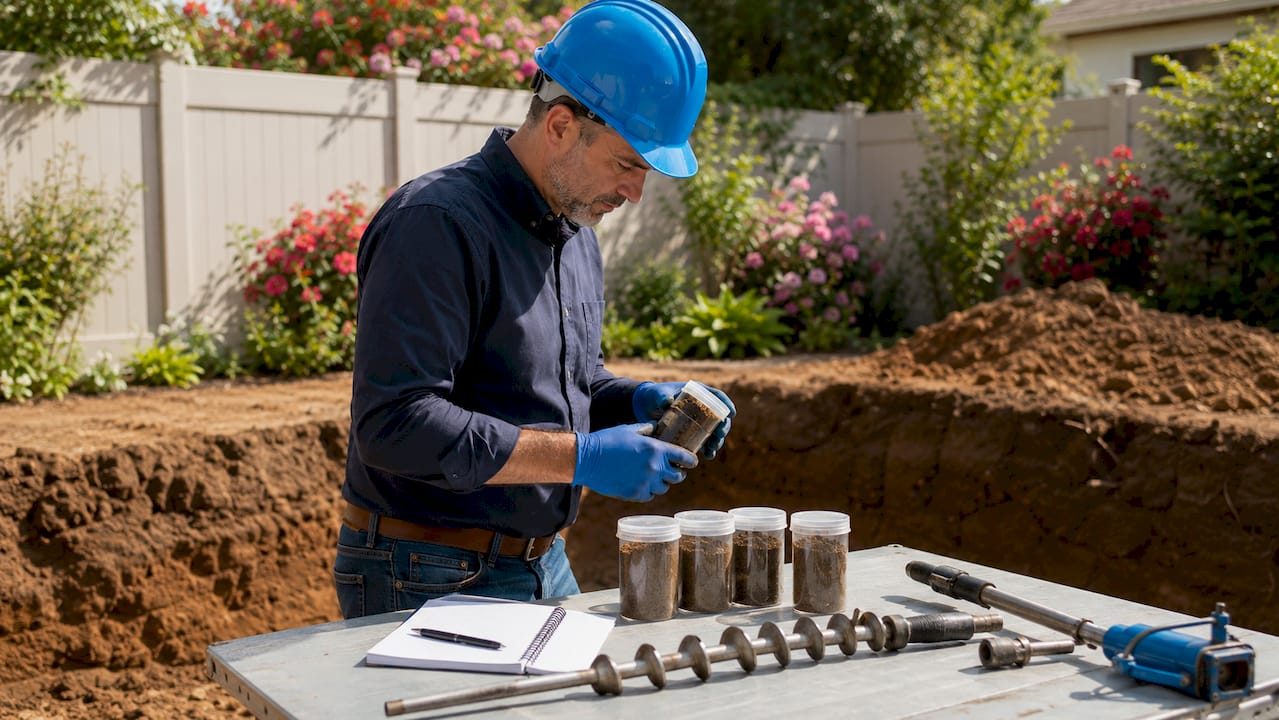
A licensed structural engineer inspects the foundation and orders soil borings or geotechnical testing. This data reveals soil type, bearing capacity, and how deep stable strata sit. Without this step, no contractor can responsibly specify a method.
Step 2: Engineering Design and Permits
The engineer produces a site-specific design that details bay widths, concrete mix, pile depths, or beam configurations. Permits are required for virtually every underpinning project, and most jurisdictions require a notification period of at least two working days before excavation begins. Skipping permits exposes you to fines and can complicate a future home sale.
Step 3: Sequential Bay Excavation
Workers excavate beneath the existing footing in controlled sections called bays. Alternating bay excavation in sections no wider than 1.5 meters is the industry standard. Adjacent bays are never opened at the same time. This sequencing prevents the footing above from losing support and collapsing.
Step 4: Installing the Underpinning System
Depending on the engineering design, workers pour mass concrete, install steel mini-piles, or set helical piles into each bay. Each bay is completed and cured before the next one opens.
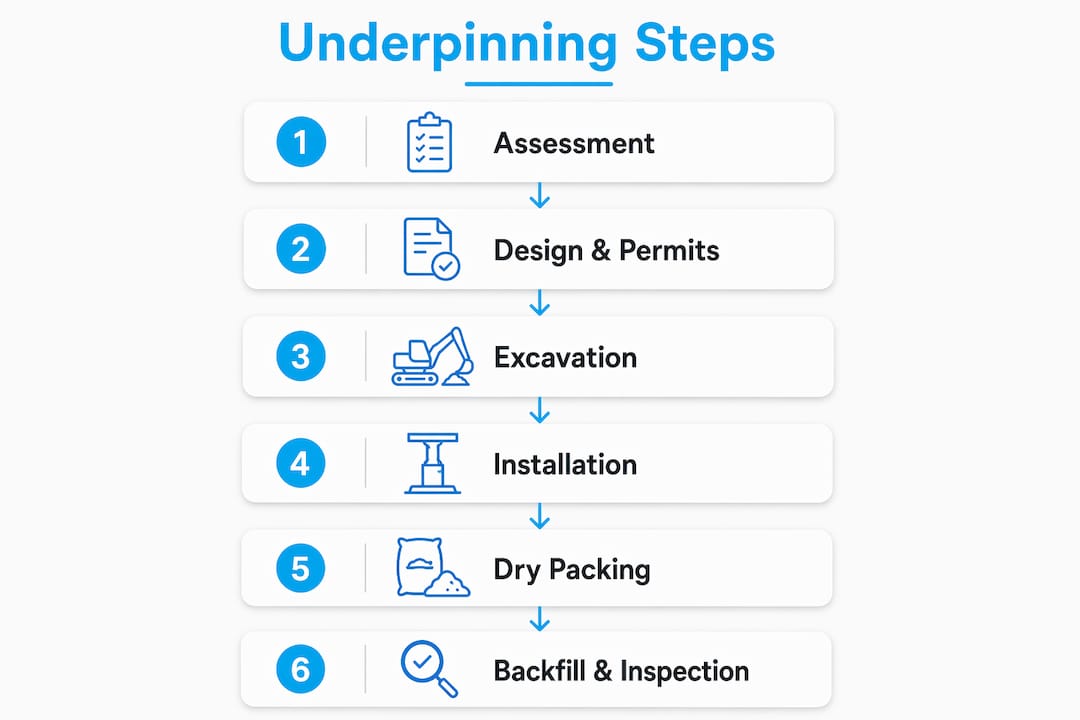
Step 5: The Dry Packing Joint
This step surprises most homeowners. After the new concrete cures, a 50mm gap is filled with stiff, non-shrink mortar. This dry packing joint is the only reliable way to transfer the building’s load from the old footing to the new underpinning. Without it, the new concrete sits beneath the foundation without actually carrying any weight.
Step 6: Backfill, Inspection, and Completion Certificate
Once all bays are complete and the dry pack has cured for 48–72 hours, the site is backfilled and a final inspection is carried out. You receive a completion certificate confirming the work meets structural standards.
Pro Tip: Ask your contractor to show you the engineering drawings before any excavation starts. If they cannot produce stamped drawings from a licensed structural engineer, stop the project.
Foundation underpinning options compared
Different sites call for different solutions. Here is how the main types of foundation underpinning methods stack up against each other.
Traditional mass concrete underpinning
Mass concrete underpinning is the most common method for residential properties. Workers excavate in 1-meter bays, pour concrete, cure it, and move to the next bay. The process takes 4–8 weeks. It works well for shallow foundations on stable soil but requires significant excavation space.
Beam and base underpinning
This method installs a reinforced concrete beam beneath the existing footing, then transfers the load down to a series of concrete bases. It requires less excavation than mass concrete and suits situations where the load needs to be redistributed across a wider area rather than pushed deeper.
Mini-piled (micropile) underpinning
Mini-piled underpinning drills steel piles to depths of 15–60+ feet to reach competent soil far below the surface. It completes in 1–3 weeks and works in tight spaces where excavation equipment cannot fit. This method suits properties with deep problem soils, restricted access, or sensitive neighboring structures.
Helical pile underpinning
Helical piles are screwed into the ground using hydraulic torque equipment. Load capacity is verified in real time during installation, which removes guesswork. This method is fast, minimally disruptive, and well-suited to both residential and light commercial buildings.
| Method | Typical Depth | Duration | Best For | Relative Cost |
|---|---|---|---|---|
| Mass Concrete | Shallow (2–6 ft) | 4–8 weeks | Standard residential, stable soil | Lower |
| Beam and Base | Shallow to medium | 3–6 weeks | Load redistribution, less excavation | Moderate |
| Mini-Piled | 15–60+ ft | 1–3 weeks | Deep problem soils, restricted access | Higher |
| Helical Pile | 10–40+ ft | 1–2 weeks | Residential and light commercial | Moderate to higher |
Pro Tip: Mini-piled underpinning often costs more upfront but saves money on excavation labor in tight urban lots. Get a site-specific quote before ruling it out.
Methods like mudjacking and resin injection are not underpinning. Resin injection lasts 10–20 years and addresses shallow soil voids. True underpinning lasts 50+ years and permanently transfers structural loads. Knowing the difference protects you from paying for a temporary fix when a permanent one is needed.
Common misconceptions about the underpinning process
The biggest misconception homeowners carry into a foundation repair project is that any soil stabilization work qualifies as underpinning. Soil stabilization methods like mudjacking and resin injection fill voids or compact loose soil. They do not extend the foundation to deeper strata or permanently transfer structural loads. Calling them underpinning is like calling a bandage a surgery.
“Engineering professionals stress that method choice depends exclusively on geotechnical data and building conditions. Ignoring this professional sequence causes failures.” — National Foundation Authority
A second common error is assuming the homeowner selects the underpinning method. Method selection belongs to engineers, not contractors or homeowners. The engineer reviews soil boring results, load calculations, and site access before specifying anything. A contractor who quotes a method before seeing engineering data is guessing.
Sequencing is also misunderstood. Many homeowners assume workers simply dig under the whole foundation and pour concrete. Opening adjacent bays simultaneously would remove support from the footing above and risk collapse. The alternating bay sequence is not a preference. It is a structural safety requirement.
Finally, the dry packing joint is often overlooked in contractor explanations. Without this step, the new concrete beneath the footing carries no load at all. The joint must be filled with non-shrink mortar and given adequate curing time before the next phase begins.
Pro Tip: Before signing any contract, ask the contractor to explain their bay sequencing plan and how they handle the dry packing joint. A qualified crew will answer without hesitation.
What homeowners should know about cost and timelines
Foundation underpinning costs typically range from $15,000 to $80,000 depending on the method, site conditions, and the extent of the problem. That range is wide because a shallow mass concrete project on a small home differs enormously from a mini-piled solution on a large property with deep clay soils.
Cheaper alternatives like mudjacking cost $500–$3,000 but last only 5–15 years. Underpinning, done correctly, lasts 50+ years and improves property value when documented with engineering certificates. The math favors underpinning for any structural problem that will not resolve itself.
Here is what to expect during the project:
- Site disruption: Expect excavation equipment, material deliveries, and restricted access to parts of your yard or crawl space for the project duration.
- Living in the home: Most underpinning projects allow homeowners to stay in place, though some structural situations require temporary relocation. Your engineer will advise.
- Timeline: Mass concrete projects run 4–8 weeks. Mini-piled and helical pile methods typically finish in 1–3 weeks.
- Contractor verification: Confirm the contractor carries general liability insurance and works under a licensed structural engineer. Ask for references from completed underpinning projects specifically, not just general foundation work.
- Post-installation documentation: Obtain the completion certificate and keep the engineering drawings. These documents are required if you refinance or sell the property.
For crawl space foundations, underpinning access is more restricted, which often increases labor costs. Factor this in when comparing quotes.
Key takeaways
Foundation underpinning permanently transfers structural loads to competent soil using engineering-designed methods, making it the only reliable long-term solution for failing foundations.
| Point | Details |
|---|---|
| Underpinning is structural, not cosmetic | It extends foundations to stable soil, unlike mudjacking or resin injection which only address surface voids. |
| Sequential bay excavation is non-negotiable | Alternating bays no wider than 1.5 meters prevents collapse and is a structural safety requirement. |
| The dry packing joint transfers the load | Without non-shrink mortar filling the 50mm gap, new concrete carries no structural weight. |
| Engineers specify the method, not homeowners | Soil borings and load calculations determine which underpinning method is appropriate for your site. |
| Costs range from $15,000 to $80,000 | Method, depth, and site complexity drive the final price, but underpinning lasts 50+ years versus 5–15 for cheaper alternatives. |
What i’ve learned after watching homeowners get this wrong
I have seen homeowners spend $2,500 on mudjacking, feel relieved for two years, then face the same cracks and worse settling because the underlying structural problem was never addressed. The frustration is real. The money is gone. And now the repair costs more because the problem progressed.
The part that sticks with me is how often the confusion starts with language. A contractor says “we stabilize foundations” and a homeowner hears “underpinning.” Those are not the same thing. Stabilization addresses soil. Underpinning addresses structure. If your foundation is failing because it cannot reach competent bearing soil, no amount of foam injection will fix that.
What I tell every homeowner I work with: get the geotechnical report first. Not a contractor’s opinion. Not a free inspection that skips soil testing. An actual soil boring with lab results. That document tells you whether you need underpinning or whether a lighter intervention will hold. Without it, you are guessing with a five-figure decision.
The sequencing and dry packing steps are where I see the most contractor shortcuts. Both steps are tedious and slow. Both are also the difference between underpinning that works for 50 years and underpinning that shifts again in five. Ask about both before you sign anything.
Proper underpinning is not a quick fix. It is a structural investment that protects your home’s value, your family’s safety, and your peace of mind for decades. That is worth doing right.
— Kayle
Get expert foundation repair help from Foundationresq
If this article raised more questions than it answered, that is a good sign. Foundation underpinning is complex, and the details matter. Foundationresq specializes in engineering-backed permanent foundation repair solutions for homeowners in the Tallahassee area, covering everything from mass concrete underpinning to helical pile systems. The team works under licensed structural engineers and provides full documentation at project completion.
Before committing to any repair method, use the Foundationresq foundation repair cost estimator to get a realistic budget range for your specific situation. Free inspections are available, and financing options make it easier to choose the right solution rather than the cheapest one. Reach out to Foundationresq to schedule your assessment and get a clear picture of what your foundation actually needs.
FAQ
What is the difference between underpinning and mudjacking?
Underpinning permanently extends a foundation to deeper, stable soil and lasts 50+ years. Mudjacking fills shallow voids with a cement slurry and typically lasts 5–15 years without addressing structural load transfer.
How long does foundation underpinning take?
Mass concrete underpinning takes 4–8 weeks due to sequential bay excavation and curing requirements. Mini-piled and helical pile methods typically complete in 1–3 weeks.
Do i need a permit for foundation underpinning?
Yes. Permits are required for underpinning in virtually every jurisdiction, along with a structural engineering design and post-installation inspection. Most areas require at least two working days of advance notice before excavation begins.
Can i stay in my home during underpinning?
Most underpinning projects allow homeowners to remain in the property. Your structural engineer will assess whether the extent of the work requires temporary relocation.
How do i know if my foundation needs underpinning?
Signs include progressive cracking in walls or floors, doors and windows that no longer close properly, and visible foundation settlement. A licensed structural engineer with underpinning expertise can confirm whether underpinning is necessary after reviewing soil data and structural conditions.
Recommended
- Foundation Underpinning Services 101 – Tallahassee Foundation Repair | Foundation ResQ
- The Foundation Whisperers: Unveiling Expert Underpinning Solutions – Tallahassee Foundation Repair | Foundation ResQ
- Underpinning in Construction: Methods, Procedures, and Why It Matters – Tallahassee Foundation Repair | Foundation ResQ
- Sinking Home Foundation Solutions: A Homeowner’s Guide for 2026 – Tallahassee Foundation Repair | Foundation ResQ