
How slab leveling protects property value: the core answer
Slab leveling lifts and stabilizes sunken or tilted concrete surfaces, and it directly protects your property value by eliminating the safety hazards, visual damage, and structural risk that buyers and appraisers penalize. Unrepaired foundation problems can reduce a home’s value by 10–30%, and buyers routinely demand price concessions that exceed the actual repair cost. Fixing the problem before listing, or simply before it worsens, closes that gap.
Here is what slab leveling actually does for your home’s value:
- Restores a smooth, level surface that signals a well-maintained property to buyers and appraisers
- Removes trip hazards that create liability exposure and raise insurance red flags
- Prevents progressive settlement from spreading into the foundation itself
- Converts a visible defect into a documented, repaired feature, which appraisers treat more favorably than an active problem
- Improves curb appeal on driveways, walkways, patios, and garage floors, all of which factor into first impressions and buyer perception
Slab leveling typically does not push your home’s value above the market baseline. What it does is prevent the value loss that comes with leaving settlement unaddressed—which can reach 10–30% of the property’s worth if not repaired.
Safety benefits that directly affect your home’s value
Uneven concrete slabs are one of the most common trip hazards on residential properties, and the liability exposure they create is a real concern for both homeowners and buyers. A raised slab edge on a front walkway or driveway is the kind of defect that shows up in home inspection reports, triggers insurance questions, and gives cautious buyers a reason to negotiate hard or walk away.
Correcting uneven slabs creates smooth, stable surfaces that reduce accident risk for everyone who walks the property. That matters during showings, during appraisals, and every day you live there.
- Raised slab edges on walkways and driveways are frequent causes of falls
- Garage floor settlement can create drainage problems and structural stress on adjacent walls
- Pool deck unevenness poses specific risks and affects insurance coverage in some policies
- Patio slab gaps allow water to pool, accelerating freeze-thaw damage in colder climates
Pro Tip: Don’t evaluate slab safety by cracks alone. A slab can look intact but still be tilted enough to redirect water toward your foundation or create a subtle trip hazard. Run a level across the surface and check for standing water after rain.
Slab leveling versus concrete replacement: what you need to know
The choice between leveling and full replacement comes down to the slab’s condition, the severity of settlement, and what outcome you need for your property’s value. Leveling is more cost-effective and faster than replacement and causes far less disruption, but it is not the right answer for every situation.
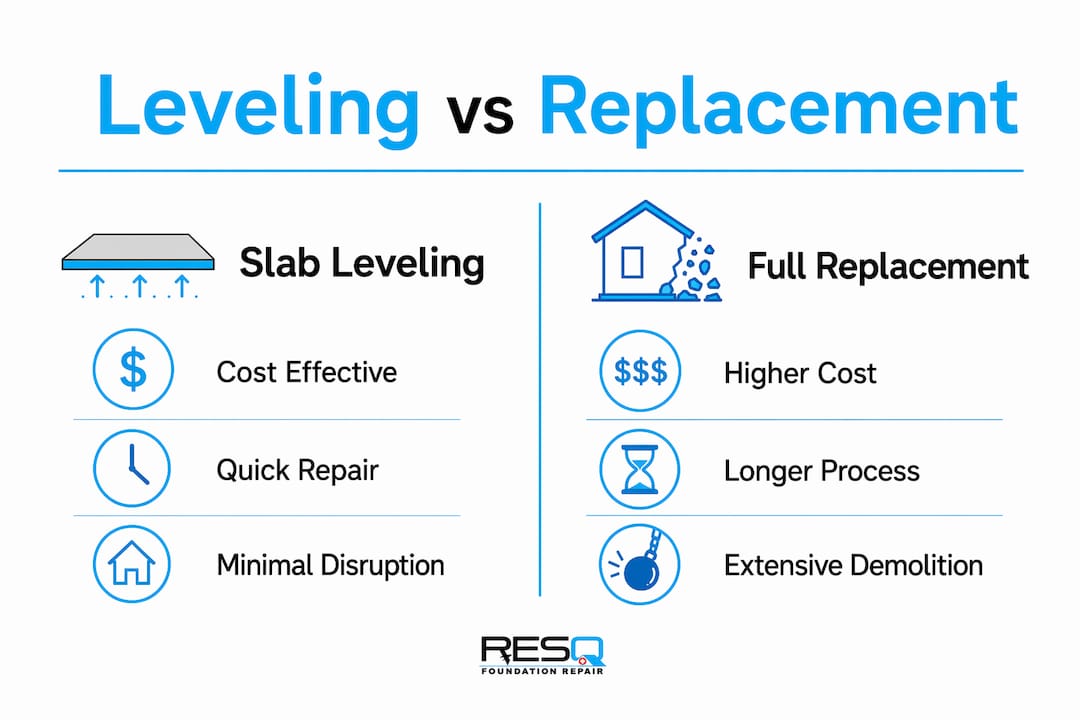
| Factor | Slab Leveling | Full Replacement |
|---|---|---|
| Cost | Lower cost per square foot; no demolition or disposal fees | Higher cost; includes removal, haul-away, and new pour |
| Durability | Long-lasting when root causes are addressed; may need retreatment if soil issues persist | New slab with full lifespan, assuming proper base preparation |
| Impact on value | Restores marketability; documented repair reduces buyer risk premium | Eliminates defect entirely; strongest outcome for severely damaged slabs |
| Disruption | Minimal; typically completed in hours | Significant; curing time prevents use for days |
| Best for | Slabs with moderate settlement, intact structure, and addressable soil conditions | Severely cracked, crumbling, or structurally compromised slabs |
Replacement becomes necessary when a slab has deteriorated beyond the point where lifting it restores structural integrity. For most residential driveways, walkways, and patios with moderate settlement, leveling delivers comparable results at a fraction of the cost, and buyers respond well to a documented, professional repair.
Common mistakes that hurt your property value
Most slab leveling problems that end up hurting property value are not caused by the repair itself. They are caused by decisions made before or after the work is done.
- Hiring unlicensed contractors. A repair done without proper credentials gives buyers and appraisers nothing to stand on. No license, no warranty, no documentation.
- Ignoring the root cause. Drainage and soil issues left unaddressed before leveling mean the slab will re-settle. Appraisers look specifically at why a slab moved, not just whether it was fixed.
- Skipping documentation. Photos taken before and after, a professional invoice, and a written warranty are what transform a repair into a selling point. Without them, the repair is invisible to appraisers and suspicious to buyers.
- Delaying the repair. Unaddressed slab issues expand over time. What starts as a minor settlement crack can develop into a foundation problem that costs far more to fix and causes far greater value loss.
- Choosing cosmetic patches over structural solutions. Filling a crack with caulk or patching the surface without addressing the underlying settlement does not fix the problem. It just hides it temporarily, and inspectors will find it.
The pattern behind most of these mistakes is the same: treating slab leveling as a cosmetic task rather than a structural one. Buyers and appraisers see through surface fixes quickly.
Checklist for deciding on slab leveling before it affects your home’s value
Use this before scheduling any repair, and especially before listing your home.
- Assess the slab condition. Is the settlement moderate or severe? Are there active cracks widening, or is the surface structurally intact but tilted?
- Identify the cause. Has a contractor or engineer confirmed whether poor drainage, soil erosion, or tree root intrusion caused the settlement? Fixing the slab without fixing the cause is a short-term solution.
- Get a professional evaluation. A licensed contractor can tell you whether leveling is appropriate or whether replacement is the better call. Get this in writing.
- Compare costs and outcomes. Request itemized quotes for both leveling and replacement so you can weigh the actual cost difference against the expected value impact.
- Verify credentials and warranty terms. Confirm the contractor is licensed, insured, and offers a transferable warranty. Transferability matters if you plan to sell.
- Time the repair strategically. If you are within six months of listing, complete the repair early enough to obtain documentation and allow any follow-up inspection before the appraisal.
- Plan your documentation. Arrange for before-and-after photos, keep the invoice, and store the warranty where you can produce it quickly for a buyer or appraiser.
How documentation and professional transparency protect your value after the repair
Documented repairs transform a known defect into a maintained feature. That distinction is what drives the difference between a buyer demanding a $30,000 discount and one who accepts the home at near market value.
Appraisers are trained to adjust value for foundation and slab issues. A repair with no documentation leaves the appraiser guessing about the severity of the original problem and the quality of the fix. A repair backed by photos, a professional invoice, and a transferable warranty gives the appraiser something concrete to work with, and it gives the buyer confidence that the problem was handled properly.
- Before-and-after photos establish the scope of the original settlement and the quality of the repair
- Professional invoices confirm that a licensed contractor performed the work
- Written warranties reduce buyer risk and signal that the contractor stands behind the result
- Engineer or inspector sign-off, when available, carries significant weight with appraisers
Professional appraisers advise that hiding cracks without documentation is one of the most damaging mistakes a seller can make. Transparent communication of repair history also reduces negotiation friction, because buyers who discover a repair on their own during inspection are far more skeptical than buyers who were told about it upfront.
A documented repair typically recovers $12,000–$22,000 over selling a home as-is with known foundation defects. That figure reflects the buyer discount for uncertainty, which documentation eliminates.
How long does slab leveling actually last?
Slab leveling done correctly lasts for years, but the honest answer is that longevity depends almost entirely on whether the root cause was addressed before the repair. A leveled slab sitting on soil that still has poor drainage or active erosion will re-settle. One sitting on stable, properly graded soil can hold its position for a decade or more.
Polyurethane foam injection, one of the most common modern leveling methods, cures quickly and resists moisture better than older mudjacking materials. It does not wash out or compress under load the way cement-based slurry can. That said, no leveling method is permanent if the underlying soil conditions are not corrected first.
Maintenance after leveling is straightforward. Seal any remaining surface cracks to prevent water infiltration, maintain proper drainage away from the slab, and have the area inspected if you notice new movement. Catching re-settlement early keeps repair costs low and protects the value you restored with the original fix. Pairing concrete work with other home maintenance investments compounds the curb appeal benefit over time.
What slab leveling does for your foundation’s structural health
Slab leveling and foundation health are connected more directly than most homeowners realize. A settled slab on a driveway or walkway might seem like a cosmetic issue, but slabs adjacent to the home’s foundation can affect how water drains around the structure. When a slab tilts toward the house, it directs rainwater toward the foundation rather than away from it, and that water intrusion is one of the primary drivers of foundation settlement and damage.
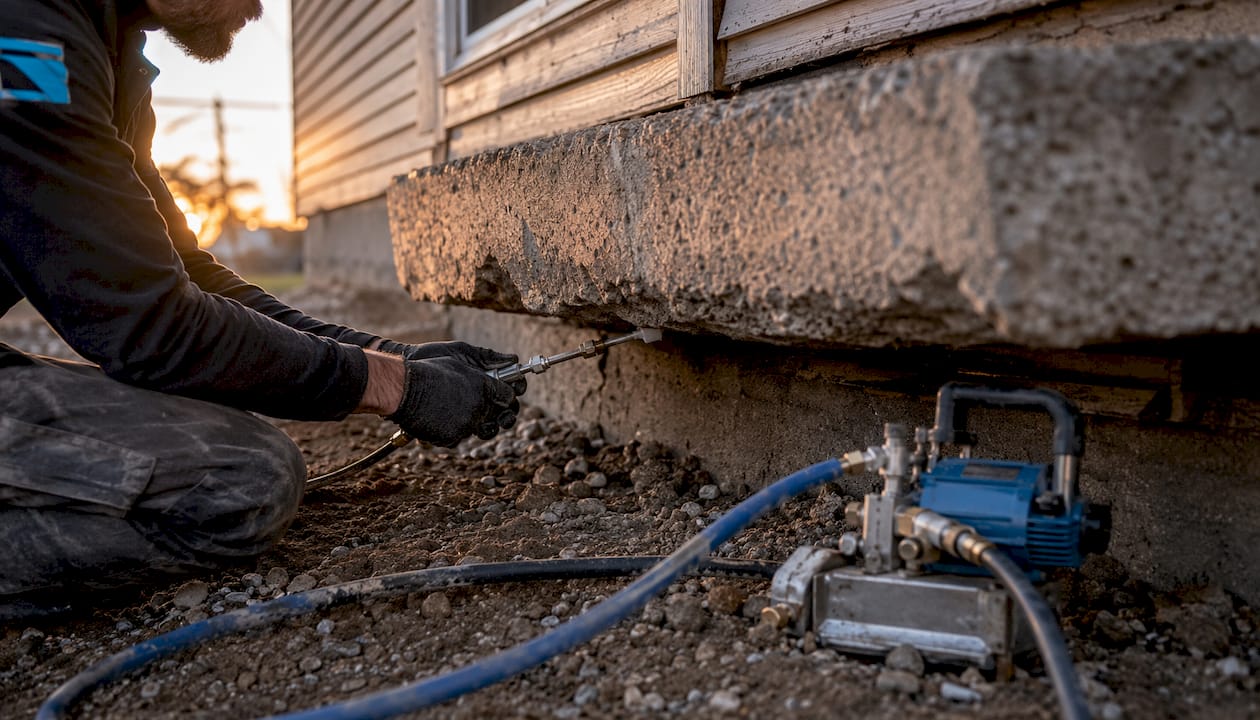
Correcting slab elevation restores proper drainage patterns, which reduces hydrostatic pressure against foundation walls and lowers the risk of moisture-related foundation movement. For homes with slab foundations specifically, leveling interior or garage slabs can also relieve stress on load-bearing areas that have shifted due to soil movement beneath the concrete.
The long-term value of foundation repair is tied directly to catching these problems before they compound. A slab that tilts toward the foundation today can contribute to wall cracking, door misalignment, and floor unevenness within a few years if left alone.
Does slab leveling cost less than the value it protects?
In most cases, yes, by a meaningful margin. Slab leveling costs a fraction of full concrete replacement, and both cost far less than the buyer discount applied to a home with visible, unrepaired settlement. The math is straightforward: buyers price in uncertainty, and unrepaired problems carry a risk premium that typically exceeds the actual repair cost.
The value protection calculation works like this. A home with unrepaired foundation or slab issues can lose 10–30% of its market value in buyer negotiations. Leveling a driveway or walkway costs a fraction of what a buyer would demand as a concession for the same visible defect. The repair cost is the smaller number in almost every scenario.
For homeowners not planning to sell, the calculation is different but the conclusion is similar. Catching settlement early means a leveling job. Waiting until the slab has cracked severely or begun affecting the foundation means replacement or, worse, foundation repair, which costs orders of magnitude more. Investing in professional concrete leveling early is the lower-cost path in nearly every scenario.
Curb appeal also has a dollar value. Homes with level, damage-free concrete surfaces tend to receive better initial offers, and first impressions set the anchor for every negotiation that follows. Pairing slab leveling with other visible improvements like exterior painting compounds the effect on buyer perception.
Environmental factors that affect how well slab leveling holds up
Soil type, climate, and drainage patterns all influence how long a leveled slab stays level. In regions with expansive clay soils, like much of the American Southeast, soil swells when wet and shrinks when dry. That repeated movement is one of the most common causes of slab settlement, and it is also one of the reasons re-settlement can occur if drainage is not corrected before leveling.
Freeze-thaw cycles in northern climates create a different problem. Water that infiltrates beneath a slab expands when it freezes, lifting the concrete, then contracts when it thaws, leaving voids beneath the surface. Over multiple cycles, those voids cause settlement. Proper sealing of slab joints and surface cracks before winter reduces this risk.
Tree roots are another underappreciated factor. Roots growing beneath driveways and walkways displace soil and create uneven pressure that tilts slabs over time. Leveling a slab without addressing nearby root intrusion is a temporary fix at best. A contractor who evaluates the full site, not just the settled panel, is the one worth hiring.
How slab leveling affects your insurance and appraisal outcomes
Insurance carriers and appraisers both treat visible, unrepaired slab settlement as a risk indicator. For insurance, a property with documented trip hazards can face higher liability premiums or coverage exclusions, particularly for slip-and-fall claims. Correcting the hazard and documenting the repair removes that exposure.
For appraisals, the impact is more nuanced. Appraisers look at the cause of settlement, not just its presence. A slab that settled due to poor drainage, and where that drainage has not been corrected, signals ongoing risk. A slab that settled, was leveled by a licensed contractor, and has documented drainage corrections signals a maintained property. Those two scenarios produce different appraisal adjustments.
FHA and VA loan appraisals apply stricter standards to visible concrete defects than conventional appraisals. A cracked or settled driveway slab can trigger a repair requirement that delays or kills a transaction. Completing the repair before listing eliminates that risk entirely and keeps the transaction on schedule.
Key Takeaways
Slab leveling protects property value by eliminating the safety hazards, structural risks, and buyer uncertainty that unrepaired settlement creates, and documented repairs typically recover $12,000–$22,000 over selling a home with known foundation defects.
| Point | Details |
|---|---|
| Value protection, not inflation | Slab leveling prevents value loss of 10–30% from unrepaired settlement; it restores baseline, not above-market value. |
| Documentation drives appraisal outcomes | Photos, invoices, and transferable warranties convert a defect into a maintained feature appraisers treat favorably. |
| Root cause first | Leveling without fixing drainage or soil issues risks re-settlement and repeated value loss. |
| Leveling beats replacement on cost | Leveling costs less per square foot, causes less disruption, and delivers comparable value protection for moderately settled slabs. |
| Timing matters before a sale | Complete repairs at least six months before listing to allow documentation, follow-up inspection, and appraiser review. |
The real case for slab leveling most homeowners miss
Most articles frame slab leveling as a way to increase property value. That framing is slightly off, and the distinction matters when you are making a financial decision.
Slab leveling does not typically push your home above its market baseline. What it does is prevent the discount that buyers and appraisers apply when they see a problem and lack documentation that it was handled. That discount, driven by uncertainty and perceived risk, routinely exceeds the repair cost. You are not buying upside. You are buying back the value you already had.
The more interesting argument for slab leveling is the one about compounding damage. A settled driveway slab that redirects water toward your foundation is not just a curb appeal problem. It is the beginning of a sequence that can end in foundation repair, which costs far more and carries a much larger appraisal impact. Addressing slab settlement early is almost always the lower-cost path, and it keeps a manageable problem from becoming a structural one.
What I find homeowners consistently underestimate is the power of documentation. A repair with photos, a warranty, and a licensed contractor’s invoice is a different asset than the same repair without those records. One gives a buyer confidence. The other gives them a reason to negotiate. The repair itself is only half the job.
FAQ
Does slab leveling increase my home’s appraised value?
Slab leveling typically restores your home to its baseline market value rather than pushing it above it. It eliminates the appraisal discount applied to unrepaired settlement, which is where the real financial benefit lies.
What lowers property value the most when it comes to concrete?
Unrepaired foundation and slab problems are among the most damaging value factors, with buyers applying discounts that can reach 10–30% of market value. Visible settlement, active cracking, and poor drainage around the foundation all trigger significant buyer risk premiums.
What are the drawbacks of concrete leveling?
Leveling is not appropriate for severely deteriorated or structurally compromised slabs, which require full replacement. It also provides limited long-term benefit if the root cause, such as poor drainage or expansive soil, is not corrected before the repair.
Can you raise a house that sits on a slab foundation?
Lifting a slab-foundation home is possible but technically complex and requires specialized equipment and engineering assessment. For most homeowners, the more practical application is leveling adjacent slabs, such as driveways and walkways, rather than the structural foundation slab itself.
Recommended
- Polyurethane Foam Leveling Benefits for Homeowners – Tallahassee Foundation Repair | Foundation ResQ
- Slab Foundation Repair in Tallahassee: What to Expect in 2026 – Tallahassee Foundation Repair | Foundation ResQ
- Meet the Slab Jackers: Experts in Concrete Lifting – Tallahassee Foundation Repair | Foundation ResQ