
A properly installed and maintained sump pump prevents many common basement floods by collecting groundwater in a sump pit and automatically ejecting it away from your foundation the moment water reaches a preset level. What it will not stop: sewer backflow, overland flooding that overtops your discharge line, or hydrostatic pressure cracking through foundation walls. For those scenarios, you need a backwater valve, exterior grading work, or structural repair alongside the pump.
Three things to do right now:
- Check pump status: Unplug the pump, pour water into the pit, replug, and confirm it activates and discharges outside.
- Confirm discharge routing: Trace the pipe to its outlet. It should terminate at least 10 feet from your foundation on permeable ground, not toward a neighbor’s yard or a sidewalk.
- Consider a backup: Power outages and heavy storms arrive together. A battery backup or dual-pump setup keeps you protected when the grid goes down.
The float switch that triggers your pump typically activates when water reaches a moderate depth in the pit. A check valve on the discharge line stops ejected water from draining back in and forcing the pump to short-cycle. Both components are small, cheap, and among the most common failure points in any system.
Table of Contents
- How sump pumps prevent flooding: the mechanics behind the system
- Which pump type fits your home?
- Backup options that keep you protected when the power goes out
- What sump pumps actually protect against — and where they fall short
- What to confirm before approving a sump pump installation
- How to maintain and test your sump pump before storm season hits
- What sump pumps and full systems typically cost
- When to DIY and when to call a waterproofing professional
- How Foundationresq integrates sump pumps into whole-house waterproofing
- Key Takeaways
- A practitioner’s perspective on the mistakes homeowners keep making
- Foundationresq: professional waterproofing and sump pump services for your home
- Useful sources for homeowners
- FAQ
How sump pumps prevent flooding: the mechanics behind the system
Understanding the parts makes troubleshooting much easier. Here is what a standard residential sump system contains and how each piece fits together.
Key components:
- Sump pit (basin): A cylindrical liner sized to fit common residential basement installations, set into the lowest point of the basement floor. Water from the surrounding soil or an interior perimeter drain flows into it.
- Float or pressure switch: Senses rising water and signals the motor to start. Float switches ride the water surface on a tether; pressure switches use field-effect technology and have no moving parts.
- Pump motor and impeller: The motor spins an impeller that draws water in through an intake screen and forces it up the discharge pipe.
- Discharge pipe: Carries water from the pit up and out of the house. PVC is standard.
- Check valve: An inline one-way valve that closes the moment the pump shuts off, preventing backflow into the pit.
- Outlet point: Where water exits — ideally to a storm drain, dry well, or open ground at least 10 feet from the foundation.
Step-by-step operation sequence:
- Groundwater or interior drain water flows into the sump pit.
- The water level rises until it reaches the float or pressure switch trigger point (typically 8–12 inches).
- The switch signals the motor to start; the impeller spins and draws water through the intake screen.
- Water travels up the discharge pipe and out of the house.
- The pump shuts off once the water level drops below the switch threshold.
- The check valve closes, blocking discharged water from returning to the pit.
- The system sits idle until the next trigger event.
Common parts and their failure modes:
| Component | Common failure mode | Result |
|---|---|---|
| Float switch | Tangled or stuck on pump housing | Pump never starts or runs continuously |
| Check valve | Debris jam or worn seal | Water returns to pit; short cycling |
| Intake screen | Clogged with sediment or gravel | Reduced flow; motor overheats |
| Discharge pipe | Frozen or blocked outlet | Pump runs but water cannot exit |
| Motor/impeller | Worn bearings or burned windings | No water movement despite running |
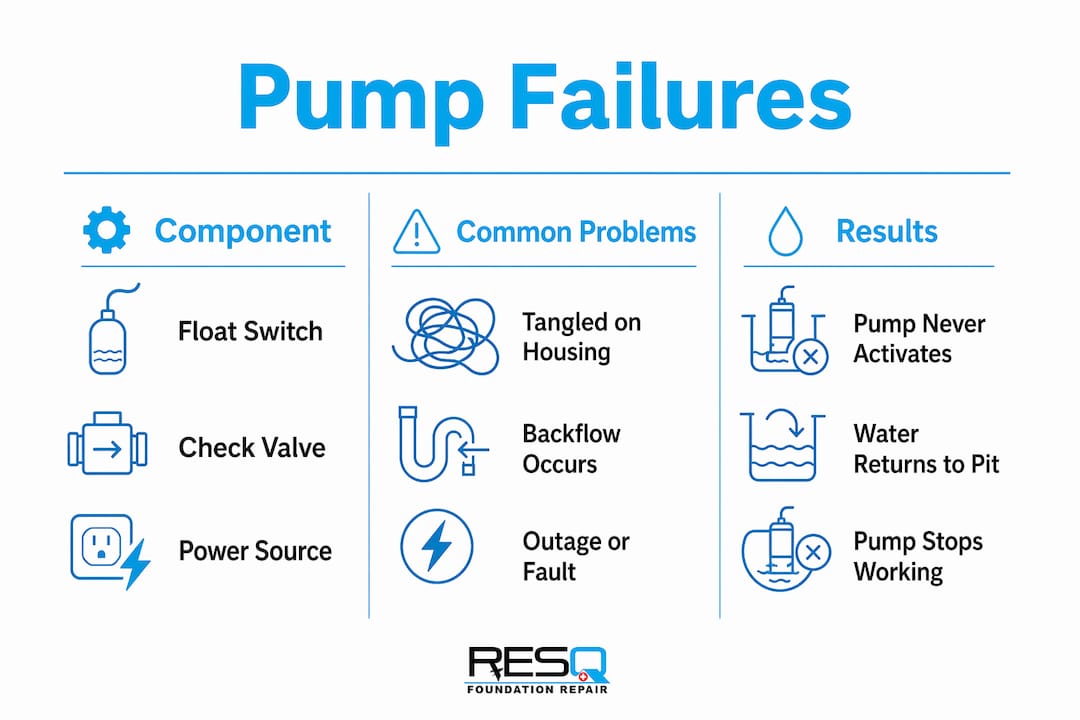
A sump pump is reactive by design: it removes water that has already reached the pit. Pair it with an interior French drain to relieve hydrostatic pressure before water enters the living space, and you have a real waterproofing system rather than a last-resort bucket.
Which pump type fits your home?
Two primary designs dominate the residential market, with combination units bridging both.
Submersible pumps sit fully submerged inside the pit. The motor is sealed against water intrusion, which keeps noise low and allows the unit to handle small debris without jamming. Most homeowners with a finished basement or a pit that collects sediment choose submersible. The trade-off is cost: submersibles run higher than pedestals, and motor repairs require pulling the unit from the pit.
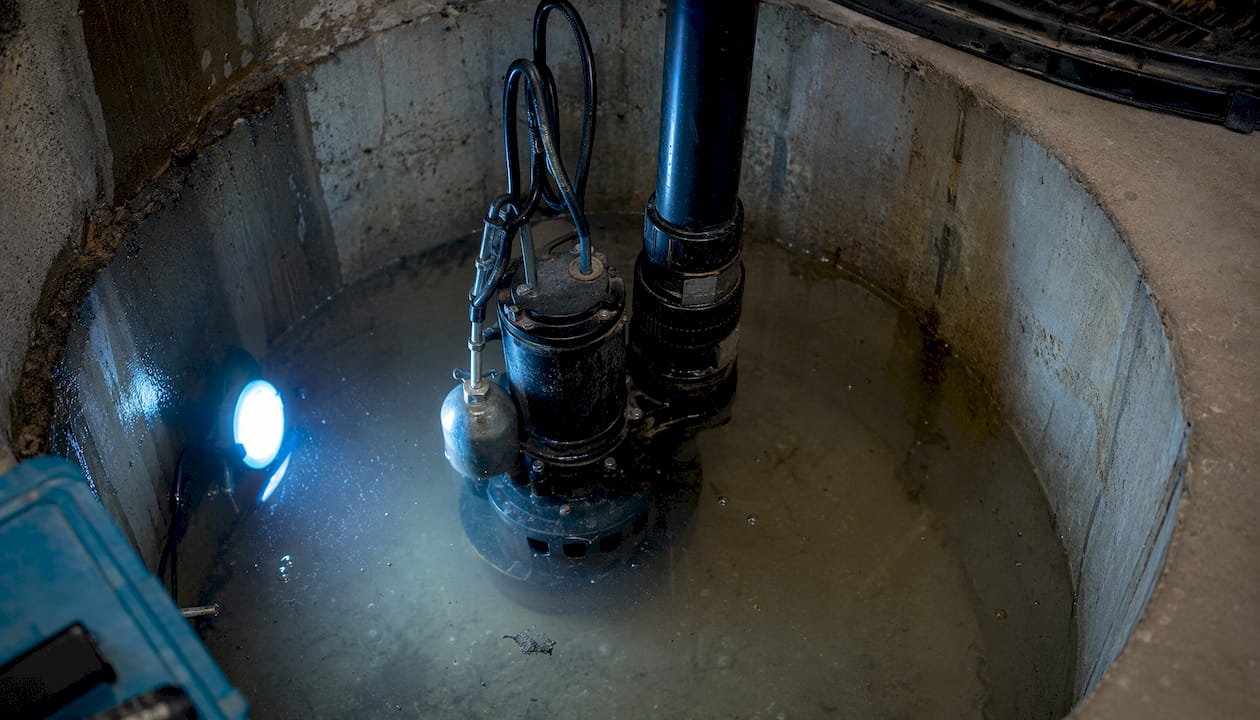
Pedestal pumps mount the motor on a column above the pit, with only the impeller and intake submerged. The motor is accessible without reaching into the pit, which simplifies servicing. Noise is noticeably higher because the motor sits in open air. Pedestal units tend to cost less upfront and can outlast submersibles in clean-water conditions because the motor never contacts water.
Combination primary/backup units pair a primary AC pump with a battery-powered secondary in a single housing. They cost more than either standalone option but eliminate the need to install a separate backup system.
| Type | Power source | Noise level | Debris tolerance | Typical cost (unit only) |
|---|---|---|---|---|
| Submersible | AC | Low | Moderate | $150–$400 |
| Pedestal | AC | High | Low | — |
| Combination primary/backup | AC + DC battery | Low–moderate | Moderate | — |
Quick selection guide:
- Finished basement or low-clearance pit: submersible.
- Unfinished utility basement, tight budget, clean groundwater: pedestal.
- High flood risk or frequent storm outages: combination unit or separate battery backup.
Backup options that keep you protected when the power goes out
Power outages commonly coincide with the storms that cause basement flooding. Your primary pump runs on household current, which means the moment the grid fails, your protection disappears unless you have a backup.
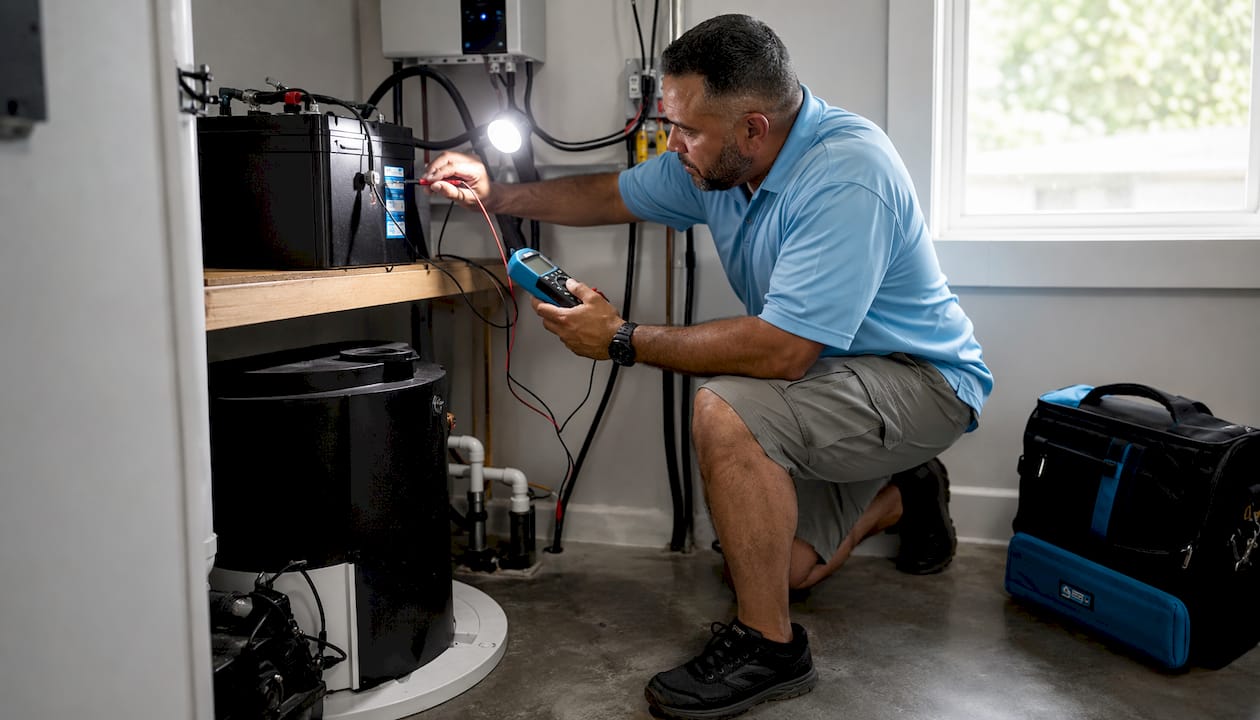
Battery backup units connect to a dedicated 12V or 24V deep-cycle battery and activate automatically when the primary pump cannot run. Most residential units provide several hours of continuous run-time on a fully charged battery, though actual duration depends on how frequently the pump cycles. The battery requires replacement every 3–5 years regardless of use; a dead backup battery is no backup at all.
Water-powered backup pumps use municipal water pressure to create suction via a venturi effect, requiring no electricity and no battery. They work only where municipal water pressure is available and consume roughly two gallons of tap water for every gallon of sump water removed. Check local codes before installing one; some municipalities restrict them.
Dual-pump setups run two independent primary pumps in the same pit, wired to separate circuits. If one motor fails or a breaker trips, the second takes over. This is the highest-capacity redundancy option for homes in flood-prone areas or with a high water table.
Alarms and remote alerts are the cheapest layer of protection. A float-activated audible alarm mounted a few inches above the pump’s trigger level warns you before water reaches the floor. Wi-Fi-enabled water sensors paired with a smart home hub send push notifications to your phone during a storm, even when you are away.
Pro Tip: Mount your audible alarm at least two inches above the pump’s normal activation level so it only sounds when the pump is failing to keep up. For remote alerts, place a Wi-Fi water sensor on the pit rim and connect it to a notification app before storm season starts.
What sump pumps actually protect against — and where they fall short
A sump pump handles one specific problem well: groundwater that migrates through soil and into a sump pit. That covers a lot of common basement flooding scenarios, including a high water table pushing water through the floor slab, interior perimeter drain discharge after heavy rain, and seepage through porous block or concrete walls that drains to the pit.
What a pump cannot do:
- Stop sewer surcharge. When a municipal sewer line backs up, sewage enters through floor drains and toilet connections. A sump pump is isolated from sanitary lines. The correct fix is a backwater valve on the main sewer line.
- Handle overland flooding. If a river overtops its banks or surface runoff enters through windows and doors, the volume overwhelms any residential pump.
- Relieve hydrostatic pressure on its own. A pump removes water from the pit; it does not reduce the pressure bearing against your foundation walls. Without a perimeter drain to intercept that pressure first, structural damage can still occur even with a working pump.
- Substitute for exterior water management. Negative grading, clogged gutters, and downspouts that discharge against the foundation send water straight to your walls before any interior system can intercept it.
A sump pump is the final mechanical stage of a drainage strategy, not the whole strategy. Without a perimeter drain to relieve hydrostatic pressure, a pump can only remove water after it enters the basement — it cannot stop long-term structural damage driven by that pressure. Pair the pump with drainage, grading, and a backwater valve where needed, and you have a system that actually protects the structure.
Diagnosing the water source matters. Water coming up through a floor drain almost always signals sewer surcharge and needs a backwater valve. Water seeping through the floor slab or wall base points to groundwater, which is where a sump pump and drainage system belong.
What to confirm before approving a sump pump installation
Most homeowners hire a contractor for installation, but knowing the basics lets you ask the right questions and catch shortcuts before they become problems.
Installation checklist:
- Pit location: The pit should sit at the lowest point of the basement floor, ideally at the corner where two perimeter walls meet. Water naturally flows there.
- Pit liner: Use a perforated liner (18–24 inches diameter minimum) so groundwater can enter from the sides, not just the top.
- Discharge routing: Pipe exits the house and terminates at least 10 feet from the foundation on permeable ground. Discharging onto a sidewalk, toward a neighbor’s property, or into a sanitary sewer line violates most local codes.
- Check valve placement: Installed on the vertical discharge run, above the pump but below any freeze line, so the valve body stays warm.
- Freeze protection: In climates with hard winters, insulate the discharge line where it passes through an unheated space, or use a freeze-relief hole drilled just above the pump to prevent a blocked line from burning out the motor.
- Daylight vs. dry well discharge: Daylight discharge (open ground) is simplest; a dry well works where surface discharge is restricted. Confirm the dry well has adequate capacity for your soil’s percolation rate.
Questions to ask your installer:
- Does this installation require a permit in my municipality?
- Where exactly does the discharge terminate, and can you show me?
- Is the discharge line sloped continuously downward to prevent standing water that could freeze?
- What size pump are you specifying, and how did you calculate the required capacity?
Exterior measures reduce the load on any interior system. Redirecting roof runoff with downspout extensions and maintaining positive grading away from the foundation cuts the volume of water a pump must handle, which extends motor life.
How to maintain and test your sump pump before storm season hits
Most pump failures happen during storms, not on dry days. A simple annual test and a quarterly check routine catch problems before they matter.
Step-by-step test procedure:
- Locate the discharge outlet outside and confirm it is clear of debris, ice, or obstructions.
- Pour a five-gallon bucket of water slowly into the sump pit.
- Watch the float rise and confirm the pump activates automatically.
- Go outside and verify water is visibly discharging from the outlet.
- Let the pump run until it shuts off on its own, then confirm it stops cleanly.
- Check that the water level in the pit drops and does not immediately refill (which would indicate a failed check valve).
This fill-test method is one of the highest-return maintenance actions a homeowner can take.
Maintenance schedule:
- Monthly: Pour water into the pit and confirm automatic activation.
- Quarterly: Inspect the float for tangles or obstructions; confirm it moves freely.
- Twice a year: Clean the intake screen; check the discharge line opening for debris.
- Annually: Remove the pump, clean the pit of sediment and gravel, inspect the check valve, and test the backup system.
- Every 5 years: Replace the check valve proactively. A failed check valve causes short cycling that can kill a motor in 1–3 years.
Signs of impending failure:
- Pump runs but water level in the pit does not drop.
- Pump cycles on and off rapidly (short cycling).
- Unusual grinding or rattling noise during operation.
- Visible rust or corrosion on the motor housing.
- Pump runs continuously without shutting off.
Lifespan and replace-by guidance: Most sump pump motors last 8–12 years with regular maintenance. Set a replace-by date at the 10-year mark. Proactive replacement costs a few hundred dollars and an afternoon; reactive replacement after a basement flood costs far more.
What sump pumps and full systems typically cost
Costs vary significantly by scope, region, and whether you are replacing an existing pump or starting from scratch.
Typical price ranges:
- Pump unit only (submersible): $150–$400 for the hardware.
- Basic pump replacement (swap existing unit): Often under $2,000 installed, including labor and basic parts.
- New installation with pit: Higher than a straight swap due to excavation and liner work.
- Interior perimeter drain plus sump pump: System installations typically range $4,000–$8,000 depending on basement perimeter length and regional labor rates.
- Battery backup add-on: $200–$500 for the unit; add $100–$200 for installation.
Example cost scenarios:
| Scenario | Approximate cost range |
|---|---|
| Full interior perimeter drain + pump | $4,000–$8,000 |
Regional labor rates, soil conditions, and basement depth all shift these numbers. Get at least two written quotes for any job over $1,000. The lifespan math is straightforward: a pump replaced proactively at 8–10 years costs a fraction of the water damage, mold remediation, and structural repair that follows a flood.
When to DIY and when to call a waterproofing professional
Swapping a failed pump for a new one in an existing pit is a reasonable DIY job for a handy homeowner. Everything beyond that usually warrants a professional.
Call a pro when you see:
- Water entering through the floor drain (sewer surcharge, not a pump problem).
- Sewage smell in the basement.
- Water seeping through wall cracks or the base of the wall, not just the floor.
- The pump runs constantly without lowering the water level.
- Repeated flooding despite a working pump (points to drainage design failure).
- Any sign of foundation movement: stair-step cracks in block walls, bowing walls, or doors that no longer close properly.
- Electrical issues near the pump circuit.
Decision flow for common scenarios:
- Pump is dead, pit is dry otherwise, no structural concerns: Replace the pump yourself or hire a plumber.
- Pump works but basement still floods: The drainage system is inadequate. Call a waterproofing contractor.
- Water comes through the wall, not the floor: Hydrostatic pressure or a crack. A pump alone will not fix this.
- Sewage smell or floor drain backup: Call a plumber for a backwater valve assessment.
- Foundation cracks or wall movement: Call a structural contractor before touching the waterproofing.
Questions to ask a waterproofing contractor:
- What is the source of the water, and how did you determine that?
- Will a pump alone solve this, or do I need interior drainage as well?
- What warranty do you offer on the system, and what does it cover?
- Are you licensed and insured in this state?
For persistent seepage or recurring problems, a professional sump pump repair and waterproofing assessment gives you a diagnosis, not just a part swap.
How Foundationresq integrates sump pumps into whole-house waterproofing
Foundationresq serves homeowners across North Florida, South Georgia, and Alabama, and sump pump installation and repair sit inside a broader waterproofing workflow rather than as a standalone service. The process starts with an inspection to identify the water source: groundwater through the slab, seepage through wall cracks, or a drainage design problem. That diagnosis determines whether a pump alone is sufficient or whether interior drainage, exterior grading corrections, or foundation repair needs to come first.
Integrated solution checklist Foundationresq applies:
- Identify water entry points (floor, wall base, cracks, floor drain).
- Assess water table conditions and seasonal flooding patterns for the property.
- Size the pump correctly for the pit volume and expected inflow rate.
- Recommend interior perimeter drain installation where hydrostatic pressure is the driver.
- Confirm discharge routing meets local code and terminates away from the foundation.
- Evaluate backup needs based on local storm frequency and power reliability.
- Assess exterior grading and downspout routing to reduce load on the interior system.
- Flag any foundation movement that requires structural stabilization before waterproofing.
Services include sump pump installation and repair, battery backup systems, interior perimeter drains, basement waterproofing, crawl space encapsulation, and mold remediation. For homeowners in the service area, a free inspection is the starting point for understanding what the home actually needs.
Key Takeaways
A sump pump prevents basement flooding by collecting groundwater in a pit and ejecting it away from the foundation automatically, but it works best as part of a drainage system that includes interior perimeter drains, proper grading, and a battery backup for storm outages.
| Point | Details |
|---|---|
| Pump role and limits | Removes groundwater from a sump pit; cannot stop sewer backup, overland flooding, or hydrostatic wall pressure alone. |
| Backup is non-negotiable | Power outages coincide with storms; a battery backup or dual-pump setup maintains protection when the grid fails. |
| Lifespan and replace-by | Most pumps last 8–12 years with regular maintenance; set a replace-by date at the 10-year mark. |
| Annual test procedure | Pour water into the pit, confirm automatic activation, and verify visible discharge outside at least once a year. |
| Foundationresq inspection | Foundationresq diagnoses water source, sizes the pump, and integrates drainage and foundation repair for North Florida, South Georgia, and Alabama homeowners. |
A practitioner’s perspective on the mistakes homeowners keep making
The single most common mistake is treating a sump pump as a complete solution rather than the last line of defense. A pump that runs every time it rains is not doing its job well — it is compensating for a drainage or grading problem that should have been fixed upstream. When a pump cycles frequently, the real question is: why is so much water reaching the pit in the first place?
Seasonal checklist:
- Spring thaw: Test the pump with the fill method before the first heavy rain. Inspect the discharge outlet for frost heave or debris that accumulated over winter.
- Storm season (summer/fall): Confirm battery backup is charged and the battery is less than 3–5 years old. Check that downspout extensions are directing water at least 6 feet from the foundation.
- Winterizing: Insulate exposed sections of the discharge line in freeze-prone climates. Drill a small freeze-relief hole in the discharge pipe just above the pump if the line runs through an unheated space.
The homes that flood are almost never the ones with a failed pump alone. They are the ones where the pump was the only layer of protection, and that layer gave out at the worst possible moment.
Foundationresq: professional waterproofing and sump pump services for your home
Replacing a pump yourself is straightforward. Figuring out why your basement keeps flooding despite a working pump is not. Foundationresq specializes in exactly that second problem: diagnosing the water source, designing a drainage system that actually relieves pressure, and installing the pump and backup as the final mechanical stage of a system that works.

For homeowners in North Florida, South Georgia, and Alabama, Foundationresq offers free inspections covering sump pump condition, discharge routing, interior drainage needs, and foundation integrity. Services span sump pump installation and repair, battery backup systems, interior perimeter drains, basement waterproofing, crawl space encapsulation, and mold remediation. If the scope of the repair gives you pause on cost, financing options are available for larger projects. Schedule your free inspection at foundationresq.com/basement-waterproofing-services and get a clear picture of what your home actually needs before the next storm season.
Useful sources for homeowners
- EPA: A Brief Guide to Mold, Moisture, and Your Home — The EPA’s primary resource on moisture control and mold prevention; useful for understanding why keeping basements dry matters beyond flood damage.
- Wikipedia: Sump Pump — A solid technical overview of pump types, float switch mechanics, and maintenance principles.
- Wikipedia: Basement Waterproofing — Covers interior and exterior waterproofing methods, drainage systems, and how pumps fit into the broader strategy.
- American Family Insurance: How Long Should a Sump Pump Last? — Practical lifespan guidance and replacement planning from an insurance perspective.
- Sump Pump Central: What Is a Sump Pump? — Detailed breakdown of components, float trigger specs, and discharge routing requirements.
- Foundationresq: Sump Pump Installation in Tallahassee — Local installation guidance and service contact for North Florida homeowners.
FAQ
Will a sump pump prevent all basement flooding?
A sump pump prevents flooding caused by groundwater and high water table conditions, but it cannot stop sewer backflow, overland flooding, or water entering through foundation cracks under hydrostatic pressure. For complete protection, pair the pump with interior drainage, a backwater valve, and proper exterior grading.
How do you stop a sump pump from short cycling?
Short cycling is almost always caused by a failed or missing check valve that lets discharged water drain back into the pit. Replace the check valve first; if cycling continues, check that the float switch is not stuck and that the discharge line terminates far enough from the foundation to prevent recirculation.
What is a better alternative to a sump pump for basement water?
There is no single alternative that does the same job. An interior French drain relieves hydrostatic pressure but still needs a pump to remove collected water. A backwater valve handles sewer surcharge but not groundwater. Exterior grading and waterproofing reduce water volume reaching the foundation. Most effective solutions combine two or more of these approaches rather than replacing the pump entirely.
How many years does a sump pump usually last?
Most sump pumps last 8–12 years with regular maintenance. Set a replace-by date at the 10-year mark. Pumps in high-water-table areas or with infrequent maintenance tend to fail at the lower end of that range.
Recommended
- Sump Pump Installation in Tallahassee: Protecting Your Home from Moisture Damage – Tallahassee Foundation Repair | Foundation ResQ
- 7 Critical Sump Pump Failure Signs Tallahassee Homeowners Must Know
- How the Water Table Affects Basement Flooding – Tallahassee Foundation Repair | Foundation ResQ
- How to Assess Sump Pump Performance in Your Basement – Tallahassee Foundation Repair | Foundation ResQ