
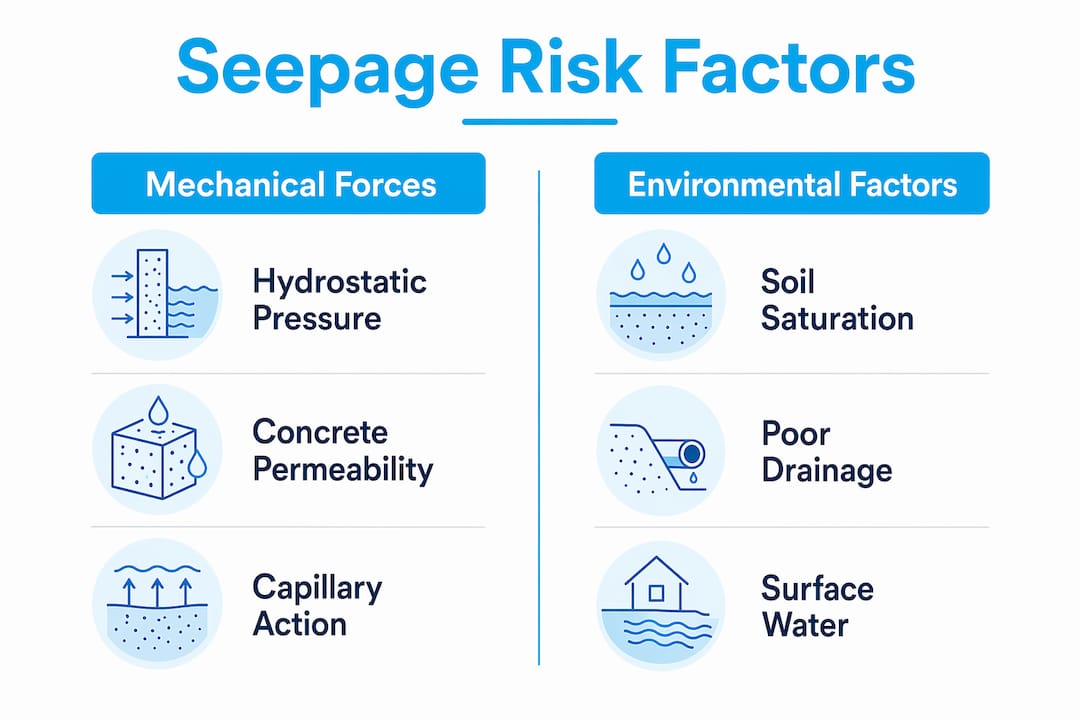
Basement seepage is the intrusion of water through foundation walls or floors, driven by hydrostatic pressure, soil saturation, and concrete permeability. Left unaddressed, this moisture problem escalates from a minor nuisance into a structural threat that compromises your home’s foundation, air quality, and resale value. Why basement seepage becomes a major issue is straightforward: water does not stop moving once it finds a path. Basement flooding accounts for nearly 30% of all foundation-related problems for homeowners. That number reflects how often a “damp corner” turns into a full repair project.
Why basement seepage becomes a major issue: root causes
Seepage issues arise from a combination of soil, water, and construction factors rather than a single defect. That complexity is exactly why a quick patch rarely holds. Understanding each cause helps you target the right fix.
Hydrostatic pressure is the primary mechanical force behind most basement leaks. Water in saturated soil presses outward and downward against your foundation walls. Water pressure increases with depth, which is why seepage almost always starts at the base of walls first, not at the top.
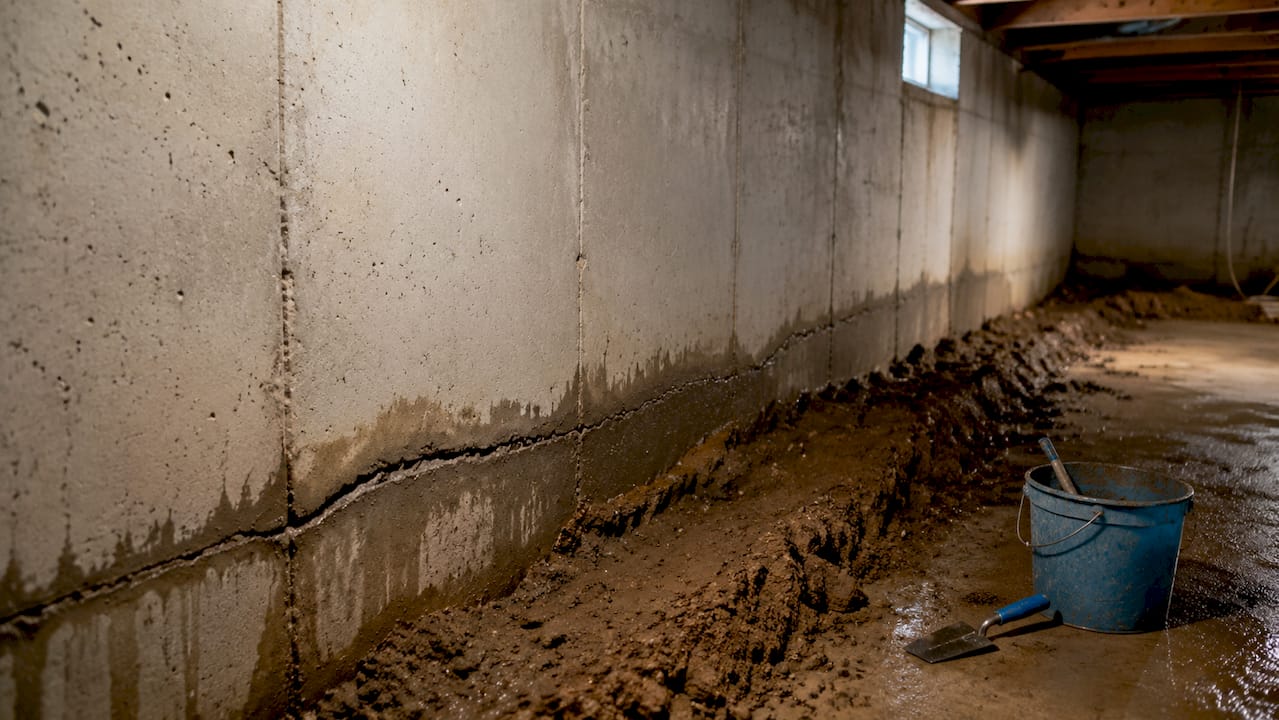
Concrete permeability and capillary action compound the problem. Concrete is not waterproof by nature. It contains microscopic pores that draw moisture inward through capillary suction, even when no visible crack exists. This process is slow but relentless, and it deposits minerals on the wall surface over time.
Poor external drainage multiplies the pressure your foundation faces. Drainage failures can increase hydrostatic pressure by up to 50%, raising seepage risk significantly. A yard that slopes toward the house, or gutters that dump water near the foundation, creates the same effect as a slow flood around your basement walls.
| Cause | Typical Impact |
|---|---|
| Hydrostatic pressure | Forces water through cracks and porous masonry at wall base |
| Poor grading or drainage | Concentrates surface water against foundation, raising pressure |
| Concrete capillary action | Draws moisture through pores even without visible cracks |
| Clogged or short downspouts | Deposits roof runoff directly at the foundation perimeter |
| Soil type (clay-heavy) | Retains water longer, sustaining pressure between rain events |
Pro Tip: Check your yard’s slope after a heavy rain. If water pools within 6 feet of your foundation, your grading is contributing to seepage risk right now.
It also matters whether you are dealing with surface water or groundwater. Surface water leaks often appear after storms, while groundwater seepage produces persistent dampness regardless of recent rainfall. Each source calls for a different response, which is why diagnosing the type of moisture matters before you spend money on repairs.
What signs show seepage is becoming a structural threat?
Catching seepage early is the difference between a manageable repair and a major structural project. Several warning signs tell you the problem has moved beyond surface dampness.
- White mineral deposits on walls (efflorescence). Efflorescence is a definitive indicator of active water migration through masonry. It signals that moisture has been moving through your concrete consistently, not just once after a storm.
- Cracks at the base of walls or along the cove joint. The cove joint is the seam where your basement floor meets the wall. This joint is structurally non-bonded, making it a primary entry point for pressure-driven seepage that surface patches cannot fix.
- Bowing or bulging walls. Sustained water pressure against a foundation wall causes the concrete or block to flex inward over time. You can learn more about what this progression looks like in this guide on bowing basement walls.
- Persistent musty odors. A musty smell means mold or mildew is actively growing. Mold requires sustained moisture, so that odor confirms the seepage is not a one-time event.
- Rust stains near floor drains or wall anchors. Metal components corrode when exposed to chronic moisture. Rust streaks are a reliable sign that water has been present long enough to cause material degradation.
Pro Tip: Run your hand along the base of your basement walls after a dry week. Any dampness you feel is capillary moisture, not rainwater, and it means the problem is active even without recent rain.
Prolonged seepage does not just stain walls. It weakens the concrete matrix itself, reducing the wall’s load-bearing capacity over time. Once structural movement begins, repair costs rise sharply.
How drainage failures and indoor humidity accelerate damage
Most homeowners focus on what is happening inside the basement. The bigger driver of seepage severity is almost always outside.
Clogged gutters are a leading contributor to foundation moisture problems. When gutters overflow, they deposit roof runoff directly against the foundation perimeter. Downspouts should discharge at least 4 feet away from the foundation to prevent this concentration of water. Most homes in older neighborhoods fall short of that standard.
Grading failures are equally damaging. Soil settles over time, and a yard that once sloped away from the house may now slope toward it. This redirects every inch of rainfall straight toward your foundation. Proper gutter maintenance, including cleaning gutters seasonally, is one of the most cost-effective ways to reduce the water load on your foundation.
Inside the basement, humidity control matters more than most homeowners realize. High indoor humidity creates vapor pressure that pulls additional moisture through porous walls. Maintaining relative humidity between 30% and 50% reduces this effect and slows mold growth. A quality dehumidifier running continuously in a damp basement is not a luxury. It is a maintenance tool.
The most effective long-term strategy is to manage moisture at its source with exterior grading and drainage before treating symptoms inside. Skipping this step and going straight to interior coatings is the most common and costly mistake homeowners make.
Interior coatings alone do not solve seepage. Trapped water finds new entry points, often behind the coating where you cannot see it. Hidden deterioration accelerates, and the next repair is always more expensive than the one you avoided.
How to prevent and fix basement leaks before they worsen
The most effective approach to basement moisture problems combines exterior source control with interior moisture management. Neither alone is sufficient for a lasting result.
Exterior solutions to address first
- Regrade soil so it slopes away from the foundation at a minimum of 1 inch per foot for the first 6 feet.
- Extend downspouts at least 4 feet from the foundation, or connect them to underground drainage lines.
- Install or repair French drains to redirect groundwater away from the foundation perimeter.
- Keep window wells clear of debris and install covers to prevent direct water entry.
Interior measures that support the system
- Run a dehumidifier rated for your basement’s square footage to keep humidity in the 30%–50% range.
- Inspect and maintain your sump pump annually. A failed sump pump during a heavy rain event is one of the fastest ways seepage becomes a flood.
- Seal visible cracks with hydraulic cement as a temporary measure, but treat it as a diagnostic step, not a permanent fix.
- Improve ventilation to reduce condensation on cold walls and floors.
| Approach | Best For | Limitation |
|---|---|---|
| Exterior regrading | Surface water redirection | Does not address groundwater pressure |
| French drain system | Groundwater management | Requires professional installation |
| Sump pump system | Active water removal | Needs power and regular maintenance |
| Interior dehumidifier | Humidity and vapor control | Does not stop liquid water entry |
| Interior drainage channel | Managing water that enters | Treats symptom, not source |
Moisture enters basements via liquid flow, vapor diffusion, capillary suction, and air movement. A repair plan that addresses only one of these pathways will fail. A systemic diagnosis, one that maps all four entry mechanisms, is the only approach that produces a permanent result.
Pro Tip: Before calling a contractor, photograph every damp spot, crack, and stain in your basement after a heavy rain. That visual record helps a professional identify the source pattern faster and gives you documentation if you are buying or selling the home.
When seepage has caused visible wall movement, floor heaving, or persistent mold growth, professional assessment is not optional. These are signs that the structural integrity of your foundation is already compromised. For homeowners managing moisture across both basement and crawl space areas, understanding how to keep your crawl space dry is equally important, since moisture migrates between connected spaces.
Key takeaways
Basement seepage becomes a major structural issue when water pressure, drainage failures, and concrete permeability combine without intervention.
| Point | Details |
|---|---|
| Seepage starts with pressure | Hydrostatic pressure at the wall base is the primary force driving water through cracks and pores. |
| Drainage failures multiply risk | Poor grading and clogged gutters can increase hydrostatic pressure by up to 50%. |
| Efflorescence is an early warning | White mineral deposits on walls confirm active water migration and signal the need for professional review. |
| Interior coatings are not a fix | Sealing surfaces alone traps moisture and redirects it to new entry points, worsening hidden damage. |
| Systemic diagnosis is required | Lasting repair requires addressing exterior drainage, interior humidity, and structural entry points together. |
Why i think most homeowners underestimate this problem
I have seen a lot of basements, and the pattern is almost always the same. A homeowner notices a damp spot, buys a can of waterproofing paint, and considers the problem solved. Two years later, the wall is bowing and the repair estimate is five times what it would have been.
The misconception is that seepage is a cosmetic issue. It is not. It is a pressure problem. Water does not care about paint. It will find the path of least resistance, and if you block one path without addressing the source, you have simply redirected the damage somewhere less visible.
What I find most useful to tell homeowners is this: treat efflorescence the way you would treat a check engine light. It does not mean your house is falling down today. It means something is wrong and getting worse. The cost of ignoring it is always higher than the cost of investigating it.
The other thing I push back on is the idea that exterior work is too expensive to bother with. Regrading a yard and extending downspouts costs a fraction of what a French drain or interior drainage system costs. Start outside. Fix the source. Then evaluate what interior work is actually needed. Most of the time, you will need less than you feared.
Seepage is a structural warning sign. The homeowners who treat it that way protect their investment. The ones who treat it as a nuisance pay for it later.
— Kayle
Protect your foundation before seepage gets worse
Basement moisture problems do not resolve on their own. Every season you wait, water pressure and soil movement do more work on your foundation walls and floor. Foundationresq specializes in diagnosing and permanently resolving basement seepage, foundation damage, and moisture intrusion for homeowners in the Tallahassee area.

Whether you are seeing your first signs of dampness or dealing with visible wall cracks, Foundationresq offers free inspections so you know exactly what you are facing before committing to any repair. Explore your permanent foundation repair options or use the repair cost estimator to understand what a fix might cost. You can also schedule a free inspection and get a professional assessment before the problem grows.
FAQ
What is basement seepage and why does it matter?
Basement seepage is water intrusion through foundation walls or floors caused by hydrostatic pressure, capillary action, and drainage failures. It matters because unchecked seepage weakens concrete, promotes mold growth, and leads to costly structural repairs.
What are the first signs of a serious basement moisture problem?
Efflorescence (white mineral deposits), cracks at the cove joint, musty odors, and bowing walls are the clearest early indicators. Any of these signs means seepage has been active long enough to begin damaging your foundation.
Can i fix basement leaks with waterproofing paint?
Interior coatings do not eliminate seepage. They trap moisture behind the surface, which redirects water pressure to new entry points and causes hidden deterioration that is more expensive to repair.
How does poor drainage outside cause basement problems?
Clogged gutters, short downspouts, and soil that slopes toward the house concentrate water against your foundation. This raises hydrostatic pressure by up to 50%, forcing water through cracks and porous concrete at an accelerated rate.
When should i call a professional about basement seepage?
Call a professional when you see wall cracks, bowing, persistent mold, or water that returns after patching. These signs indicate the seepage has progressed beyond surface moisture and requires a systemic structural assessment.
Recommended
- Is That Puddle a Problem? A Guide to Crawl Space Water Damage – Tallahassee Foundation Repair | Foundation ResQ
- Drowning in Damp? Expert Tips for Crawl Space Water Removal – Tallahassee Foundation Repair | Foundation ResQ
- Mold After a Leak? How to Tackle Crawl Space and Basement Mold Yourself – Tallahassee Foundation Repair | Foundation ResQ
- Is a Crawl Space Drainage System a Bad Idea? Find Out Here – Tallahassee Foundation Repair | Foundation ResQ