
Interior drain tile rarely needs excavation or invasive repair, but the parts you can reach, the sump pump, check valve, and discharge line, need a real inspection every year. Test the pump before storm season, watch for a wet cove joint or short cycling, and if the pump passes but water still shows up at the perimeter, that points to a buried problem a camera inspection can confirm. Fix the exterior drainage (gutters, grading, discharge routing) at the same time, because a clean sump won’t compensate for water that keeps finding its way back to the foundation.
TL;DR:
- Annual testing of the sump pump, including cleaning the inlet screen and running a bucket test, can prevent most failure issues before they cause damage.
- Problems like buried clogs, collapsed pipes, or iron ochre buildup often require professional inspection with a camera, especially when visible components test normal but water still seeps around the foundation.
- Homeowners can clear simple blockages at accessible cleanouts but should avoid chemical drain treatments and unnecessary slab work, which are unlikely to resolve deeper pipe issues.
- Proper exterior drainage, including gutter maintenance and yard grading, is essential to reduce the water load on the interior drain tile system and extend its lifespan.
- Drain tile systems mostly last several decades if installed correctly; heavy clay soil and poor grading increase water pressure and shorten the system’s effective life.
Table of Contents
- Your Annual Interior Drain Tile Maintenance Checklist
- How Do You Safely Test Your Drain Tile System?
- Cleaning Your Drain Tile: What You Can Do vs. What to Leave Alone
- When Should You Call a Drainage Professional?
- Preventing Drain Tile Problems From Outside the House
- How Long Do Interior Drain Tiles Actually Last?
- Does Soil Type Affect How Well Drain Tile Performs?
- Does Your Basement Flooring Affect Drain Tile Maintenance?
- Seasonal Maintenance: Protecting Your System From Freeze-Thaw Damage
- Beyond Cleaning: Common Drain Tile Repair Techniques
- The Health Risks of Neglected Drain Tile Systems
- An Editorial Take on Drain Tile Maintenance Priorities
- How Foundation RESQ Handles Interior Drain Tile Problems
- Primary Sources for Drain Tile Maintenance
- Sources
- FAQ
Your Annual Interior Drain Tile Maintenance Checklist
Most interior drainage failures trace back to skipped maintenance on the one component homeowners can actually reach: the sump pump. FEMA’s sump-pump guidance recommends a full assessment at least once a year, and that single habit catches most problems before they become foundation repairs.
Here’s the sequence to run every spring, and again before hurricane season if you’re in a storm-prone region:
- Cut power to the pump before touching anything.
- Remove the pump and clean the inlet screen. FEMA notes some homes benefit from doing this more than once a year, especially if the sump collects sediment.
- Inspect the check valve for cracks or a stuck flapper.
- Reinstall the pump and run a bucket test, pour water into the basin and confirm the float triggers and the pump clears it.
- Watch for warning signs between inspections: a pump that runs constantly, one that short cycles, a damp cove joint where the wall meets the floor, new stains on the slab, or standing water along the perimeter.
Keep a simple log with the pump model, its install date, and every service visit. If the pump is past the 10 year mark or acting strangely, FEMA’s own guidance says replace it rather than nurse it along. A $150 pump failing during a heavy rain event costs a lot more than a $150 pump replaced on your schedule.
How Do You Safely Test Your Drain Tile System?
Testing takes fifteen minutes and tells you more than a visual glance ever will. Clear any debris from the inlet screen, check the discharge line for kinks or blockages outside the house, and inspect the check valve, the small one way flap that keeps water from flowing back into the pit after the pump shuts off.
Then run the bucket test: pour water in steadily and time how fast the float rises and triggers the motor.
Pro Tip: Test right after a heavy rain, not just on a dry afternoon. A dry-day test only proves the motor works, while a storm test proves the whole system can keep up with real water volume.
The results tell you where to look next. If the pump activates normally but you’re still seeing water at the perimeter or a persistently damp cove joint, the problem probably isn’t the pump at all, it’s likely a buried clog, a cracked connector pipe, or a section of collapsed drain tile downstream. If the pump doesn’t run at all, suspect an electrical issue, a stuck float switch, or a burned out motor.
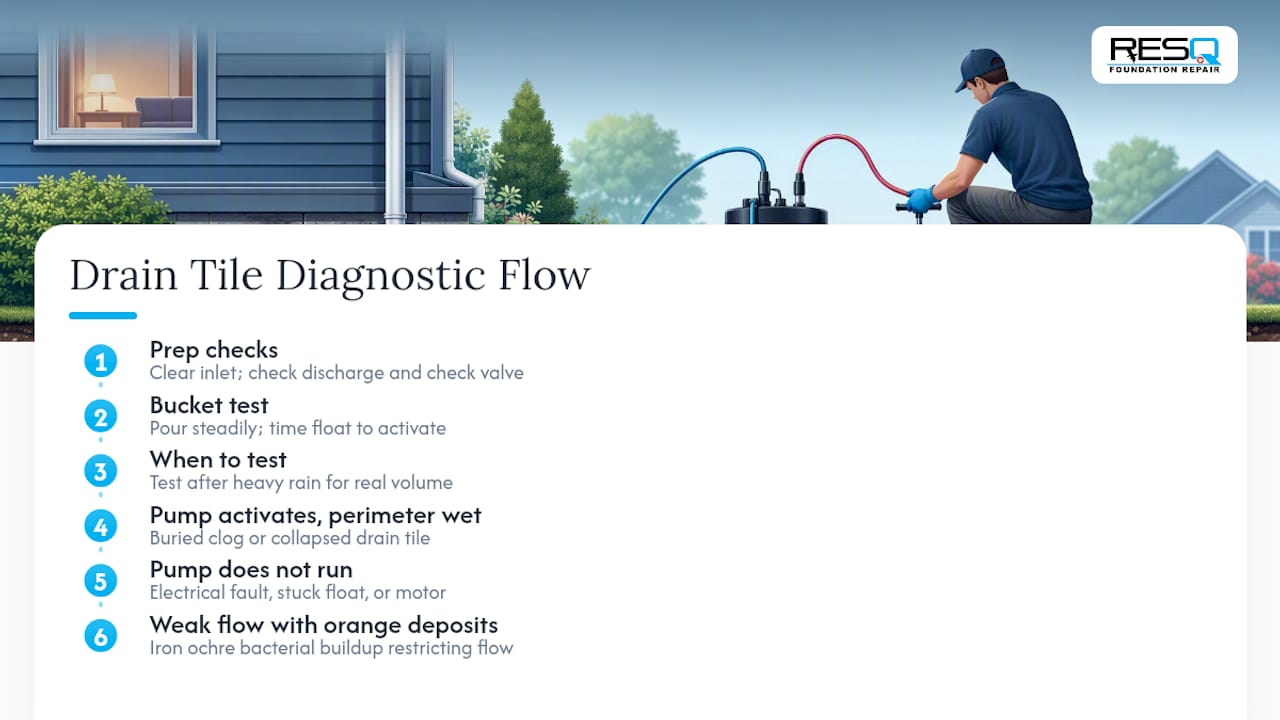
One diagnostic clue worth flagging early: reddish or orange deposits in the sump basin or a discharge stream that’s noticeably weaker than it used to be. That’s often iron ochre, a bacterial buildup that can restrict flow inside the pipe long before you’d notice a difference at the surface.
Cleaning Your Drain Tile: What You Can Do vs. What to Leave Alone
Homeowners can handle a fair amount of maintenance without ever calling in a contractor. What you should not do is treat a stubborn clog like a problem you can solve with a hardware store bottle of drain cleaner.
Here’s where the line sits:
- Clean the pump inlet screen and scoop out any sediment or debris sitting in the sump basin.
- Clear the visible portion of the discharge outlet outside your home, leaves, mulch, and ice are common culprits.
- If your system has an accessible cleanout, a garden hose flush at low pressure can knock loose fresh, minor buildup.
- A plumber’s snake through an accessible cleanout is reasonable for a suspected shallow clog, but stop and call a professional the moment the snake meets resistance you can’t clear or the water backs up again within days.
What to avoid entirely: pouring aggressive chemical drain treatments into the system. Michigan State University Extension’s research on iron ochre notes that ochre buildup hardens over time, and chemical treatments have real limits against it once that happens. Don’t cut into the slab without a diagnostic first, and don’t assume a new pump fixes a clog that’s sitting upstream in the pipe itself, replacing the pump when the actual problem is a collapsed lateral just wastes money and delays the real fix.
When Should You Call a Drainage Professional?
Call a professional when the accessible parts check out fine but the symptoms don’t stop. That combination, a passing pump test alongside recurring seepage, is the clearest sign the problem sits somewhere a homeowner can’t reach or safely diagnose.
Specific triggers worth acting on:
- Water keeps appearing at the cove joint or perimeter even after the pump tests normally.
- You suspect root intrusion or see the reddish staining associated with iron ochre.
- A section of pipe may have collapsed or separated from the sump connection, something University of Minnesota Extension flags as a common and easily missed failure point.
- Your garden hose flush or snake attempt made no difference after two tries.
A qualified contractor will typically run a camera inspection through an existing cleanout to see exactly what’s happening inside the pipe, then decide between low pressure flushing, high pressure jetting, or targeted excavation depending on what the footage shows. Ask specifically: Will you show me camera footage before recommending repairs? Will you try jetting before you talk about excavation? Are permits required for this scope of work? What’s covered under warranty once the repair is done?
Pro Tip: Get the diagnosis in writing, with photos or video, before agreeing to any excavation. A camera inspection costs far less than tearing into a slab on a guess.
Preventing Drain Tile Problems From Outside the House
The drain tile system doesn’t work in isolation. It’s absorbing whatever water your roof, gutters, and yard grading fail to redirect, and fixing those exterior factors first is often more effective than any amount of interior cleaning. Building America’s guidance on sump and drainage systems treats discharge routing as part of the drainage system itself, not an afterthought.
A few things worth checking every season:
- Keep gutters clear and route downspouts at least 5 feet from the foundation, or further if your yard slopes toward the house.
- Confirm the ground slopes away from your foundation walls; regrading a low spot is often cheaper than any drain tile repair it would otherwise cause.
- Fill or extend window wells with coarse gravel so they drain instead of collecting runoff against the foundation wall.
- Trim tree roots and rethink plantings positioned close to the footings, root intrusion is a documented cause of drain tile blockage.
- Check that your sump discharge outlet is visible, unobstructed, and actually routes water away from the house rather than letting it pool back toward the foundation, which the same Building America guidance warns can recirculate moisture right back into the system it’s supposed to protect.
How Long Do Interior Drain Tiles Actually Last?
Modern interior drain tile, almost always perforated PVC pipe wrapped in a fabric sock rather than the old clay tile the name comes from, typically holds up for several decades when it was installed correctly and the soil around it hasn’t shifted. The material itself rarely wears out on its own; PVC doesn’t corrode or rot the way older clay segments could.
What actually shortens the lifespan is what happens around the pipe: sediment settling into the gravel bed, root intrusion working through joints, or iron ochre accumulating inside the perforations. ENERGY STAR’s national water management specifications describe the standard for sound installation: pipe set below the slab, surrounded by clean gravel, wrapped in filter fabric, and routed either to daylight or to a sump.
If your home still has its original permits or builder documentation, check them. Installation depth, gravel type, and pipe diameter all vary by jurisdiction and by the era the house was built, so don’t assume your system matches a neighbor’s just because the houses look similar. A system installed to spec in the 1990s can still be performing exactly as designed. One installed with undersized gravel or without a fabric sock might start showing sediment issues well before the pipe itself would ever fail.
Does Soil Type Affect How Well Drain Tile Performs?
Soil type has more influence on drain tile performance than most homeowners realize. Clay soil holds water and drains slowly, which means a drain tile system serving a clay heavy lot works harder and stays wetter for longer after every rain event compared to the same system under sandy or well draining soil.
Homes on clay or compacted soil tend to see more hydrostatic pressure pushing against foundation walls, which increases the volume the interior drainage system has to handle. That extra load makes sump pump reliability even more important, a pump that’s marginal on sandy soil can get overwhelmed on clay after the same storm. University of Minnesota Extension’s research on basement moisture points out that treating the visible symptom, like sealing a crack, without accounting for how the surrounding soil behaves tends to fail because the underlying water pressure hasn’t changed.
Moisture content matters just as much as soil composition. A yard that stays saturated because of poor grading or a high water table puts continuous pressure on the drain tile, while a yard that dries out between storms gives the system time to catch up. If your property sits on heavy clay, prioritize the exterior grading and gutter fixes covered earlier, since they reduce the total water load your drain tile has to manage in the first place.
Does Your Basement Flooring Affect Drain Tile Maintenance?
Whatever sits on top of your basement floor determines how easily you, or a technician, can get to the drain tile system when something goes wrong. A poured slab with no finish gives direct access to any cleanouts and lets water stains and cracks show up where you can actually see them.
Finished basements complicate that picture. Carpet, laminate, or a framed out wall built along the perimeter can hide the early warning signs, a damp cove joint, a hairline crack, discoloration, until the problem has had time to spread. Tile and stained concrete finishes tend to hold up better around drain tile access points since they’re less absorbent, but they still cover the cleanouts most systems rely on for camera inspections or flushing.
If you’re finishing a basement that has interior drain tile, leave access points exposed or install removable panels over cleanouts rather than sealing them behind drywall. It’s a small design choice that saves a contractor from cutting into finished walls later, and it means you can run your own annual checks without moving furniture or pulling up flooring first.
Seasonal Maintenance: Protecting Your System From Freeze-Thaw Damage
Freeze-thaw cycles put real stress on any part of the drainage path that sits above ground or close to the surface, mainly the discharge line and the point where it exits your foundation wall.
In fall, before temperatures drop, clear gutters one final time and disconnect any garden hose extensions on the discharge line, trapped water in a hose freezes and can crack fittings. Check that the discharge outlet itself is elevated slightly and angled to drain fully rather than pooling water that will freeze solid overnight.
In winter, walk the discharge line’s exterior path after any hard freeze and look for ice buildup at the outlet. A frozen discharge line backs water up into the sump, and a sump that can’t discharge is a sump that’s about to overflow during the next thaw or rain event.
In spring, run your full annual pump test as soon as the ground thaws, this is when winter damage to the discharge line or check valve typically shows up first, and it’s also when snowmelt puts the heaviest seasonal load on the system. Inspect for any cracking in the exterior discharge pipe caused by ground movement during freeze cycles.
In summer, this is your maintenance window for anything that requires digging or exterior work, extending a downspout, regrading a low spot, replacing a cracked discharge pipe, since the ground is workable and you’re not racing a storm.
Beyond Cleaning: Common Drain Tile Repair Techniques
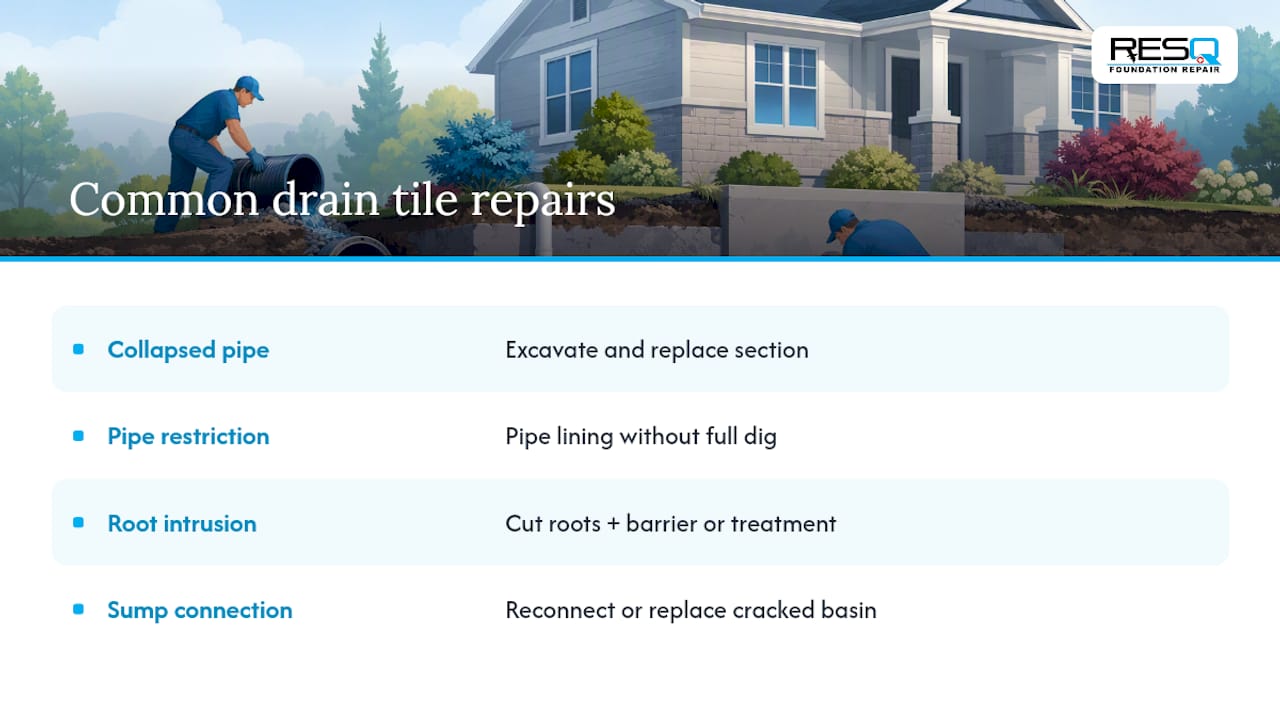
When cleaning and flushing don’t solve the problem, the repair options escalate based on what a camera inspection actually shows. A section of collapsed or crushed pipe usually gets replaced outright rather than repaired in place, contractors excavate the specific run, remove the damaged segment, and install new perforated pipe with fresh gravel and fabric wrap around it.
For pipe that’s structurally sound but severely restricted by ochre or root intrusion, pipe lining is sometimes an option, a process that inserts a new interior surface inside the existing pipe without full excavation. It’s less disruptive than a full dig, though it works best on runs where the underlying pipe hasn’t physically deformed.
Root intrusion repairs typically combine mechanical removal of the roots themselves with a barrier or chemical root treatment near the joint to slow regrowth, since simply cutting roots out without addressing the entry point invites the same problem within a year or two. For persistent iron ochre, MSU Extension’s drainage research points to design changes as the longer term fix, larger perforations, synthetic sock filters, or steeper pitch, rather than repeated jetting on a system that’s poorly matched to the ochre risk in that soil.
A broken sump connection is its own category of repair, sometimes it’s a simple reconnection, other times the sump basin itself needs to be reset or replaced if it’s cracked or undersized for the water volume reaching it.
The Health Risks of Neglected Drain Tile Systems
A drain tile system that isn’t managing water properly doesn’t just risk foundation damage, it creates the exact conditions mold and mildew need to establish themselves. Standing water in a sump pit, a chronically damp cove joint, or moisture trapped behind finished basement walls all provide the sustained humidity mold spores need to take hold.
Mold growth in a basement rarely stays contained to the wet area. Airflow moves spores throughout the home’s lower level and, depending on your HVAC setup, potentially into the air circulating on upper floors too. Musty odors are usually the first sign, showing up long before you’d see visible growth, especially behind finished walls or under flooring that’s hiding the moisture source from view.
This is one more reason the annual pump test and seasonal checks matter beyond protecting the foundation itself. Catching a failing check valve or a clogged discharge line before it causes standing water means catching a mold problem before it starts, rather than after you’re already dealing with remediation on top of a drainage repair.
An Editorial Take on Drain Tile Maintenance Priorities
Most homeowners either ignore drain tile entirely or panic and assume every damp spot means the whole system needs replacing. Neither instinct serves you well. The diagnostic order that actually works is boring and sequential: test the pump, check the discharge, and only escalate to a camera inspection or excavation once the evidence points past the parts you can reach. Document what you see, dates, photos of stains or standing water, before any contractor walks through your door. That record turns a vague “it’s been damp” into a diagnosis someone can actually act on.
— Kayle
How Foundation RESQ Handles Interior Drain Tile Problems
If your pump tests fine but water keeps showing up at the perimeter, that is exactly the point where guessing gets expensive and a proper diagnostic pays for itself. A professional contractor works through that same sequence homeowners should start with themselves, sump and pump evaluation, discharge inspection, then camera work through existing cleanouts when the accessible components check out but the symptoms persist.

During an inspection visit, expect a technician to walk the same path you already tested: pump function, discharge routing, and any visible signs at the cove joint or perimeter. Then document findings with photos before recommending anything invasive. That evidence based order matters because it means you’re not paying for excavation when a targeted repair or a sump pump service would have solved it. For homes where the drainage issue has already led to standing moisture or mold concerns, Foundationresq’s basement waterproofing services address the interior drainage path and the water source together rather than treating them as separate problems. If your annual pump test raised more questions than it answered, request an inspection and get a written diagnosis before committing to any repair.
Primary Sources for Drain Tile Maintenance
The guidance in this article draws directly from agency and university research rather than general contractor advice, and it is worth reading in full if you want the technical detail behind each recommendation.
- FEMA’s sump pump maintenance instructions cover the annual assessment checklist and pump replacement timeline in full detail.
- University of Minnesota Extension’s basement moisture guidance explains the systems approach to diagnosing drainage failures.
- Michigan State University Extension’s iron ochre bulletin details ochre clogging and jetting remedies.
- Building America’s sump and discharge guidance covers proper discharge routing and system design.
Sources
- Fema
- Moisture in basements: causes and solutions | UMN Extension
- Iron ochre clogging – Drainage | Michigan State University Extension
- Drain or Sump Pump Installed in Basements or Crawlspaces | Building America Solution Center
FAQ
How Do I Maintain Drainage Tiles?
Test the sump pump annually using FEMA’s checklist: disconnect power, clean the pump and inlet screen, inspect the check valve, then run a bucket test to confirm activation. Pair that with keeping gutters clear and grading yard soil away from the foundation, since exterior water management directly affects how hard the interior system has to work.
What Are the Most Common Problems With Drain Tile Systems?
The most frequent failures are silt or root intrusion clogging the pipe, a broken connection at the sump, a collapsed pipe section, and iron ochre buildup restricting flow, according to University of Minnesota Extension. Sump pump failure from a stuck float or worn motor is also common and is usually the easiest of these problems to catch early through annual testing.
Are Interior Drain Tiles Worth Installing?
For homes with a documented history of basement seepage or high water tables, interior drain tile paired with a working sump system is one of the more reliable ways to manage water that’s already found its way inside. It works best alongside exterior fixes like grading and gutter management rather than as a standalone solution, and a company like Foundationresq can evaluate whether your specific soil and water conditions justify the investment.
My Drain Tile Is Clogged. How Can I Clean It?
Start with what’s accessible: clear the sump basin, clean the pump inlet screen, and flush any reachable cleanout with a garden hose at low pressure. If that doesn’t restore flow, or if you see reddish iron ochre deposits, the clog likely needs professional jetting or a camera inspection rather than continued homeowner attempts, since MSU Extension notes that hardened ochre resists simple flushing.
How Often Should I Test My Sump Pump?
Test it at minimum once a year, and again before any predicted heavy storm season, per FEMA’s recommendation. Homes with sediment prone sumps or older pumps may benefit from checking the inlet screen more frequently than the annual full assessment.