
Mold exposure most commonly causes allergy-type and respiratory symptoms: a stuffy or runny nose, coughing, wheezing, and itchy or watery eyes, according to the CDC. Many of these complaints overlap with colds and seasonal allergies, so they are not proof of mold on their own. Severe shortness of breath or a high fever after heavy exposure needs immediate medical attention. For everything else, reduce your exposure first and call a clinician if symptoms are severe or do not improve.
TL;DR:
- Seek emergency care for severe breathlessness, trouble speaking, blue lips, or collapse; worsening wheezing, fever after heavy exposure, or persistent symptoms warrant prompt care.
- People with asthma, chronic lung disease, or weakened immunity should seek care sooner; children and older adults should stay out until cleanup is complete.
- Visible mold rarely needs sampling, and no federal airborne limits exist; urine mycotoxin screens cannot diagnose illness, so prioritize moisture repair over test results.
- Dry wet materials within 24 to 48 hours when possible, clean areas under 10 square feet yourself, and hire professionals for larger areas or HVAC contamination.
- Keep indoor humidity between 30% and 50%; recurring mold, basement or crawl space growth, or hidden moisture calls for professional assessment.
Table of Contents
- Common Symptoms, Organized by Body System
- Who Faces Higher Risk From Mold Exposure
- When to Seek Medical or Urgent Care
- How Clinicians Evaluate Suspected Mold-Related Illness
- Limits of Mold Testing and Mycotoxin Screens
- Immediate Steps to Cut Exposure and Clean Up Safely
- Preventing Mold From Coming Back
- When to Bring in Mold Remediation or Structural Repair Professionals
- How Mold Symptoms Connect to Foundation and Crawl Space Problems
- A Practical View on Health Versus Property Action
- FAQ
- Sources
Common Symptoms, Organized by Body System
Mold-related symptoms tend to cluster around a few body systems, which makes them easier to recognize even when they overlap with other illnesses.
- Upper respiratory: sneezing, nasal congestion or a runny nose, sore throat, and postnasal drip.
- Lower respiratory and asthma: cough, wheeze, chest tightness, and shortness of breath, which can mean a flare of existing asthma or, less often, a new reaction.
- Eyes and skin: red, itchy, or watery eyes, skin rash or dermatitis, and a burning sensation.
- Non-specific symptoms: headache, fatigue, and brain fog, which show up in many unrelated conditions and are not diagnostic on their own.
The CDC notes that these reactions reflect allergic responses, irritation, or asthma, and that some people are exposed to mold without developing any symptoms at all. One practical clue worth tracking: symptoms that ease up when you leave the building and return when you come back support a connection to that space, though it still is not a diagnosis by itself, a pattern clinicians weigh as part of a broader exposure history.
A useful marker: damp or moldy indoor spaces are linked to upper-respiratory symptoms, cough, and wheeze in otherwise healthy people, and to asthma exacerbations in those who already have asthma, per reviewed evidence on dampness and health.
Who Faces Higher Risk From Mold Exposure
Not everyone reacts to mold the same way, and that difference matters for how quickly you should act.
- People with asthma or chronic lung disease, whose airways react more strongly to irritants.
- People with weakened immune systems, who face a higher risk of more serious complications.
- Children, whose developing lungs and airways are more sensitive to irritants.
- Sensitized individuals who have already developed an allergic response to mold.
- Workers in high-dose settings such as farming, composting, or remediation, where exposure levels run far above a typical home.
If you fall into one of these groups, give yourself less room to wait out symptoms in a contaminated space. Faster consultation and faster professional remediation reduce the time you spend breathing irritants your body is least equipped to handle.
When to Seek Medical or Urgent Care
Most mold-related symptoms are manageable at home once exposure stops, but a few signs mean you should not wait.
- Call 911 or go to the emergency room for severe shortness of breath, trouble speaking in full sentences, blue-tinged lips, or collapse.
- See a clinician promptly for wheezing that is rapidly worsening, a fever that follows heavy mold exposure, or new respiratory symptoms that persist beyond a few days.
- Reach out earlier than you might otherwise if you have asthma, chronic lung disease, or a weakened immune system, since these conditions reduce your margin for waiting things out.
The CDC specifically recommends urgent care for severe respiratory reactions and flags that people with these underlying conditions should seek care sooner rather than later.
How Clinicians Evaluate Suspected Mold-Related Illness
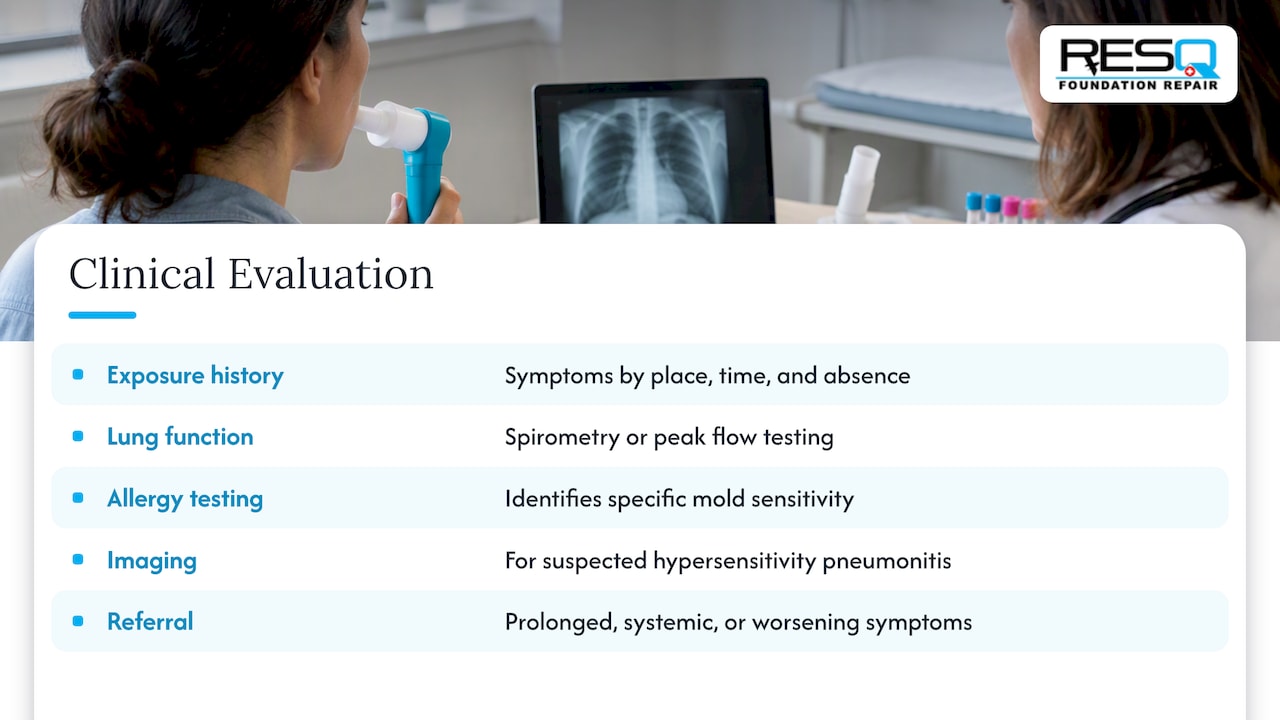
A clinician working up suspected mold-related illness starts with an exposure history: where your symptoms happen, whether you have seen or smelled mold, how symptoms track with time spent at home or work, and whether they ease when you are away.
From there, common diagnostics include spirometry or peak flow testing to check lung function, allergy testing to identify a specific mold sensitivity, and imaging when a specialist suspects hypersensitivity pneumonitis, a rarer but more serious reaction. There is no single lab test that confirms “mold illness” in most cases; the diagnosis is clinical, built from your history and these objective measures together rather than one standalone result. When symptoms are prolonged, systemic, or progressively worsening, a referral to pulmonology or allergy specialists becomes appropriate, since that workup goes beyond what a primary care visit typically covers.
Limits of Mold Testing and Mycotoxin Screens
When you can already see mold, testing for it rarely adds anything useful. The EPA states that sampling is usually unnecessary in that situation, and there are no federal standards for airborne mold concentrations to compare results against anyway. Surface sampling has a narrower, legitimate use: documenting that a cleanup worked. Professional air or surface sampling makes more sense for complex cases or legal disputes, where interpretation by an experienced inspector matters.
Urine mycotoxin tests, sold directly to consumers, are not a reliable way to diagnose mold-related illness, a point echoed in health reporting on the topic. The practical takeaway holds regardless of your specific situation: put your effort into fixing the moisture problem and cleaning safely rather than chasing a species-level identification or a test result that will not change your treatment plan.
Immediate Steps to Cut Exposure and Clean Up Safely
Once you spot a leak or moldy smell, speed matters more than precision.
- Stop the water source first, whether that is a plumbing leak, roof issue, or grading problem.
- Dry wet materials within 24 to 48 hours when possible, a window the EPA ties directly to limiting mold growth.
- Remove heavily contaminated porous materials such as soaked drywall or carpet padding that cannot be fully dried.
- Clean small areas yourself (under 10 square feet) using gloves, detergent, and thorough drying; call in professionals for larger areas or anything involving the HVAC system.
- Run dehumidifiers or exhaust fans to bring indoor humidity down toward 30 to 50 percent, and use HEPA filtration or HEPA vacuuming during cleanup to limit airborne spread.
- Keep children, older adults, and anyone with lung disease or immune compromise out of the affected area until cleanup is done.
Pro Tip: Open windows and run a box fan pointed outward while you clean. Pushing air out, rather than recirculating it indoors, keeps spores from settling in rooms you have already cleared.
For a closer look at drying timelines and why that 24 to 48 hour window matters so much, our guide on stopping moisture fast walks through the mechanics step by step, and a licensed contractor’s water-damage checklist covers the same early hours from a restoration standpoint.
Preventing Mold From Coming Back
Cleanup only solves today’s problem. Keeping mold from returning means managing moisture on an ongoing basis.
- Fix roof leaks, plumbing issues, and poor grading that channel water toward your foundation.
- Keep gutters and downspouts clear, and make sure basements and crawl spaces drain away from the structure.
- Run dehumidifiers and exhaust fans in bathrooms, basements, and kitchens to control humidity day to day.
- Check attics, crawl spaces, and window areas for condensation, a common early sign of a moisture problem before mold appears.
- Schedule routine checks of basements, crawl spaces, and HVAC systems rather than waiting for a smell or stain to prompt action.
Understanding why mold grows so quickly after water intrusion helps explain why these habits matter more in humid climates and older homes with a history of leaks.
When to Bring in Mold Remediation or Structural Repair Professionals
Widespread visible mold, moisture problems that keep coming back, crawl space or basement mold, or mold that reappears after a DIY cleanup are all signs the job has outgrown a bucket of detergent. A professional assessment typically includes an inspection, moisture mapping to find the source, containment during the work, and remediation paired with a fix for whatever is letting water in, not just surface cleaning.
We offer crawl space and basement waterproofing along with mold remediation services, with free inspections so you know what you are dealing with before committing to a repair plan. Before hiring any remediation company, ask about their containment methods, how they confirm the moisture source is fixed, and what their remediation process actually involves from start to finish.
How Mold Symptoms Connect to Foundation and Crawl Space Problems
Mold rarely shows up on its own. It is almost always a symptom of a structural or moisture problem somewhere in the building, and the health complaints people notice upstairs often trace back to a crawl space or foundation issue below.
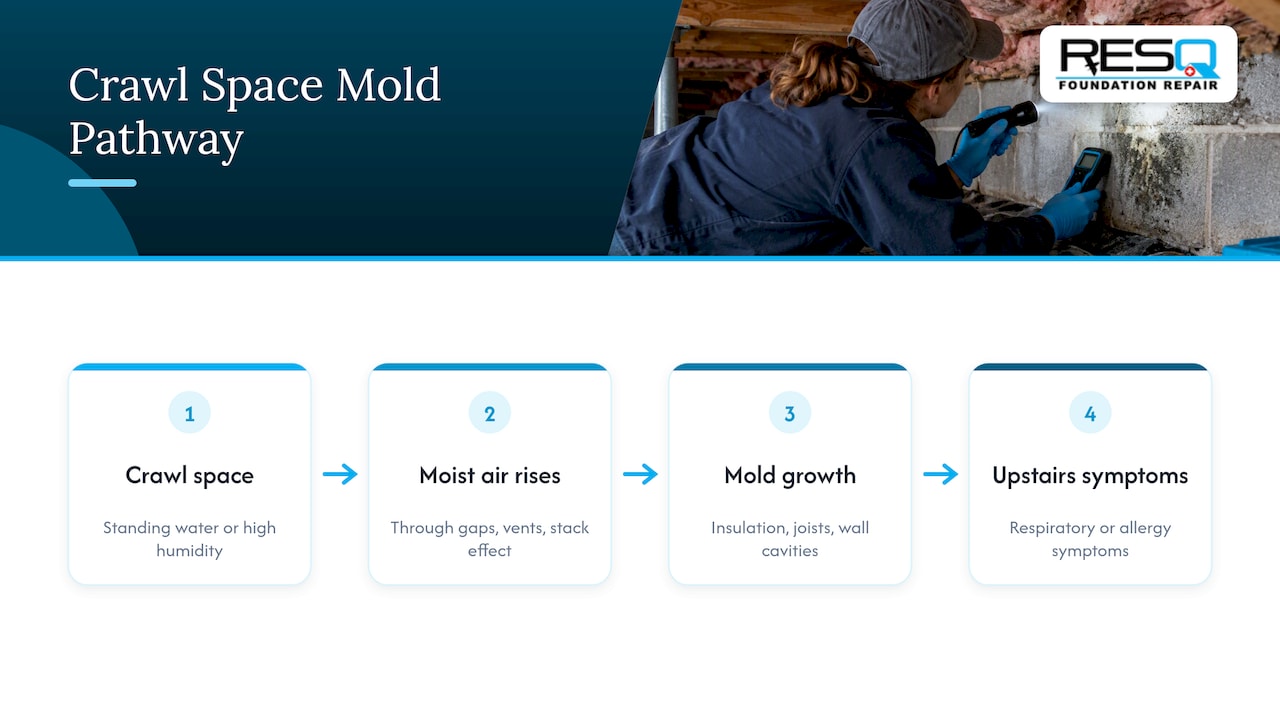
A crawl space with standing water or high humidity pushes moist air upward into living spaces through gaps, vents, and the stack effect, feeding mold growth in places you rarely see: subfloor insulation, joists, and wall cavities near the foundation. Foundation cracks and poor grading let groundwater intrude after heavy rain, and that water does not just damage concrete, it creates the damp conditions mold needs to establish itself. If your household’s respiratory or allergy symptoms seem tied to certain rooms, especially rooms closer to the ground floor or above a crawl space, that pattern is worth mentioning to both your clinician and whoever inspects your home.
This is also why treating the mold alone without addressing the underlying moisture source tends to produce recurring problems. A room can be cleaned and symptoms can ease for a while, but if the foundation crack or crawl space leak that caused the dampness is never fixed, the conditions for regrowth remain in place.
A Practical View on Health Versus Property Action
The right response to mold symptoms scales with severity, not with worst-case thinking. Mild, short-lived symptoms call for drying out the space and watching how you feel. Persistent or severe symptoms call for a clinician, and a home with recurring moisture calls for a building professional. The two conversations work best together, not in isolation.
— Kayle
This article is general information, not a substitute for advice from a qualified doctor. Consult a qualified healthcare professional about your own circumstances before acting on anything here.
FAQ
How do you clean black mold safely?
For a small area under 10 square feet, scrub the surface with detergent and water while wearing gloves, then dry it completely, following EPA guidance on cleanup scale. Larger areas, contamination inside the HVAC system, or mold that keeps returning call for a professional remediation team rather than a repeat DIY attempt.
How does mold exposure affect the nervous system?
Memory issues, mood changes, and brain fog are sometimes reported alongside mold exposure, but these symptoms are non-specific and show up in many other conditions. The CDC and EPA caution against using symptoms like these alone to diagnose mold-related illness, so a broader medical evaluation is the right next step.
What are the symptoms of a mold allergy?
A mold allergy typically causes sneezing, a runny or stuffy nose, itchy and watery eyes, and sometimes a skin rash, the same allergic pattern described by the CDC. People with asthma may also notice their symptoms worsening when mold levels in a space are higher.
What does mold look like in a home?
Mold commonly appears as fuzzy or slimy patches in black, green, white, or gray, often with a musty smell, and it tends to cluster in damp spots like bathrooms, basements, crawl spaces, and around past leaks. Discoloration or a persistent musty odor without visible growth can still signal a hidden moisture problem behind a wall or under flooring.
Can air sampling confirm whether my home has a mold problem?
Not usually. The EPA states that sampling is generally unnecessary when mold is already visible, and there are no federal limits for airborne mold to compare a result against. Fixing the moisture source and cleaning the visible mold matters more than getting a species-level lab result.
Sources
- Mold | CDC
- Mold testing or sampling | US EPA
- Can mold cause health problems? | US EPA
- Dampness and mould and the health effects: a review | PMC