
For most homes outside consistently dry, arid regions, a sealed and conditioned crawl space beats a vented one. Building science research backs this up with measured energy and moisture data. The main exceptions are homes in genuinely dry climates, properties in flood zones with legal venting requirements, and any crawl space with an unresolved bulk-water problem, gas appliance, or radon issue that needs fixing before sealing. Get those factors checked first. The Department of Energy’s Building America program and the decision checklist below can help you sort out which category your house falls into.
TL;DR:
- Vented crawl spaces often trap moisture in humid climates, while sealed and conditioned spaces provide better moisture control and reduce mold risk.
- In cold and humid regions, sealing and insulating the crawl space improves energy efficiency and prevents frozen pipes, but in dry climates, vented spaces can still perform well.
- Converting a crawl space requires inspecting for water issues and radon, sealing vents and penetrations, installing vapor barriers, and adding dehumidification; DIY sealing can backfire without proper steps.
- Homeowners should evaluate moisture levels with a hygrometer and assess risks like leaks, mold, pests, or gas appliances before deciding whether to seal or vent.
- A professional inspection from a qualified contractor is recommended to ensure proper sealing, safety, and compliance with local codes, especially in flood zones or when appliances are present.
Table of Contents
- Open Vs Closed Crawl Space: How Each System Actually Works
- Should You Open or Close Crawl Space Vents By Season?
- How to Convert a Vented Crawl Space to a Sealed One
- Why DIY Vent Sealing Often Backfires
- Open or Closed? A Decision Checklist for Your Home
- What Foundation RESQ Sees in the Field
- Get a Free Crawl Space Inspection
- Where This Guidance Comes From
- Sources
- FAQ
Open Vs Closed Crawl Space: How Each System Actually Works
A vented crawl space relies on foundation vents to exchange indoor and outdoor air, on the theory that airflow dries out ground moisture. A sealed crawl space, also called an encapsulated crawl space, closes those vents, covers the exposed dirt with a heavy vapor barrier, insulates the perimeter walls instead of the floor above, and conditions the air with a dehumidifier or a supply duct tied into the home’s HVAC system.
The venting theory made sense decades ago when building codes were written, but it has a flaw that shows up constantly in humid regions: outdoor air is often more humid than the air already trapped in the crawl space. When that warm, moist air hits the cooler soil, framing, and ductwork under your house, it condenses. You end up adding moisture instead of removing it.
Field monitoring backs this up. Studies comparing vented and sealed crawl spaces in mixed-humid climates found sealed spaces delivered meaningfully better moisture control and lower mold growth potential than their vented counterparts. The practical differences show up in a few consistent ways:
- Moisture and mold risk: sealed spaces run drier relative humidity year round; vented spaces swing with the weather.
- Energy use: conditioned air stays put instead of leaking through open vents, cutting HVAC losses.
- Pest and pest ingress: fewer open vents means fewer entry points for rodents, snakes, and insects.
- Duct performance: HVAC ducts routed through a vented crawl space lose conditioned air to a hot or freezing space; sealing keeps that air where it belongs.
Should You Open or Close Crawl Space Vents By Season?
Climate is the deciding factor, and it splits homes into three rough categories. In hot, humid, and mixed-humid regions, which cover most of the eastern and southeastern United States, sealed crawl spaces consistently outperform vented ones because outdoor air rarely offers real drying potential. In cold climates, sealing plus insulation prevents frozen pipes and cuts heat loss through the floor. In genuinely arid or desert climates, some regions still get good results from vented crawl spaces, since dry outside air actually pulls moisture out rather than adding it.
If you’re not ready to fully encapsulate and still rely on operable vents, seasonal management matters more than most homeowners realize:
- Late spring through summer: keep vents closed if humidity outside regularly exceeds indoor crawlspace humidity. Opening vents in a humid summer often makes things worse, not better.
- Fall through early spring: vents can stay open in drier, cooler climates where outdoor air genuinely helps dry residual moisture.
- Any season, any climate: close vents immediately if you see standing water, active leaks, or a spike in musty odor, and get an inspection before deciding on venting for the year.
Pro Tip: Buy an inexpensive hygrometer and leave it in the crawl space for a week before you touch a single vent. Guessing at humidity swings is how homeowners end up chasing the wrong problem all season.
A few special cases override the general climate rule. Homes in FEMA flood zones may be legally required to keep flood vents in place regardless of climate, since those vents let floodwater equalize pressure and avoid structural damage. Ducts running through the crawl space raise the stakes on sealing, since a bad vapor barrier or humid air reaching cold ductwork accelerates condensation damage. And any home with a combustion appliance, a gas water heater or furnace, in the crawl space needs that equipment evaluated before vents get sealed.
Sealed, conditioned crawl spaces have been measured to cut heating and cooling costs by roughly 15% to 20% compared with vented crawl spaces in Building America field research, largely because conditioned air stops leaking out through open vents and ductwork stays in a stable environment.
How to Convert a Vented Crawl Space to a Sealed One
Converting a crawl space isn’t a weekend project you knock out with a roll of plastic sheeting. Skipping steps is exactly how homeowners trade one moisture problem for a worse one.
- Inspect before you seal anything. Check for standing water, active leaks, poor exterior grading, and signs of wood rot or pest activity. Fix bulk-water sources first; a vapor barrier can’t compensate for a gutter dumping water against the foundation.
- Confirm combustion safety. Any gas appliance in the crawl space needs to be direct-vent, sealed-combustion, or relocated before you seal vents. A sealed space with an improperly vented gas appliance is a carbon monoxide risk, not a minor detail to handle later.
- Install a heavy-duty ground vapor barrier. ENERGY STAR’s specifications call for lapped seams sealed with tape or mastic, and the barrier run up piers, columns, and walls to a code-specified height rather than just laid flat on the dirt. Loose seams and unsealed pier wraps are the most common installation failure.
- Insulate the perimeter walls, not the floor above. Rim-joist and foundation-wall insulation keeps the conditioned crawl space thermally connected to the house instead of the outdoors.
- Seal the vents and every penetration. That includes plumbing and wiring chases, not just the foundation vents themselves.
- Seal any ductwork running through the space. Leaky supply and return ducts undo a lot of the energy benefit sealing is supposed to deliver.
- Add conditioning. A standalone dehumidifier or a small supply duct from the home’s HVAC system keeps relative humidity in the 45% to 55% range that most building science guidance recommends.
- Check for radon. Sealing changes how soil gases move through the space. If radon was never tested before, test after sealing, and budget for a mitigation system if levels come back elevated.
- Leave an access point for future inspections. A sealed crawl space you can’t get back into isn’t a finished job.
Most of these steps are doable by a motivated homeowner up through the vapor barrier stage. Vent sealing near combustion equipment, duct sealing, and radon assessment are where hiring a licensed crawl space contractor earns its cost.
Why DIY Vent Sealing Often Backfires
Nailing a piece of plywood over your foundation vents is not encapsulation, and treating it like it is causes real problems. Ground moisture still evaporates into the space; without a vapor barrier and dehumidification, blocking airflow just traps that moisture instead of letting any of it escape. Relative humidity climbs, and mold shows up faster than it would have with the vents left open.
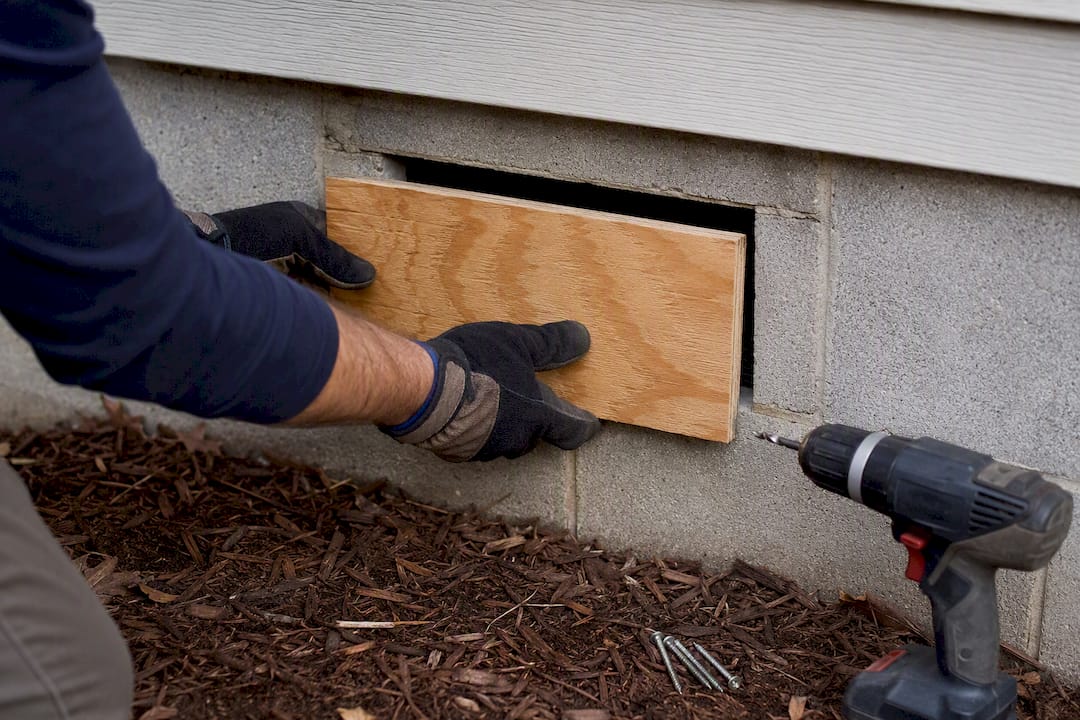
The bigger risk is combustion safety. A gas water heater or furnace that vented safely into a ventilated crawl space can backdraft dangerously once the space is sealed without proper venting for the appliance, turning a moisture fix into a carbon monoxide hazard. That’s a fix-it-first item, not a detail to revisit later.
Other common mistakes:
- Skipping the vapor barrier seam sealing, which leaves gaps that undo most of the moisture benefit.
- Ignoring an active water intrusion problem and sealing over it anyway.
- Sealing vents in a flood zone where flood vents are legally required.
- Never testing for radon after changing how soil gas moves through the space.
Moisture problems left unresolved don’t stay contained to the crawl space. The EPA links excess indoor moisture directly to mold growth and indoor air quality risk, and mold spores travel upward into living spaces through flooring and HVAC returns far more easily than most homeowners expect.
Open or Closed? A Decision Checklist for Your Home
Before you call a contractor or buy a dehumidifier, walk your crawl space with this list in hand.
Inspect for:
- Visible mold on joists, subfloor, or insulation
- Wood rot or soft, spongy framing
- Standing water or damp soil that never fully dries
- Pest droppings, nesting, or entry holes
- Ductwork or exposed plumbing running through the space
Measure if you can:
- Relative humidity across at least one full season, not a single reading
- Wood moisture content with a pin-type meter, if available
- Whether your climate zone is humid, mixed, cold, or arid
| Your situation | Likely right approach |
|---|---|
| Humid or mixed climate, any mold or musty odor present | Sealed and conditioned crawl space |
| Ducts or plumbing routed through the crawl space | Sealed and conditioned crawl space |
| Arid climate, no moisture history, no HVAC in crawl space | Vented may still work |
| Flood zone with mandated flood vents | Vented (code required), consult local ordinance |
| Any gas appliance currently in the crawl space | Get a professional safety assessment before sealing |
If two or more inspection items turn up positive, that’s your signal to get a professional evaluation rather than guessing your way through a partial fix.
What Foundation RESQ Sees in the Field
Home inspections in humid climates show a pattern: crawl spaces with open vents often have more wood rot, insulation sag, and pest activity than sealed ones. A free inspection checks grading, existing vapor barriers, duct condition, and appliance safety before recommending encapsulation or a lighter fix. That assessment, not a generic climate rule, is what actually settles the open versus closed question for your specific house.
— Kayle
Get a Free Crawl Space Inspection
Foundation RESQ handles the part homeowners can’t safely DIY: combustion appliance checks, code-compliant vapor barrier installation, and dehumidifier sizing, all backed by a direct look at your crawl space rather than a guess from a blog post. If your crawl space has any of the red flags covered above, standing water, wood rot, ducts running through damp air, a crawl space encapsulation system is worth pricing out before another humid season does more damage.

A free inspection covers the items that actually determine whether sealing makes sense for your house:
- Exterior grading and drainage around the foundation
- Existing vapor barrier condition, if one is present
- HVAC and ductwork routed through the crawl space
- Radon and flood-zone flags that affect what’s legally allowed
Foundation RESQ also offers financing options for homeowners who want to move forward with encapsulation without paying the full cost upfront. Schedule your free inspection today and get a straight answer on whether your crawl space needs sealing, venting adjustments, or nothing at all.
Where This Guidance Comes From
Building science guidance on crawl spaces isn’t static. It’s worth reading the primary sources directly, and checking your own municipality’s adoption of IRC R408.3 for unvented crawl space allowances and your local flood maps before making changes.
- DOE Building America: Unvented, Conditioned Crawlspaces
- Oak Ridge National Laboratory sealed vs. vented performance report
- ENERGY STAR Guide to Closing and Conditioning Ventilated Crawlspaces
- EPA: Mold, Moisture, and Your Home
Sources
- Energy
- Whole-house performance comparison of sealed vs vented crawlspaces (Oak Ridge National Laboratory report)
- Guide to Closing and Conditioning Ventilated Crawlspaces (ENERGY STAR)
- Mold, Moisture, and Your Home (EPA)
FAQ
Should a crawl space be open or closed?
For most homes in humid or mixed climates, a sealed and conditioned crawl space performs better than an open one. Arid climates and legally mandated flood vents are the main exceptions.
Is it better to have a vented or sealed crawl space?
Sealed crawl spaces generally win on moisture control, mold prevention, and energy costs, with measured savings around 15% to 20% in humid and mixed climates. Vented spaces can still work in genuinely dry regions.
Should I open crawlspace vents in summer?
In humid climates, no. Summer outdoor air is often more humid than the air already in the crawl space, so opening vents tends to add moisture rather than remove it.
Is a sealed crawl space worth it?
Yes for most homes outside arid climates, once the pre-conditions are met: no active water intrusion, safe combustion appliance venting, and a properly installed vapor barrier. A free inspection from Foundation RESQ can confirm whether your specific house qualifies.
What humidity level should a sealed crawl space maintain?
Most building science guidance targets 45% to 55% relative humidity, maintained with a dehumidifier or a supply duct tied into the home’s HVAC system.