Could a sunken warehouse slab be lifted without turning a floor repair into a facility-wide disruption? It’s a practical concern when uneven concrete affects movement, equipment routes, or daily work. This guide to PolyRenewal for warehouse floors Tallahassee managers can use explains how foam injection works, what to look for, and how to prepare for a slab assessment.
PolyRenewal uses expanding foam injected beneath concrete to lift and level a sinking slab. Foundation ResQ’s concrete lifting and leveling restores a sinking slab in under an hour. For a warehouse, the right repair plan also depends on the slab’s condition and how the facility operates. An inspection can identify areas of settlement and help managers discuss access and operational priorities as part of the repair plan.
Here, you’ll learn what to look for in a warehouse floor, what details to share during a local inspection, and how to plan a clear next step with Foundation ResQ in Tallahassee. The goal is an informed decision that considers both the slab and the facility’s day-to-day needs.
Key Takeaways
- Uneven areas and changing floor levels call for a slab-specific assessment, not a cause guessed from appearance alone.
- PolyRenewal uses expanding foam injected beneath the slab to lift and level concrete. An inspection helps assess the floor and repair approach.
- Compare lifting and slab replacement based on the concrete’s condition, repair scope, and warehouse priorities.
- For PolyRenewal for warehouse floors Tallahassee, note where floor changes appear and when you first noticed them before arranging an inspection.
- Foundation ResQ offers a free concrete inspection and estimate through a straightforward process.
Why Warehouse Floors in Tallahassee Need a Slab-Specific Assessment
A warehouse floor supports the steady movement of people, equipment, and stored goods. A dip in a travel path, an uneven joint between slab sections, or a change in level near a work zone can affect how the space is used. These conditions deserve attention, but their appearance alone can’t show what is happening beneath the concrete.
A settled warehouse slab is a concrete floor area that has dropped relative to adjacent areas. Assessment helps establish the extent and pattern of that change before repair options are considered. For managers considering PolyRenewal for warehouse floors Tallahassee, a site-specific review connects visible floor changes with facility priorities instead of relying on assumptions or guidance written for residential slabs.
Note where the floor seems uneven and how the affected area relates to aisles, loading or storage zones, doorways, and other active parts of the facility. These details give the inspection a useful starting point and help focus the discussion on areas that matter to daily operations, without treating a visible dip as proof of a particular cause.
Which warehouse floor conditions merit an inspection?
Consider an inspection if you notice a low spot, a raised or uneven joint, or a section that appears lower than the surrounding floor. Note whether carts, forklifts, or foot traffic move differently through the area, and whether the location affects access to a work zone. These observations help describe the impact, but they don’t diagnose the slab.
Before the visit, make a simple location record:
- Mark the affected area on a floor plan or note its nearest aisle, door, or work zone.
- Describe what you observed and when you first noticed the change.
- Note facility priorities related to access or movement through that area.
Clear notes help make the assessment specific to how the warehouse floor is used, not just its surface condition.
How can local site conditions affect a commercial slab?
Foundation ResQ’s Tallahassee commercial guide identifies shifting sands and heavy red clay as local soil factors. It also describes soil erosion and compaction as possible contributors to voids beneath concrete. These general conditions may be relevant when assessing a commercial slab, but they don’t diagnose what has happened at a specific warehouse.
A floor dip or uneven joint is visible, but its appearance can’t confirm whether changes in the supporting soil or sub-grade are involved. A site assessment considers the slab’s condition and the observed pattern before shaping a repair approach. For broader context on commercial concrete lifting in Tallahassee, see the local property manager’s guide.
Slabjacking, also known as concrete leveling, is a technique used to correct uneven concrete surfaces. This general explanation is useful, while a warehouse-specific inspection helps determine what the particular floor needs.
How PolyRenewal Foam Injection Lifts a Warehouse Floor
PolyRenewal is a concrete-lifting method that uses expanding foam injected beneath a sinking slab. Rather than covering the floor with a surface layer, the process works from below the existing concrete. For a warehouse, the repair discussion can focus on the affected slab area and its relationship to nearby floor levels, aisles, and work zones.
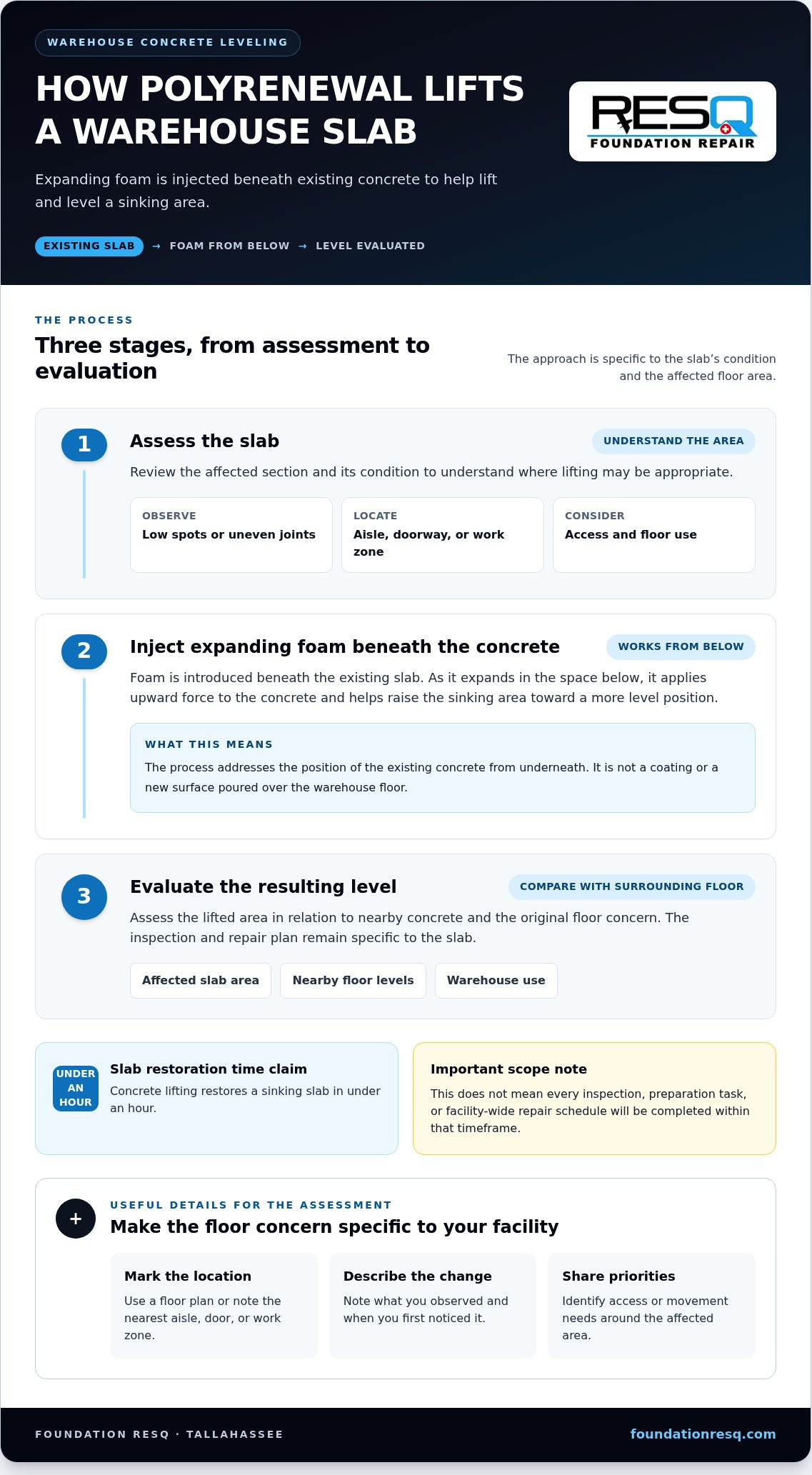
The general process follows three stages:
- Assess the slab. Review the affected area and its condition to understand where lifting may be appropriate.
- Inject foam beneath the concrete. Expanding foam is introduced under the slab, where it pushes upward as it expands.
- Evaluate the resulting level. Assess the lifted area in relation to the surrounding concrete and the original floor concern.
This sequence explains how the method works, while the inspection and repair plan remain specific to the slab. If you’re considering PolyRenewal for warehouse floors Tallahassee, a local assessment gives you the opportunity to discuss the affected area and how the floor is used before planning the work.
What happens beneath the concrete slab?
Foam is injected beneath the existing slab and expands in the space below it. That expansion applies upward force to the concrete, helping raise a sinking area toward a more level position. The process addresses the slab from underneath; it isn’t a coating or a new surface poured over the warehouse floor. The specific approach depends on the slab assessment.
This distinction is useful when discussing a repair: the goal is to address the position of the existing concrete, not simply change its surface appearance. An inspection helps establish which area is being considered and how its level relates to adjacent sections.
What does the under-an-hour time claim mean?
Concrete lifting restores a sinking slab in under an hour. That time claim applies to slab restoration, not every inspection, preparation task, or facility-wide repair schedule. It doesn’t mean all warehouse floor work will be completed within that timeframe. The scope and planning for a particular facility are discussed in relation to the slab and operational needs.
To plan around access and work sequencing, identify the affected location and describe facility priorities during the inspection. Foundation ResQ provides commercial concrete lifting in Tallahassee, with a free inspection and estimate to assess a sinking slab and discuss a suitable approach. You can arrange a concrete lifting inspection to discuss the floor’s condition.
PolyRenewal Lifting or Slab Replacement: How to Compare the Options
A settled area doesn’t automatically mean the slab should be lifted, and visible unevenness alone doesn’t establish that replacement is necessary. The decision depends on the condition and extent of the affected concrete, the work involved, and how the area serves the warehouse. An inspection helps assess these factors and discuss an approach for the specific floor.
PolyRenewal lifting works with existing concrete by injecting expanding foam beneath the slab to raise it. Slab replacement takes a different approach: affected sections are removed and replaced. Neither option suits every situation. Use the comparison below to guide a focused discussion, not as a diagnosis or prediction of results.
| Comparison factor | PolyRenewal lifting | Slab replacement |
|---|---|---|
| Work scope | Assesses whether existing concrete can be addressed by lifting. | Considers removing and replacing affected slab sections. |
| Slab condition | Suitability depends on the findings for the specific slab and settled area. | The inspection helps establish whether the affected concrete calls for a replacement plan. |
| Facility planning | Discuss the work area and its relationship to active warehouse zones. | Discuss the areas affected by removal and replacement, along with facility priorities. |
| Decision point | Review the slab assessment and whether lifting fits its condition. | Compare the replacement scope with the observed condition and repair needs. |
When should a warehouse manager consider concrete lifting?
A low area, uneven joint, or section that appears settled is a reasonable reason to request an assessment. It doesn’t confirm that lifting is suitable. The decision should account for the location, the inspection findings, and how the space is used. A slab section along a travel route may raise different planning questions from one in a less active area, even if both appear uneven. In busy transit corridors where clear floor layouts are essential, facilities often coordinate slab leveling with floor striping contractors like alotofstriping.com to restore safe, clearly marked aisles once the surface is secure.
What should the replacement-versus-lifting comparison cover?
Focus the discussion on the findings and the work each option involves. Ask how the proposed approach addresses the existing slab, which areas are included, and how access or facility priorities affect planning. These are planning topics, not promises that operations will continue uninterrupted or that one option will cost less.
For PolyRenewal for warehouse floors Tallahassee, a site-specific inspection connects the lifting option to the slab’s condition. Foundation ResQ’s PolyRenewal concrete leveling guide for Tallahassee offers more context on the method. Pair that general information with an assessment of the commercial floor and the area’s role in facility operations.
How to Prepare a Tallahassee Warehouse for a Concrete Inspection
A focused inspection starts with information from the people who know the warehouse floor and how the facility operates. Before arranging a visit, identify areas of concern, note what has changed, and consider which access or scheduling priorities the assessment should account for. This helps guide a practical discussion without requiring managers to determine the cause themselves.
Use this sequence to prepare:
- Mark the affected locations. Note nearby aisles, doors, work zones, or other landmarks so the inspection can focus on the right parts of the floor.
- Record what you’ve observed. Describe where the floor seems uneven and when you first noticed the change. Include relevant maintenance or repair history if it’s readily available.
- Describe facility priorities. Identify areas where access, movement, or timing deserves discussion, then arrange an inspection and estimate.
What floor information should you gather first?
A simple floor plan with affected areas marked is more useful than a general description such as “the floor is uneven.” Note whether the concern is near a joint, along a travel route, or within a particular work zone. Record when the change was first noticed and whether it has appeared in one location or more than one. These are observations, not conclusions about why the slab changed.
If maintenance notes or prior repair records are easy to access, gather them for context. There’s no need to create a technical report. Clear location details and a short description of what staff have seen can make the inspection discussion more specific to the warehouse.
How can managers plan around facility operations?
Consider how the affected area is used during a typical workday. Note whether it’s near a frequently used aisle, a loading area, or a zone where access is especially important. Share these priorities during the inspection so they can be included in the repair conversation. This supports planning, but it doesn’t establish that every area can remain in use during the work.
Discuss access planning for the specific floor and facility. Identify the areas you want assessed and explain any scheduling considerations that matter to warehouse operations. Don’t assume a particular work sequence or level of access is possible before the slab and site have been reviewed.
Foundation ResQ offers free inspections and estimates for concrete services. The inspection is an opportunity to discuss affected locations, facility priorities, and a repair approach for the warehouse. For managers considering PolyRenewal for warehouse floors Tallahassee, sharing these details is a practical way to start with a clear picture of the site.
Arrange a free concrete inspection and estimate to discuss your warehouse floor with Foundation ResQ.
Request a Free PolyRenewal Warehouse Floor Inspection in Tallahassee
Once you’ve identified the affected area and learned how foam injection works, have the slab assessed. An inspection connects the floor’s visible condition with a repair approach for the warehouse, rather than relying on assumptions about what the concrete needs. For PolyRenewal for warehouse floors Tallahassee, this is where observations about the floor and facility priorities come together.
Foundation ResQ offers a free concrete inspection and estimate through a straightforward process. The inspection assesses the concrete and provides an opportunity to discuss a project-specific approach. Since every floor is different, the assessment gives you a clearer basis for deciding how to proceed.
What happens after you request an inspection?
After you submit a request, Foundation ResQ can arrange an inspection and estimate. Sharing the warehouse location and a brief description of the concern helps start the conversation. During the assessment, the concrete is reviewed and the repair approach discussed in relation to the affected area and facility needs.
Make the discussion more useful by describing where the floor appears settled, what changes you’ve noticed, and how the area is used. For instance, explain if the concern is near an aisle or work zone where access matters. Those details provide context without requiring you to identify the cause or decide in advance which repair method is suitable.
How can you take the next step?
Use the company contact form to describe the warehouse floor concern and request an inspection. Include the area’s location, what you’ve observed, and any operational priorities you want considered. A floor plan or maintenance notes may help explain the concern, but the first step is sharing enough information to arrange an assessment.
Foundation ResQ’s inspection and estimate are intended to give you information about the slab and a project-specific repair approach, so you can consider the next step with a clearer understanding of the work being discussed.
Financing options are available for major repairs. If financing is relevant to your planning, discuss it as part of the repair conversation.
For a Tallahassee warehouse with uneven or settled concrete, request an inspection to have the affected slab assessed and discuss a suitable path forward.
Request a free concrete inspection and estimate.
Take the Next Step Toward a More Manageable Floor Plan
A floor concern is easier to address when it becomes part of a clear facility plan. Choose a point person to describe the affected area, share relevant observations, and bring operational priorities into the repair discussion. This gives your team a practical starting point for evaluating PolyRenewal for warehouse floors Tallahassee and deciding how to move forward.
You don’t need to choose a repair method before that conversation. Start with what the floor is doing and how the affected space is used. A site-specific assessment can help turn those details into a better-informed decision for your warehouse.
Start planning a Tallahassee warehouse-floor assessment with Foundation ResQ. A clear next step can help you approach the issue steadily and make decisions with greater confidence.
Frequently Asked Questions
Can PolyRenewal be used to lift warehouse floors in Tallahassee?
Yes. PolyRenewal concrete lifting is used for commercial slabs, including warehouse floors in Tallahassee. Whether it suits a particular floor depends on the slab’s condition and the area of concern, so an inspection is the practical way to assess it. A sunken section near storage space, for example, should be considered in context with the surrounding concrete and how the warehouse uses that area.
How does PolyRenewal foam injection lift a warehouse floor?
Expanding foam is injected beneath the concrete slab, where it expands and helps raise the settled area. The method works from below the existing floor rather than adding a surface coating. The assessment considers the repaired area in relation to adjacent slab sections, such as a joint or aisle edge, so the floor’s level can be evaluated in context.
How long does PolyRenewal concrete lifting take?
Foundation ResQ’s concrete lifting restores a sinking slab in under an hour. That time claim refers to slab restoration, not the full inspection, preparation, facility planning, or every task that may be part of a warehouse project. If you’re coordinating around deliveries or work zones, discuss those needs during the inspection so the repair conversation reflects your facility’s priorities.
Is PolyRenewal better than replacing a warehouse concrete floor?
Not in every situation. PolyRenewal addresses existing concrete by lifting it, while replacement involves removing and replacing affected slab sections. The appropriate path depends on inspection findings, the scope of the affected area, and how the space is used. Managers can discuss whether a localized settled area may be addressed by lifting or whether the slab condition calls for a different repair plan.
Can warehouse operations continue during concrete lifting?
That depends on the project area and the facility’s operating needs, so don’t assume the whole warehouse can remain open or that operations will be uninterrupted. Before planning work, identify the affected aisle, work zone, or access point and explain any priorities around its use. This makes access and timing part of the project discussion without treating a particular arrangement as guaranteed.
What should I do before a warehouse concrete inspection in Tallahassee?
Make a simple record of where the floor concern is and what you’ve observed. Note when you first noticed it, identify nearby landmarks such as a doorway or aisle, and gather readily available maintenance or repair history. Explain how the affected space is used and what access considerations matter. These details give the inspection useful context without requiring you to diagnose the cause.
Does Foundation ResQ offer free estimates for warehouse concrete lifting?
Yes. Foundation ResQ offers free inspections and estimates for concrete services, including commercial concrete lifting in Tallahassee. Describe the warehouse floor concern through the company’s contact form and arrange an inspection to discuss the slab and a project-specific approach. The straightforward estimate process gives you information to consider your next step.