A raised concrete edge can sometimes be corrected without replacing the entire slab. A sudden height difference can make a sidewalk, driveway, or patio harder to cross, so it’s reasonable to ask whether the concrete can be lifted or needs a different repair. PolyRenewal for trip hazard removal adjusts the elevation of settled concrete when the slab and site conditions make lifting suitable.
The goal is to address the uneven transition, not just disguise it. In Tallahassee, an assessment of the slab and surrounding conditions can help determine whether settlement is contributing to the height difference and whether lifting is a good fit. Foundation ResQ provides PolyRenewal concrete lifting for residential and commercial properties.
This guide explains how lifting can address an uneven slab, what an assessment and repair plan may involve, and how to weigh lifting against replacement. It also offers practical steps for documenting a trip hazard at your Tallahassee property before requesting an assessment.
Key Takeaways
- Learn how a height difference between adjoining concrete surfaces can create a tripping point.
- See how PolyRenewal for trip hazard removal aims to improve an uneven transition by adjusting the slab’s elevation.
- Understand which slab conditions may make lifting worth considering compared with replacement.
- Know what to document around your Tallahassee property to help assess an uneven walkway or concrete area.
- Follow a practical path from identifying a raised or sunken edge to evaluating a suitable repair approach.
How concrete trip hazards form, and what PolyRenewal is designed to address
A height change underfoot can make an ordinary walk harder to navigate. Where two concrete sections meet, one edge may sit higher than the other, catching a toe or interrupting a step. The shape and location of the uneven joint matter: a lip across an entry path may be more disruptive than a similar change outside a regular walking route.
A concrete trip hazard is an abrupt height difference between adjoining walking surfaces. It can develop when a slab settles, shifts, or loses support beneath it. Water movement and drainage conditions may also be relevant, but the uneven edge alone doesn’t reveal the cause. An inspection considers the concrete and surrounding site rather than diagnosing the problem from appearance alone.
Where uneven concrete can create a trip point
Uneven joints can occur on sidewalks, entry paths, patios, and driveway transitions. If one sidewalk panel settles while the neighboring panel remains higher, the joint can leave a raised lip across the route. At an entry, a height change close to the door affects the approach and each step in or out. A driveway transition can create a similar concern where people regularly cross between concrete and another surface.
When documenting the issue, note the height and length of the uneven section, where it sits, and how people use the route. A small change at a frequently used entrance may warrant attention, while the same change in a little-used area has a different context. These observations help describe the concern, but they don’t establish the slab’s condition or determine the right repair.
What PolyRenewal means in a trip-hazard context
Foundation ResQ’s PolyRenewal service lifts concrete and can be evaluated for uneven slabs. The aim is to determine whether changing a slab’s elevation could improve its relationship to adjoining sections and reduce the abrupt transition. When the slab and site conditions support lifting, this addresses the position of the concrete rather than covering or disguising the edge.
Concrete lifting changes a slab’s elevation to improve an uneven transition; it doesn’t simply hide the edge. That distinction is central to PolyRenewal for trip hazard removal. Concrete leveling is a broader category of repair methods, including approaches such as slabjacking and mudjacking, as outlined in this overview of concrete leveling. The appropriate method depends on the concrete and site conditions.
Not every crack, slab, or trip hazard is suitable for lifting. The slab’s condition, extent of movement, and conditions beneath or around the concrete all factor into the assessment. Foundation ResQ evaluates those details to determine whether PolyRenewal concrete lifting fits the repair objective. This helps keep the decision focused on the slab and uneven transition, rather than treating every raised edge as the same problem.
How PolyRenewal concrete lifting can correct an uneven slab
Once you identify an uneven transition, the next step is to assess the concrete and the conditions around it. PolyRenewal concrete lifting is not a one-size-fits-all adjustment. Foundation ResQ evaluates the Tallahassee property to determine whether lifting suits the slab’s condition and the goal for the walking surface.
What an assessment of the concrete should establish
The assessment considers where the uneven area is, which sections sit at different elevations, and how people use the route. A walkway beside an entrance, for example, has a different use from a section that sees little foot traffic. Pointing out the main walking line and the location of the height change helps clarify the repair objective.
Visible cracks, the overall condition of the slab, and signs that support beneath the concrete may have changed also matter. A crack or low edge by itself doesn’t prove what caused the movement. Looking at the concrete and its surroundings helps Foundation ResQ determine whether lifting is appropriate or whether another remedy better addresses the condition.
What homeowners can expect during repair planning
If lifting is suitable, the work plan is shaped around the slab and the layout of the site. Access to the area, nearby structures, adjoining concrete, and how the surface is used all inform planning. A narrow entry path, for instance, may have different access considerations from an open patio or driveway.
The plan should connect the work to a clear objective: improve the height relationship between concrete sections and reduce the abrupt transition. It shouldn’t assume every slab can be raised or that lifting will resolve every crack. Project details affect the work involved, so the schedule and any temporary access considerations are specific to the site.
Concrete lifting aims to adjust a slab’s elevation to reduce an uneven walking transition, rather than conceal the edge. That is the intended role of PolyRenewal for trip hazard removal when assessment indicates the slab is suitable. An evaluation helps determine whether the approach fits the concrete and the site.
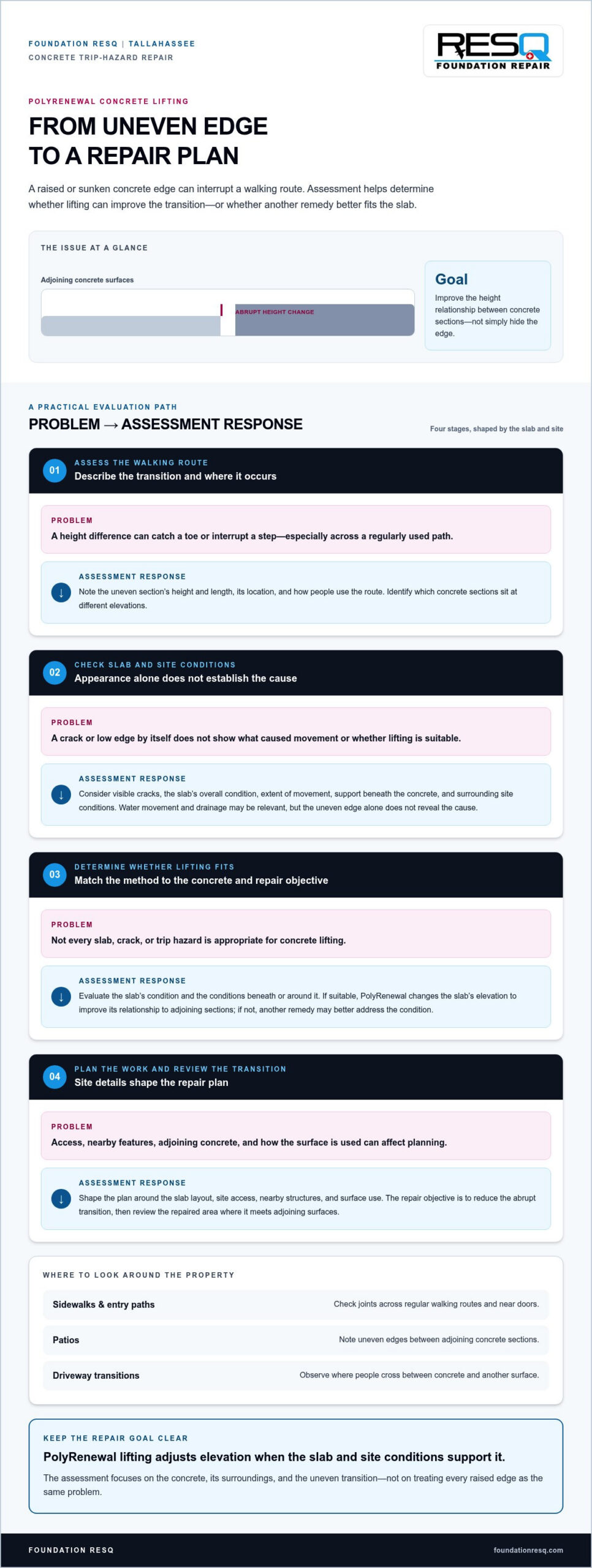
- Assess: Identify the uneven sections, walking route, visible cracking, and site conditions.
- Determine suitability: Decide whether lifting can address the transition based on the slab’s condition.
- Plan and perform: Set the repair approach around the concrete, access, and surrounding features.
- Review: Look at the repaired area and its transition with adjoining surfaces.
For workplaces, OSHA’s regulations on walking-working surfaces address maintaining safe walking surfaces. Specific requirements depend on the setting, but the practical point is that walking areas deserve attention. If an uneven slab affects a route on your Tallahassee property, a PolyRenewal concrete lifting assessment can help clarify the repair path.
PolyRenewal lifting or slab replacement: how to think through the options
Choosing between lifting and replacement starts with the slab’s condition, not just the height difference at its edge. If the concrete remains serviceable, lifting may be worth evaluating as a way to improve the transition while retaining the slab. If it is badly deteriorated or has other concerns, replacement may be a better fit. An assessment helps distinguish these situations instead of assuming one repair suits every walkway.
| Consideration | Concrete lifting | Slab replacement |
|---|---|---|
| Slab condition | May be considered when the slab can be retained and its condition supports lifting. | May be considered when deterioration or damage makes retaining the slab unsuitable. |
| Repair objective | Adjust the slab’s elevation to improve an uneven transition. | Remove and replace concrete when the existing slab cannot serve the repair objective. |
| Project considerations | Assessment considers the concrete, site conditions, and the area’s use. | Planning considers the condition of the affected area and the work needed to replace it. |
When lifting may be worth evaluating
An uneven but potentially serviceable slab is a reasonable reason to request an assessment. The key question is whether adjusting its position can address the height difference, not whether a surface patch can make the edge look less noticeable. Foundation ResQ evaluates the concrete and site conditions before determining whether PolyRenewal lifting aligns with the repair goal.
When the slab may need a different repair approach
Severe deterioration, extensive damage, or other structural concerns can change the recommendation. Replacement may be more appropriate if the slab’s condition doesn’t support lifting, but no single visible sign decides the matter in every case. The assessment should consider the concrete as a whole and the specific problem the repair needs to address.
It also helps to distinguish a localized walkway concern from signs of broader movement affecting a building. An uneven sidewalk panel by itself doesn’t establish a foundation problem. If you notice separate structural concerns, such as changes affecting the building itself, the Tallahassee foundation repair guide offers context on that different issue.
For a wider look at concrete-leveling methods and project considerations, consult the Tallahassee concrete-leveling guide. It can help frame the options, while an on-site assessment relates that general context to the condition of a particular slab.
For PolyRenewal for trip hazard removal, the practical decision is whether the existing concrete can be retained and lifted to address the uneven transition. If it cannot, another repair approach may be needed. A careful evaluation focuses the recommendation on the slab and site, rather than a universal rule or cosmetic-only fix.
Planning trip-hazard repair for a Tallahassee property
A few clear observations can make an assessment more useful. Before discussing PolyRenewal for trip hazard removal, note where the uneven concrete is, how people use the area, and whether anything around the site appears to change. These details help describe the situation without treating your observations as a diagnosis.
A short checklist before the assessment
Walk the relevant areas carefully and make a simple record. Photos can help document what you see, particularly if the surface or surrounding conditions appear different over time.
- List each affected location, such as the front walk, patio, or driveway entrance.
- Note where people typically walk and whether the uneven section affects an entry or regular route.
- Record when you first noticed the height difference and whether it appears to have changed.
- After rain, note visible changes such as pooling or water flowing near the slab. These observations may be useful, but they don’t identify the cause.
- Clear objects from the immediate area where practical so the concrete can be viewed.
If you’re in Tallahassee and have documented an uneven walking surface, you can discuss a concrete assessment with Foundation ResQ. Sharing the location and your observations gives the site review a practical starting point.
Local conditions to include in the evaluation
Conditions vary from property to property, so don’t assume a drainage or ground issue has the same cause throughout Tallahassee. Describe what you’ve observed at the specific location. For example, mention whether water appears to collect beside a slab, whether the edge looks different after wet weather, or whether the area has changed alongside nearby landscaping.
These details provide context, not a conclusion. A wet patch or visible height difference doesn’t establish why the concrete moved, and it shouldn’t be used alone to select a repair. Foundation ResQ evaluates the concrete and site conditions before determining whether PolyRenewal lifting is appropriate.
Access and nearby features also shape repair planning. Note planting beds, trees, fences, steps, or other structures close to the affected concrete. If you know where utilities or service lines run, share that information. The site layout and the way people use the surface help inform the assessment and work plan.
For a commercial property, describe how people use the route during normal operations and whether access needs consideration during planning. At home, note the main entry path or driveway crossing. You don’t need to identify the technical cause or decide whether the slab should be lifted. A clear description of the location, use, visible changes, and nearby features gives the assessment a useful starting point.
Get a PolyRenewal assessment for a trip hazard in Tallahassee
A raised or sunken concrete edge gives you a practical place to start: identify the transition, assess the slab, and determine whether lifting fits the repair. An assessment considers both the concrete and conditions around it. It can help clarify whether PolyRenewal concrete lifting is appropriate or whether the slab calls for a different approach.
Foundation ResQ provides PolyRenewal concrete lifting for residential and commercial properties in Tallahassee. The recommendation should reflect the specific surface and site, rather than assume every uneven edge has the same cause or repair.
What to share when requesting an assessment
A clear description helps focus the assessment on the area and how it’s used. You don’t need to diagnose the cause. Share what you’ve observed so the concrete and site conditions can guide the evaluation.
- Describe the area, such as a sidewalk, entry path, patio, or driveway, and point out the uneven transition.
- Mention visible cracks, loose or deteriorated areas, or drainage concerns near the concrete.
- Note when you first noticed the change and whether it appears different over time or after rain.
- Explain whether the surface is used by pedestrians, vehicles, or both.
These observations provide context, not a conclusion. Water near a slab, for example, may be useful to mention, but it doesn’t establish why the concrete is uneven. The assessment considers the slab and its surroundings before identifying a repair direction.
How the recommendation should guide your next step
A useful recommendation connects the observed condition to a clear repair objective. If the slab can be retained and its position is the concern, lifting may be considered to improve the transition. If the concrete’s condition doesn’t support lifting, another approach may be more appropriate. The goal is to address the specific issue, not promise the same result for every property.
Concrete lifting and foundation stabilization address different concerns. Uneven walkway concrete is a surface-level issue to evaluate as a slab; signs of movement affecting the building may call for a separate foundation assessment. Keeping those concerns distinct helps direct attention to the right part of the property without treating one as proof of the other.
With PolyRenewal for trip hazard removal, the decision follows a straightforward path: identify the uneven edge, assess the concrete and site conditions, and determine whether lifting fits. This helps move from uncertainty toward a repair plan focused on improving the transition.
If you’re ready to take the next step in Tallahassee, Request a concrete assessment with Foundation ResQ.
Take the next step toward a more even walkway
An uneven edge doesn’t have to leave you guessing about what to do next. Start by understanding the concrete’s condition, then choose a repair based on the assessment. PolyRenewal for trip hazard removal may be appropriate when the slab is suitable for lifting; other conditions can call for a different solution.
Make a note of the location and what you’ve observed, then arrange an assessment. This gives you a clearer basis for planning and keeps the focus on addressing the concrete rather than disguising the edge. Foundation ResQ provides PolyRenewal concrete lifting for residential and commercial properties in Tallahassee.
Request a concrete assessment to discuss the uneven surface and a practical path forward. A careful evaluation can help you move ahead with greater clarity and work toward a more even walking area.
Frequently Asked Questions
Can PolyRenewal remove a trip hazard between concrete slabs?
PolyRenewal may be considered when a height difference between slabs creates a trip point and the concrete is suitable for lifting. An assessment helps determine whether adjusting the slab makes sense for the area. When discussing PolyRenewal for trip hazard removal, describe which slabs meet at the uneven edge and where people cross it. That context connects the repair objective to how the surface is used.
Is PolyRenewal suitable for every uneven sidewalk or walkway?
No. A walkway’s appearance alone can’t show whether lifting is suitable. A settled panel with a firm, serviceable surface raises different questions from a walkway with crumbling edges or extensive damage. The location and extent of the uneven area, along with conditions beneath the concrete, also matter. An assessment in Tallahassee helps determine whether lifting fits the slab and repair goal.
Does concrete lifting repair cracks as well as trip hazards?
Not necessarily. Lifting adjusts concrete elevation; a crack is a separate condition that may need its own evaluation. If a slab has both a cracked surface and an uneven joint, note the crack’s location and whether it crosses the panel or follows an edge. This helps distinguish the trip concern from potential concrete deterioration. The repair recommendation should address each observed issue without assuming one treatment resolves both.
Can PolyRenewal be used on a driveway or patio as well as a walkway?
Different concrete surfaces, including driveways and patios, can be evaluated for lifting, but the slab’s condition and use affect whether it is appropriate. A driveway section may carry vehicles, while a patio is typically used for foot traffic and outdoor furniture. In Tallahassee, describe how the surface is used and point out uneven transitions so the site review considers its intended function.
What should I do if an uneven concrete edge seems to be getting worse?
Record where the edge is and when you first noticed the change. If it looks different later, note what changed and when instead of trying to determine the cause yourself. Take care while crossing the area, especially if it’s on a frequently used route, and keep the location visible to others where practical. An assessment can help evaluate the concrete and identify a reasonable next step.
Does PolyRenewal address the cause of a sunken concrete slab?
PolyRenewal concrete lifting is intended to adjust a slab’s elevation, but it doesn’t establish the cause of settlement on its own. An assessment considers the concrete and relevant site conditions to understand what the repair is meant to address. If support beneath a section may have changed, share observations such as nearby drainage changes without treating them as proof. The project-specific recommendation should explain its objective and scope.
Is an uneven walkway always a foundation problem?
No. A walkway can become uneven without indicating that the home’s foundation has moved. Notice whether the concern is limited to an outdoor slab or appears alongside separate building changes, such as shifting walls or new interior gaps. Those are distinct concerns to evaluate, not proof that one caused the other. Foundation ResQ provides concrete lifting and foundation services, with the assessment focused on the affected area and its condition.