
Floors sag because the system holding them up has lost stiffness or bearing capacity, usually from foundation or soil movement, weakened framing from rot or pests, excess moisture, or aging and past construction mistakes. A dip in one room points to a local joist or moisture problem; a slope across the whole house points to the foundation. Run a marble test and check for racked doors before you call anyone, but treat any sudden or worsening sag as a same-week call to a professional.
TL;DR:
- A sagging floor caused by foundation or soil movement typically requires professional diagnosis and repair, especially if the slope exceeds 1% over a 20-foot span.
- Localized dips usually stem from damaged joists or rot, while a uniform tilt across multiple rooms points to foundation settlement, soil expansion, or slab issues.
- Visible signs like cracked drywall, sticking doors, and stair-step foundation cracks help identify foundation-related problems, but moisture and pest infestations often underlie framing failures.
- Moisture problems in crawlspaces and basements often cause wood decay and pests, which weaken joists silently unless monitored with moisture meters and humidity checks.
- Early inspection and action are crucial, as waiting can allow damage to spread, leading to more costly repairs and increased safety risks.
Table of Contents
- Reading Sagging Floor Symptoms: Localized Dip or Uniform Tilt?
- Foundation and Soil Problems Behind a Sloping Floor
- Joists, Beams, and Framing Failures That Cause Sagging
- Moisture, Rot, and Crawlspace Conditions That Weaken Joists
- Termites, Beetles, and Decay Fungi Attacking Your Floor Joists
- When Age and Past Renovations Are the Real Culprit
- Elevation Surveys and Moisture Testing: How Pros Diagnose the Cause
- Matching the Repair to the Cause
- Why Homeowners Wait Too Long to Get a Floor Checked
- Get a Professional Assessment Before Small Sag Becomes Big Damage
- Sources
- FAQ
Reading Sagging Floor Symptoms: Localized Dip or Uniform Tilt?
The shape of the problem tells you where to look first. A soft, bouncy spot in one corner of a kitchen or bathroom almost always traces back to a single damaged joist, a rotted sill plate, or a beam that’s lost bearing underneath it. Moisture and rot love these confined, localized failures because leaks and plumbing lines don’t spread water evenly across a house.
A floor that slopes the same direction through multiple rooms, on the other hand, usually means the foundation itself is moving. That’s differential settlement territory, not a single bad board.
Three checks separate the two patterns quickly:
- Marble or ball test. Set a marble on the floor in several spots. If it consistently rolls toward one wall or corner across multiple rooms, suspect foundation settlement. If it only rolls in one isolated area, suspect a local joist or moisture issue.
- Straightedge check. Lay a long level or a straight board across the suspected dip. A sharp, narrow depression points to a single failed joist. A gradual, wide slope points to broader structural movement.
- Doors and windows. Sticking doors, gaps at the top corners of frames, and cracked drywall near ceiling corners often show up alongside foundation-driven tilt, not isolated joist sag.
Foundation and Soil Problems Behind a Sloping Floor
When a floor tilts consistently across several rooms, the cause usually sits below the house, not inside the floor system. Differential settlement happens when one section of the foundation sinks more than another, often because the soil underneath varies in density or moisture content from one side of the house to the other.
A few specific mechanisms drive this:
- Compressible fill soil. Sections of the lot filled with loose or poorly compacted soil during construction settle unevenly over years.
- Expansive clay. Clay-heavy soils swell when wet and shrink when dry, and that repeated movement stresses footings unevenly across seasons.
- Slab edge curl. Concrete slabs can curl upward at the edges as moisture evaporates unevenly from the top versus the bottom of the slab, creating a false sense of interior sag.
- Undermined footings. Erosion, poor drainage, or a burst pipe near the foundation can wash soil out from under a footing, leaving it partially unsupported.
The external tell is stair-step cracking in brick or block foundations, racked door and window frames, and gaps opening up between trim and walls. Engineers use tilt and slope to judge severity: a slope of roughly 1% is noticeable to the eye, and slopes above 2% are generally considered excessive under accessibility-related evaluation standards. A one-inch difference across a 20-foot span is enough to rack a door frame or crack drywall at a corner seam. If your marble test shows a consistent direction across multiple rooms, that’s the point to schedule a floor elevation survey rather than guess.
Joists, Beams, and Framing Failures That Cause Sagging
Even a perfectly stable foundation can’t save a floor built with undersized or damaged framing. Wood floor systems are designed against deflection limits set by the International Residential Code, commonly L/360 for live loads on habitable floors and sometimes a more forgiving L/240 for less sensitive applications. In practice, a 15-foot joist span under live load is allowed roughly half an inch of deflection before it’s considered out of spec, according to IRC joist span tables. Push a joist beyond its designed span, and it deflects more than that over time, especially under sustained loads like a piano, a heavy bathtub, or stacked storage.
Framing failures typically come from one of these:
- Overspanning. A joist sized for a 12-foot span but installed across 16 feet will sag regardless of wood quality.
- Notching or boring in the wrong zone. Cutting a notch into the bottom edge of a joist, where tension forces are highest, weakens it far more than a hole drilled near the center.
- Insufficient bearing. A joist resting on too little ledger or beam surface can slowly crush the wood fibers at the bearing point.
- Missing bridging or blocking. Without cross bracing between joists, individual members can twist and deflect independently, creating a bouncy feel underfoot.
Repairs generally fall into three categories: sistering a new joist alongside a weak one, adding a mid-span beam and support posts to shorten the effective span, or replacing severely damaged members outright.
Pro Tip: If a floor bounces when you walk across it but shows no visible dip, that’s often a deflection problem rather than a decay problem. Sagging with bounce and no rot smell usually means the joists were undersized or overspanned from day one.
Moisture, Rot, and Crawlspace Conditions That Weaken Joists
Moisture is the slow killer of floor framing, and it rarely announces itself until the damage is already structural. Crawlspaces and basements accumulate humidity from groundwater, poor drainage, plumbing leaks, and even everyday household humidity migrating downward through vents.
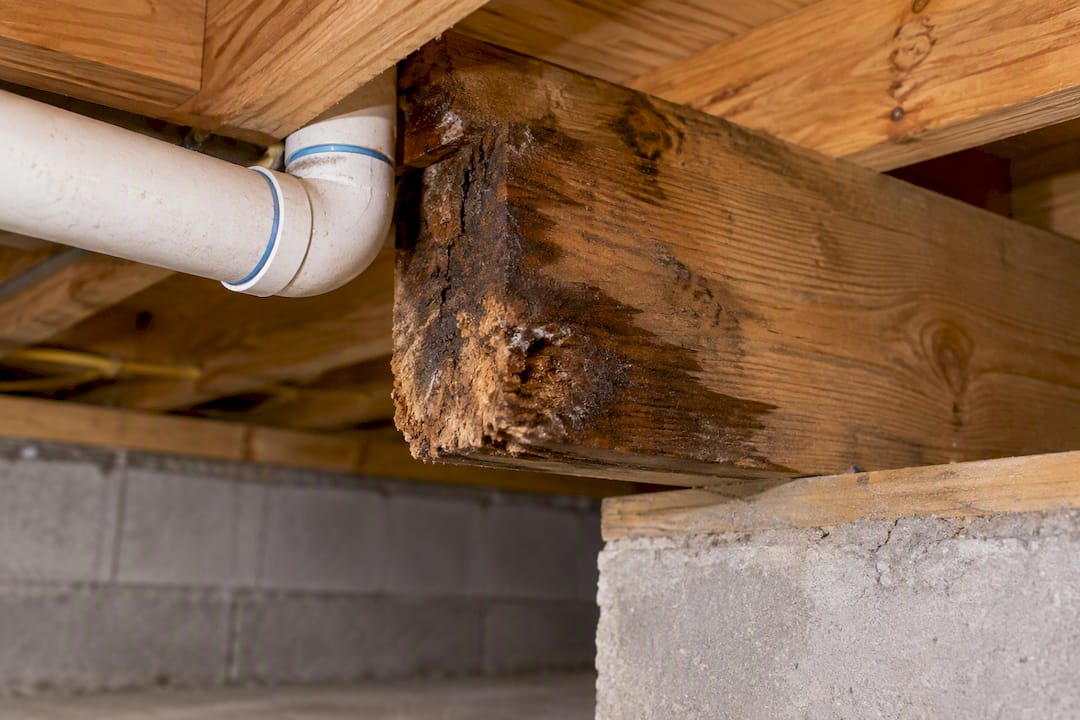
Wood doesn’t need standing water to fail. Decay fungi become active once wood moisture content climbs into the 20 to 28% range, and they thrive once crawlspace relative humidity holds above roughly 60% for extended periods, based on flood-recovery guidance from NC State Cooperative Extension. That’s well below the point where wood looks or feels obviously wet.
Diagnosing the problem usually follows this order:
- Look for visual signs first. Sagging or stained insulation, white mineral deposits on foundation walls, and visible mold on joists are all documented indicators of chronic crawlspace moisture, per PNNL’s Building America Solution Center guidance.
- Confirm with instruments. A pin-type wood moisture meter and a hygrometer for relative humidity give you numbers instead of guesses.
- Control moisture before or alongside structural repair. The EPA’s mold and moisture guidance is blunt about this: fixing rot without addressing the moisture source just buys you a repeat repair in a few years. Indoor relative humidity should ideally sit between 30 and 50%, and wet materials need to dry within about 48 hours to avoid mold colonization.
Drainage correction, crawlspace encapsulation, and dehumidification address the source; joist sistering or replacement addresses the damage that’s already been done. Skipping the first step to rush the second is the most common mistake homeowners make.
Termites, Beetles, and Decay Fungi Attacking Your Floor Joists
Pests don’t cause sagging overnight. Subterranean termites and wood-boring beetles work from the inside of a joist outward, hollowing structural wood while the surface often looks intact for years. Field research on wood durability confirms that termites will attack exposed structural timber readily, and fungal decay accelerates whenever moisture stays elevated alongside the infestation, according to USDA Forest Products Laboratory research. By the time a floor visibly sags from pest damage, the infestation is frequently years old.
Watch for these signs during a crawlspace walk-through:
- Mud tubes running up foundation walls or piers, a telltale sign of subterranean termite activity.
- Frass, the sawdust-like droppings wood-boring beetles leave behind near exit holes.
- A joist that sounds hollow or feels soft when tapped with a screwdriver handle.
- Sudden, localized floor failure with no obvious moisture source nearby.
Pest treatment alone rarely solves a sagging floor caused by insects. Once a joist has lost significant wood mass, it needs sistering or replacement even after the termites or beetles are gone. Chemical treatment stops the ongoing damage; it doesn’t restore lost load capacity.
When Age and Past Renovations Are the Real Culprit
Not every sagging floor traces back to nature. Plenty of cases come from decisions made during a past remodel or from decades of small, cumulative stresses. A plumber cutting an oversized hole through a joist for a drain line, tile set over marginal subfloor never rated for that weight, or a DIY repair that removed a load-bearing wall without adding a header can all set a slow sag in motion.
Common patterns worth checking for:
- Large notches or bored holes clustered near mid-span, where a joist is under the most stress.
- Heavy finishes (tile, stone, cast-iron tubs) added over framing designed for lighter loads.
- Support posts or beams that were shimmed or shortened during a previous “fix” instead of properly repaired.
- Visible daylight or gaps where a beam no longer fully contacts its support post.
Before calling a contractor, document what you’re seeing. Photograph the sag from multiple angles, measure the depth of the dip with a straightedge, and note which rooms are affected and since when.
Pro Tip: Take a photo of the marble test result and the straightedge measurement, then repeat both in three months. If the numbers haven’t moved, you likely have time to plan. If they have, treat it as urgent.
Elevation Surveys and Moisture Testing: How Pros Diagnose the Cause
Professionals don’t guess. They measure. A floor elevation survey maps relative heights across a house using a laser level or a water level, producing a topographic picture of exactly where and how much the floor has moved.
Here’s what that process typically involves:
- Establishing a deflection ratio or percent slope. As referenced earlier, a slope around 1% is visually noticeable, and anything above 2% is considered excessive under accessibility-based evaluation standards, per Rimkus engineering guidance.
- Cross-referencing with other symptoms. Structural evaluation guidelines recommend combining elevation data with cracking patterns and door racking rather than relying on a single elevation survey alone, according to guidance from ACE-aligned residential foundation evaluation standards.
- Testing moisture at the source. Pin-type moisture meters check individual joists and sill plates, while relative humidity loggers track crawlspace conditions over days or weeks rather than a single snapshot.
An engineer’s report typically lays out the pattern of movement, the likely cause, and whether the fix belongs in the foundation, the framing, or both. That distinction changes everything about the repair plan and its cost.
Matching the Repair to the Cause
The right fix depends entirely on what’s actually failing, and mismatched repairs waste money without solving anything.
- Moisture and rot: control the water source first through grading, gutters, or crawlspace waterproofing, then sister or replace decayed joists.
- Pest damage: treat the infestation, then replace or sister any joist that’s lost meaningful wood mass.
- Overspanned or undersized framing: add a mid-span beam and posts, or sister joists with properly sized lumber.
Simple, isolated dips with no moisture or pest signs are sometimes reasonable for a handy homeowner to shim temporarily. But anything involving foundation movement, active pest infestation, or a joist that’s visibly cracked or spongy needs a professional, full stop. Red flags that mean call someone this week, not this season: a door that suddenly won’t close, a crack that’s visibly widening, a floor that feels noticeably softer than it did a month ago, or any sign of standing water under the house.
Pro Tip: Cost and timeline hinge less on the visible sag and more on what’s hidden. A single rotted joist near an accessible crawlspace door might be a one-day fix. The same rot spread across six joists with limited crawlspace access, or paired with soil remediation, can stretch into weeks.
Why Homeowners Wait Too Long to Get a Floor Checked
I’ve seen the same pattern come up again and again in how homeowners describe a sagging floor: they notice it, live with it for a season or two, and only call once a door stops closing or a crack appears somewhere obvious. Early inspection almost always costs less than late inspection, because moisture damage and pest activity keep spreading while you wait.
Some reputable foundation repair companies build their process around that reality: starting with an inspection to identify whether moisture, framing, or soil is driving the problem, and designing a repair around the actual cause rather than a one-size-fits-all patch. If you’re noticing a dip that’s changing, or a slope that wasn’t there last year, document it and get it looked at before it becomes a bigger structural conversation.
— Kayle
Get a Professional Assessment Before Small Sag Becomes Big Damage
A sagging floor rarely fixes itself, and the cost of waiting almost always exceeds the cost of an early inspection. Foundation RESQ offers a free inspection covering foundation, crawlspace, and moisture conditions across North Florida, South Georgia, and Alabama, and builds repair plans around the specific cause your home is showing, whether that’s a settling footing, a rotted sill plate, or an overspanned joist. If your sag pattern points to a sinking slab rather than framing failure, the concrete lifting and leveling services page walks through how polyurethane foam leveling restores a slab without full replacement.
Sources
- Foundation movement: Understanding and evaluating foundation settlement
- A brief guide to mold, moisture, and your home (EPA)
- Look for crawlspace moisture issues (PNNL BASC DIY guide)
FAQ
When Should I Worry About a Sagging Floor?
Worry when the sag is spreading, when it appears alongside racked doors or widening cracks, or when the floor feels noticeably softer than it did weeks earlier. A stable, unchanging dip with no moisture or pest signs is lower urgency, but a slope that’s actively getting worse warrants a professional look right away.
How Do You Fix a Sagging Floor?
The fix depends on the cause: moisture-related rot needs source control plus joist sistering or replacement, pest damage needs treatment plus structural repair, and foundation settlement typically needs piering or concrete leveling. Overspanned framing usually gets a mid-span beam or properly sized sistered joists.
Will Homeowners Insurance Cover a Sagging Floor?
Most standard homeowners policies exclude gradual damage from settling, poor maintenance, or long-term moisture and pest issues, since insurers treat these as preventable rather than sudden events. Coverage sometimes applies if the sag results from a sudden, covered event like a burst pipe, but that determination depends on your specific policy language.
Will a Sagging Floor Eventually Collapse?
A slowly progressing, minor sag rarely leads to sudden collapse, but severely rotted or termite-hollowed joists can fail with little warning under concentrated weight. Any floor that feels spongy, bounces excessively, or shows a joist that sounds hollow when tapped should be treated as a safety issue, not a cosmetic one.